Electromagnetic waves
விளையாடிக் கற்றுக்கொள்ளுங்கள்
ஆற்றல் சம்பாதிக்க இந்த கேள்விகளுக்குப் பதிலளியுங்கள், பின்னர் மீன் பிடித்து ஆராயுங்கள். கணக்கு தேவையில்லை.
பாட குறிப்புகள்
What Are Electromagnetic Waves?
- Electromagnetic (EM) waves are transverse waves that transfer energy from a source to an absorber.
- All EM waves are transverse – the vibrations are perpendicular to the direction of energy transfer.
- They can all travel through a vacuum – they do not need a medium.
- In a vacuum, all EM waves travel at the same speed (the speed of light, 3.00 × 10⁸ m/s).
- The EM spectrum is a continuous range of waves with different wavelengths and frequencies.
The electromagnetic spectrum, showing the seven regions in order of decreasing wavelength (increasing frequency), from radio waves to gamma rays.
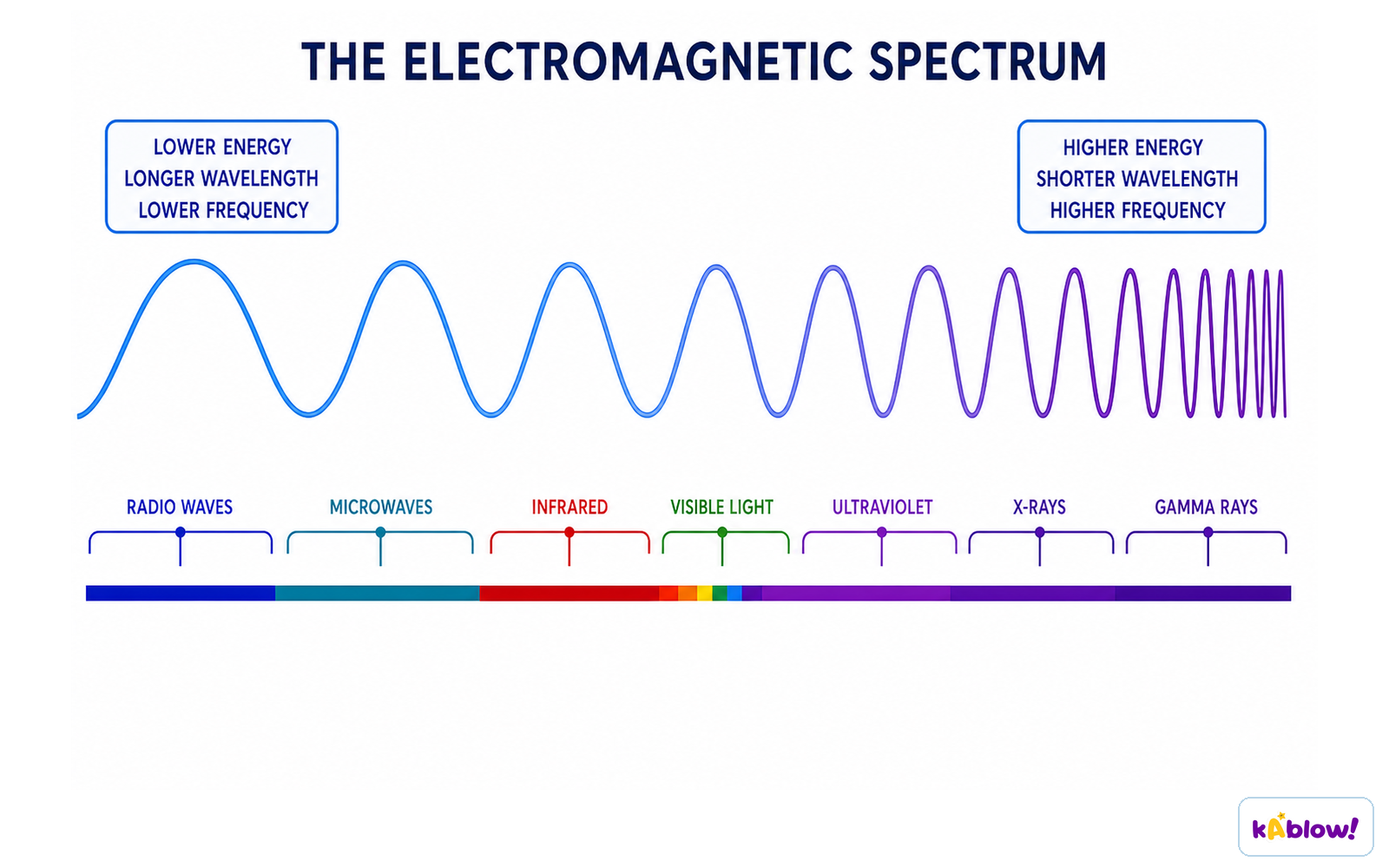
The Electromagnetic Spectrum
- The spectrum is ordered by wavelength (longest to shortest) or frequency (lowest to highest).
- From longest wavelength to shortest: radio waves, microwaves, infrared, visible light, ultraviolet, X-rays, gamma rays.
- Visible light is the only part detectable by the human eye and makes up a tiny fraction (0.0035%) of the whole spectrum.
- Within visible light, red has the longest wavelength (lowest frequency) and violet has the shortest (highest frequency).
- Remember the visible colours with "Roy G. Biv" (red, orange, yellow, green, blue, indigo, violet).
- The higher the frequency, the higher the energy of the radiation.
A summary of the uses of each region of the electromagnetic spectrum, with the reason each region is suited to its use.
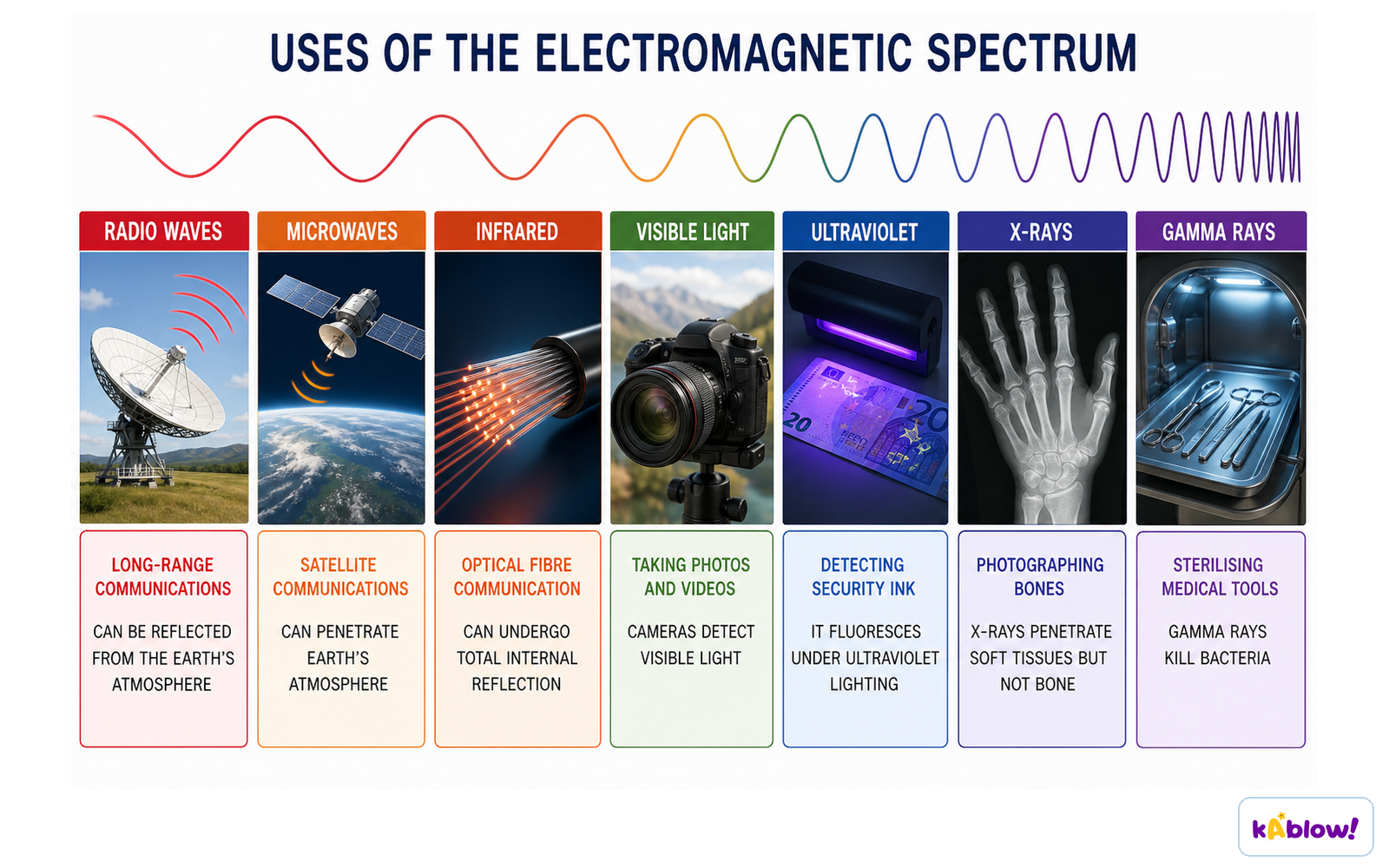
Energy Transfer by EM Waves
- EM waves carry energy and can transfer it from one point to another – this is an energy transfer pathway.
- Shorter wavelength EM waves carry more energy (e.g. UV, X-rays, gamma rays).
- The higher the energy of an EM wave, the more dangerous it is.
- Microwaves are absorbed by water molecules, so microwave ovens transfer energy to the thermal store of food.
- All hot objects emit infrared radiation, which can be absorbed by other objects, warming them up.
- The Sun emits visible light (allows us to see), infrared (heats the Earth) and ultraviolet (causes suntans and sunburn).
A toy duck bobbing up and down on water waves, illustrating that waves transfer energy but not matter.
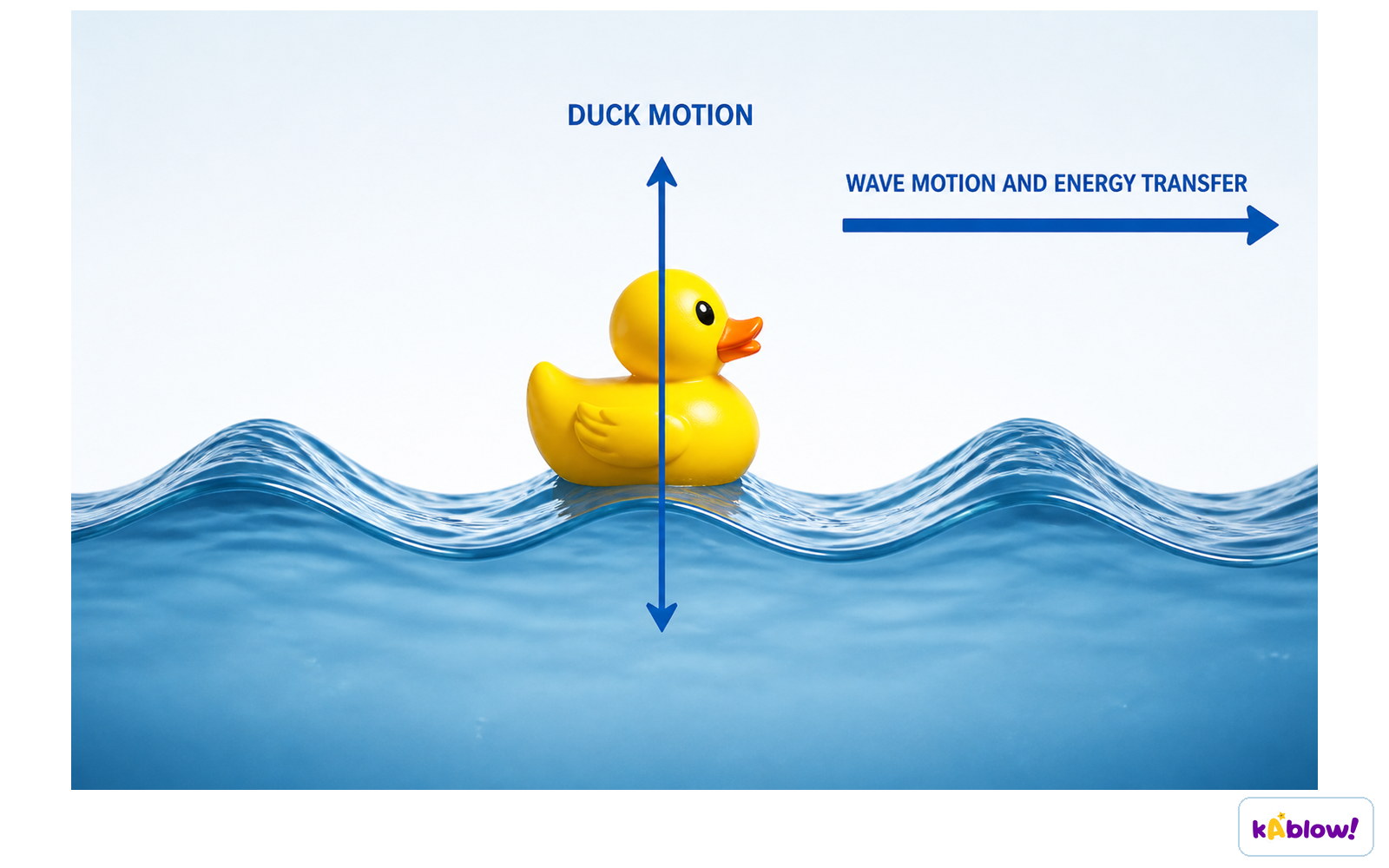
EM Waves and Matter
- When EM waves move from one medium to another, they can be transmitted, absorbed, reflected or refracted.
- Which interaction occurs depends on the wavelength of the wave and the material it is travelling through.
- For example, glass transmits and refracts visible light, absorbs UV radiation and reflects IR radiation.
- Refraction occurs because EM waves change speed when they enter a different medium.
- When EM waves pass through matter, interactions slow them down, causing them to refract (change direction).
- The only properties that change during refraction are speed and wavelength – frequency does not change.
A toy duck bobbing up and down on water as waves pass underneath, illustrating that waves transfer energy, not matter.
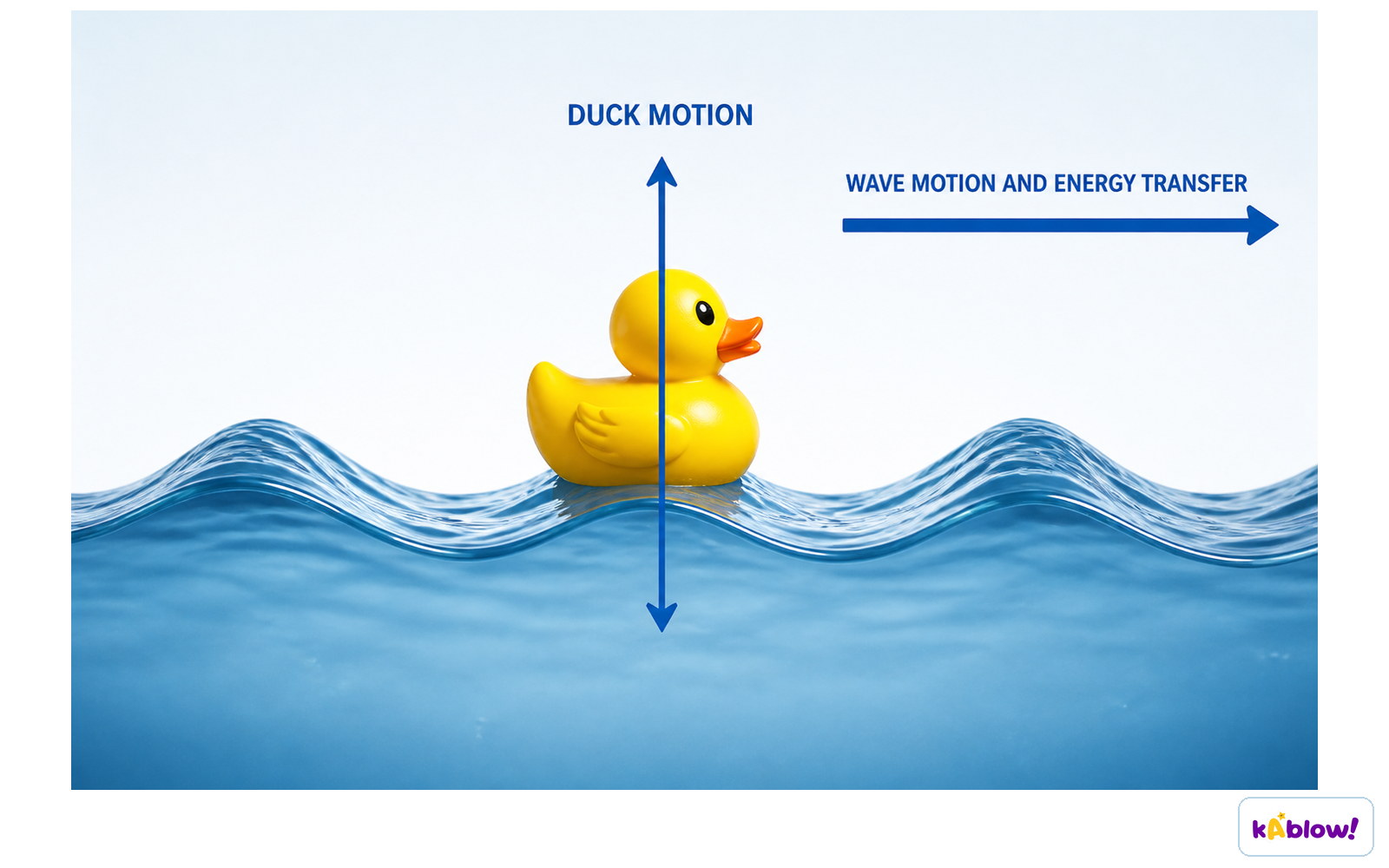
Refraction Ray Diagrams
- Refraction is the change in direction of light when it crosses a boundary between two transparent media.
- Angles are measured from the normal – a line perpendicular to the boundary.
- From less dense to more dense (e.g. air to glass), light bends towards the normal.
- From more dense to less dense (e.g. glass to air), light bends away from the normal.
- When light travels along the normal, it does not bend at all.
- Remember: "Enters Towards, Leaves Away" – entering a denser medium bends towards the normal, leaving bends away.
Required Practical: Investigating Infrared Radiation
- Aim: to investigate how the amount of infrared radiation absorbed or radiated by a surface depends on the colour of that surface.
- Independent variable: colour of the surface; dependent variable: temperature.
- Control variables: identical flasks, same amount of hot water, same starting temperature, same time interval.
- Method: fill four flasks (black, dull grey, white, silver) with hot water and measure temperature at regular intervals.
- All warm objects emit infrared radiation; the intensity depends on temperature, surface area and colour.
- Expected result: black surfaces radiate heat fastest, silver surfaces slowest.
EM Waves and Atoms
- Atoms can absorb or emit electromagnetic waves.
- When an EM wave hits an atom, it can be absorbed by an electron, giving it energy and moving it to a higher energy level.
- When an electron moves down to a lower energy level, it emits an EM wave.
- Electron transitions typically involve visible, ultraviolet and sometimes X-ray energies.
- Higher energies (e.g. gamma rays) can only be achieved when EM waves interact with the nucleus of an atom.
Radio Waves
- Radio waves are produced by connecting an antenna to a high-frequency alternating current (a.c.) power source.
- The oscillation of charge in the a.c. circuit produces radio waves with the same frequency as the oscillation.
- In a transmitting antenna, charge oscillates up and down, producing radio waves.
- In a receiving aerial, the metal aerial absorbs radio waves, creating an alternating current with the same frequency as the transmitted wave.
- Radio waves are used for long-range communication because they can be reflected from the Earth's atmosphere.
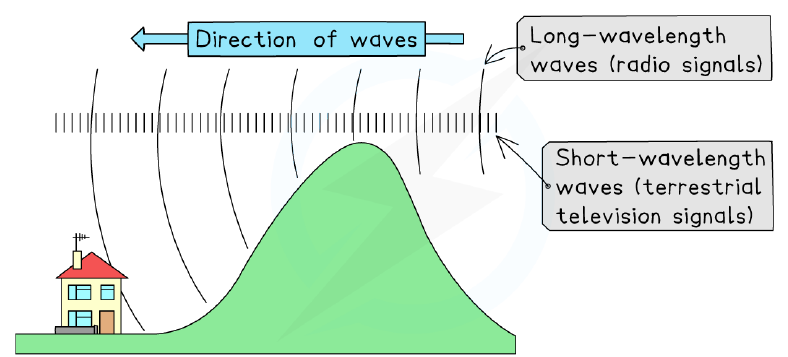
Radio waves diffracting around a hill (longer wavelength), while shorter-wavelength TV signals do not.
Dangers of High-Energy EM Waves
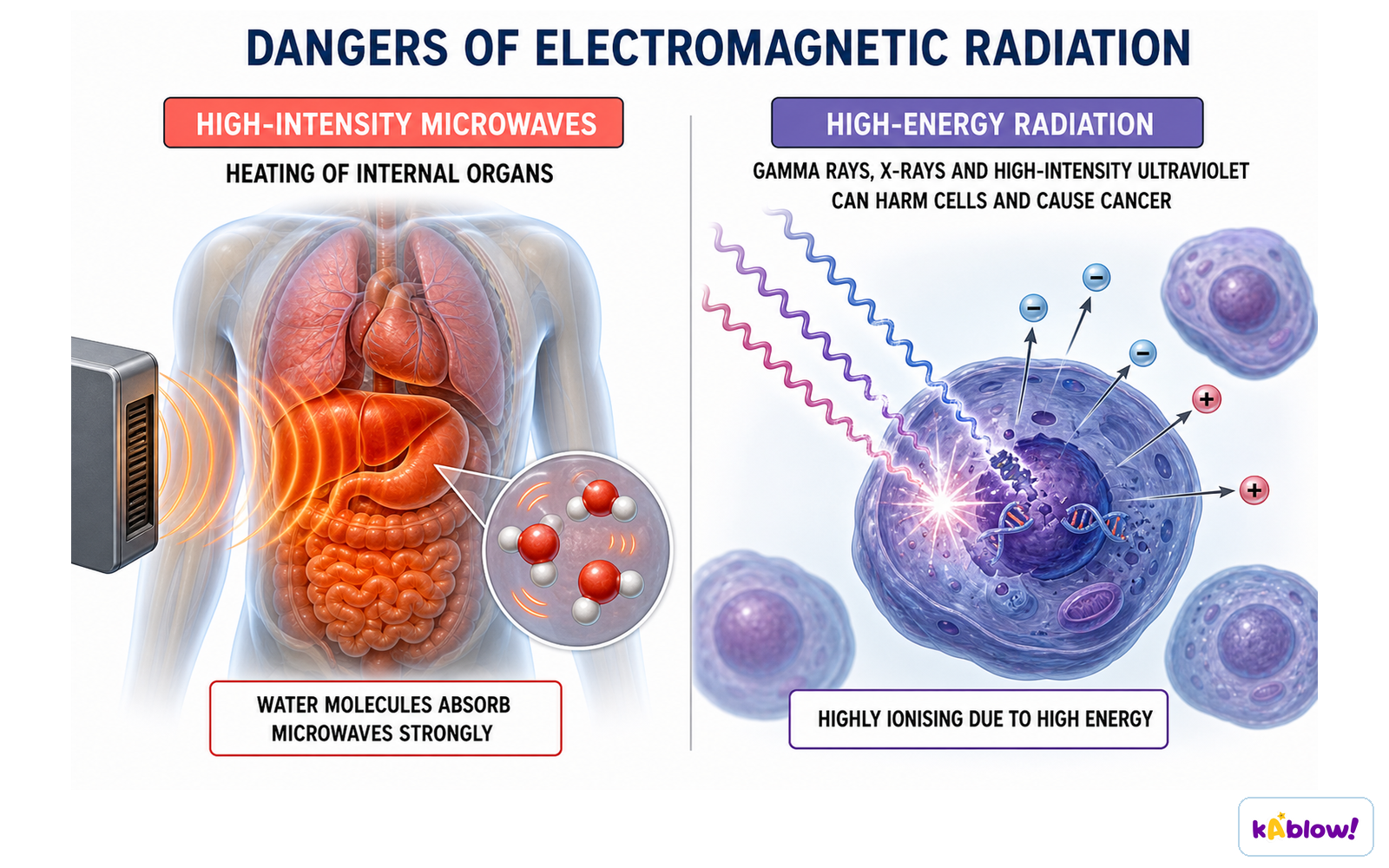
- As frequency increases, the energy of EM waves increases, making them more ionising and more dangerous.
- Ultraviolet, X-rays and gamma rays can ionise atoms, damaging cells and causing mutations that may lead to cancer.
- Radiation dose is a measure of the risk of harm from exposure to ionising radiation, measured in sieverts (Sv) or millisieverts (mSv).
- Typical background radiation is about 1.5 to 3.5 mSv per year; 8 Sv is enough to cause death.
- Microwaves can cause internal heating because they are absorbed by water molecules in the body, but everyday microwaves are safe.
- Ultraviolet can cause eye damage and skin cancer; sunscreen and good sunglasses absorb UV.
- X-rays and gamma rays are the most ionising, can penetrate the body and cause internal damage; workers wear radiation badges to monitor exposure.
The dangers of high-intensity microwaves, and of gamma rays, X-rays and high-intensity ultraviolet, with the reason each is harmful.
Applications of EM Waves
- Radio waves: long-range communication (e.g. TV, radio).
- Microwaves: cooking, satellite communication, mobile phones.
- Infrared: night-vision cameras, remote controls, thermal imaging.
- Visible light: vision, photography, optical fibres.
- Ultraviolet: sterilising surgical equipment, killing bacteria in food, sunbeds.
- X-rays: medical imaging (photographing bones), checking luggage in airports.
- Gamma rays: sterilising medical equipment, cancer treatment (radiotherapy).
- Different EM waves are suited to specific purposes because of their penetrating ability, energy and frequency.
ஸ்லைடுகள்
Sign up free to view the lesson slides
Step through every slide for this topic — plus flashcards and revision notes — with a free account.
பயிற்சி கேள்விகள்
இலவச முன்னோட்டம் — 63-இல் 8 கேள்விகள். அனைத்தையும் பார்க்க பதிவு செய்யவும்.
1.Which of the following electromagnetic waves has the longest wavelength?
Easy- AGamma
- BMicrowave
- CUltraviolet
- DInfrared
2.Which of the following electromagnetic waves transfers the greatest amount of energy?
Medium- ARadio waves
- BX-rays
- CVisible light
- DUltraviolet
3.Which of the following correctly describes the use, and the reason for that use, of radio waves and microwaves?
Medium- ARadio: long-range communication, reason: reflected from Earth's atmosphere
- BMicrowave: satellite communication, reason: reflected from Earth's atmosphere
- CRadio: satellite communication, reason: penetrate Earth's atmosphere
- DMicrowave: long-range communication, reason: penetrate Earth's atmosphere
4.Which of the following statements are true for all electromagnetic waves? (Select all that apply.)
Medium- AThey are transverse waves.
- BThey can travel through a vacuum.
- CThey all travel at the same speed in a vacuum.
- DThey have the same wavelength.
- EThey are all ionising.
5.All electromagnetic waves are transverse waves.
EasyTrue or false?
6.Match each description to the correct type of electromagnetic radiation.
Medium- emitted by warm objects and can be used in night-vision cameras
- can be used to photograph bones and for checking luggage in airports
- can be used to cook food and for satellite communications
- can be used to sterilise surgical equipment and to kill bacteria in food
- Infrared
- X-rays
- Microwaves
- Ultraviolet
7.Place the following parts of the electromagnetic spectrum in order of increasing wavelength (shortest first).
Medium- Gamma rays
- X-rays
- Ultraviolet
- Visible light
- Infrared
- Microwaves
- Radio waves
8.Which of these colours of visible light has the highest frequency?
Medium- Ablue
- Bgreen
- Corange
- Dyellow
Unlock all 63 questions, flashcards & more
இந்த தலைப்பிற்கான ஒவ்வொரு கேள்வியையும், ஸ்லைடுகளையும், ஃப்ளாஷ் கார்டுகளையும் மற்றும் திருப்புதல் குறிப்புகளையும் பார்க்க இலவச கணக்கை உருவாக்கவும்.