The motor effect
விளையாடிக் கற்றுக்கொள்ளுங்கள்
ஆற்றல் சம்பாதிக்க இந்த கேள்விகளுக்குப் பதிலளியுங்கள், பின்னர் மீன் பிடித்து ஆராயுங்கள். கணக்கு தேவையில்லை.
பாட குறிப்புகள்
Magnetic Field Around a Current-Carrying Wire
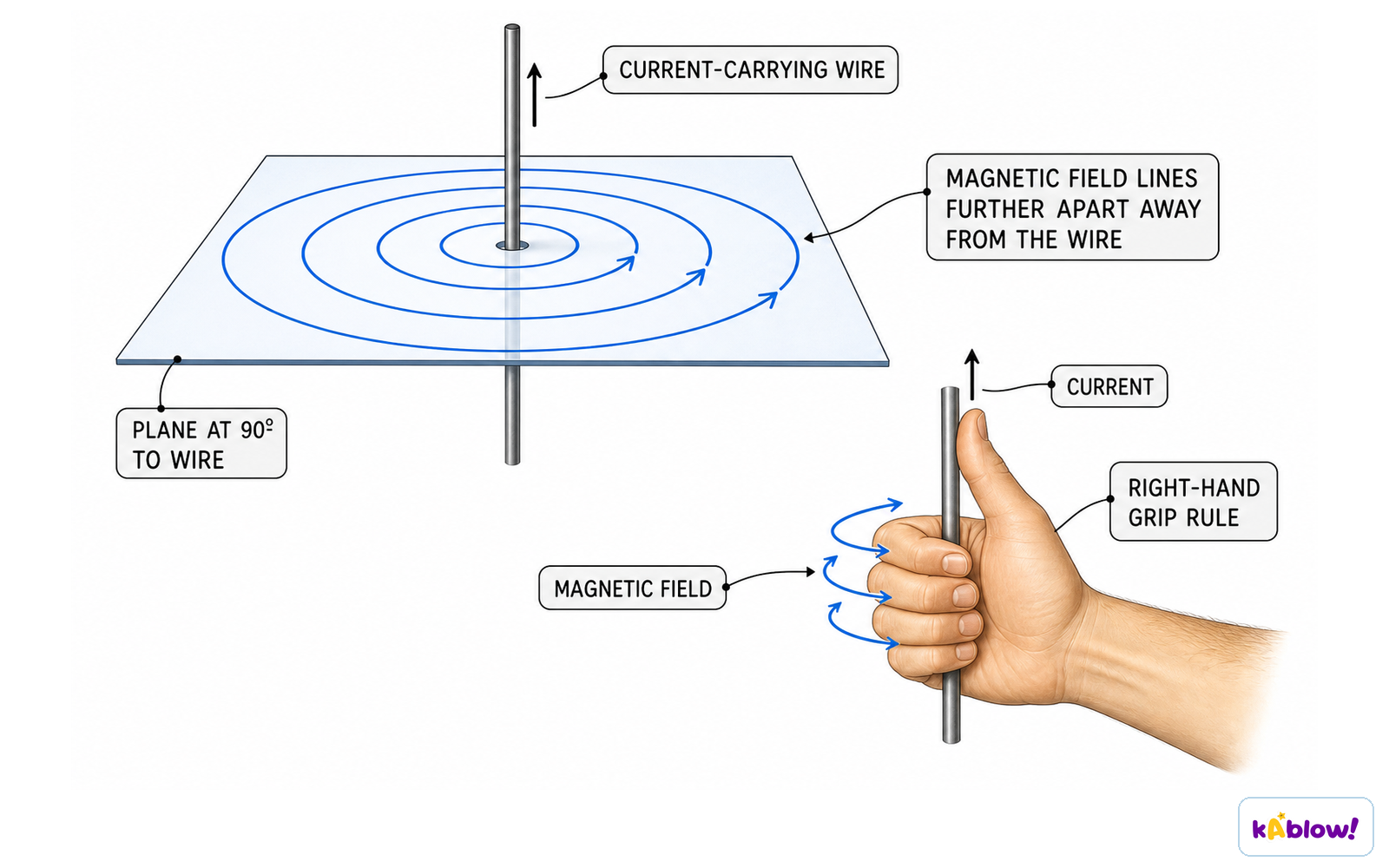
- When a current flows through a conducting wire, a magnetic field is produced around the wire.
- The field pattern is made up of concentric circles around the wire, showing the field has no poles.
- The field is strongest closest to the wire and gets weaker as the distance from the wire increases — the circles get further apart.
- The direction of the field can be found using the right-hand thumb rule: point your thumb in the direction of the current, and your fingers curl in the direction of the magnetic field.
- Reversing the current reverses the direction of the magnetic field.
- If there is no current, there is no magnetic field.
- Increasing the current increases the strength of the magnetic field, making the field lines closer together.
The direction of the magnetic field around a current-carrying wire, found using the right-hand grip rule.
Magnetic Field Around a Solenoid
- A solenoid is a coil of wire. The magnetic field lines around each loop add together, passing through the centre of the coil.
- The magnetic field around a solenoid is similar to that of a bar magnet, with one end acting as a north pole and the other as a south pole.
- Inside the solenoid, the magnetic field is strong and uniform (same strength and direction at all points).
- To find the polarity of the ends, view the solenoid from one end: if the current flows clockwise, that end is the south pole; if anticlockwise, it is the north pole.
- If the current direction changes, the north and south poles are reversed.
- If there is no current, there is no magnetic field around or through the solenoid.
Increasing the Strength of a Solenoid's Magnetic Field
- Increase the current flowing through the wire.
- Increase the number of turns in the coil in a given length.
- Reduce the length of the wire while keeping the same number of turns.
- Add an iron core through the centre of the coils — the iron becomes an induced magnet, making the overall magnet much stronger.
- An electromagnet is a solenoid with an iron core; its magnetic field can be switched on and off with the current.
- The strength of an electromagnet can be changed by increasing or decreasing the current.
The Motor Effect
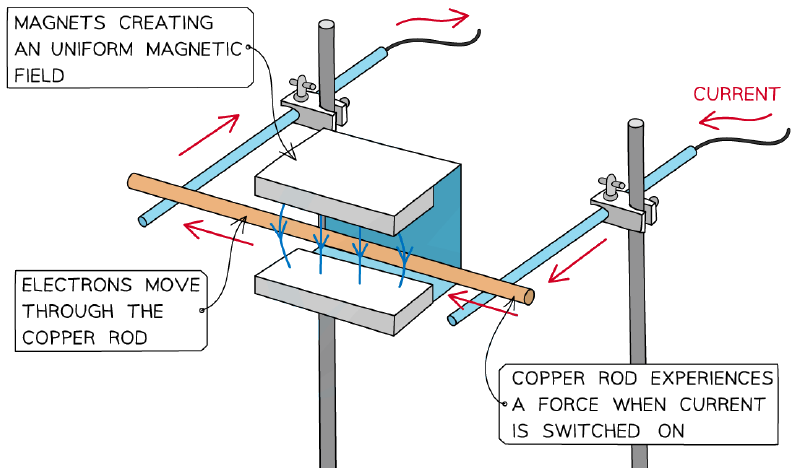
- The motor effect occurs when a wire carrying a current is placed in a magnetic field and experiences a force.
- It is caused by the interaction of two magnetic fields: the field around the current-carrying wire and the external magnetic field (e.g. between two magnets).
- The size of the force can be increased by: increasing the current, using stronger magnets, or placing the wire at 90° to the magnetic field lines.
- If the wire is parallel to the magnetic field, there is no force (F = 0).
- The force is maximum when the wire is perpendicular to the field lines.
Fleming's Left-Hand Rule
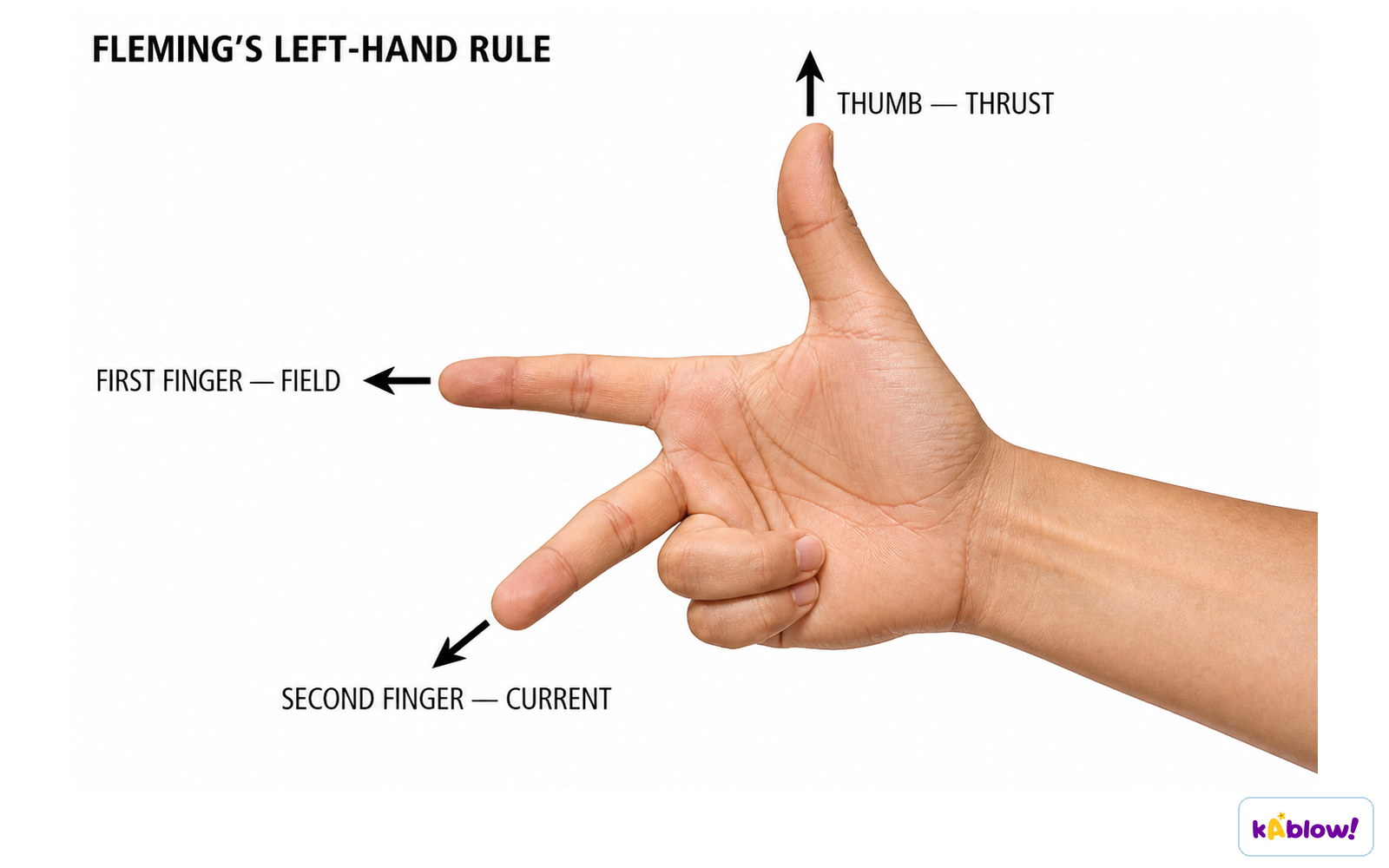
- Use Fleming's left-hand rule to find the direction of the force (thrust) on a current-carrying wire.
- Point your First finger in the direction of the magnetic Field (N to S).
- Point your seCond finger in the direction of the Current (positive to negative terminal).
- Your THumb then points in the direction of the THrust (force).
- The force, current and magnetic field are all perpendicular to each other.
- Remember: the rule gives the direction of the force (movement), not the current or field.
Fleming's left-hand rule: thumb = force (thrust), first finger = field, second finger = current.
Calculating Magnetic Force
- The force on a current-carrying conductor at right angles to a magnetic field is calculated using: F = B × I × L.
- F = force in newtons (N).
- B = magnetic flux density (strength of the magnetic field) in tesla (T).
- I = current in amperes (A).
- L = length of the conductor in the magnetic field in metres (m).
- Always convert lengths from cm to m before calculating (e.g. 5 cm = 0.05 m).
- Example: A 0.05 m wire with 1.5 A in a field experiences a force of 0.06 N. Then B = F / (I × L) = 0.06 / (1.5 × 0.05) = 0.8 T.
Setup for demonstrating the force on a current-carrying conductor in a magnetic field.
The Electric Motor
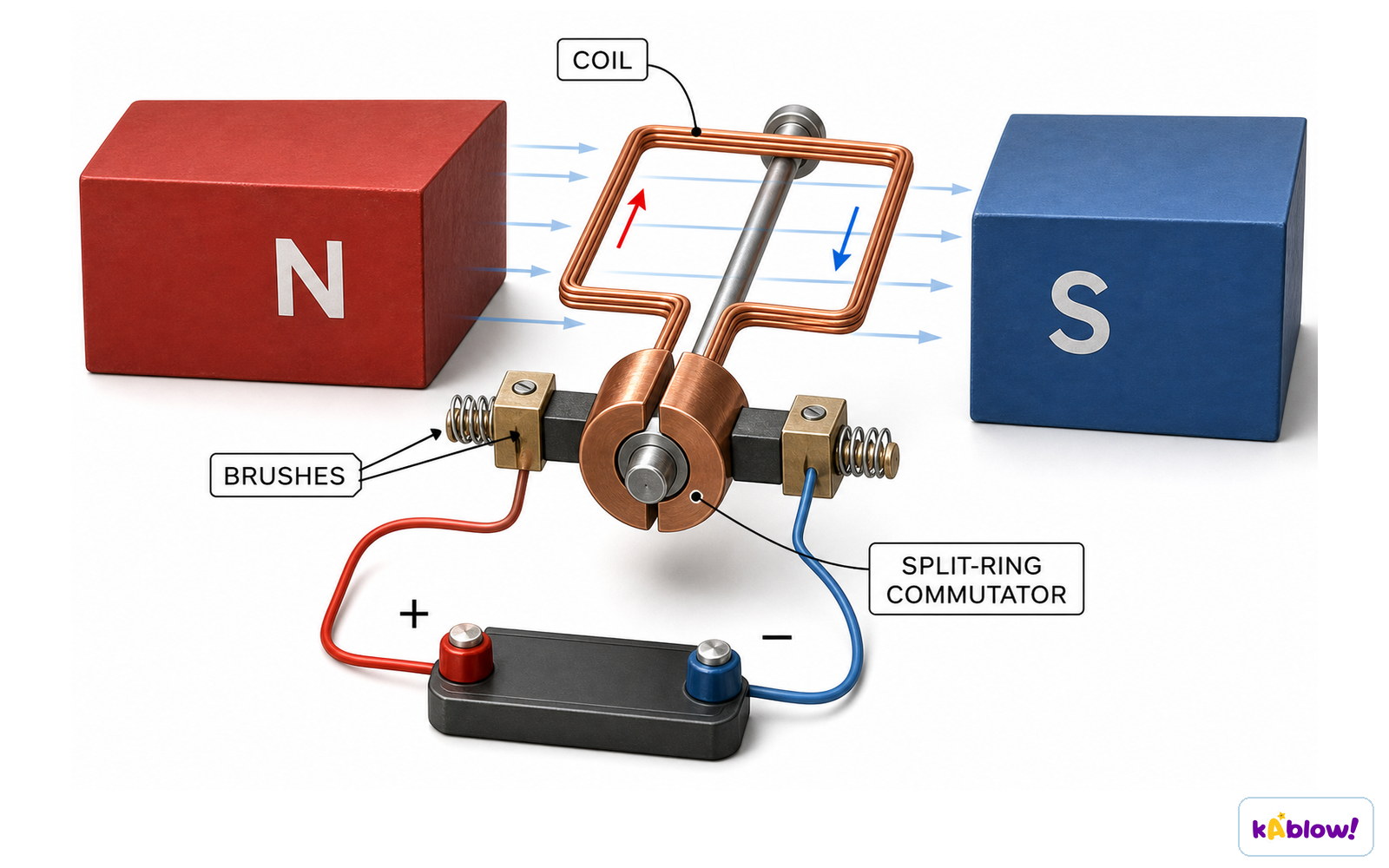
- A simple d.c. electric motor uses the motor effect to make a coil rotate continuously in one direction.
- The motor consists of a coil of wire free to rotate in a uniform magnetic field, connected to a cell via a split-ring commutator and carbon brushes.
- Current in the coil produces a magnetic field that interacts with the external field, exerting forces on the sides of the coil.
- The forces act in opposite directions on each side of the coil, causing it to rotate.
- When the coil is vertical, the split ring is not in contact with the brushes, so no current flows and no forces act — but momentum carries it past this point.
- The split-ring commutator reverses the current every half turn, so the coil continues to rotate in the same direction.
- To increase the speed of rotation: increase the current or use a stronger magnet.
- To change the direction of rotation: reverse the current supply or reverse the magnetic field (swap the poles).
- To increase the force supplied by the motor: increase the current, increase the magnetic field strength, or add more turns to the coil.
Structure of a simple d.c. motor, showing the coil, split-ring commutator, carbon brushes and magnetic field.
Loudspeakers and Headphones
- Loudspeakers and headphones convert electrical signals into sound waves using the motor effect.
- A loudspeaker has a coil of wire wrapped around one pole of a permanent magnet.
- An alternating current passes through the coil, creating a changing magnetic field around it.
- This changing field interacts with the field from the permanent magnet, exerting a force on the coil.
- The direction of the force can be found using Fleming's left-hand rule.
- As the current constantly changes direction, the force on the coil constantly changes direction, making the coil oscillate.
- The oscillating coil makes the speaker cone oscillate, which makes the air oscillate, creating sound waves.
- Headphones are essentially small moving-coil loudspeakers and work in the same way.
ஸ்லைடுகள்
Sign up free to view the lesson slides
Step through every slide for this topic — plus flashcards and revision notes — with a free account.
பயிற்சி கேள்விகள்
இலவச முன்னோட்டம் — 62-இல் 8 கேள்விகள். அனைத்தையும் பார்க்க பதிவு செய்யவும்.
1.What happens when a current flows through a conducting wire?
Easy- AA magnetic field is produced around the wire
- BThe wire becomes magnetic only if it is made of iron
- CA magnetic field is produced only inside the wire
- DNo magnetic field is produced unless there is an iron core
2.What is the shape of the magnetic field lines around a long straight current-carrying wire?
Easy- AConcentric circles around the wire
- BStraight lines parallel to the wire
- CStraight lines radiating out from the wire
- DEllipses along the length of the wire
3.The magnetic field around a straight current-carrying wire is strongest closest to the wire and gets weaker as the distance from the wire increases.
EasyTrue or false?
4.Which change will increase the strength of the magnetic field produced around a straight current-carrying wire?
Medium- AIncreasing the current in the wire
- BIncreasing the distance from the wire
- CReversing the direction of the current
- DUsing a longer piece of wire
5.The magnetic field around a solenoid is most similar to the magnetic field of which object?
Easy- AA bar magnet
- BA straight current-carrying wire
- CA single flat circular coil
- DA uniform field with no poles
6.Which of the following will increase the strength of the magnetic field produced by a solenoid? (select all that apply)
Medium- AIncreasing the current through the coil
- BIncreasing the number of turns in the coil in a given length
- CAdding an iron core through the centre of the coils
- DReversing the direction of the current
- EIncreasing the length of the wire while keeping the number of turns the same
7.The magnetic field inside a solenoid is strong and uniform.
EasyTrue or false?
8.What is an electromagnet?
Easy- AA solenoid with an iron core
- BA permanent bar magnet
- CA solenoid with no core
- DA coil of wire with no current flowing
Unlock all 62 questions, flashcards & more
இந்த தலைப்பிற்கான ஒவ்வொரு கேள்வியையும், ஸ்லைடுகளையும், ஃப்ளாஷ் கார்டுகளையும் மற்றும் திருப்புதல் குறிப்புகளையும் பார்க்க இலவச கணக்கை உருவாக்கவும்.