Organic formulae and functional groups
விளையாடிக் கற்றுக்கொள்ளுங்கள்
ஆற்றல் சம்பாதிக்க இந்த கேள்விகளுக்குப் பதிலளியுங்கள், பின்னர் மீன் பிடித்து ஆராயுங்கள். கணக்கு தேவையில்லை.
பாட குறிப்புகள்
Big idea: organic formulae and functional groups
- Key concept: Relationships. A functional group is the atom or group of atoms responsible for characteristic reactions. Homologous-series members share a functional group and show a pattern in their formulae.
- Related concepts: Models and evidence. Use a scientific explanation to make predictions, then test it against observations.
- Global context: Scientific and technical innovation. Functional groups guide the design and identification of useful organic compounds.
Organic Formulae
- Organic compounds contain carbon (except metal carbonates, CO₂, CO).
- Hydrocarbons contain only hydrogen and carbon atoms.
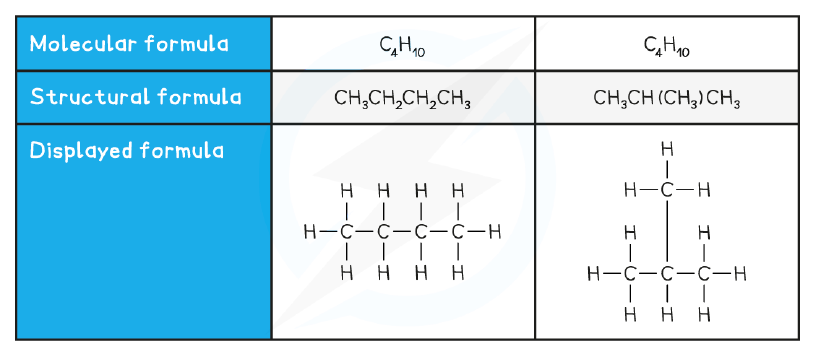
- Displayed formula shows the spatial arrangement of all atoms and bonds.
- Structural formula shows only important bonds (e.g., C=C); identical groups may be bracketed.
- Molecular formula gives the actual number of each atom in a compound.
- Structural isomers have the same molecular formula but different structural formulae (e.g., C₄H₁₀: butane and 2-methylpropane).
Structural isomers of C4H10
Homologous Series
- A homologous series is a family of organic compounds with the same functional group and similar chemical properties.
- The functional group is a specific arrangement of atoms responsible for characteristic reactions.
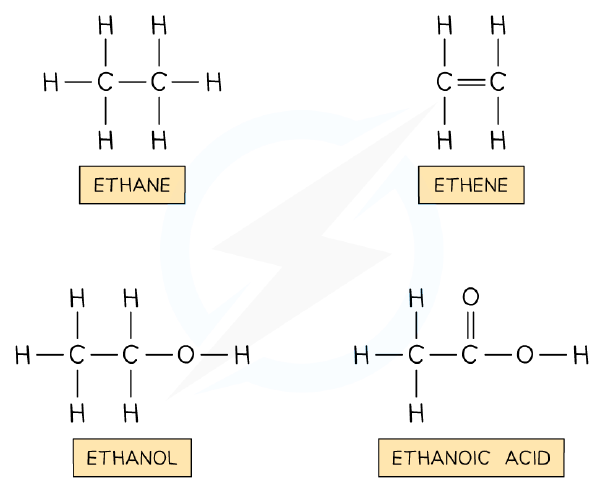
- Key functional groups: alkane (C–C), alkene (C=C), alcohol (–OH), carboxylic acid (–COOH), ester (–COO–).
- General formulae: alkane CₙH₂ₙ₊₂, alkene CₙH₂ₙ, alcohol CₙH₂ₙ₊₁OH, carboxylic acid CₙH₂ₙ₊₁COOH.
- Members differ by CH₂ and show a gradation in physical properties (e.g., boiling point increases with chain length).
- Example: ethanol (C₂H₅OH, b.p. 78°C) and propanol (C₃H₇OH, b.p. 97°C) are both alcohols with –OH group.
Displayed formulae of ethane, ethene, ethanol and ethanoic acid
Saturated & Unsaturated Compounds
- Saturated compounds have only single C–C bonds (e.g., alkanes).
- General formula for alkanes: CₙH₂ₙ₊₂; first three: methane (CH₄), ethane (C₂H₆), propane (C₃H₈).
- Unsaturated compounds contain at least one C=C double bond (e.g., alkenes).
- General formula for alkenes: CₙH₂ₙ; first three: ethene (C₂H₄), propene (C₃H₆), butene (C₄H₈).
- Mnemonic: Saturated = Single bonds; Unsaturated = doUble bonds.
Naming Organic Compounds
- Name consists of a stem (number of C atoms) and suffix (functional group).
- Stems: 1=meth, 2=eth, 3=prop, 4=but, 5=pent, 6=hex.
- Suffixes: -ane (alkane), -ene (alkene), -anol (alcohol), -anoic acid (carboxylic acid), -yl-anoate (ester).
- For positional isomers, number the carbon chain to locate the functional group (e.g., propan-1-ol, but-2-ene).
- For a simple monocarboxylic acid, number the chain from the carboxyl carbon, which is carbon 1.
- Ester names: the alcohol part (alkyl) comes first, then the carboxylic acid part (alkanoate) – e.g., methyl ethanoate from methanol + ethanoic acid.
Key Functional Groups Table
- Alkane: C–C, suffix -ane.
- Alkene: C=C, suffix -ene.
- Alcohol: –OH, suffix -anol.
- Carboxylic acid: –COOH, suffix -anoic acid.
- Ester: –COO–, suffix -yl-anoate.
Think like a scientist
- Classify a teacher-provided set of organic structures by functional group and compare their reaction patterns.
- Comparison: the functional group in each structure. Outcome: the assigned organic family and expected reaction type.
- Control: compare structures using the same naming rules. Explain why this makes the comparison fairer.
- Evidence: Use a consistent method, repeated observations where appropriate and a table with labelled quantities and units. Keep unexpected results and investigate their cause.
- Safety: Practical activities need teacher supervision and an appropriate risk assessment. Use the provided data or simulation where the investigation specifies it.
- Inquiry task: State a testable question, predict the outcome using the science, then explain how your observations would support or challenge the prediction.
Evaluate the science
- Functional groups guide the design and identification of useful organic compounds.
- A molecular formula can describe more than one structure, so it may not uniquely identify a compound.
- Evaluation task: Link your conclusion to evidence, identify a limitation and suggest a specific improvement. Distinguish a measured result from an explanation of its cause.
ஸ்லைடுகள்
Sign up free to view the lesson slides
Step through every slide for this topic — plus flashcards and revision notes — with a free account.
பயிற்சி கேள்விகள்
இலவச முன்னோட்டம் — 52-இல் 8 கேள்விகள். அனைத்தையும் பார்க்க பதிவு செய்யவும்.
1.Which of the following formulae shows an alkane?
Easy- AC2H4
- BC4H8
- CC4H10
- DC5H10
2.Which of the following is not a feature of a homologous series?
Easy- ACompounds have the same functional group
- BCompounds have the same physical properties
- CCompounds have the same general formula
- DCompounds have similar chemical properties
3.What is the general formula of the alkenes?
Easy- ACnH2n+2
- BCnH2n
- CCnH2n-2
- DCnH2n+1OH
4.What is the name of the compound with the formula CH3CH2CH2OH?
Easy- APropan-1-ol
- BPropan-2-ol
- CButan-1-ol
- DButan-2-ol
5.Which of the following structures shows a compound that belongs to a different homologous series to octane?
Medium- AA straight-chain hydrocarbon with all single bonds and 8 carbons
- BA hydrocarbon with 8 carbons and one double bond
- CA hydrocarbon with 8 carbons and all single bonds
- DA hydrocarbon with 8 carbons and only single bonds
6.Which of the following compounds is unsaturated?
Easy- AC2H6
- BC3H8
- CC2H4
- DCH4
7.What is the name of the compound with the structural formula CH3CH2CH2COOH?
Easy- AButanoic acid
- BPropanoic acid
- CButanol
- DButanone
8.Three statements about propane and propanol are listed below. 1. Propane and propanol belong to the same homologous series. 2. Propanol is a compound that contains three carbon atoms. 3. Propane is an unsaturated hydrocarbon. Which statements are correct?
Medium- A1 and 2 only
- B1 and 3 only
- C2 only
- D3 only
Unlock all 52 questions, flashcards & more
இந்த தலைப்பிற்கான ஒவ்வொரு கேள்வியையும், ஸ்லைடுகளையும், ஃப்ளாஷ் கார்டுகளையும் மற்றும் திருப்புதல் குறிப்புகளையும் பார்க்க இலவச கணக்கை உருவாக்கவும்.