Energy resources and efficiency
விளையாடிக் கற்றுக்கொள்ளுங்கள்
ஆற்றல் சம்பாதிக்க இந்த கேள்விகளுக்குப் பதிலளியுங்கள், பின்னர் மீன் பிடித்து ஆராயுங்கள். கணக்கு தேவையில்லை.
பாட குறிப்புகள்
Big idea: choosing where our energy comes from
- Big idea. Key concept: Systems. An energy resource, a power station and the homes it supplies form one connected system, so a change in one part affects all the others.
- Related concept: Consequences. Every way of making electricity has benefits and costs for people and for the environment.
- Global context: Globalization and sustainability. We share one planet, so how a country makes its electricity affects the climate and the resources everyone depends on.
- An energy resource is a source we can use to heat buildings, move vehicles and make electricity.
- Non-renewable resources will run out because we use them much faster than they form. Coal, oil and natural gas (the fossil fuels) and uranium are non-renewable.
- Renewable resources are replaced as fast as we use them, or cannot run out. Wind, solar, hydroelectric, geothermal, tidal, wave and biofuels are renewable.
- Most of our resources trace back to the Sun: fossil fuels formed from living things that once used sunlight, and the Sun heating the air drives the wind. Nuclear, geothermal and tidal energy do not.
Renewable and non-renewable energy resources
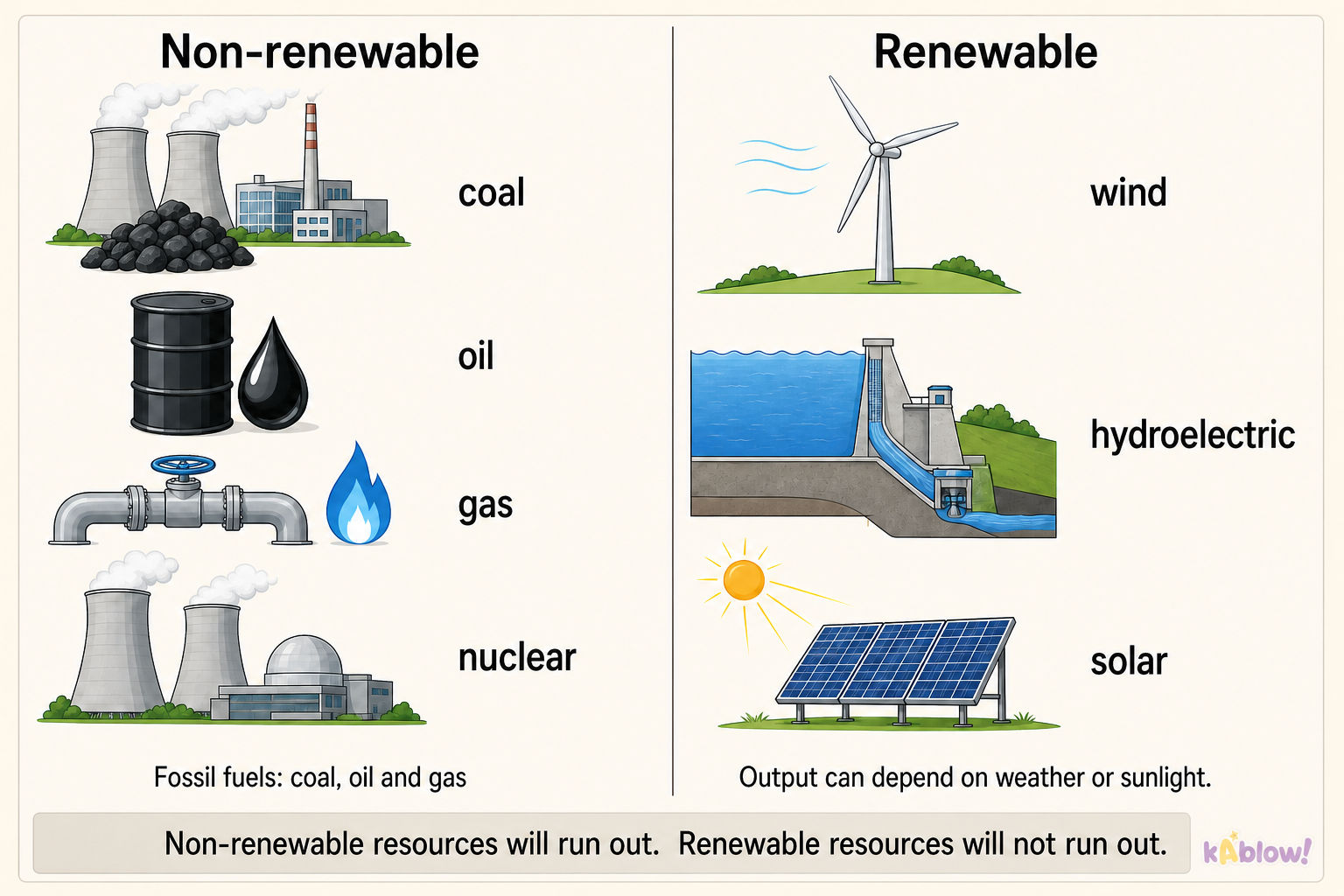
Fossil fuels and the power station
- Coal, oil and natural gas formed over millions of years from the remains of plants and tiny animals that were buried and squashed under rock. We are using them far faster than they form.
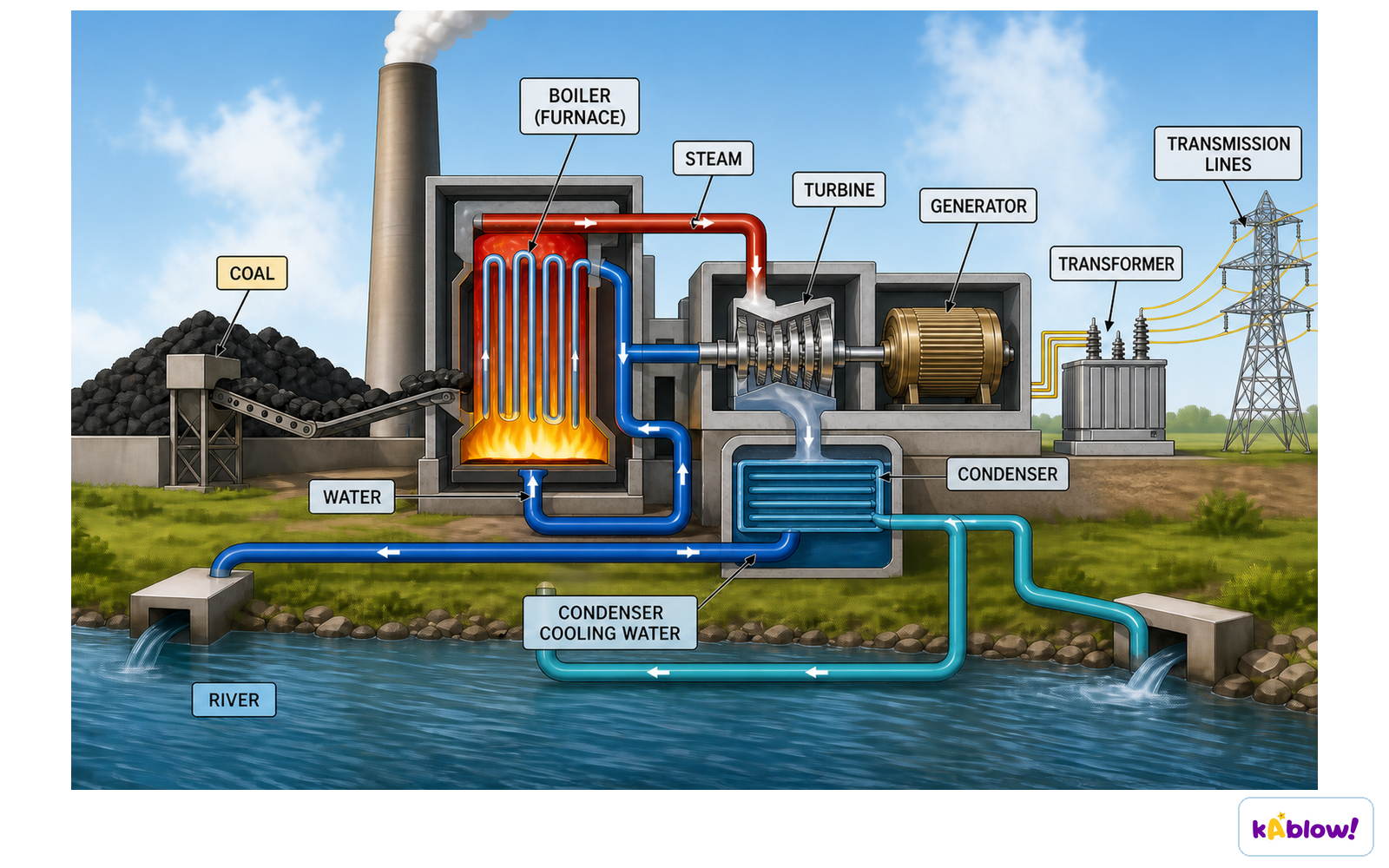
- In a power station the boiler burns the fuel. Energy moves from the chemical store of the fuel to the thermal store of the water, which turns to steam.
- The steam rushes through a turbine and spins it, so energy is now in the kinetic store of the turbine.
- The turbine turns a generator, which transfers energy electrically. The electricity passes through a transformer and along power lines to homes and businesses.
- A condenser cools the used steam back into water so that it can be heated again.
- Burning fossil fuels releases carbon dioxide, a greenhouse gas that adds to global warming. Coal and oil also release sulfur dioxide, which dissolves in rain to make acid rain.
- On the plus side, fossil fuel stations are reliable: they can be switched on whenever people need electricity, whatever the weather.
Parts of a coal-fired power station
Nuclear power
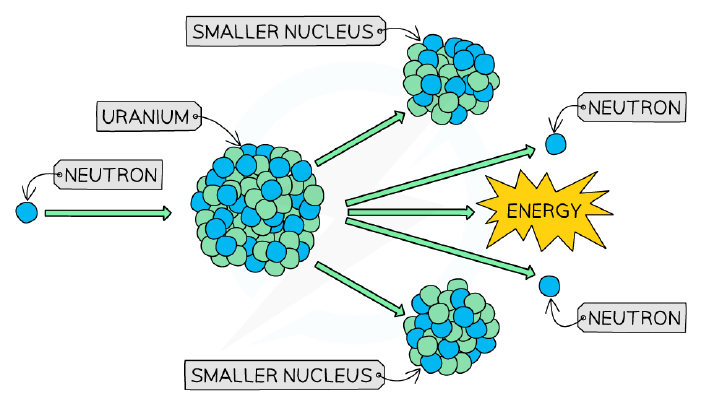
- In a nuclear reactor, the nuclei of uranium atoms are split when a neutron hits them. This is nuclear fission.
- Each splitting releases energy and more neutrons, which can split further nuclei. This is a chain reaction. Control rods soak up neutrons to keep the reaction steady.
- The energy heats water into steam. After that, the turbine and generator work just as they do in a fossil fuel station.
- A reactor releases no carbon dioxide while it runs, and a small mass of fuel releases a very large amount of energy. Output is reliable day and night.
- The drawbacks are radioactive waste, which must be stored safely for a very long time, the high cost of building and later closing a station, and the serious (though rare) consequences of an accident.
- Uranium is mined from the ground and the supply is limited, so nuclear power is non-renewable even though it does not burn fuel.
Nuclear fission of a uranium nucleus
Renewable resources
- Wind: moving air turns the blades of a wind turbine, which spins a generator. No fuel is burned, but the wind must be blowing.
- Solar: solar cells transfer energy from light directly to electricity. Solar panels can also heat water. Output falls in cloud and is zero at night.
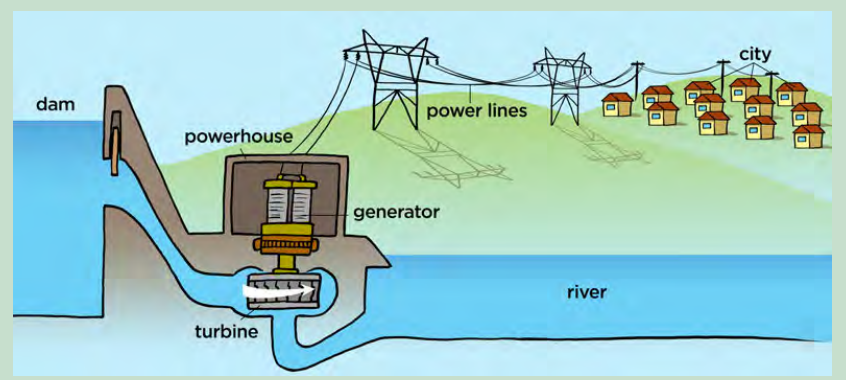
- Hydroelectric: water stored behind a dam has gravitational potential energy. When it falls through a turbine the energy becomes kinetic, then electrical. Building a dam can flood land and affect wildlife.
- Geothermal: in volcanic regions, hot rocks heat water underground. The steam turns a turbine. It is reliable, but only possible in certain places.
- Tidal and wave: the rise and fall of tides, or the movement of waves, turns turbines. Tides are very predictable but the equipment is costly and can affect marine life.
- Biofuels: fuels made from plants or waste. The plants take in carbon dioxide as they grow, so the carbon dioxide released when the fuel burns is partly balanced out. Growing the crops needs land that might be used for food.
- Because some renewables depend on the weather, countries usually use a mix of resources and look for ways to store energy.
A hydroelectric power plant
Wasted energy and efficiency
- Energy is conserved: it cannot be created or destroyed, only transferred between stores. So the total energy input always equals the useful output plus the wasted output.
- Wasted energy usually ends up in the thermal store of the surroundings, spread out and hard to use again. We say it is dissipated.
- Efficiency tells us how much of the input is useful: efficiency = useful energy output / total energy input.
- Efficiency is a number from 0 to 1, or a percentage from 0% to 100% if you multiply by 100. No real machine reaches 100%.
- Worked example. A lamp takes in 200 J and gives out 30 J of light. Efficiency = 30 J / 200 J = 0.15, which is 15%. The wasted energy is 200 J - 30 J = 170 J.
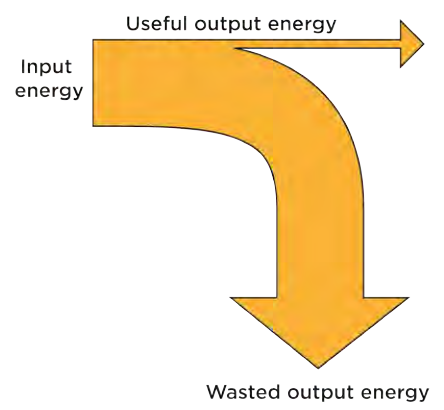
- A Sankey diagram shows energy transfers as arrows. The width of each arrow is proportional to the amount of energy. The input arrow splits into a useful arrow and a wasted arrow.
- Ways to reduce waste include lubrication to cut friction, insulation to slow thermal losses and better design.
A simple Sankey diagram
Think like a scientist: which blades make the best wind turbine?
- Question. Does the length of the blades change how far a model wind turbine can lift a small mass?
- The independent variable is the blade length, for example 8 cm, 12 cm and 16 cm. The dependent variable is the height the mass is lifted in 10 seconds, measured in centimetres.
- To make it a fair test, keep the same fan, the same fan distance and speed setting, the same mass, the same number of blades and the same blade angle. Use a small battery-powered fan, never mains equipment.
- Repeat each blade length three times and calculate the mean, so that one odd reading does not decide the result.
- Evaluate a method. A fan may not blow steadily, the height is hard to read while the mass moves, and three blade lengths give only a rough pattern. Suggest how to improve each one.
- Inquiry task. Plan an investigation into whether the number of blades changes the height lifted. State the variable you change, the variable you measure, three variables you control and how many repeats you will take.
ஸ்லைடுகள்
Sign up free to view the lesson slides
Step through every slide for this topic — plus flashcards and revision notes — with a free account.
பயிற்சி கேள்விகள்
இலவச முன்னோட்டம் — 53-இல் 8 கேள்விகள். அனைத்தையும் பார்க்க பதிவு செய்யவும்.
1.Which of these is a renewable energy resource?
Easy- ACoal
- BWind
- CNatural gas
- DUranium
2.What does it mean to call an energy resource non-renewable?
Easy- AIt cannot be used to make electricity in any form
- BIt is only available while the Sun is out shining
- CIt always damages the land where it is found now
- DIt will run out as we use it faster than it forms
3.Which fuel formed from the buried remains of ancient plants?
Easy- ACoal
- BWind
- CUranium
- DTidal water
4.What is the job of the generator in a power station?
Easy- ATo burn the fuel and make steam for the turbine
- BTo cool the used steam back into liquid water
- CTo turn the turbine's kinetic energy into electricity
- DTo carry the electricity along the high power lines
5.Which gas released when fossil fuels burn adds to global warming?
Easy- AOxygen
- BNitrogen
- CCarbon dioxide
- DHelium
6.Which renewable resource uses hot rocks underground?
Easy- AGeothermal
- BTidal
- CSolar
- DHydroelectric
7.What is the useful energy output of a filament lamp?
Easy- AHeat
- BSound
- CChemical energy
- DLight
8.Which of these is a disadvantage of wind turbines?
Medium- AThey release carbon dioxide while they are working
- BThey only generate when the wind is blowing hard enough
- CThey use up a fuel that will eventually run out
- DThey leave radioactive waste that must be stored
Unlock all 53 questions, flashcards & more
இந்த தலைப்பிற்கான ஒவ்வொரு கேள்வியையும், ஸ்லைடுகளையும், ஃப்ளாஷ் கார்டுகளையும் மற்றும் திருப்புதல் குறிப்புகளையும் பார்க்க இலவச கணக்கை உருவாக்கவும்.