Sound, ultrasound and measurement
விளையாடிக் கற்றுக்கொள்ளுங்கள்
ஆற்றல் சம்பாதிக்க இந்த கேள்விகளுக்குப் பதிலளியுங்கள், பின்னர் மீன் பிடித்து ஆராயுங்கள். கணக்கு தேவையில்லை.
பாட குறிப்புகள்
Big idea: sound, ultrasound and measurement
- Key concept: Relationships. Sound is a longitudinal wave requiring a medium. Echo distance equals sound speed times round-trip time divided by two.
- Related concepts: Models and evidence. Use a scientific explanation to make predictions, then test it against observations.
- Global context: Scientific and technical innovation. Ultrasound supports distance measurement and imaging.
Sound Waves
- Sound waves are longitudinal waves produced by vibrating sources.
- They require a medium (solid, liquid, gas) to travel; cannot travel through a vacuum.
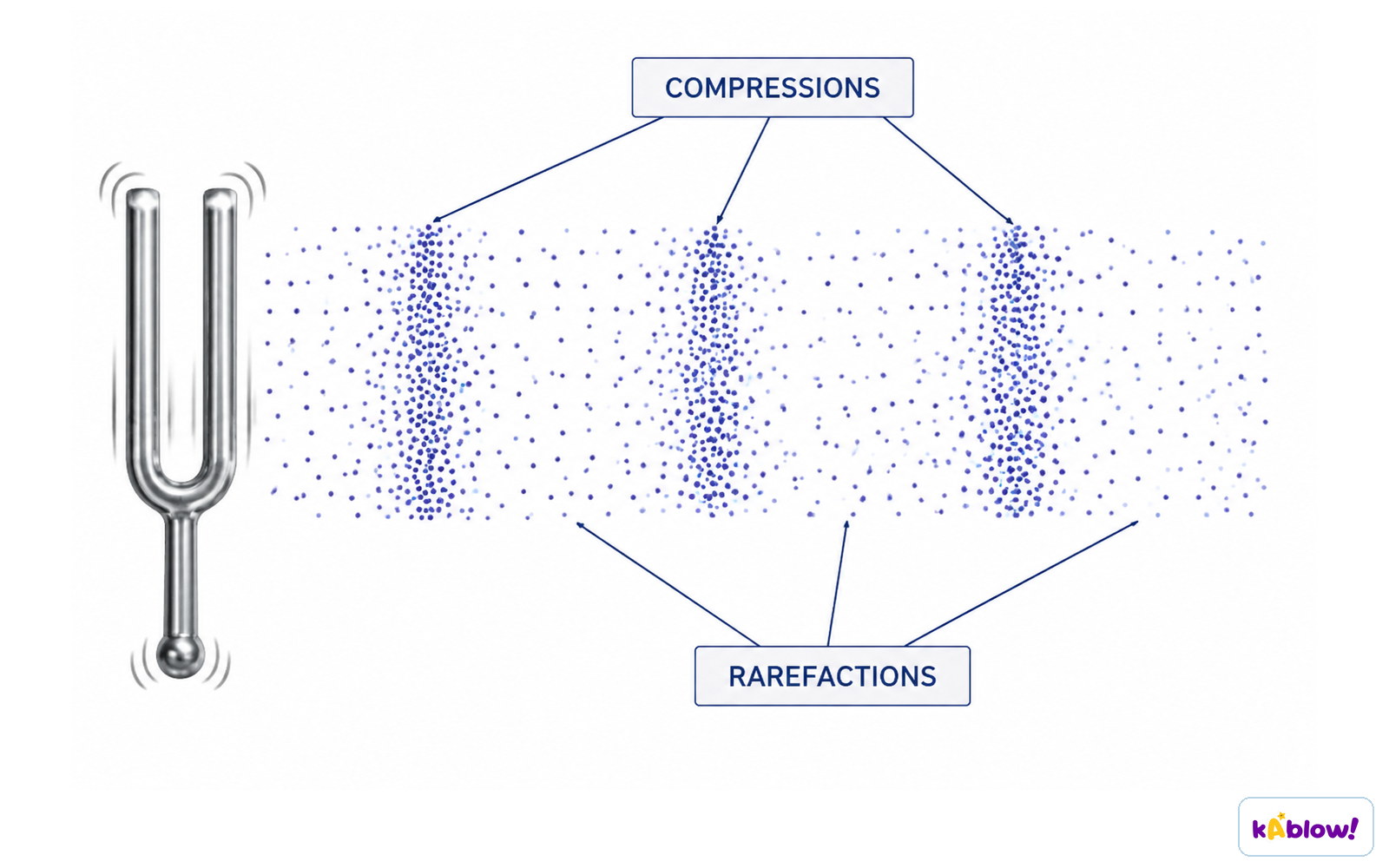
- Longitudinal waves consist of compressions (regions of higher density) and rarefactions (regions of lower density).
- Sound is a pressure wave; compressions and rarefactions cause pressure variations.
- When sound hits a solid, the pressure variations cause the solid to vibrate in sync with the wave.
A diagram illustrating compressions and rarefactions in a sound wave generated by a vibrating solid.
Measuring the Speed of Sound
- Speed of sound in air: 330–350 m/s (increases with temperature).
- Sound travels fastest in solids (~5000 m/s), slower in liquids (~1500 m/s), slowest in gases.
- Experiment 1 (two-point method): Measure distance (e.g., 100 m) and time (stopwatch) between a sound source and observer. Speed = distance / time.
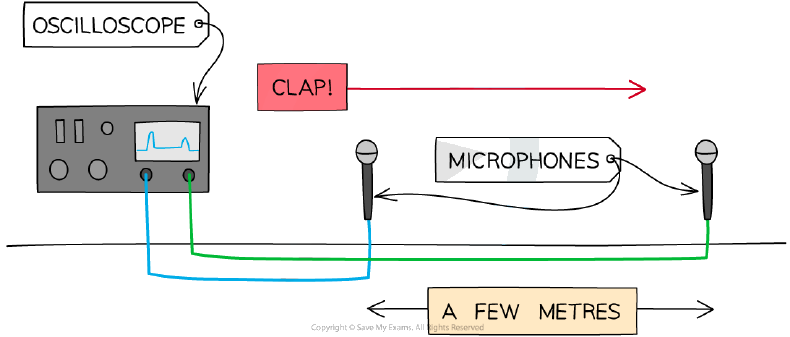
- Experiment 2 (oscilloscope method): Two microphones connected to an oscilloscope, distance ~2 m. Clap near first mic; oscilloscope measures time difference. More accurate than stopwatch.
- Accuracy: Experiment 2 is more accurate because timing is automatic; Experiment 1 suffers from human reaction time (~0.2 s error).
- Use repeat readings and larger distances to reduce random errors.
Experiment setup for measuring the speed of sound using two microphones and an oscilloscope.
Effects of Sound Waves
- Pitch depends on frequency: high frequency → high pitch; low frequency → low pitch.
- Loudness depends on amplitude: large amplitude → loud sound; small amplitude → quiet sound.
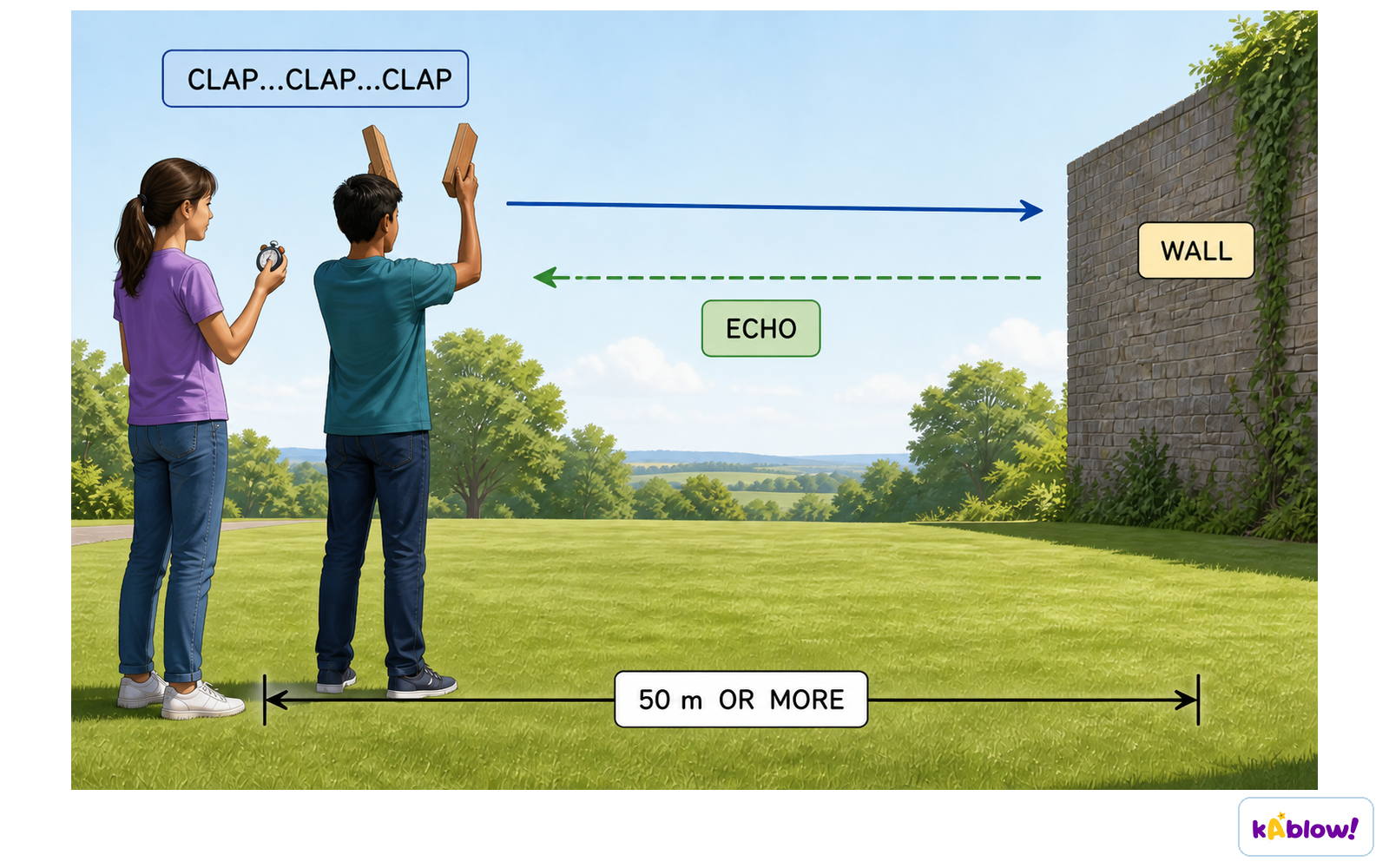
- Echoes are reflections of sound waves off hard, flat surfaces.
- Distance to reflecting surface: distance = ½ × speed × time (time is total for sound to travel to surface and back).
A person clapping to create an echo off a wall, while another person times the event.
Ultrasound
- Human hearing range: 20 Hz – 20,000 Hz (20 kHz).
- Ultrasound is sound with frequency above 20 kHz.
- Ultrasound is partially reflected at boundaries between different media.
- Uses: medical scanning (foetus, soft tissues), non-destructive testing (detecting cracks in metal), sonar (depth measurement).
- Depth calculation: depth = ½ × speed × time (same as echo formula).
- Ultrasound is non-invasive and considered harmless.
Think like a scientist
- Use a teacher-operated ultrasonic distance sensor to compare echo return times for a target at different measured distances.
- Comparison: the target distance. Outcome: the echo round-trip time.
- Control: keep the medium and temperature approximately constant. Explain why this makes the comparison fairer.
- Evidence: Use a consistent method, repeated observations where appropriate and a table with labelled quantities and units. Keep unexpected results and investigate their cause.
- Safety: Practical activities need teacher supervision and an appropriate risk assessment. Use the provided data or simulation where the investigation specifies it.
- Inquiry task: State a testable question, predict the outcome using the science, then explain how your observations would support or challenge the prediction.
Evaluate the science
- Ultrasound supports distance measurement and imaging.
- Changing temperature, target angle or reflective surface can affect the measurement; a missing echo does not prove the target is absent.
- Evaluation task: Link your conclusion to evidence, identify a limitation and suggest a specific improvement. Distinguish a measured result from an explanation of its cause.
ஸ்லைடுகள்
Sign up free to view the lesson slides
Step through every slide for this topic — plus flashcards and revision notes — with a free account.
பயிற்சி கேள்விகள்
இலவச முன்னோட்டம் — 52-இல் 8 கேள்விகள். அனைத்தையும் பார்க்க பதிவு செய்யவும்.
1.Which of the following frequency ranges is completely audible by a human with average hearing?
Easy- A200 Hz to 200 kHz
- B5 Hz to 50 kHz
- C50 Hz to 5 kHz
- D50 kHz to 50 MHz
2.A tuba player plays a loud note on her tuba. She then plays a quiet note of the same pitch. Which property of the sound wave she produced has changed?
Easy- AFrequency
- BWavelength
- CAmplitude
- DSpeed
3.A high frequency note is played on a violin. The violinist then reduces the frequency of the note. What change in the note do the audience hear?
Easy- APitch increases
- BPitch decreases
- CVolume increases
- DVolume decreases
4.Sound wave W has amplitude A and frequency f. Sound wave X is louder and lower in pitch than sound wave W. What can be said about the amplitude and frequency of sound wave X?
Easy- AAmplitude higher than A, frequency higher than f
- BAmplitude higher than A, frequency lower than f
- CAmplitude lower than A, frequency higher than f
- DAmplitude lower than A, frequency lower than f
5.Which of the following is not a use of ultrasound?
Easy- AScanning a fetus during pregnancy
- BNon-destructive testing of materials such as to find leaks in copper pipes
- CMapping with sonar
- DIdentifying broken bones
6.When objects vibrate, they produce sound waves. An object in a room vibrates. However, a person in that same room does not hear anything. Why not?
Easy- AThe room contains no air.
- BThe sound waves are travelling too fast.
- CThe amplitude of the sound waves is too great.
- DThe frequency of the sound waves is too great.
7.After a lockdown drill, the management notes the siren is too quiet and its pitch is too low. They ask the company to make the alarm louder and give it a higher pitch. What effect does this have on the resulting sound wave?
Easy- AIt has a larger amplitude and a lower frequency.
- BIt has a larger frequency and a lower amplitude.
- CIt has a smaller frequency and a larger amplitude.
- DIt has a larger frequency and a larger amplitude.
8.A teacher uses a signal generator connected to a speaker to make sounds of different frequencies. Which frequency can be heard by a student?
Easy- A10 Hz
- B30 kHz
- C440 Hz
- D120 kHz
Unlock all 52 questions, flashcards & more
இந்த தலைப்பிற்கான ஒவ்வொரு கேள்வியையும், ஸ்லைடுகளையும், ஃப்ளாஷ் கார்டுகளையும் மற்றும் திருப்புதல் குறிப்புகளையும் பார்க்க இலவச கணக்கை உருவாக்கவும்.