Ecological Niches
விளையாடிக் கற்றுக்கொள்ளுங்கள்
ஆற்றல் சம்பாதிக்க இந்த கேள்விகளுக்குப் பதிலளியுங்கள், பின்னர் மீன் பிடித்து ஆராயுங்கள். கணக்கு தேவையில்லை.
பாட குறிப்புகள்
Ecological Niches
- A habitat is the place where a species lives; a niche is the role of a species within its habitat.
- The role of a species includes what it eats, which other species depend on it for food, what time of day it is active, and exactly where in a habitat it lives and feeds.
- The niche also includes the abiotic factors (e.g. oxygen, temperature) and biotic factors (e.g. competitors, predators) acting on a species.
- No two species can fill the same niche within a habitat; if this happens, they will be in direct competition, and one species will out-compete the other, causing it to die out in that habitat.
- Even when species appear to occupy the same niche, there are subtle differences in their role, such as feeding at different times of day or having different food sources.
- Feeding location is an example of a feature that may differ between niches.
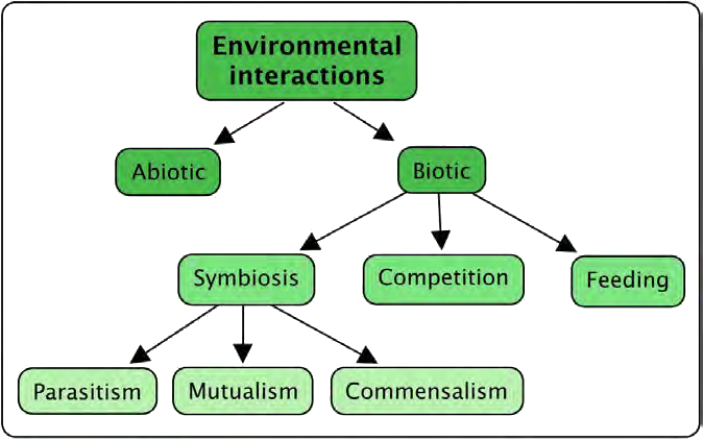
Interactions in an ecosystem
Anaerobes & Aerobes
- All living organisms carry out some form of respiration; aerobic respiration requires oxygen, while anaerobic respiration does not.
- Obligate anaerobes are single-celled organisms that can only carry out anaerobic respiration and cannot tolerate oxygen; they are found in oxygen-free environments such as lower soil layers, deep water, and inside other organisms.
- Facultative anaerobes mainly respire aerobically but can switch fully to anaerobic respiration in the absence of oxygen, with no negative effects; examples include brewer's yeast (×Saccharomyces cerevisiae×) and×Escherichia coli×.
- Obligate aerobes cannot survive without oxygen and rely on aerobic respiration; they may carry out anaerobic respiration for only a few seconds. Examples include most animals, most fungi (not yeast), and some bacteria such as×Mycobacterium tuberculosis×.
Methods of Nutrition
- Organisms need energy in the form of ATP, which comes from organic molecules such as carbohydrates transferred during respiration.
- The way an organism gains organic molecules to fuel respiration is its method of nutrition; the two main modes are autotrophy and heterotrophy.
- An autotroph synthesises its own organic molecules from simple inorganic substances; photoautotrophs use light energy, while chemoautotrophs use energy from oxidation of chemicals.
- A heterotroph gains organic molecules from the tissues of other organisms.
- Photosynthesis is carried out by autotrophs that use light energy to convert carbon dioxide into organic molecules; photosynthetic pigments such as chlorophyll absorb light energy.
- Photosynthetic organisms are producers because they make their own organic molecules without relying on other organisms; they include plants, algae, and photosynthetic bacteria such as cyanobacteria.
- Photosynthesis transfers light energy into a chemical form usable by living organisms and releases oxygen into the atmosphere, enabling aerobic respiration.
Holozoic Nutrition, Mixotrophs & Saprotrophs
- Holozoic nutrition is used by heterotrophs that gain organic molecules by ingesting, digesting, absorbing, and assimilating molecules from the tissues of other organisms.
- Ingestion = eating; digesting = breaking down larger molecules into smaller ones; absorbing = transport of molecules from the digestive tract into cells; assimilation = using molecules to build cells and tissues.
- Holozoic nutrition involves internal digestion; animals such as house flies that secrete enzymes onto food externally are heterotrophs but do not use holozoic nutrition.
- Mixotrophs use more than one method of nutrition, such as both auto- and heterotrophy; obligate mixotrophs must constantly have access to both methods, while facultative mixotrophs can survive using one method supplemented by the other.
- ×Euglena×is a mixotroph that can photosynthesise and also take in bacterial cells by endocytosis, digesting them with lysosomal enzymes; it has a light-sensitive spot to position itself for maximum light absorption.
- Other examples of mixotrophs include carnivorous plants, corals, and marine plankton such as dinoflagellates.
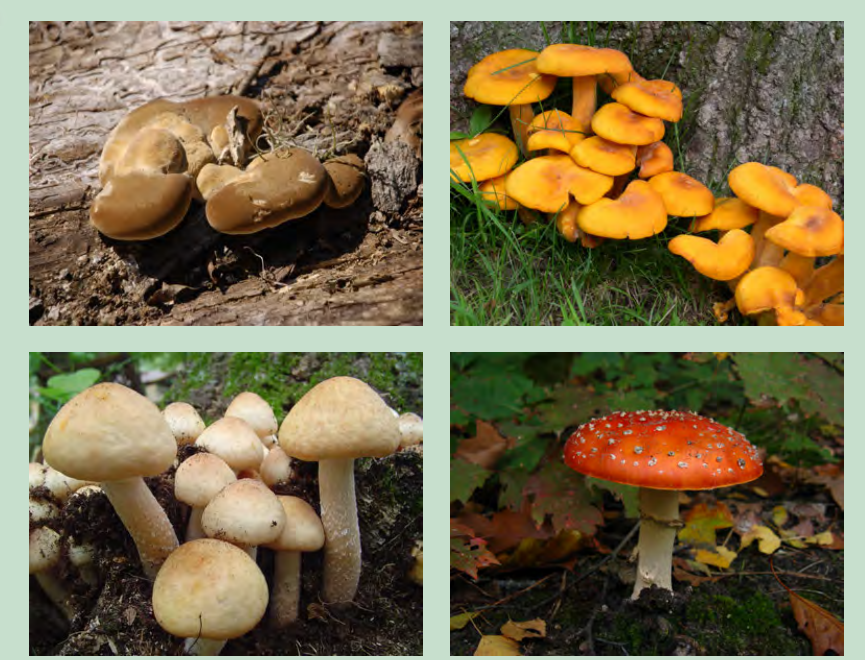
- Saprotrophs are heterotrophs that digest dead organisms and waste material externally by secreting enzymes, then absorb the products; examples include fungi and bacteria, which act as decomposers.
- Saprotrophs release mineral ions such as ammonium and phosphate; not all products are absorbed, leaving minerals in the soil for plants. Without saprotrophs, nutrients would remain locked in dead matter.
Fungi as decomposers
Nutrition in Archaea
- Archaea are a diverse group of single-celled organisms forming one of the three domains; they vary metabolically, including phototrophic, chemotrophic, and heterotrophic groups.
- Phototrophic archaea use light energy to generate ATP; e.g.×Halobacteria×use bacteriorhodopsin to absorb light and pump H⁺ ions across a membrane, producing ATP via ATP synthase.
- This is not oxygen-releasing photosynthesis, and×Halobacteria×are not autotrophic; they are photoheterotrophs because they use light for ATP but gain carbon compounds from other organisms.
- Chemoautotrophic archaea produce their own carbon compounds using energy from chemicals such as hydrogen gas, ammonia, methane, and hydrogen sulfide.
- Chemoheterotrophic archaea use chemicals to produce ATP but gain their carbon compounds from other organisms.
- Heterotrophic archaea gain carbon compounds from other organisms and use them to generate ATP, e.g. archaea that break down dead plant material.
Nutrition in Hominidae: Skills
- Humans are part of the Hominidae family, along with chimps, gorillas, orangutans, and gibbons; most existing hominids are omnivores.
- Chimps are mainly frugivores (fruit-eaters) but also eat other plant matter and some small mammals; gorillas are mainly herbivores, feeding on leafy vegetation and sometimes insects.
- Jaw and dentition are specialised for diet: chimps have small jaw muscles and long canines for biting and tearing, while gorillas have strong jaw muscles and large molars and premolars for grinding tough vegetation.
- Incisors are chisel-shaped for cutting and biting; canines are pointed for holding and tearing; premolars and molars are flat and ridged for grinding.
- The relationship between diet and dentition in existing hominids can be applied to extinct species by studying preserved skulls and jaws.
- Dentition is not always a perfect indicator of diet: modern humans eat meat but have plant-eater-like teeth; orangutans and gorillas have pointed canines but do not eat meat; male chimps have longer canines than females despite similar diets.
- Teeth may also play roles in defence or competition for mates, so other evidence such as tooth abrasion patterns under a microscope should be considered.
- Examples of extinct hominids include×Australopithecus africanus×,×Paranthropus robustus×,×Homo floresiensis×, and×Homo neanderthalensis×.
Deductions from Hominid Fossils
- ×Paranthropus robustus×had a robust skull with attachment points for large jaw muscles, large molars and premolars, and thick tooth enamel, suggesting a diet of tough plant material.
- ×Homo floresiensis×had large premolars, small canines, a square robust jaw, and tooth abrasion suggesting a fibrous plant-based diet; hunting/cutting tools provide additional evidence of meat eating.
- Scientists make observations (e.g. how teeth of existing hominids relate to diet) and develop theories (e.g. that extinct hominid diets can be deduced from dentition).
- New evidence must be taken into account; discrepancies between dentition and diet in modern hominids show that deductions about extinct species may be flawed and additional evidence may be needed.
Adaptations of Herbivores & Plants
- Herbivores are heterotrophs that feed on plants; adaptations are characteristics that aid survival in their environment.
- Aphids have specialised mouthparts called stylets to pierce plant tissues and reach sugary sap in the phloem; caterpillars, grasshoppers, and beetles have mandibles to cut through leaves.
- Grazing mammals such as sheep and horses have flat teeth for grinding plant matter.
- Ruminants such as cattle and deer have multi-compartment stomachs, can regurgitate and re-chew food, and have specialised bacteria that produce cellulase to break down cellulose.
- Some mammals neutralise plant toxins: deer produce salivary proteins that bind tannins; proboscis monkeys have gut bacteria that neutralise leaf toxins; 'cautious sampling' avoids consuming large amounts of toxic chemicals.
- Plants cannot move away from herbivores, so they use mechanical deterrents such as cacti spines, nettle hairs, thick bark, and tiny leaf hairs.
- Plants also produce toxic secondary compounds: foxgloves produce digitalis (affects heartbeat), deadly nightshade produces atropine (blocks neurotransmitters), tannins deter by bitter taste, and alkaloids such as caffeine and nicotine deter insects.
Adaptations of Predators & Prey
- Predators hunt and eat other animals or consume recently dead animals; prey are hunted and consumed. Adaptations can be chemical, physical, or behavioural.
- Predator chemical adaptations include venoms: haemotoxic venoms (e.g. adders, rattlesnakes) damage the circulatory system, while neurotoxic venoms (e.g. mambas, cobras, scorpions, spiders) interfere with nerve impulses.
- Predators may use chemical mimicry (e.g. bolas spiders release moth pheromones) or chemical crypsis (scent camouflage, e.g. pirate perch fish) to attract or ambush prey.
- Predator physical adaptations include forward-facing eyes for distance perception, excellent vision in birds of prey, Jacobson's organ in snakes, and echolocation in bats.
- Predators have body structures for catching prey: cheetahs' long limbs and flexible spines, swordfish streamlined bodies, mantis shrimp modified front limbs, and large canine teeth in carnivorous mammals.
- Predator behavioural adaptations include ambush (puff adders, mantis shrimps, crocodiles), pack hunting (orcas, wolves, lions), and pursuit hunting (cheetahs, wolves, painted dogs).
- Prey chemical adaptations include toxins (poison dart frogs, skunks, tiger moths) and scent camouflage (puff adders, harlequin filefish).
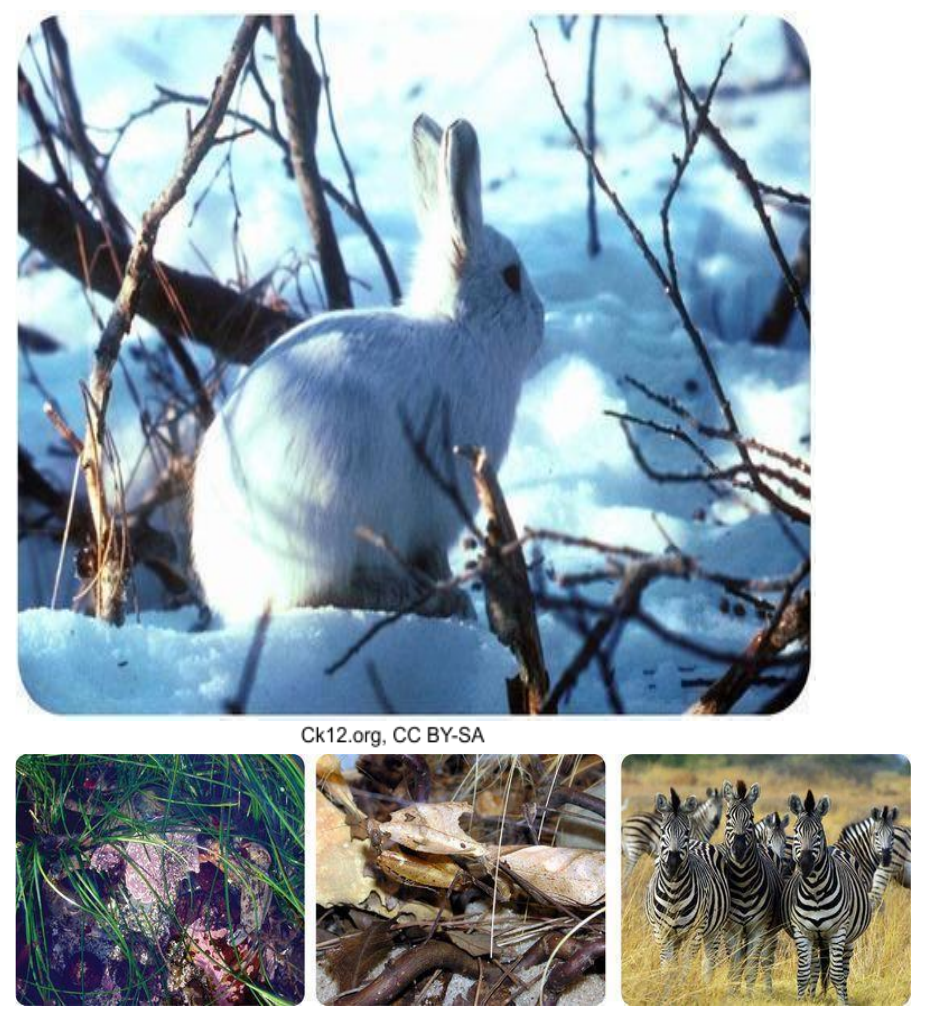
- Prey physical adaptations include eyes on the sides of the skull for wide vision, camouflage, mimicry (owl butterflies, king snakes), aposematism (bright warning colours), and mechanical defences (exoskeletons, shells, spines).
- Prey behavioural adaptations include preference for dark sheltered places, fleeing, avoiding predator locations/times, grouping in large groups, mobbing predators, warning calls, and bluffing (playing dead, frill-necked lizards).
Camouflage as an adaptation
Plant Adaptations for Harvesting Light
- Plants have whole-organism form adaptations that maximise light absorption for photosynthesis.
- Trees form the canopy; emergent trees grow above the canopy, and understory trees grow beneath it. Maximising height allows the tallest trees to gain the most sunlight.
- Lianas are woody vines that use tree trunks for support to reach the canopy; they germinate on the forest floor, grow toward tree trunks, and compete with trees for light, nutrients, and moisture.
- Epiphytes grow high in tree branches to absorb sunlight without beginning life on the forest floor; they gain nutrients from the canopy (e.g. moss from rainwater, bromeliads collect rainwater, orchids have aerial roots).
- Strangler epiphytes begin life in the canopy and grow roots down to the soil, gaining nutrients and water while taking advantage of height; strangler figs can kill their host trees by taking all resources.
- Shade-tolerant shrubs and herbaceous plants grow on the forest floor, may contain different photosynthetic pigments, often have large leaves, and produce brightly coloured or strongly scented flowers to attract pollinators in low light.
- Shrubs have woody stems but are not tall like trees; herbaceous plants lack woody stems and rely on soft tissues with turgid cells for support.
Fundamental & Realised Niches
- The fundamental niche is the full range of conditions and resources in which a species could survive and reproduce, based on its adaptations and tolerance limits.
- The realised niche is the actual conditions and resources in which a species exists, due to biotic interactions.
- The fundamental niche is the potential distribution of a species, with no competition or predation, and is large in size.
- The realised niche is the actual distribution, with competition and predation occurring, and is smaller in size.
- Example: the barnacle×Chthamalus dalli×has a wide fundamental niche but its realised niche is restricted to higher up the shore where it avoids competition with×Balanus glandula×.
Competitive Exclusion
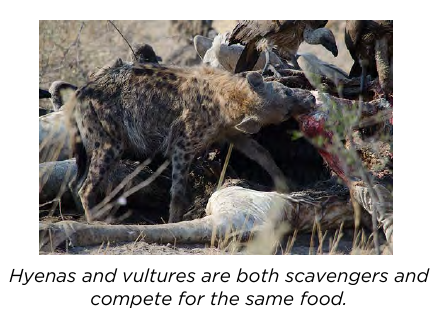
- A niche can only be occupied by one species; if two species try to occupy the same niche, they compete for the same resources.
- The result of competition is that one species out-competes the other until the second species is either forced into a new, slightly different niche or made locally extinct.
- Both species may also be forced into a smaller part of their fundamental niches.
- The elimination of a competing species from its niche is known as competitive exclusion.
- A classic example is×Paramecium aurelia×and×Paramecium caudatum×: grown separately both thrive, but grown together×P. aurelia×out-competes×P. caudatum×, leading to its elimination.
- This example occurs under laboratory conditions; in nature it is rare for two species to occupy exactly the same niche.
Interspecific competition
ஸ்லைடுகள்
Sign up free to view the lesson slides
Step through every slide for this topic — plus flashcards and revision notes — with a free account.
பயிற்சி கேள்விகள்
இலவச முன்னோட்டம் — 61-இல் 8 கேள்விகள். அனைத்தையும் பார்க்க பதிவு செய்யவும்.
1.Which of the following correctly describe aspects of an ecological niche? I. How a species gains its food II. Abiotic factors that influence species growth III. Biotic factors that influence species survival
Easy- AI only
- BI and II only
- CII and III only
- DI, II and III
2.Saccharomyces cerevisiae is a species of yeast that can survive at a range of oxygen concentrations, including in the absence of oxygen. Which term describes Saccharomyces cerevisiae?
Easy- AObligate anaerobe
- BFacultative anaerobe
- CObligate aerobe
- DMixotroph
3.Which of the following statements about ecological niches is correct?
Medium- ACompetition reduces the size of an ecological niche.
- BAn ecological niche can be shared between two similar species.
- CCompetition for a niche always results in local extinction for one species.
- DA realised niche is larger than a fundamental niche.
4.A habitat is the role of a species within its environment, while a niche is the place where a species lives.
EasyTrue or false?
5.Which of the following are adaptations that aid herbivory? (select all that apply)
Medium- AThe presence of an enzyme that breaks down cellulose.
- BProduction of toxic secondary compounds.
- CProteins that bind to toxins.
- DSharp spines to deter herbivores.
6.The Ghost Orchid (Epipogium aphyllum) is a rare plant species which lacks leaves or chlorophyll. The plant has formed a symbiotic relationship with a fungus in order to obtain the nutrition it requires. The growth of the fungus is slowed as a result of the relationship. Which of the following rows correctly describes E. aphyllum?
Medium- AHeterotroph: ✓, Autotroph: X, Parasite: X, Saprotroph: ✓
- BHeterotroph: X, Autotroph: ✓, Parasite: X, Saprotroph: ✓
- CHeterotroph: ✓, Autotroph: X, Parasite: ✓, Saprotroph: ✓
- DHeterotroph: ✓, Autotroph: X, Parasite: ✓, Saprotroph: X
7.Match each term with its correct description.
Medium- Obligate anaerobe
- Facultative anaerobe
- Obligate aerobe
- Cannot survive in the absence of oxygen
- Can only carry out anaerobic respiration and cannot tolerate oxygen
- Mainly respires aerobically but can switch fully to anaerobic respiration
8.Place the steps of holozoic nutrition in the correct order.
Medium- Assimilation
- Ingestion
- Absorption
- Digestion
Unlock all 61 questions & more
இந்த தலைப்பிற்கான ஒவ்வொரு கேள்வியையும், ஸ்லைடுகளையும், ஃப்ளாஷ் கார்டுகளையும் மற்றும் திருப்புதல் குறிப்புகளையும் பார்க்க இலவச கணக்கை உருவாக்கவும்.