Integration Of Body Systems
விளையாடிக் கற்றுக்கொள்ளுங்கள்
ஆற்றல் சம்பாதிக்க இந்த கேள்விகளுக்குப் பதிலளியுங்கள், பின்னர் மீன் பிடித்து ஆராயுங்கள். கணக்கு தேவையில்லை.
பாட குறிப்புகள்
Integration in Living Organisms
- Complex organisms have body systems made of component parts that work together for an overall function.
- Cell-cell communication is needed within a system and between different systems in different parts of the organism.
- Hormones are an example: produced in the endocrine system but can affect a different system, such as the reproductive system.
- Multicellular organisms show a hierarchy of organisation: cells → tissues → organs → organ systems → organism.
- Emergent properties arise when cells organise and interact, allowing functions unicellular organisms cannot perform.
- The phrase 'the whole is greater than the sum of its parts' describes how systems are more effective working together.
- Communication in animals is mainly by the nervous system or the endocrine system, often working together.
- Transport vessels in the blood system move materials such as oxygen, glucose, urea, and hormones like FSH and LH.
The central and peripheral nervous systems
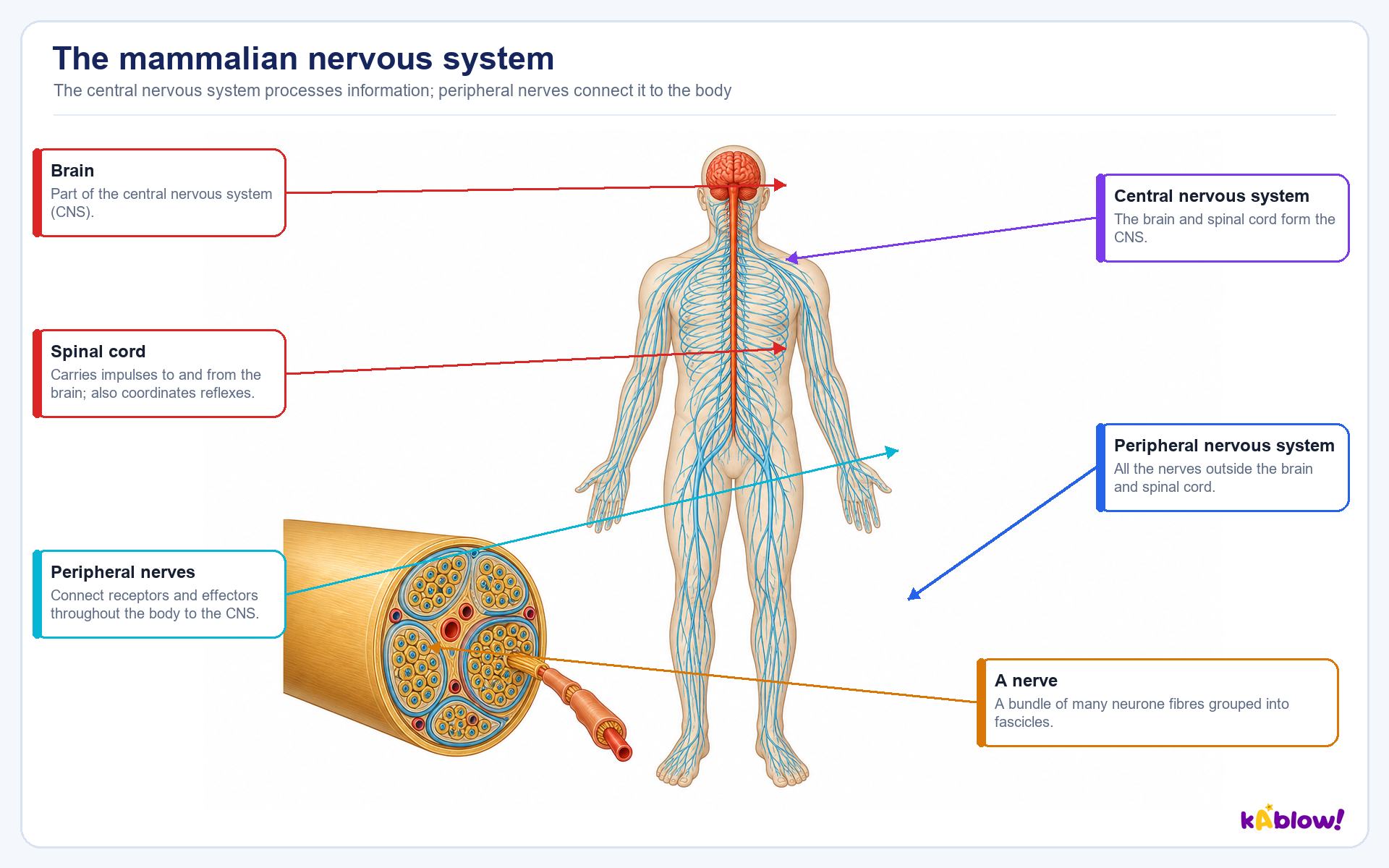
The Nervous System
- The nervous system consists of the central nervous system (CNS) – brain and spinal cord – and the peripheral nervous system (PNS) – all other nerves.
- Information travels as electrical impulses along nerve cells called neurones; a bundle of neurones is a nerve.
- The brain is made of billions of interconnected neurones and controls complex conscious and unconscious behaviours.
- The cerebral cortex is the highly folded outer layer responsible for intelligence, memory, consciousness and personality.
- The cerebellum coordinates balance, muscle coordination and movement.
- The brainstem relays messages; the medulla controls unconscious activities such as heart rate and breathing.
- The pituitary gland produces many hormones including FSH and LH; the hypothalamus regulates body temperature and controls the pituitary gland.
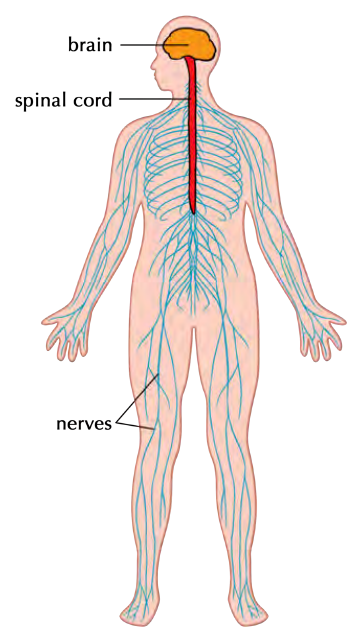
Diagram of the human nervous system showing the brain, spinal cord and nerves.
The Spinal Cord as Integration Centre
- The spinal cord is part of the CNS and a neural pathway between the body and the brain, but can process information independently.
- It is an integration centre for unconscious processes, including some reflex reactions.
- White matter contains mainly axons carrying information to and from the brain.
- Grey matter contains neurones and synapses involved in spinal cord integration, creating reflex responses.
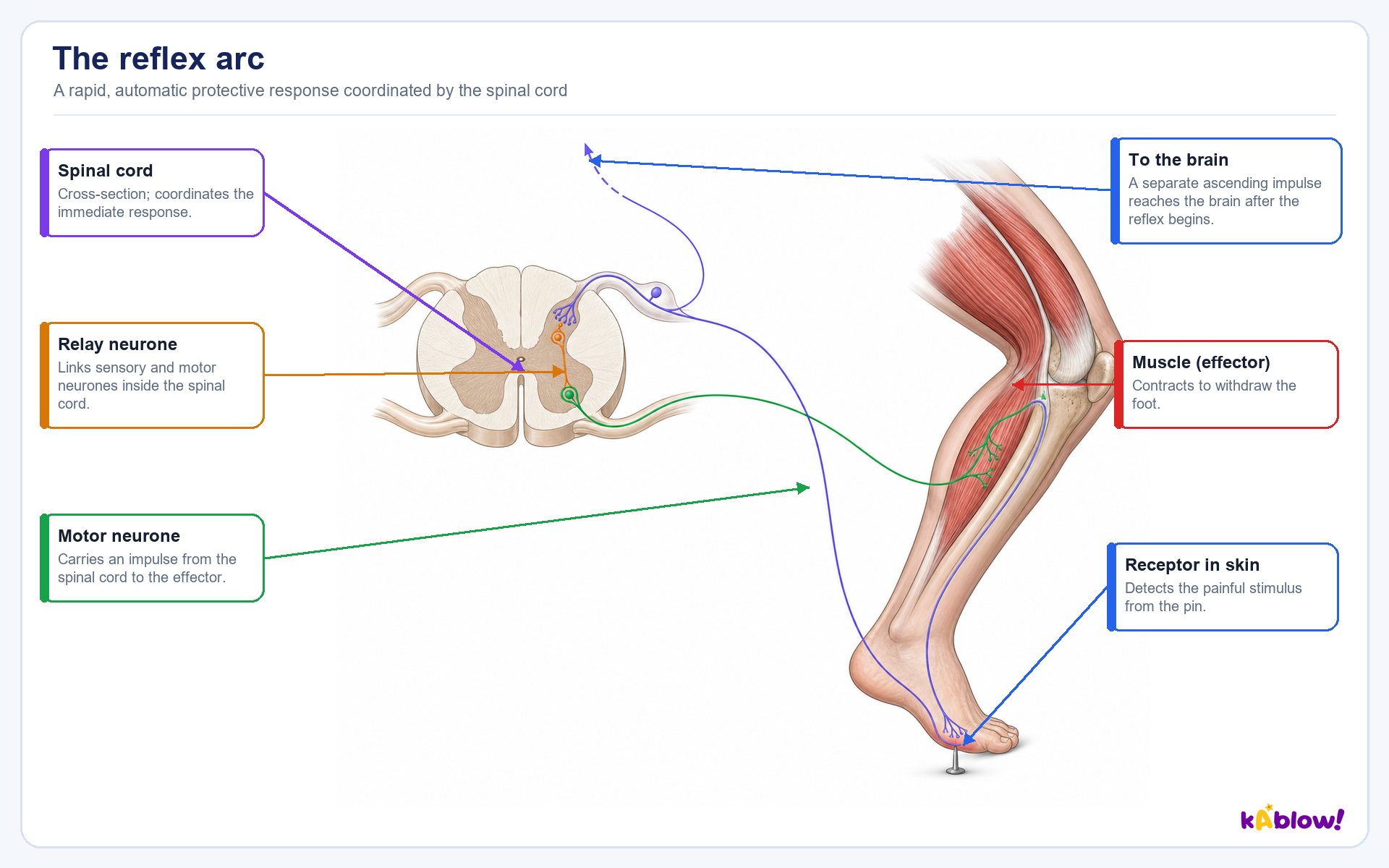
- Sensory information enters along sensory neurones, is processed, and leaves along motor neurones; this pathway is a reflex arc.
- Because the brain is not involved, this is unconscious control directed by the spinal cord alone.
A reflex arc
Input Through Sensory Neurones
- A receptor is a specialised cell that detects changes in the environment (a stimulus).
- Receptor cells are transducers – they convert energy (light, heat, sound) into an electrical impulse in a sensory neurone.
- When stimulated, receptor cells are depolarised; a strong enough stimulus initiates an action potential.
- The impulse is transmitted to the CNS, specifically the spinal cord and cerebral hemispheres.
- Chemoreceptors in taste buds detect chemicals; salt (sodium chloride) is detected by sodium ions diffusing into the receptor cell.
- This depolarisation creates a receptor potential; if large enough, calcium ions enter and stimulate release of neurotransmitter.
- The neurotransmitter stimulates an action potential in the sensory neurone, which transmits an impulse to the brain.
Output Through Motor Neurones
- The cerebrum processes movements; the motor cortex is the region responsible.
- Motor neurones carry action potentials to muscles to initiate movement.
- Motor neurones terminate at a neuromuscular junction (motor end plate), which works like a synapse.
- At the junction, calcium ions enter the neurone and stimulate vesicles of acetylcholine (ACh) to fuse with the presynaptic membrane.
- ACh binds to receptors on the sarcolemma, opening ion channels and allowing sodium ions to diffuse in.
- Sodium influx depolarises the sarcolemma, generating an action potential that passes down T-tubules.
- Action potentials trigger release of calcium ions from the sarcoplasmic reticulum, which bind troponin and expose myosin-binding sites on actin.
- This begins the sliding filament model of muscle contraction.
Reflex Arc & Movement Control
- Reflex responses are automatic, rapid actions without conscious thought, minimising damage and aiding survival.
- Awareness of a reflex occurs after it has happened because information takes longer to reach conscious brain regions.
- Examples include blinking, coughing, pupil reflex, and knee reflex.
- A reflex arc is the pathway from receptor to effector without involving conscious brain regions.
- In a pain reflex arc, a nocireceptor detects the stimulus; an afferent action potential travels along a sensory neurone to the CNS.
- An impulse passes to a relay neurone in the spinal cord grey matter, which synapses with a motor neurone.
- The motor neurone carries an impulse to an effector muscle, which contracts and pulls the hand away.
- The cerebellum coordinates movement, balance, posture, walking, hand and finger movements, eye movements, and speech; it does not initiate movement.
Epinephrine & Melatonin
- Circadian rhythms are daily cycles in physiology and behaviour, such as physical activity, sleep, body temperature, and hormone secretion.
- Melatonin is secreted by the pineal gland in the brain; secretion increases in the evening in response to darkness and decreases at dawn in response to light.
- Melatonin controls the sleep-wake cycle; its production is influenced by light detected by the retina.
- Increasing melatonin levels cause tiredness and promote sleep; decreasing levels prepare the body for waking.
- Melatonin contributes to the night-time drop in core body temperature and the night-time decrease in urine production.
- Melatonin is still released in the absence of light and dark, on a slightly longer than 24-hour cycle; light resets the system daily.
- Epinephrine (adrenaline) is secreted by the adrenal medulla during stress, fear or excitement, preparing the body for 'fight or flight'.
- Epinephrine increases heart rate by binding to the SAN and stimulating the cardiovascular control centre in the medulla oblongata.
- Blood vessels to less important organs constrict, diverting blood to organs involved in 'fight or flight'; blood flow to the brain remains constant.
The major endocrine glands
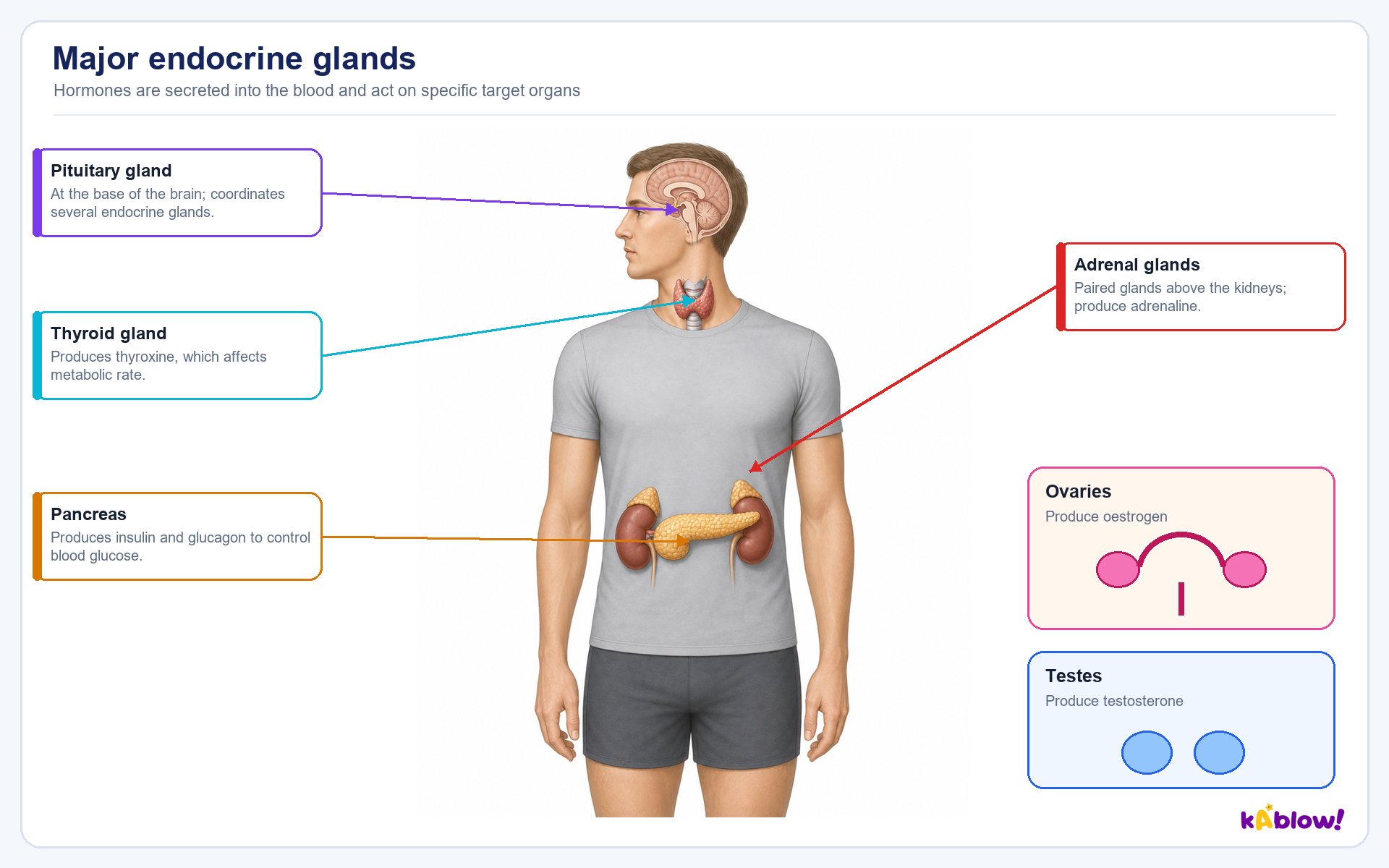
Control Mechanisms: Endocrine System
- A hormone is a chemical messenger produced by an endocrine gland and carried by the blood.
- Hormones alter the activity of specific target organs and are used for functions that do not need instant responses.
- Control of the endocrine system is primarily by the hypothalamus and the pituitary gland.
- The hypothalamus monitors blood and releases hormones or stimulates the pituitary gland to release hormones.
- Hypothalamus functions include regulating body temperature, osmoregulation (releasing ADH), regulating digestive activity, and controlling endocrine functions.
- The pituitary gland produces a range of hormones; the anterior pituitary produces and releases hormones, while the posterior pituitary stores and releases hormones made by the hypothalamus (e.g. ADH and oxytocin).
Feedback Control of Heart Rate
- The medulla in the brain is the cardioregulatory centre, made of the acceleratory centre and the inhibitory centre.
- Both centres connect to the sinoatrial node (SAN) by nerves of the autonomic nervous system, which is self-controlling.
- Activation of the acceleratory centre sends impulses along sympathetic neurones to the SAN; norepinephrine is secreted, increasing heart rate.
- Activation of the inhibitory centre sends impulses along parasympathetic neurones to the SAN; acetylcholine is secreted, reducing heart rate.
- Chemoreceptors detect changes in blood pH, oxygen and carbon dioxide levels; baroreceptors monitor blood pressure changes.
- These receptors are located in the aorta and carotid arteries and send impulses to the acceleratory and inhibitory centres.
- Lower frequency impulses activate the inhibitory centre to slow heart rate and stroke volume; higher frequency impulses activate the acceleratory centre to speed them up.
Monitoring heart rate
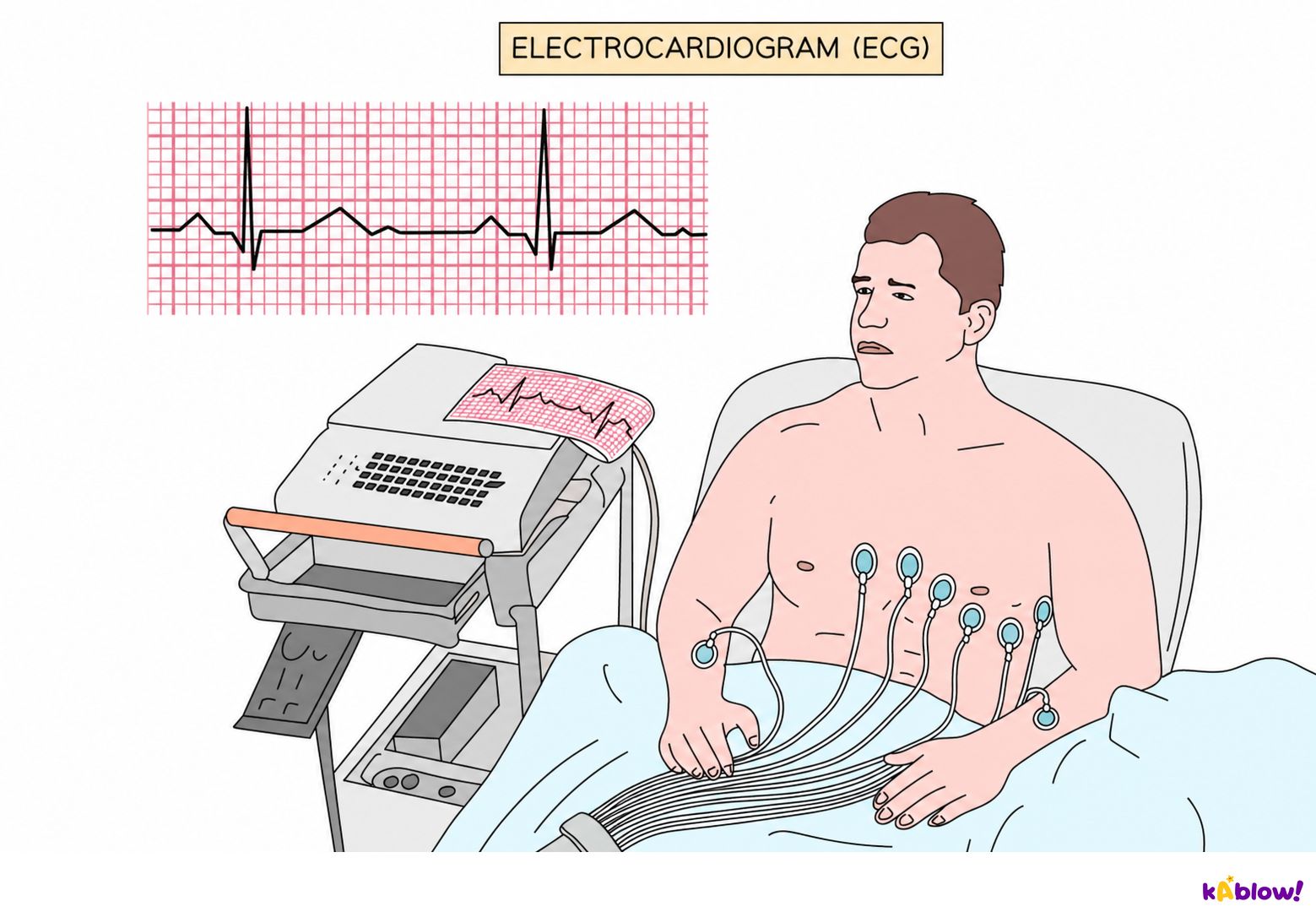
Feedback Control of Ventilation and Peristalsis
- Respiratory centres in the medulla control ventilation rate; at rest, action potentials travel at random to the diaphragm and intercostal muscles.
- During exercise, higher carbon dioxide levels are produced; carbon dioxide is transported as hydrogen carbonate ions (~85%), dissolved in plasma (~5%), and bound to haemoglobin (~10%).
- In red blood cells, carbon dioxide combines with water to form carbonic acid, catalysed by carbonic anhydrase.
- Carbonic acid dissociates into hydrogen ions and hydrogen carbonate ions; hydrogen ions lower blood pH, detected by chemoreceptors in the medulla.
- Action potentials are sent at a higher rate to the diaphragm and intercostal muscles, increasing ventilation; this is an example of negative feedback.
- Peristalsis is a series of muscle contractions in the walls of the oesophagus or small intestine that forces the bolus along the alimentary canal.
- It is controlled unconsciously by the enteric nervous system (ENS), a web of sensory, relay and motor neurones in the alimentary canal.
- Stretch receptors detect the bolus; relay neurones synapse with two motor neurones – one excites longitudinal muscles behind the bolus to contract, the other inhibits circular muscles ahead to relax.
- Circular muscles contract behind the bolus to reduce lumen diameter, preventing food moving backwards.
ஸ்லைடுகள்
Sign up free to view the lesson slides
Step through every slide for this topic — plus flashcards and revision notes — with a free account.
பயிற்சி கேள்விகள்
இலவச முன்னோட்டம் — 60-இல் 8 கேள்விகள். அனைத்தையும் பார்க்க பதிவு செய்யவும்.
1.Which row of the table correctly describes examples of unconscious and conscious processes?
Easy- AConscious control: Detecting taste on the tongue; Unconscious control: Detecting information on balance
- BConscious control: Detecting temperature changes of the skin; Unconscious control: Sensing sound vibrations in the inner ear
- CConscious control: Detecting the water content of the blood; Unconscious control: Sensing pressure changes of the blood
- DConscious control: Sensing sound vibrations in the inner ear; Unconscious control: Detecting taste on the tongue
2.Which statement best describes the action of peristalsis in the alimentary canal?
Easy- AStriated muscles contract to move the partially digested food in a wave-like movement along the alimentary canal.
- BCircular muscles contract behind the partially digested food and the longitudinal muscles shorten.
- CSkeletal muscle contractions force the food through the alimentary canal with valves preventing backflow.
- DLongitudinal muscles contract behind the partially digested food and the circular muscles shorten.
3.Which statement accurately describes the raising of heart rate by the cardioregulatory centre of the brain?
Medium- ALow blood pressure, high blood oxygen concentration, and high blood pH result in a nerve signal sent by the acceleratory centre to speed up heart rate.
- BLow blood pressure, low blood oxygen concentration, and low blood pH result in a nerve signal sent by the acceleratory centre to speed up heart rate.
- CHigh blood pressure, high blood oxygen concentration, and high blood pH result in a nerve signal sent by the acceleratory centre to speed up heart rate.
- DHigh blood pressure, low blood oxygen concentration, and low blood pH result in a nerve signal sent by the acceleratory centre to speed up heart rate.
4.A person is admitted to hospital after suffering a stroke. It was found that the suprachiasmatic nucleus in the hypothalamus of the brain was damaged by the event. This resulted in the pineal gland secreting less melatonin into the bloodstream. Which of the following changes would be observed in the patient?
Medium- AIncreased thirst and more frequent urination.
- BDisrupted sleep patterns and increased irritability.
- CConstantly feeling cold and weight gain.
- DFatigue and forgetfulness.
5.The spinal cord is an integration centre for unconscious processes.
EasyTrue or false?
6.Place the events of a pain reflex arc in the correct order.
Medium- Nocireceptor detects stimulus
- Sensory neurone transmits impulse to spinal cord
- Relay neurone in spinal cord processes impulse
- Motor neurone carries impulse to effector muscle
- Muscle contracts and hand pulls away
7.Match each brain region or gland with its function.
Medium- Cerebral cortex
- Cerebellum
- Medulla
- Hypothalamus
- Pituitary gland
- Higher-order processes such as intelligence, memory, consciousness and personality
- Balance, muscle coordination and movement
- Unconscious activities such as heart rate and breathing
- Regulating body temperature and controlling the pituitary gland
- Producing many hormones including FSH and LH
8.Which of the following statements about melatonin are correct? (select all that apply)
Medium- AMelatonin secretion increases in the evening in response to darkness.
- BMelatonin is secreted by the pineal gland.
- CMelatonin is secreted by the hypothalamus.
- DIncreasing melatonin levels prepare the body for waking up and staying awake during the day.
- EMelatonin levels vary during a 24-hour cycle known as a circadian rhythm.
Unlock all 60 questions & more
இந்த தலைப்பிற்கான ஒவ்வொரு கேள்வியையும், ஸ்லைடுகளையும், ஃப்ளாஷ் கார்டுகளையும் மற்றும் திருப்புதல் குறிப்புகளையும் பார்க்க இலவச கணக்கை உருவாக்கவும்.