Protein Synthesis
விளையாடிக் கற்றுக்கொள்ளுங்கள்
ஆற்றல் சம்பாதிக்க இந்த கேள்விகளுக்குப் பதிலளியுங்கள், பின்னர் மீன் பிடித்து ஆராயுங்கள். கணக்கு தேவையில்லை.
பாட குறிப்புகள்
Transcription: Making mRNA
- Transcription is the first stage of protein synthesis, occurring in the nucleus.
- Part of the DNA molecule unwinds and hydrogen bonds between complementary bases break, exposing the gene to be transcribed.
- Free RNA nucleotides pair with complementary bases on the template strand of DNA.
- RNA polymerase bonds the sugar-phosphate groups of RNA nucleotides to form the mRNA backbone.
- The mRNA molecule is a single-stranded copy of the gene, complementary to the template strand.
- After transcription, hydrogen bonds between mRNA and DNA break, and the DNA double helix re-forms.
- mRNA leaves the nucleus through a nuclear pore and moves into the cytoplasm.
- DNA is too large to leave the nucleus, so mRNA acts as a messenger carrying the genetic code.
Protein synthesis
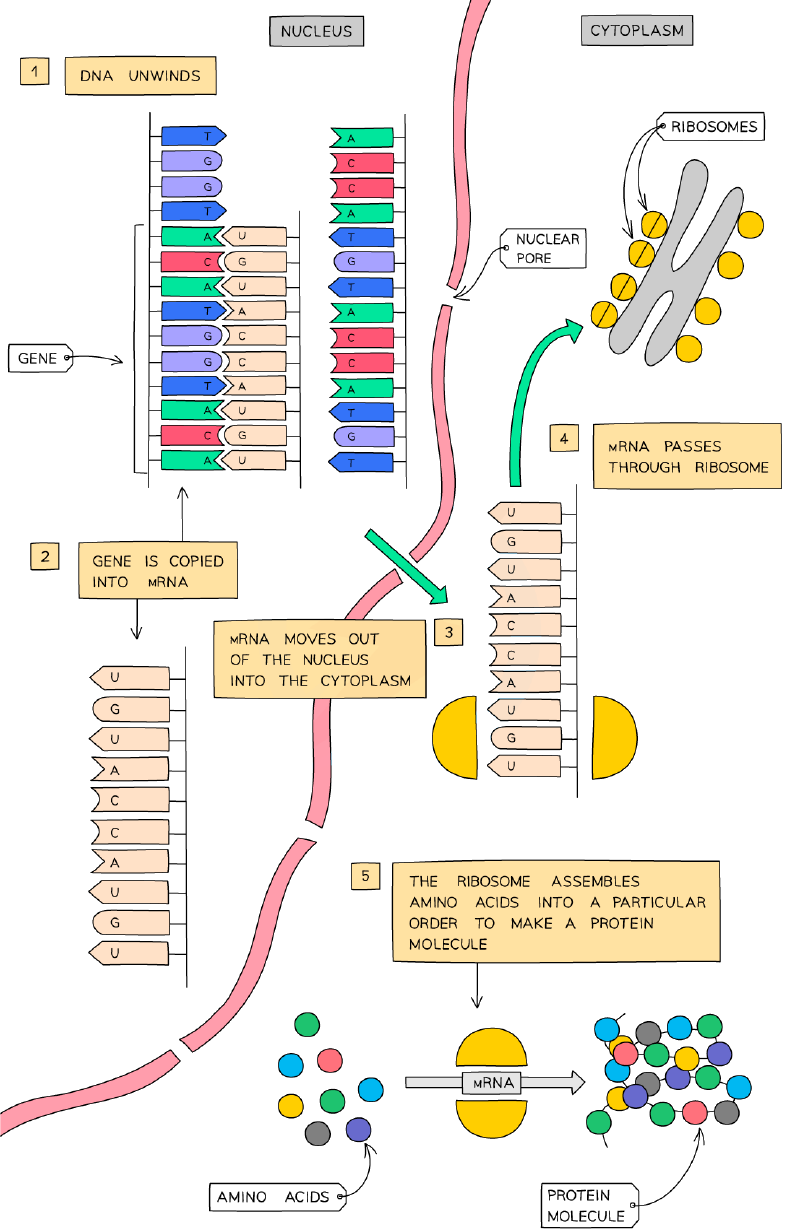
Complementary Base Pairing in Transcription
- In RNA, adenine pairs with uracil (not thymine), and cytosine pairs with guanine.
- The DNA strand that carries the genetic code is the coding strand; the opposite strand is the template strand.
- The template strand is transcribed to produce mRNA, which is complementary to it.
- Example: DNA template strand TAC GGA AGA CTT GGG produces mRNA AUG CCU UCU GAA CCC.
- RNA polymerase is the enzyme for transcription; DNA polymerase is for DNA replication — do not confuse them.
Translation: Synthesising Polypeptides
- Translation takes place in the cytoplasm and uses the genetic code on mRNA to build a polypeptide.
- mRNA attaches to a ribosome, which is made of a large and small subunit and ribosomal RNA (rRNA).
- The mRNA binds to the small subunit; two tRNA molecules can bind to the large subunit simultaneously.
- tRNA molecules carry specific amino acids to the mRNA on the ribosome.
- The anticodon on tRNA pairs with a complementary codon on mRNA.
- A peptide bond forms by condensation between adjacent amino acids, requiring ATP.
- The ribosome moves along the mRNA one codon at a time until a stop codon is reached.
- The completed amino acid chain is released from the ribosome and forms the final polypeptide.
Codons, Anticodons and tRNA Structure
- A triplet is a sequence of three DNA bases that codes for a specific amino acid.
- A codon is a sequence of three mRNA bases that codes for a specific amino acid.
- An anticodon is a sequence of three tRNA bases complementary to a codon.
- The anticodon is located at the bottom of the tRNA molecule and consists of three exposed RNA bases.
- tRNA molecules bind to their specific amino acids before participating in translation.
- tRNA-activating enzymes attach amino acids to their corresponding tRNA molecules.
- Complementary base pairing between mRNA codons and tRNA anticodons ensures the correct amino acid sequence.
- Example: if an mRNA codon is CAG, the complementary tRNA anticodon is GUC.
Features of the Genetic Code
- The genetic code is a triplet code: each sequence of three bases codes for one amino acid.
- There are 20 different amino acids used to make proteins.
- The code is non-overlapping: each base is read only once as part of a codon.
- There are 64 possible codons (4³) but only 20 amino acids, so the code is degenerate (multiple codons can code for the same amino acid).
- The genetic code is universal: almost all organisms use the same code, enabling genetic engineering.
- Some triplets code for start (TAC – methionine) and stop signals, marking where genes begin and end.
- Degeneracy can limit the effect of mutations because a change in the third base may still code for the same amino acid.
Deducing Amino Acid Sequences
- To deduce an amino acid sequence from a DNA coding strand, first work out the template strand using complementary base pairing (A-T, C-G).
- Then work out the mRNA codons, complementary to the template strand (A-U, C-G).
- Use an mRNA codons and amino acids table to identify the amino acid for each codon.
- Example: DNA coding strand TTC GAG CAT TAC GCC gives mRNA UUC GAG CAU UAC GCC, which codes for Phe-Glu-His-Tyr-Ala.
- The number of amino acids can be calculated by dividing the number of mRNA nucleotides by 3.
Gene Expression and DNA Stability
- The human genome contains approximately 20,000 protein-coding genes.
- Not every protein is needed in every cell; gene expression switches genes on or off.
- Genes that are expressed are 'switched on' and undergo transcription and translation.
- Genes that are not expressed are 'switched off' or silenced.
- Transcription is a key stage at which gene expression can be controlled.
- DNA is very stable due to hydrogen bonds between bases and strong phosphodiester bonds between nucleotides.
- This stability allows DNA strands to act as reliable templates over generations of cell replication.
Protein Structure and Mutations
- A gene mutation is a change in the base sequence of DNA, which may result in a new allele.
- Mutations occur randomly and are copying errors during DNA replication in S phase of interphase.
- Mutations in body cells are not inherited; mutations in gametes are inherited by offspring.
- Most mutations are harmful or neutral, but some can be beneficial.
- A point mutation alters one base and can change a single amino acid in the polypeptide.
- Sickle cell disease is caused by a point mutation: DNA triplet GAG changes to GTG on the coding strand.
- This results in mRNA codon GUG instead of GAG, so valine replaces glutamic acid at position 6 of the β-globin chain.
- The altered haemoglobin (HbS) distorts red blood cells into a sickle shape, reducing oxygen capacity and blocking capillaries.
The sickle cell mutation
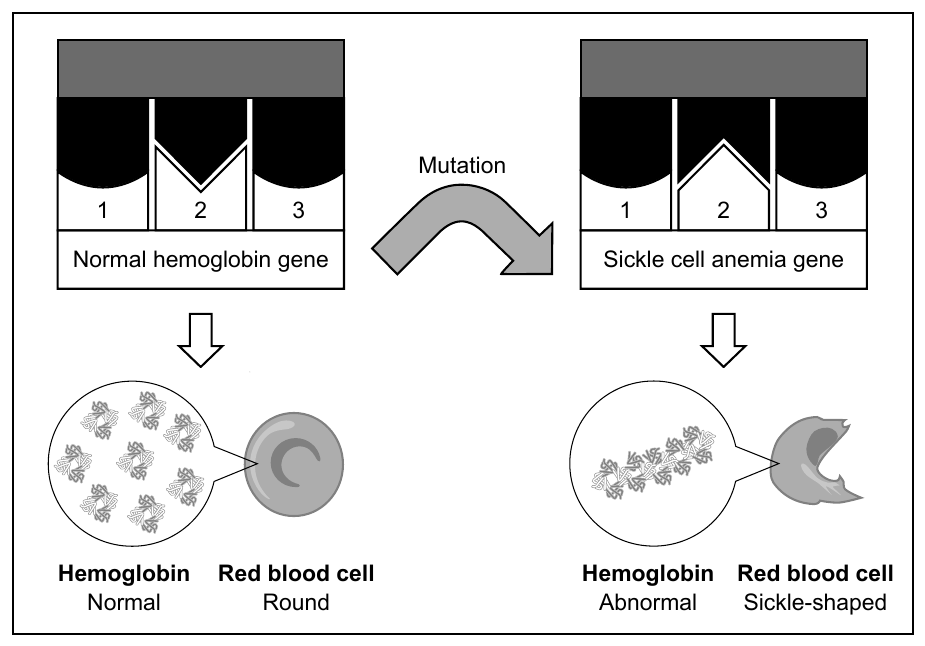
Effects of Sickle Cell Mutation
- Sickle-shaped red blood cells have a limited oxygen-carrying capacity.
- They can block capillaries and limit the flow of normal red blood cells.
- People with sickle cell anaemia suffer from acute pain, fatigue and anaemia.
- There is a correlation between the global distribution of sickle cell disease and malaria.
- In areas with high malaria incidence, the sickle cell allele is more frequent, likely due to increased resistance to the malaria parasite in heterozygotes.
ஸ்லைடுகள்
Sign up free to view the lesson slides
Step through every slide for this topic — plus flashcards and revision notes — with a free account.
பயிற்சி கேள்விகள்
இலவச முன்னோட்டம் — 64-இல் 8 கேள்விகள். அனைத்தையும் பார்க்க பதிவு செய்யவும்.
1.In which part of the cell does transcription occur?
Easy- ANucleus
- BCytoplasm
- CRibosome
- DMitochondria
2.Which enzyme is responsible for catalysing the formation of the sugar-phosphate backbone of mRNA during transcription?
Easy- ADNA polymerase
- BRNA polymerase
- CtRNA-activating enzyme
- DHelicase
3.Which of the following correctly describes the role of the ribosome in protein synthesis?
Easy- AIt catalyses the formation of peptide bonds between amino acids
- BIt transcribes DNA into mRNA
- CIt carries amino acids to the mRNA
- DIt unwinds the DNA double helix
4.A tRNA molecule has the anticodon UAC. Which mRNA codon will it pair with?
Medium- AAUG
- BTAC
- CUAC
- DATG
5.Which of the following statements about the genetic code are correct? (select all that apply)
Medium- AIt is degenerate, meaning multiple codons can code for the same amino acid.
- BIt is non-overlapping, meaning each base is read only once.
- CIt is universal, meaning almost all organisms use the same code.
- DIt is overlapping, meaning each base is read multiple times.
- EIt contains 64 codons, each coding for a different amino acid.
6.The genetic code is degenerate, meaning that a single amino acid can be coded for by more than one codon.
EasyTrue or false?
7.During translation, the mRNA molecule is used as a template to synthesise a polypeptide chain.
EasyTrue or false?
8.Match each term with its correct definition.
Medium- Codon
- Anticodon
- Triplet
- A sequence of three mRNA bases that codes for a specific amino acid
- A sequence of three tRNA bases that are complementary to a codon
- A sequence of three DNA bases that codes for a specific amino acid
Unlock all 64 questions & more
இந்த தலைப்பிற்கான ஒவ்வொரு கேள்வியையும், ஸ்லைடுகளையும், ஃப்ளாஷ் கார்டுகளையும் மற்றும் திருப்புதல் குறிப்புகளையும் பார்க்க இலவச கணக்கை உருவாக்கவும்.