Electron Pair Sharing Reactions
விளையாடிக் கற்றுக்கொள்ளுங்கள்
ஆற்றல் சம்பாதிக்க இந்த கேள்விகளுக்குப் பதிலளியுங்கள், பின்னர் மீன் பிடித்து ஆராயுங்கள். கணக்கு தேவையில்லை.
பாட குறிப்புகள்
Nucleophiles and Nucleophilic Substitution
- A nucleophile is an electron-rich species that donates a pair of electrons; it is attracted to positively charged species.
- Neutral nucleophiles include H₂O, NH₃, ROH and RNH₂; charged nucleophiles include OH⁻, Cl⁻, CN⁻ and carbanions (R⁻).
- OH⁻ is a stronger nucleophile than H₂O because it carries a full negative charge, making its lone pair more readily available.
- In nucleophilic substitution, a nucleophile attacks a carbon atom carrying a partial positive charge (δ⁺), replacing an atom with a partial negative charge (δ⁻).
- Halogenoalkanes undergo nucleophilic substitution because the polar C–X bond creates a δ⁺ carbon that is susceptible to attack.
- Hydrolysis of a halogenoalkane uses aqueous NaOH or KOH with ethanol, warmed, to produce an alcohol; the halide ion is the leaving group.
- When the nucleophile is neutral (e.g. H₂O), the initial product is positive and is then deprotonated to give a neutral product.
Heterolytic Fission
- Heterolytic fission is the breaking of a covalent bond so that both bonding electrons are taken by the more electronegative atom.
- It produces a negative ion (gains both electrons) and a positive ion (left with none).
- In mechanism diagrams, a curly double-headed arrow shows the movement of a pair of electrons from the bond to one atom.
- For example, when H–Cl breaks heterolytically, the electrons move to chlorine forming Cl⁻ and leaving H⁺.
- The negative ion is electron-rich and acts as a nucleophile; the positive ion is electron-deficient and acts as an electrophile.
- A nucleophile donating a pair of electrons to an electrophile forms a coordinate covalent bond — the reverse of heterolytic bond breaking.
Electrophilic Addition Reactions
- An electrophile is an electron-deficient species that accepts a pair of electrons to form a covalent bond; it has a full or partial positive charge.
- Neutral electrophiles include HX, X₂, H₂O and RX; positively charged electrophiles include H⁺, NO₂⁺, NO⁺ and carbocations (R⁺).
- Electrophilic addition is the reaction of an electrophile with a C=C double bond, which is an area of high electron density.
- The C=C bond consists of one σ-bond and a weaker π-bond; the π-bond breaks and is replaced by stronger σ-bonds.
- Atoms around the C=C bond are planar with a bond angle of 120°; alkenes are more reactive than saturated alkanes.
- Hydration: alkenes react with steam at 300 °C and 60 atm with an acid catalyst (H₂SO₄ or H₃PO₄) to form alcohols.
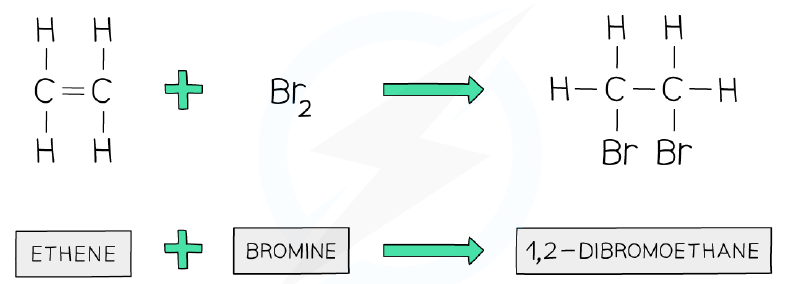
- Halogenation: alkenes react readily with halogens at room temperature to form dihalogenoalkanes; bromine water is decolourised by a C=C bond.
- Hydrohalogenation: alkenes react rapidly with HX at room temperature; rate order is HI > HBr > HCl because weaker H–X bonds break more easily.
Addition across a carbon–carbon double bond
Lewis Acids and Bases (HL)
- A Lewis acid is a lone pair acceptor; a Lewis base is a lone pair donor.
- Lewis theory is broader than Brønsted–Lowry theory because it includes reactions that do not involve proton transfer.
- A coordinate covalent bond forms when a Lewis base donates a lone pair to a Lewis acid: A + :B → A←:B.
- OH⁻ and NH₃ act as both Lewis bases (donate a lone pair) and Brønsted–Lowry bases (accept a proton).
- A Brønsted–Lowry acid donates H⁺; H⁺ is also a Lewis acid because it accepts a lone pair.
- An electrophile is a Lewis acid and a nucleophile is a Lewis base.
- Water is amphoteric — it can act as both a Lewis acid and a Lewis base depending on the situation.
Lewis Acid–Base Reactions and Coordination Bonds (HL)
- In NH₃ + BF₃ → NH₃BF₃, BF₃ is the Lewis acid and NH₃ is the Lewis base; a coordinate bond forms with no proton transfer.
- Boron in BF₃ forms three sp² hybridised orbitals, leaving a vacant 2p orbital that accepts a lone pair from nitrogen.
- In hexaaquacopper(II), Cu²⁺ is the Lewis acid (accepts a lone pair) and the water molecules are Lewis bases (donate a lone pair).
- A ligand is a molecule or ion that forms a coordinate bond with a transition metal by donating a lone pair; ligands are Lewis bases and nucleophiles.
- Monodentate ligands form one coordinate bond (e.g. H₂O, NH₃, Cl⁻, CN⁻, OH⁻); bidentate ligands form two (e.g. en, ox); multidentate form more (e.g. EDTA, hexadentate).
- The coordination number is the number of coordinate bonds to the central metal ion; common geometries are linear (2), tetrahedral/square planar (4) and octahedral (6).
- The overall charge on a complex ion is the sum of the oxidation states of all species present; neutral ligands contribute zero charge.
SN1 and SN2 Mechanisms in Halogenoalkanes (HL)
- SN1 occurs in tertiary halogenoalkanes: step 1 is slow heterolytic C–X bond breaking to form a tertiary carbocation; step 2 is nucleophile attack.
- The rate equation for SN1 is rate = k[halogenoalkane]; it is unimolecular and the rate-determining step depends on one reagent.
- SN2 occurs in primary halogenoalkanes: a one-step reaction where the nucleophile attacks the δ⁺ carbon from the opposite side of the leaving group.
- The rate equation for SN2 is rate = k[halogenoalkane][nucleophile]; it is bimolecular and no intermediate is formed.
- In SN2, the transition state has partial bonds to both the incoming nucleophile and the leaving group.
- SN2 causes inversion of configuration (umbrella analogy) because the nucleophile attacks from the backside due to steric hindrance.
- In SN1, heterolytic fission produces a cation and an anion; homolytic fission (single-headed arrow) produces two free radicals.
Relative Rates of Nucleophilic Substitution (HL)
- Three factors affect the rate: the nature of the nucleophile, the halogen (leaving group) and the class of halogenoalkane.
- Nucleophile strength: negatively charged species are stronger than neutral; lower electronegativity gives a stronger nucleophile. Order: CN⁻ > OH⁻ > NH₃ > H₂O.
- The weaker the C–X bond, the faster the reaction. Bond energies: C–F (492) > C–Cl (324) > C–Br (285) > C–I (228 kJ mol⁻¹).
- Iodoalkanes are the most reactive and fluoroalkanes the least reactive because C–I is weakest and C–F is strongest.
- Aqueous silver nitrate detects halide ions: Cl⁻ gives a white precipitate (AgCl), Br⁻ cream (AgBr), I⁻ yellow (AgI); F⁻ gives no precipitate (AgF is soluble).
- Primary halogenoalkanes undergo SN2; tertiary undergo SN1; secondary can undergo either depending on solvent, temperature and nucleophile.
- Carbocation stability increases with more alkyl groups due to the positive inductive effect: tertiary > secondary > primary.
Mechanisms of Electrophilic Addition (HL)
- Electrophilic addition involves an electrophile (Lewis acid) adding across the C=C bond; the π bond breaks to form a single C–C bond and two new σ-bonds.
- Addition of H₂O: water is a weak electrophile; H₃O⁺ acts as the electrophile, a carbocation forms, then water attacks to give a protonated alcohol that deprotonates.
- Addition of HX: HBr is permanently polar (δ⁺ H, δ⁻ Br); the π electrons attack the δ⁺ hydrogen, forming a carbocation and a bromide ion.
- Addition of X₂: Br₂ is non-polar but becomes polarised by the high electron density of the C=C bond, inducing a temporary dipole.
- Curly arrows must be double-headed, start from a lone pair or region of high electron density, and point towards a δ⁺ atom or positive charge.
- The key difference: hydrogen halides are permanently polar, whereas halogens rely on temporary induced dipoles.
Addition to Unsymmetrical Alkenes and Markovnikov's Rule (HL)
- A carbocation is a positively charged carbon with only three covalent bonds; types are primary, secondary and tertiary.
- Alkyl groups are electron-donating via the inductive effect, pushing electron density towards the positively charged carbon and stabilising it.
- Tertiary carbocations are most stable (three alkyl groups); carbocations act as electrophiles due to their positive charge.
- Markovnikov's rule: in electrophilic addition of HX to an alkene, the halogen bonds to the more substituted carbon atom.
- For molecules with two different halogens (e.g. ICl), the more electronegative halogen bonds to the more substituted carbon.
- The major product forms via the more stable carbocation intermediate; the minor product forms via the less stable one.
- Carbocation stability order: tertiary > secondary > primary; the major product usually forms via a secondary or tertiary carbocation.
Electrophilic Substitution in Benzene (HL)
- Benzene undergoes electrophilic substitution, unlike alkenes which undergo electrophilic addition, because the delocalised π system is extremely stable.
- The three steps are: generation of an electrophile, electrophilic attack, and regeneration of aromaticity.
- In nitration, the electrophile is the nitronium ion, NO₂⁺, produced in situ from concentrated HNO₃ and concentrated H₂SO₄ at 25–60 °C.
- In electrophilic attack, a pair of π electrons from benzene forms a covalent bond with the electrophile, disrupting aromaticity and creating a positively charged intermediate.
- Aromaticity is restored by heterolytic cleavage of the C–H bond, with the electrons returning to the benzene π bonding system.
- Nitration replaces a hydrogen atom on the arene with a nitro group; the electrophile can be a positive ion or the positive end of a polar molecule.
ஸ்லைடுகள்
Sign up free to view the lesson slides
Step through every slide for this topic — plus flashcards and revision notes — with a free account.
பயிற்சி கேள்விகள்
இலவச முன்னோட்டம் — 55-இல் 8 கேள்விகள். அனைத்தையும் பார்க்க பதிவு செய்யவும்.
1.Which of these compounds would act as a nucleophile?
Easy- AC2H6
- BH+
- COH-
- DAl
2.Ethene reacts with steam in the presence of sulfuric acid: C2H4 + H2O → CH3CH2OH. What type of reaction is this?
Easy- Aacid / base
- Baddition
- Chydrolysis
- Dsubstitution
3.Which reaction is an example of nucleophilic substitution?
Easy- AC6H6 + Br2 → C6H5Br + HBr
- BCH2=CH2 + HBr → CH3CH2Br
- CC3H7Br + H2O → C3H7OH + HBr
- DC2H6 + Br2 → C2H5Br + HBr
4.Bromomethane, CH3Br, can be made by reacting methanol with hydrogen bromide: CH3OH + HBr → CH3Br + H2O. What type of reaction is this?
Easy- Acondensation
- Belectrophilic substitution
- Cfree radical substitution
- Dnucleophilic substitution
5.What reagents and conditions are needed to convert but-2-ene into butane?
Easy- AConcentrated sulfuric acid, steam, 300 °C
- BHydrogen gas, Ni catalyst, 150 °C
- CAcidified potassium dichromate, heating under reflux
- DHydrogen bromide, room temperature
6.Which species can not act as a ligand?
Easy- AH2O
- BNH4+
- CCl-
- DOH-
7.Which definition of a Lewis acid is correct?
Easy- AElectron pair donor
- BElectron pair acceptor
- CProton donor
- DProton acceptor
8.Which of the following best describes ammonia, NH3, in the equation BF3 + NH3 → BF3NH3?
Medium- ALewis acid
- BLewis base
- CCoordinate bond
- DBrønsted-Lowry acid
Unlock all 55 questions & more
இந்த தலைப்பிற்கான ஒவ்வொரு கேள்வியையும், ஸ்லைடுகளையும், ஃப்ளாஷ் கார்டுகளையும் மற்றும் திருப்புதல் குறிப்புகளையும் பார்க்க இலவச கணக்கை உருவாக்கவும்.