Energy From Fuels
விளையாடிக் கற்றுக்கொள்ளுங்கள்
ஆற்றல் சம்பாதிக்க இந்த கேள்விகளுக்குப் பதிலளியுங்கள், பின்னர் மீன் பிடித்து ஆராயுங்கள். கணக்கு தேவையில்லை.
பாட குறிப்புகள்
Combustion Reactions
- Combustion is a rapid, exothermic reaction involving a fuel, oxygen (it is a type of oxidation) and an ignition source such as a spark, flame or heat build-up.
- It is commonly called burning and releases heat and light.
- There are two main types: complete combustion (with sufficient oxygen) and incomplete combustion (limited oxygen).
- All metals oxidise, but not all combust; some only burn if finely divided as powders or filings with a high surface area.
- Less reactive metals such as copper do not combust but do oxidise, forming black copper oxide on heating.
- More reactive metals such as magnesium combust in air with a bright white flame: 2Mg (s) + O₂ (g) → 2MgO (s).
- The general word equation for metal combustion is: metal + oxygen → metal oxide; the oxides of s-block metals are ionic and basic (pH > 7 in water).
- Many non-metals form covalent oxides that are usually acidic (pH < 7 in water); e.g. sulfur burns with a blue flame: S (s) + O₂ (g) → SO₂ (g).
Complete Combustion of Organic Compounds
- Organic fuels such as hydrocarbons (especially alkanes) and alcohols release large amounts of energy when combusted.
- They do not spontaneously combust because their reactions have a high activation energy, making them easy and safe to transport and store.
- In excess oxygen, complete combustion occurs: all carbon and hydrogen are oxidised, giving carbon dioxide and water.
- Word equation: fuel + oxygen → carbon dioxide + water.
- Example: CH₄ (g) + 2O₂ (g) → CO₂ (g) + 2H₂O (l).
- Alcohols also undergo complete combustion: C₂H₅OH (l) + 3O₂ (g) → 2CO₂ (g) + 3H₂O (l).
- When balancing alcohol combustion equations, remember to count the oxygen atom already present in the alcohol.
- Lower alcohols like ethanol burn with an almost invisible flame; blending ethanol with gasoline or diesel increases energy density and makes flames more visible for safety.
Incomplete Combustion
- Incomplete combustion occurs when oxygen is limited; it still produces water from the hydrogen in the fuel.
- Carbon is not fully oxidised, so the products include carbon monoxide (CO) or carbon (C).
- It is common in car engines and faulty boilers where the oxygen supply is restricted.
- In a Bunsen burner, complete combustion gives a blue, non-luminous flame; incomplete combustion gives a yellow, luminous flame.
- With limited oxygen, CO forms: e.g. C₃H₈ (l) + 3½O₂ (g) → 3CO (g) + 4H₂O (l).
- Carbon monoxide is colourless and odourless, making it hard to detect without a sensor.
- CO binds irreversibly to haemoglobin, preventing oxygen transport; this causes dizziness, loss of consciousness and potentially death.
- With very limited oxygen, carbon is produced as soot; a yellow, sooty flame signals incomplete combustion, and compounds with higher carbon percentage produce more soot.
Fossil Fuels and Carbon Dioxide Production
- Fossil fuels include coal, oil and natural gas; they are hydrocarbons formed from buried dead plants and animals millions of years ago.
- They are non-renewable (finite) and cannot be replaced quickly once used.
- Advantages: coal is cheap and widely available; oil has high energy density and is easily processed by fractional distillation and cracking; natural gas is the cheapest and burns relatively cleanly with a blue flame.
- Disadvantages: all are finite; combustion releases CO₂ (global warming), SO₂ (acid rain), particulates (global dimming) and CO; mining and drilling cause habitat destruction and safety risks.
- Specific energy is a measure of the energy stored in a substance; different fuels release different amounts of energy when combusted.
- As the hydrocarbon chain length increases, carbon content increases, so more CO₂ and CO/C are produced, London dispersion forces are stronger (less volatile), and less energy is released per unit mass.
- Longer hydrocarbons are also more likely to undergo incomplete combustion.
- Methane releases the most energy per unit mass of fuel among the straight-chain alkanes.
Carbon Dioxide Levels and the Greenhouse Effect
- Atmospheric CO₂ is rising due to human activities: combustion of fossil fuels (electricity generation, transport, construction), deforestation and livestock farming.
- The main driver is the combustion of fossil fuels, which releases carbon stored for millions of years.
- Stations such as the Mauna Loa Observatory take quantitative measurements; CO₂ records date from 1958 and methane from 1984.
- CO₂ levels constantly change due to seasonal fluctuations in photosynthesis, which removes CO₂ from the atmosphere.
- Main greenhouse gases: carbon dioxide (CO₂), methane (CH₄), nitrous oxides (NOₓ) and water vapour (H₂O).
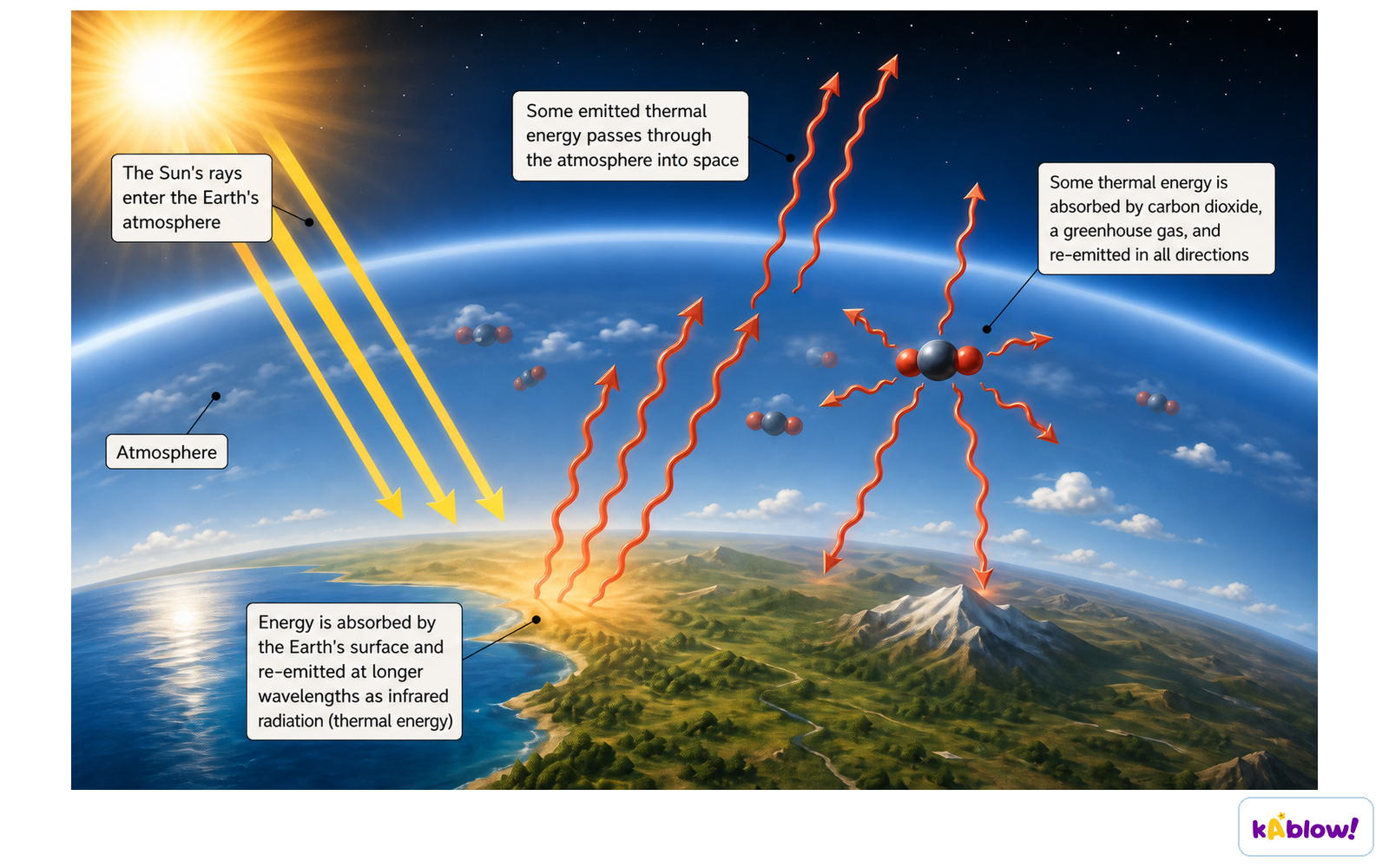
- The sun emits shortwave radiation; Earth absorbs it and re-emits longwave infrared radiation, which greenhouse gases absorb and re-radiate in all directions, trapping heat.
- This natural warming is the greenhouse effect; without it Earth's temperature would swing wildly, like on Mars.
- Human activities increase greenhouse gas levels, trapping more heat and causing the enhanced greenhouse effect and global warming.
The greenhouse effect
Biofuels
- Renewable resources will not run out in the foreseeable future and can be replaced over a short period; non-renewable resources are finite and cannot be replaced quickly.
- The three main biofuels are bioethanol, biodiesel and biogas, all made from organic compounds produced by biological carbon fixation.
- Bioethanol: plants absorb CO₂ by photosynthesis (6CO₂ + 6H₂O → C₆H₁₂O₆ + 6O₂), then glucose is converted to ethanol by fermentation; it can be carbon neutral because CO₂ absorbed equals CO₂ released on burning.
- Biodiesel is made from renewable vegetable oils by transesterification with methanol, catalysed by acid or alkali (alkaline catalysts like NaOH or KOH are more common); excess methanol shifts the reversible equilibrium towards products, giving up to 98% yield.
- Biogas is made when organic matter is broken down by microorganisms in the absence of oxygen (anaerobic conditions); it is mostly methane and carbon dioxide.
- Carbohydrates such as glucose produce biogas with 50.0% methane: C₆H₁₂O₆ (s) → 3CO₂ (g) + 3CH₄ (g).
- Advantages of biofuels: carbon neutral, renewable and sustainable if crops are replanted; reduce greenhouse gas emissions and landfill waste; can generate income and jobs.
- Disadvantages: high conversion and harvesting costs, land-use conflict with food crops, deforestation, soil nutrient depletion, fertiliser and pesticide use, and generally lower specific energy than fossil fuels.
Fuel Cells
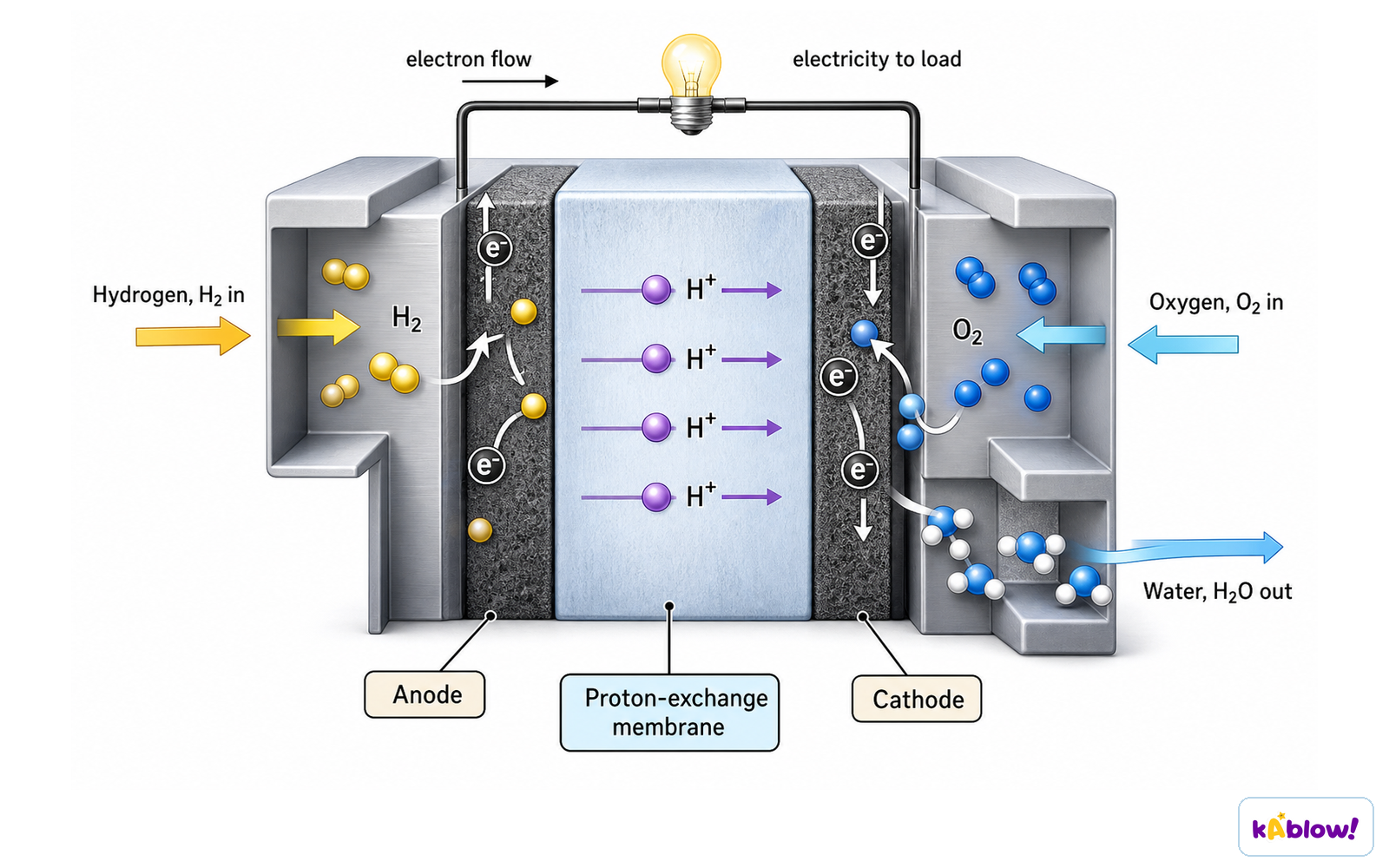
- A fuel cell is an electrochemical cell in which a fuel donates electrons at one electrode and oxygen gains electrons at the other.
- As fuel enters the cell it is oxidised, setting up a potential difference (voltage); different electrolytes and fuels give different types of fuel cell.
- The hydrogen-oxygen fuel cell has separate inlets for hydrogen and oxygen, an outlet for water, an electrolyte of aqueous sodium hydroxide, and a semi-permeable membrane separating the gases.
- Half-equations (alkaline): 2H₂ (g) + 4OH⁻ (aq) → 4H₂O (l) + 4e⁻ (Eθ = –0.83 V) and O₂ (g) + 2H₂O + 4e⁻ → 4OH⁻ (aq) (Eθ = +0.40 V).
- Overall: 2H₂ (g) + O₂ (g) → 2H₂O (l) with Eθ = +1.23 V.
- Advantages of hydrogen fuel cells: only product is water (environmentally friendly), reaction occurs at room temperature avoiding combustion, no NOₓ produced, and the water can supplement drinking water for astronauts.
- Disadvantages: hydrogen is highly flammable, needs heavy thick-walled storage tanks, is mostly sourced from fossil fuels, and has low energy density by volume.
- Fuel cells operate continuously as long as fuel and oxidant are supplied; the energy is not stored in the cell, so they do not need recharging.
A hydrogen–oxygen fuel cell
Methanol Fuel Cells
- The methanol fuel cell works like the hydrogen fuel cell, but the fuel (source of H⁺ ions) is methanol rather than hydrogen.
- It consists of separate inlets for methanol and oxygen, outlets for carbon dioxide and water, and an electrolyte typically a proton exchange membrane.
- Half-equations: CH₃OH (aq) + H₂O (l) → CO₂ (g) + 6H⁺ (aq) + 6e⁻ and O₂ (g) + 4H⁺ (aq) + 4e⁻ → 2H₂O (l).
- Overall equation: CH₃OH (aq) + 1.5O₂ (g) → CO₂ (g) + 2H₂O (l).
- Advantages over hydrogen fuel cells: easier to store and transport, operates at low pressure and temperature, longer membrane lifespan, higher energy density per unit volume, can be made from renewable resources, and lower greenhouse gas emissions than hydrogen from fossil fuels.
- Disadvantages: methanol is toxic and highly flammable, commonly made from non-renewable fossil fuels, lower voltage and power output per unit mass, low efficiency due to methanol crossing the membrane, requires expensive catalysts (e.g. ruthenium, palladium), and produces CO₂.
ஸ்லைடுகள்
Sign up free to view the lesson slides
Step through every slide for this topic — plus flashcards and revision notes — with a free account.
பயிற்சி கேள்விகள்
இலவச முன்னோட்டம் — 64-இல் 8 கேள்விகள். அனைத்தையும் பார்க்க பதிவு செய்யவும்.
1.Which of the following is a definition of complete combustion?
Easy- ABurning in a plentiful supply of oxygen to produce carbon dioxide and water
- BBurning in a limited supply of oxygen to produce carbon monoxide and water
- CBurning in a limited supply of oxygen to produce carbon and water
- DBurning in a plentiful supply of oxygen to produce carbon monoxide and hydrogen
2.Which of the following is the main greenhouse gas discussed in the context of global warming?
Easy- ACarbon dioxide
- BOxygen
- CNitrogen
- DArgon
3.Incomplete combustion of a hydrocarbon fuel produces carbon monoxide and/or carbon, as well as water.
EasyTrue or false?
4.Which observation indicates that incomplete combustion is occurring in a Bunsen burner?
Easy- AA blue, non-luminous flame
- BA yellow, luminous flame
- CA lilac flame
- DA bright white flame
5.Which of the following are greenhouse gases? (select all that apply)
Medium- ACarbon dioxide
- BMethane
- COxygen
- DWater vapour
- ENitrogen
6.Match each type of combustion with its characteristic product or observation.
Easy- Complete combustion
- Incomplete combustion (limited oxygen)
- Incomplete combustion (very limited oxygen)
- Combustion of magnesium
- Combustion of sulfur
- Carbon dioxide and water
- Carbon monoxide and water
- Carbon and water
- Bright white flame, forms magnesium oxide
- Blue flame, forms sulfur dioxide
7.Place the steps of the greenhouse effect in the correct order, starting from the Sun's radiation.
Medium- Sun emits shortwave radiation that reaches Earth's surface
- Earth absorbs energy and re-emits it as longwave infrared radiation
- Greenhouse gases absorb some of the infrared radiation
- Greenhouse gases re-radiate energy in all directions, trapping heat
8.Which of the following is a biofuel?
Medium- ABioethanol
- BPetrol
- CDiesel from crude oil
- DNatural gas
Unlock all 64 questions & more
இந்த தலைப்பிற்கான ஒவ்வொரு கேள்வியையும், ஸ்லைடுகளையும், ஃப்ளாஷ் கார்டுகளையும் மற்றும் திருப்புதல் குறிப்புகளையும் பார்க்க இலவச கணக்கை உருவாக்கவும்.