Functional Groups: Classification Of Organic Compounds
விளையாடிக் கற்றுக்கொள்ளுங்கள்
ஆற்றல் சம்பாதிக்க இந்த கேள்விகளுக்குப் பதிலளியுங்கள், பின்னர் மீன் பிடித்து ஆராயுங்கள். கணக்கு தேவையில்லை.
பாட குறிப்புகள்
Representing Organic Compounds
- Empirical formula shows the simplest whole-number ratio of atoms in a molecule (e.g. hydrogen peroxide H₂O₂ → HO).
- Molecular formula shows the actual number of atoms in a molecule (e.g. butane C₄H₁₀, butene C₄H₈).
- Structural formula (displayed/graphical) shows the spatial arrangement of all atoms and bonds.
- Condensed structural formula omits most covalent bonds but always shows important bonds like double/triple bonds; identical groups can be bracketed.
- Skeletal formula uses lines for C–C bonds; each end/junction is a carbon; hydrogens on carbon are omitted unless part of a functional group (e.g. –OH).
- Methane (CH₄) has no skeletal formula because it lacks carbon–carbon bonds.
- Stereochemical formula shows 3D arrangement around a chiral carbon: solid line = in plane, solid wedge = out of plane, dashed wedge = behind plane.
Functional groups in organic compounds
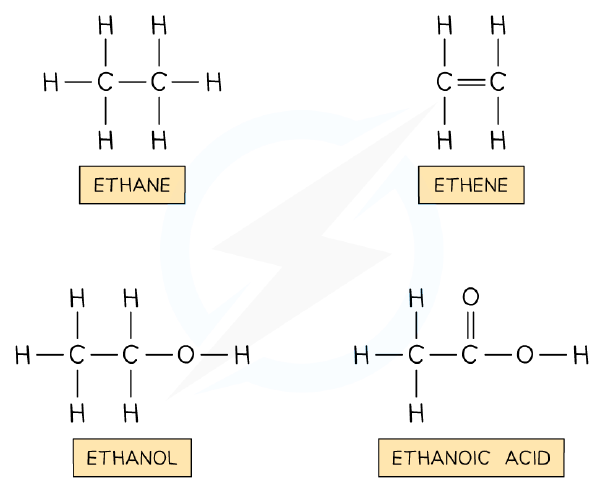
Functional Groups
- Functional groups are atoms or groups of atoms that give organic compounds their characteristic physical and chemical properties.
- Compounds with the same functional group belong to the same class (e.g. alkenes contain C=C; aldehydes contain –CHO).
- Saturated compounds have only single C–C bonds; unsaturated compounds contain C=C or C≡C bonds.
- Common classes and suffixes: alkane (–ane), alkene (–ene), alkyne (–yne), alcohol (–ol), aldehyde (–al), ketone (–one), carboxylic acid (–oic acid), ester (–oate), amine (–amine), amide (–amide).
- Halogenoalkanes use prefixes fluoro-, chloro-, bromo-, iodo-.
- Ethers contain an alkoxy group (e.g. ethoxyethane); aromatics contain a phenyl group (e.g. ethylbenzene).
Homologous Series
- A homologous series is a family of similar compounds with the same functional group and similar chemical properties, differing by a –CH₂– unit.
- Each member has the same general formula; each successive member differs by –CH₂– (the homologous increment).
- Physical properties change gradually as carbon number increases: boiling/melting points and density increase.
- Increasing chain length increases molecular size and surface area, strengthening London dispersion forces, so more energy is needed to separate molecules.
- General formulas: alkanes CₙH₂ₙ₊₂; alkenes CₙH₂ₙ; alkynes CₙH₂ₙ₋₂; alcohols CₙH₂ₙ₊₁OH; halogenoalkanes CₙH₂ₙ₊₁X.
- Ethene is the smallest alkene (minimum two carbons for C=C).
IUPAC Nomenclature
- IUPAC nomenclature provides systematic names for organic compounds.
- Alkanes: alk + ane; stem indicates number of carbons (meth-, eth-, prop-, but-, pent-, hex-).
- Number the longest chain from the end giving the lowest numbers to substituents; side chains named as alkyl groups (–yl).
- Use di-, tri-, tetra- for multiple identical groups; list different side chains alphabetically; separate numbers by commas and numbers from words by hyphens.
- Alkenes: alk + ene; indicate position of C=C with the lowest-numbered carbon (e.g. but-1-ene, but-2-ene).
- Alkynes: alk + yne; indicate position of C≡C (e.g. but-1-yne, pent-2-yne).
- Alcohols: alkan + ol (e.g. propan-1-ol); two –OH groups = diol.
- Aldehydes: alkan + al (no number needed, always C-1); ketones: alkan + one (numbering needed after butanone).
- Carboxylic acids: alkan + oic acid (no number needed, always C-1).
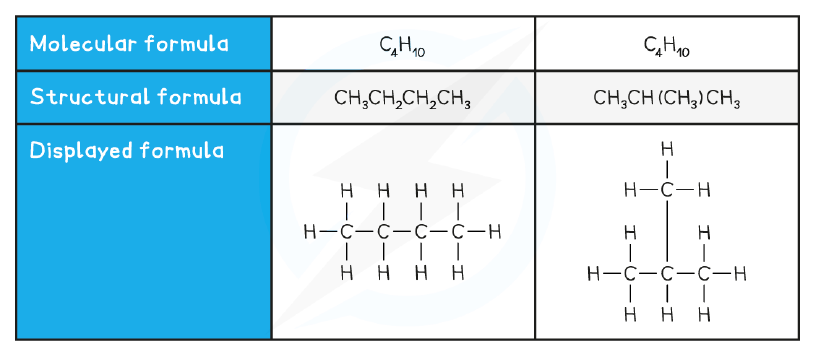
Structural Isomers
- Structural isomers have the same molecular formula but different structural formulae.
- Three types: functional group isomerism, positional isomerism, branched chain isomerism.
- Functional group isomers have different functional groups (e.g. propanal and propanone; alcohols and ethers; alkenes and cycloalkanes).
- Positional isomers have the same functional group attached to different carbon atoms (e.g. butan-1-ol and butan-2-ol).
- Branched chain isomers have different longest hydrocarbon chains (e.g. pentane and 2,2-dimethylpropane).
- Primary, secondary, tertiary classification relates to the number of carbon atoms attached to the functional group carbon (or nitrogen in amines).
- Amines: primary (1 carbon on N), secondary (2 carbons), tertiary (3 carbons).
Structural isomers
Cis-Trans Isomers (HL)
- Stereoisomers have the same order of atoms but different spatial arrangement.
- Conformational isomers arise from free rotation about a single σ-bond (e.g. staggered and eclipsed conformers of ethane; boat and chair forms of cyclohexane).
- Staggered conformer is more stable (lower energy) due to minimised repulsion; eclipsed is less stable (higher energy).
- Configurational isomers can only interconvert by breaking bonds; they include cis/trans and optical isomers.
- In unsaturated compounds, rotation about C=C is restricted by the π bond, fixing groups in position.
- Cis isomers have two functional groups on the same side of the double bond/ring; trans isomers have them on opposite sides.
- For cis/trans isomerism, each carbon of the C=C must have two different atoms or groups (e.g. but-2-ene has cis/trans; 2-methylpropene does not).
- Cis/trans isomerism also occurs in cyclic structures because the ring prevents free rotation.
Enantiomers (HL)
- Optical isomers contain a chiral carbon (chiral centre).
- A chiral carbon has four different atoms or groups attached, creating a tetrahedral shape with bond angles ~109.5°.
- A chiral molecule has no plane of symmetry; the carbon is described as asymmetric.
- Compounds with one chiral centre exist as a pair of enantiomers — non-superimposable mirror images.
- Enantiomers are drawn using stereochemical formulae (solid lines, wedges, dashed wedges).
- Optical isomers have identical chemical and physical properties except their effect on plane-polarised light.
- A racemic mixture contains equal amounts of both enantiomers and is optically inactive.
- Optical activity is detected using a polarimeter.
Analytical Techniques: MS, IR and NMR
- Mass spectrometry (MS) gives the relative molecular mass and fragmentation pattern.
- Infrared spectroscopy (IR) identifies functional groups by characteristic absorption peaks.
- ¹H NMR gives information about hydrogen environments: number of peaks = number of unique H environments; area under peak = relative number of H atoms; chemical shift = environment type; splitting pattern = number of neighbouring H atoms.
- Tetramethylsilane (TMS) has formula Si(CH₃)₄; it is used as the reference standard (0 ppm) in ¹H NMR.
- Advantages of TMS: it gives a single sharp peak, is chemically inert, is volatile (easily removed), and is non-toxic.
- Splitting patterns follow the n+1 rule: a proton with n neighbouring protons gives n+1 peaks.
ஸ்லைடுகள்
Sign up free to view the lesson slides
Step through every slide for this topic — plus flashcards and revision notes — with a free account.
பயிற்சி கேள்விகள்
இலவச முன்னோட்டம் — 55-இல் 8 கேள்விகள். அனைத்தையும் பார்க்க பதிவு செய்யவும்.
1.Which of the following best describes a functional group?
Easy- AA specific atom or group of atoms that gives an organic compound its characteristic physical and chemical properties
- BA group of atoms that increases the boiling point of a compound
- CA group of atoms that contains only carbon and hydrogen
- DA group of atoms that is always attached to a chiral carbon
2.Which class of organic compound contains the carbonyl group?
Easy- AAldehydes and ketones
- BAlcohols and ethers
- CCarboxylic acids and esters
- DAmines and amides
3.Which functional group is present in ethanoic acid?
Easy- ACarboxyl, –COOH
- BHydroxyl, –OH
- CCarbonyl, –CHO
- DEster, –COO–
4.Which of the following compounds is a hydrocarbon?
Medium- AButane, C4H10
- BButan-1-ol, C4H9OH
- CChlorobutane, C4H9Cl
- DEthanoic acid, CH3COOH
5.Which of the following statements about a homologous series is correct?
Medium- AAll members have the same functional group and the same general formula
- BAll members have the same molecular formula but different functional groups
- CAll members have the same boiling point
- DAll members have the same number of carbon atoms
6.Which of the following pairs are functional group isomers?
Medium- APropanal and propanone
- BButan-1-ol and butan-2-ol
- CButane and 2-methylpropane
- DPropene and butene
7.The general formula for an alkyne is:
Medium- ACnH2n–2
- BCnH2n
- CCnH2n+2
- DCnH2n+1
8.Which of the following statements about stereoisomers is correct?
Medium- AThey have the same molecular formula and the same order of atoms but different spatial arrangements
- BThey have the same molecular formula but different functional groups
- CThey have different molecular formulae but the same functional group
- DThey are always structural isomers
Unlock all 55 questions & more
இந்த தலைப்பிற்கான ஒவ்வொரு கேள்வியையும், ஸ்லைடுகளையும், ஃப்ளாஷ் கார்டுகளையும் மற்றும் திருப்புதல் குறிப்புகளையும் பார்க்க இலவச கணக்கை உருவாக்கவும்.