The Covalent Model
விளையாடிக் கற்றுக்கொள்ளுங்கள்
ஆற்றல் சம்பாதிக்க இந்த கேள்விகளுக்குப் பதிலளியுங்கள், பின்னர் மீன் பிடித்து ஆராயுங்கள். கணக்கு தேவையில்லை.
பாட குறிப்புகள்
Covalent Bonds
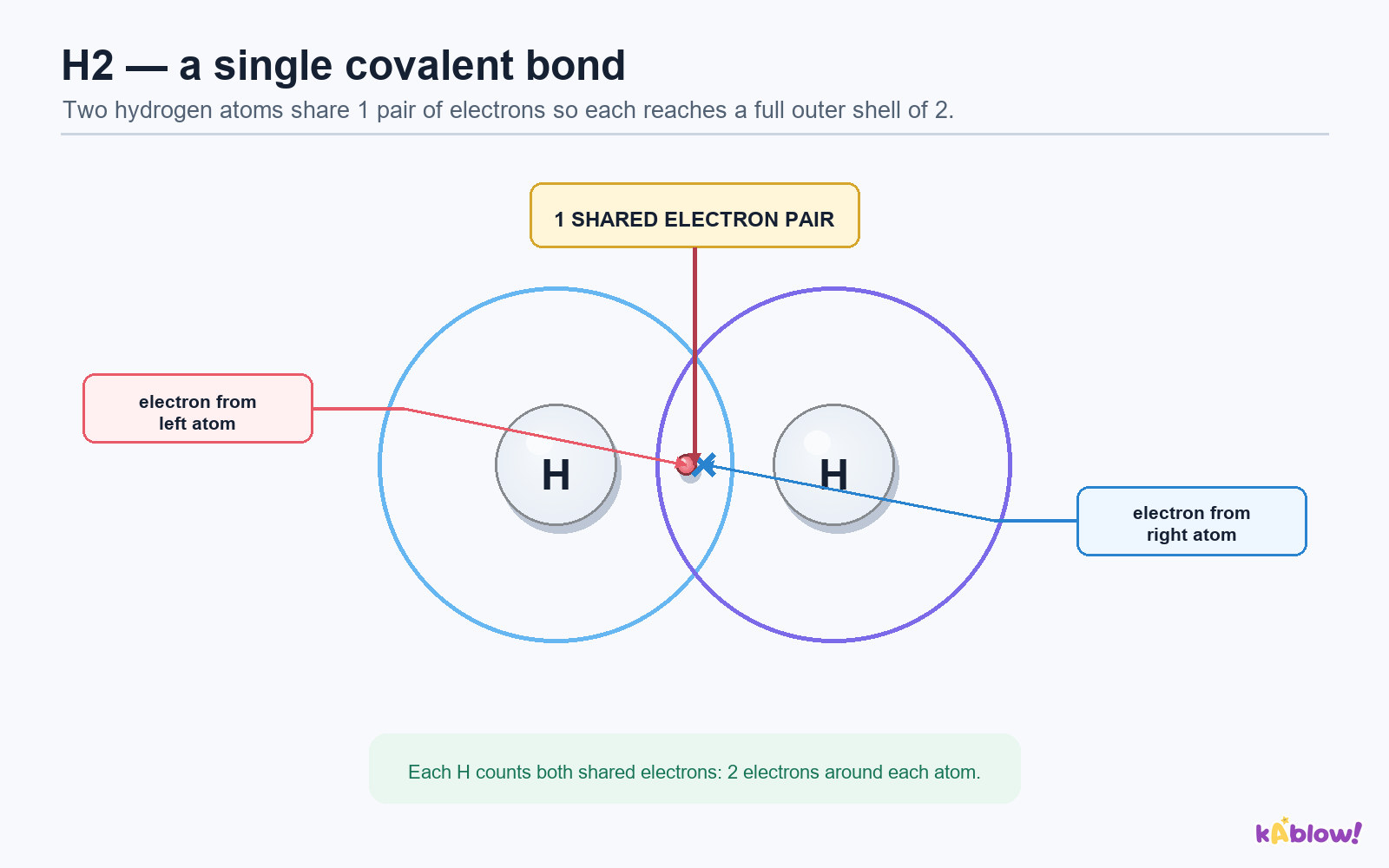
- Covalent bonding occurs between two non-metals and is the electrostatic attraction between a shared pair of electrons and the positively charged nuclei of two atoms.
- No electrons are transferred; electrons are shared between atoms, and each atom typically contributes one electron to the shared pair.
- When a covalent bond forms, two atomic orbitals overlap to form a molecular orbital.
- Covalent bonding occurs because electrons are more stable when shared between two nuclei than when held by one atom alone.
- By sharing electrons, both atoms achieve a noble gas configuration, making them more stable.
- A single covalent bond is represented by a short straight line, e.g. H–H, Cl–Cl, H–Br.
- Covalent bonds are not fixed lines; the shared electrons are constantly moving and are best represented as charge clouds.
- The octet rule refers to the tendency of atoms to gain a valence shell with a total of 8 electrons; exceptions include electron-deficient and expanded octet species.
A single covalent bond
Lewis Formulas
- Lewis formulas (electron dot diagrams) show all valence electrons in a covalently bonded species, including bonding pairs and lone pairs.
- Electron pairs can be represented by dots, crosses, a combination of dots and crosses, or a line.
- Steps for drawing Lewis formulas: count total valence electrons, draw skeletal positions with the central atom (usually least electronegative) in the middle, add bonding pairs then lone pairs, and check the structure.
- When adding electron pairs, first add bonding pairs between bonded atoms, then add lone pairs to complete octets (or duets for hydrogen), starting with outer atoms.
- For methane, CH₄: total valence electrons = (1 × 4) + (4 × 1) = 8; carbon has a full octet and each hydrogen has a duet.
- For ammonia, NH₃: total valence electrons = (1 × 5) + (3 × 1) = 8; nitrogen has a full octet and one lone pair.
- For tetrachloromethane, CCl₄: total valence electrons = (1 × 4) + (4 × 7) = 32; carbon has a full octet and each chlorine has three lone pairs.
- Exceptions to the octet rule include hydrogen (stable with 2 electrons), beryllium (4 valence electrons in BeCl₂), and boron (6 valence electrons in BF₃).
Multiple Bonds
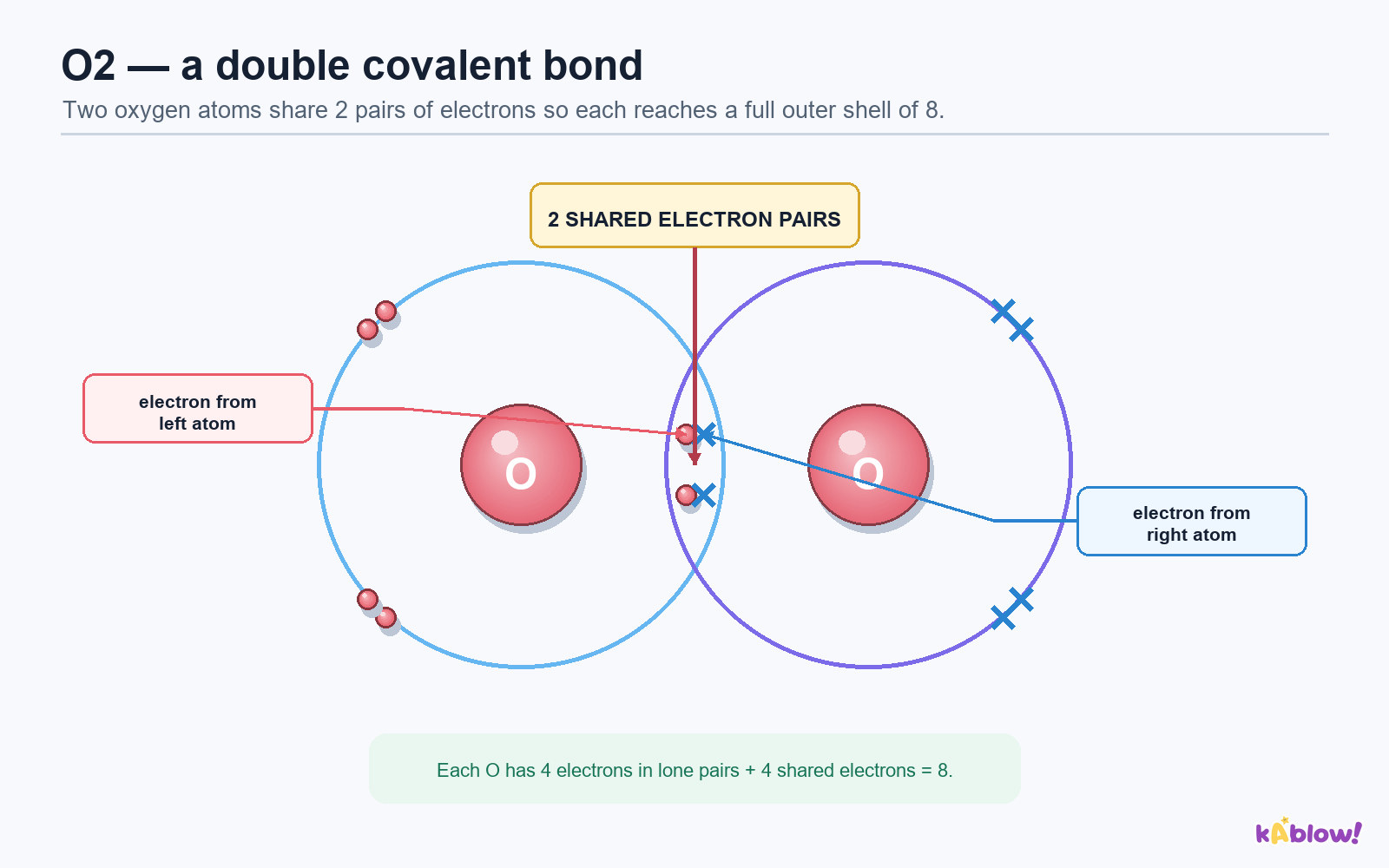
- Non-metal atoms can share more than one pair of electrons to form single, double, or triple covalent bonds.
- A single bond (C–C) has 2 shared electrons, a double bond (C=C) has 4 shared electrons, and a triple bond (C≡C) has 6 shared electrons.
- Quadruple covalent bonds are not possible because the repulsion between 8 electrons between the two nuclei is too great.
- Bond energy is the amount of energy required to break one mole of a covalent bond in the gaseous state, with units kJ mol⁻¹.
- The higher the bond energy, the stronger the bond.
- Bond length is the distance between the nuclei of two covalently bonded atoms.
- As more electrons are shared, electron density between the atoms increases, increasing electrostatic attraction and pulling atoms closer together.
- Triple bonds are the shortest and strongest covalent bonds; single bonds are the longest and weakest.
A double covalent bond
Coordinate Bonds
- In a regular covalent bond, each atom contributes one electron to the shared pair.
- In a coordinate bond, both electrons in the bond come from the same atom.
- Coordinate bonding typically occurs when one atom has a lone pair of electrons and the other atom is electron-deficient (has an unfilled outer shell).
- Example: the ammonium ion (NH₄⁺) forms when the nitrogen atom in ammonia (NH₃) donates a lone pair to an electron-deficient hydrogen ion (H⁺).
- Coordinate bonding also occurs in transition metal complexes, such as the aluminium(III) hexaaqua ion ([Al(H₂O)₆]³⁺).
- In [Al(H₂O)₆]³⁺, each oxygen atom in H₂O donates a lone pair to the Al³⁺ ion, forming six coordinate bonds.
Shapes of Molecules
- VSEPR theory states that bonding and non-bonding electron pairs around a central atom repel each other and arrange themselves as far apart as possible in three-dimensional space.
- VSEPR rules: all electron pairs spread out as far as possible; lone pairs repel more strongly than bonding pairs; multiple bonds behave like a single bond when determining shape.
- Each region of electron density around the central atom is called an electron domain; a domain may contain one, two, or three pairs of electrons.
- Two electron domains give a linear shape with a bond angle of 180° (e.g. BeCl₂, CO₂, HC≡CH).
- Three electron domains give a trigonal planar electron domain geometry with a bond angle of 120°; with one lone pair the molecular shape is bent with a bond angle of approximately 118° (e.g. SO₂).
- Four electron domains give a tetrahedral electron domain geometry with an ideal bond angle of approximately 109.5°.
- With one lone pair, the molecular shape is trigonal pyramidal with a bond angle of around 107° (e.g. NH₃); with two lone pairs, the shape is bent with a bond angle of approximately 104.5° (e.g. H₂O).
- The order of electron pair repulsion is: lone pair–lone pair > lone pair–bonding pair > bonding pair–bonding pair.
Bond and Molecular Polarity
- Electronegativity is the ability of an atom to attract the shared pair of electrons in a covalent bond; values are shown on the Pauling scale (Data Booklet Section 9).
- In diatomic molecules with identical atoms (e.g. H₂, O₂, Cl₂), electron density is shared equally, resulting in a nonpolar covalent bond.
- When two atoms have different electronegativities, the bonding electrons are drawn closer to the more electronegative atom, creating a polar covalent bond with δ⁺ and δ⁻ charges.
- The greater the difference in electronegativity, the more polar the bond and the greater the dipole moment.
- A dipole forms when there is a separation of charge across a covalent bond; the dipole arrow points toward the more electronegative atom (δ⁻).
- To determine molecular polarity, consider both the bond polarity and the arrangement of bonds in space (molecular geometry).
- Molecules with polar bonds can be nonpolar overall if the bond dipoles are arranged symmetrically and cancel out (e.g. CO₂, CCl₄).
- Molecules with polar bonds are polar overall if the bond dipoles are arranged asymmetrically and do not cancel (e.g. H₂O, NH₃, CH₃Cl).
Giant Covalent Structures
- Giant covalent structures (covalent network structures) are large networks of atoms joined by strong covalent bonds extending throughout the entire lattice.
- Examples include silicon, silicon dioxide, diamond, graphite, buckminsterfullerene, and graphene.
- In diamond, each carbon atom is covalently bonded to four others in a tetrahedral geometry with bond angles of approximately 109.5°; it is extremely hard and does not conduct electricity.
- In graphite, each carbon atom is bonded to three others in hexagonal rings arranged in flat layers with bond angles of 120°; the fourth electron is delocalised, so graphite conducts electricity and layers can slide (soft and slippery).
- Graphene is a single layer of carbon atoms in a hexagonal lattice with trigonal planar geometry and bond angles of 120°; it conducts electricity due to delocalised electrons and is strong and flexible.
- Buckminsterfullerene (C₆₀) is a molecular form of carbon made of 60 atoms in a spherical structure of interlocking hexagons and pentagons; it is a semiconductor.
- Giant covalent lattices have very high melting and boiling points because they contain a large number of strong covalent bonds requiring large amounts of energy to break.
- Most covalent network structures are insoluble in water; graphite and graphene conduct electricity due to delocalised electrons.
Intermolecular Forces
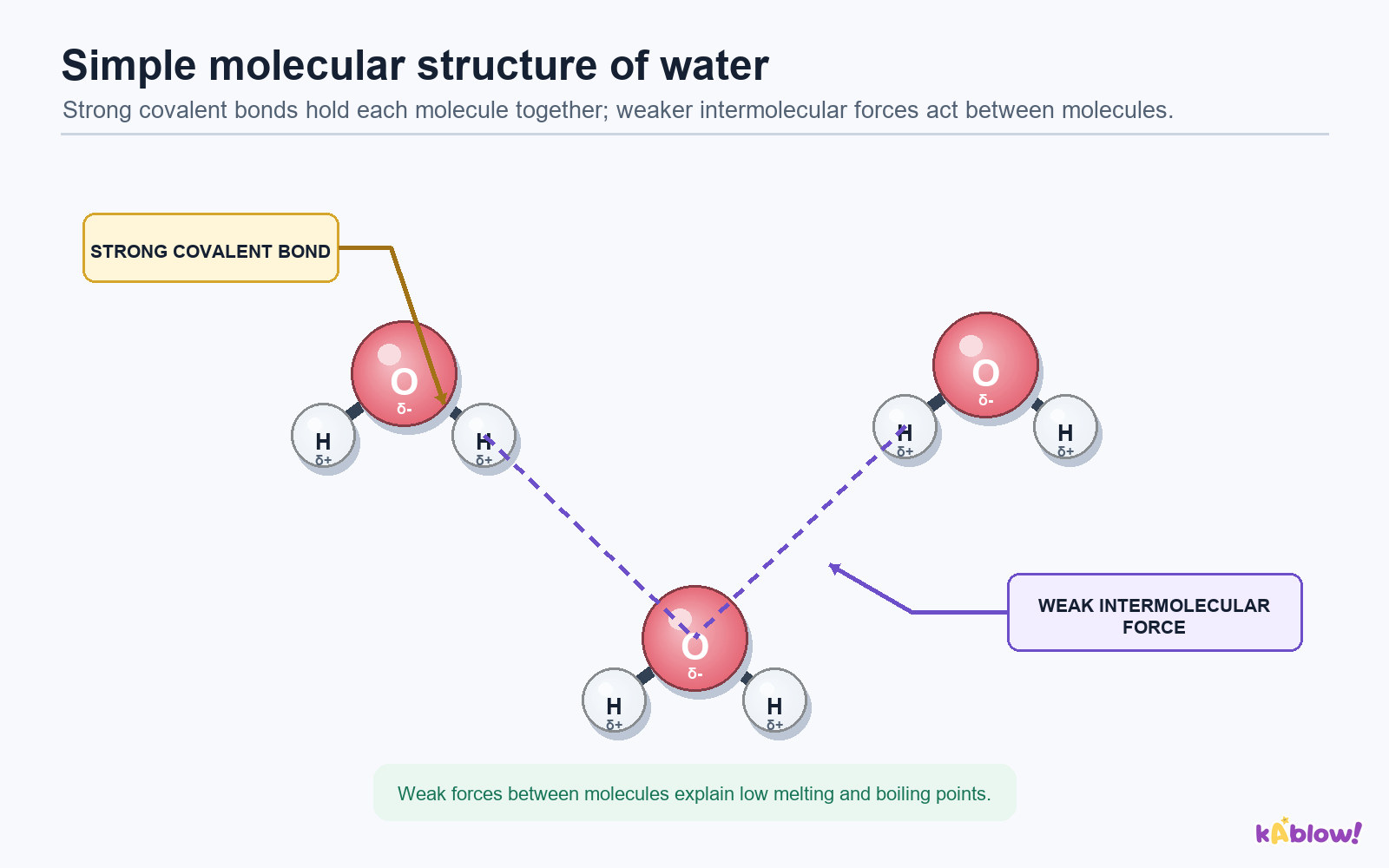
- Covalent molecular substances are held together by intermolecular forces, which are much weaker than covalent or ionic bonds.
- There are four types of intermolecular force: London (dispersion) forces, dipole–dipole attractions, dipole–induced dipole attractions, and hydrogen bonding.
- Van der Waals forces is a collective term that includes London (dispersion) forces, dipole–dipole attractions, and dipole–induced dipole attractions.
- London (dispersion) forces arise from temporary dipoles and induced dipoles; they are present between all atoms and molecules but are usually very weak (1–50 kJ mol⁻¹).
- The strength of London forces depends on the number of electrons and the surface area available for contact; more electrons and larger surface area increase the strength.
- Dipole–dipole attractions occur between the δ⁺ end of one polar molecule and the δ⁻ end of a neighbouring polar molecule, in addition to London forces.
- Dipole–induced dipole attractions occur when a polar molecule distorts the electron cloud of a nonpolar molecule, creating a temporary dipole.
- Hydrogen bonding is the strongest type of intermolecular force and requires a hydrogen atom covalently bonded to O, N, or F, and a lone pair on an O, N, or F atom in a neighbouring molecule.
Simple molecular structure of water: strong covalent bonds within each molecule, weak intermolecular forces between molecules.
Physical Properties of Covalent Substances
- The physical properties of molecular covalent compounds are largely influenced by their intermolecular forces.
- When molecular covalent substances change state, the intermolecular forces between their molecules are overcome, not the covalent bonds.
- The stronger the intermolecular forces, the higher the melting and boiling point; substances with low boiling points are described as volatile.
- The strength of intermolecular forces depends on the size (molar mass) of the molecule, the polarity of the molecule, and the type of intermolecular force present.
- The order of intermolecular force strength is: London < dipole–dipole < hydrogen bonding.
- The general rule for solubility is “like dissolves like”: nonpolar substances dissolve in nonpolar solvents, and polar substances dissolve in polar solvents.
- Most covalent network structures are insoluble in water and do not conduct electricity, except graphite and graphene which conduct due to delocalised electrons.
ஸ்லைடுகள்
Sign up free to view the lesson slides
Step through every slide for this topic — plus flashcards and revision notes — with a free account.
பயிற்சி கேள்விகள்
இலவச முன்னோட்டம் — 62-இல் 8 கேள்விகள். அனைத்தையும் பார்க்க பதிவு செய்யவும்.
1.Which statement best defines a covalent bond?
Easy- AThe electrostatic attraction between a shared pair of electrons and the positively charged nuclei of two atoms
- BThe transfer of electrons from a metal to a non-metal
- CThe attraction between oppositely charged ions in a lattice
- DA weak force of attraction between molecules
2.In a typical covalent bond, each atom contributes one electron to the shared pair.
EasyTrue or false?
3.Which of the following molecules contains a coordinate bond?
Easy- ANH4+
- BCH4
- CH2O
- DCO2
4.Which of the following statements about sigma (σ) and π (π) bonds are correct? (select all that apply)
Medium- AA sigma bond is formed by the end-on overlap of atomic orbitals.
- BA π bond is formed by the sideways overlap of p-orbitals.
- CA sigma bond is weaker than a π bond.
- DA π bond allows free rotation about the bond axis.
- EA sigma bond has electron density concentrated along the internuclear axis.
5.Match each molecule with its molecular geometry.
Medium- CH4
- NH3
- H2O
- CO2
- Tetrahedral
- Trigonal pyramidal
- Bent
- Linear
6.Arrange the following carbon-carbon bonds in order of increasing bond length.
Medium- C≡C (triple bond)
- C=C (double bond)
- C–C (single bond)
7.Which of the following molecules is polar overall?
Medium- ACCl4
- BCO2
- CCH3Cl
- DBF3
8.Graphite conducts electricity because each carbon atom forms four covalent bonds, leaving no free electrons.
MediumTrue or false?
Unlock all 62 questions & more
இந்த தலைப்பிற்கான ஒவ்வொரு கேள்வியையும், ஸ்லைடுகளையும், ஃப்ளாஷ் கார்டுகளையும் மற்றும் திருப்புதல் குறிப்புகளையும் பார்க்க இலவச கணக்கை உருவாக்கவும்.