The Ionic Model
விளையாடிக் கற்றுக்கொள்ளுங்கள்
ஆற்றல் சம்பாதிக்க இந்த கேள்விகளுக்குப் பதிலளியுங்கள், பின்னர் மீன் பிடித்து ஆராயுங்கள். கணக்கு தேவையில்லை.
பாட குறிப்புகள்
Forming Ions
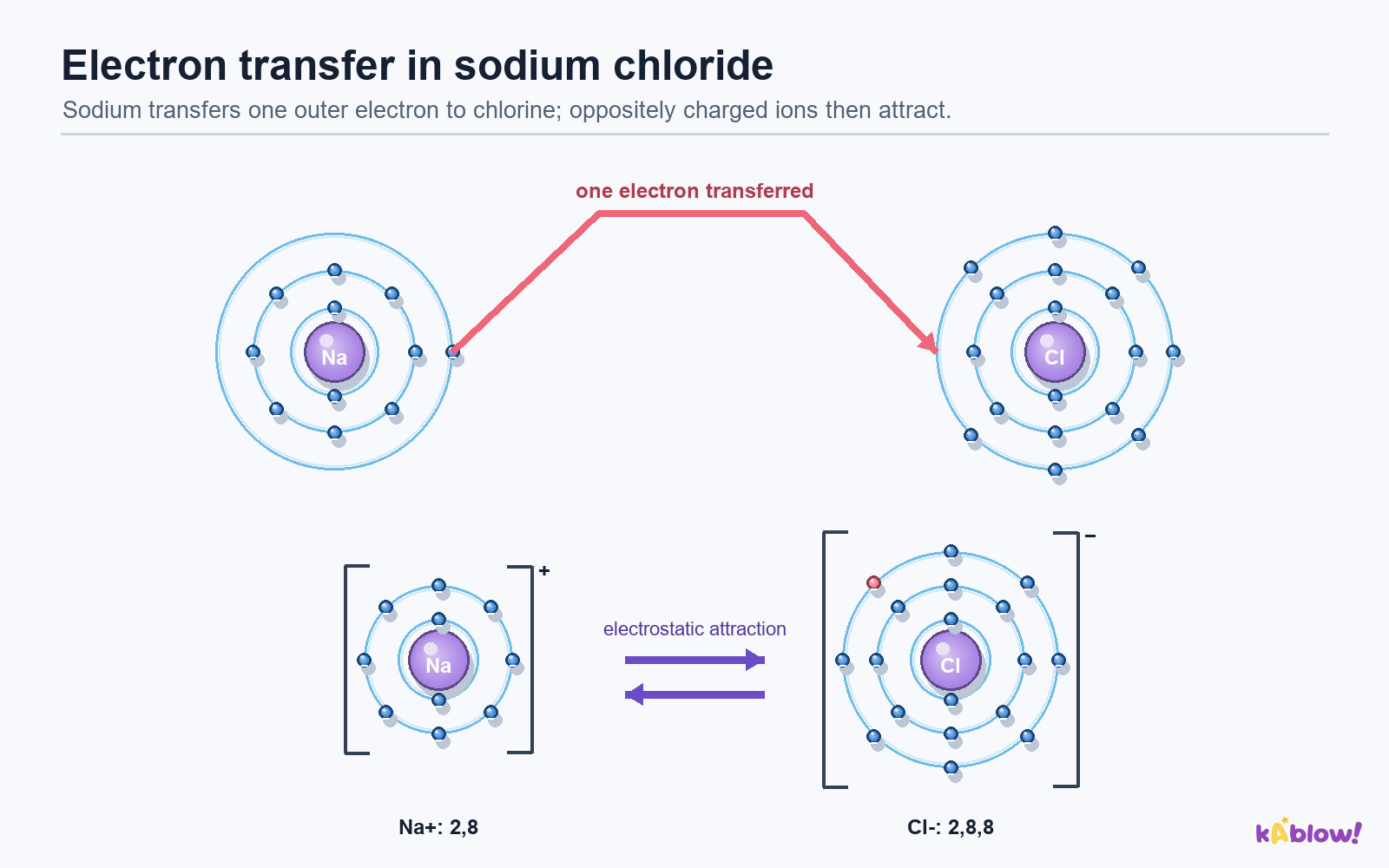
- Ionic bonds form by the transfer of electrons from a metallic element to a non-metallic element.
- Metals lose electrons from their valence shell to form positively charged cations.
- Non-metal atoms gain electrons to form negatively charged anions.
- After electron transfer, ions usually have the same electronic configuration as a noble gas.
- For example, Na⁺ has the configuration [2,8] like neon, and Cl⁻ has [2,8,8] like argon.
- The group number of an element helps predict how many electrons it will lose or gain.
Formation of ions
Binary Ionic Compounds
- A binary ionic compound is composed of ions of two different elements: a metal cation and a non-metal anion.
- Ionic bonding is the force of attraction between oppositely charged species/ions.
- The strong electrostatic attractions between cations and anions require a lot of energy to overcome, giving ionic compounds high melting points.
- Binary ionic compounds are named with the cation first, followed by the anion with the suffix -ide (e.g. sodium iodide).
- Ionic compounds are electrically neutral; the total positive charge equals the total negative charge.
Charges on Ions
- Group 1, 2 and 13 metals form ions with charges of +1, +2 and +3 respectively.
- Transition elements can form ions with variable charges, shown by Roman numerals in names (Stock notation), e.g. copper(II) oxide has Cu²⁺.
- Non-metals in Group 17 gain 1 electron and have a 1− charge, e.g. Br⁻.
- Non-metals in Group 16 gain 2 electrons and have a 2− charge, e.g. O²⁻.
- Non-metals in Group 15 gain 3 electrons and have a 3− charge, e.g. N³⁻.
- Some non-metals form positive ions, such as ammonium, NH₄⁺, and hydrogen, H⁺.
Polyatomic Ions
- Polyatomic ions are ions made up of more than one type of atom, also called compound negative ions.
- The seven polyatomic ions you need to know are: ammonium NH₄⁺, hydroxide OH⁻, nitrate NO₃⁻, hydrogencarbonate HCO₃⁻, carbonate CO₃²⁻, sulfate SO₄²⁻, and phosphate PO₄³⁻.
- When more than one polyatomic ion is needed in a formula, it is placed in brackets with the number outside, e.g. Ca(NO₃)₂.
- To determine a formula, balance the positive and negative charges so they cancel out.
Ionic Lattices
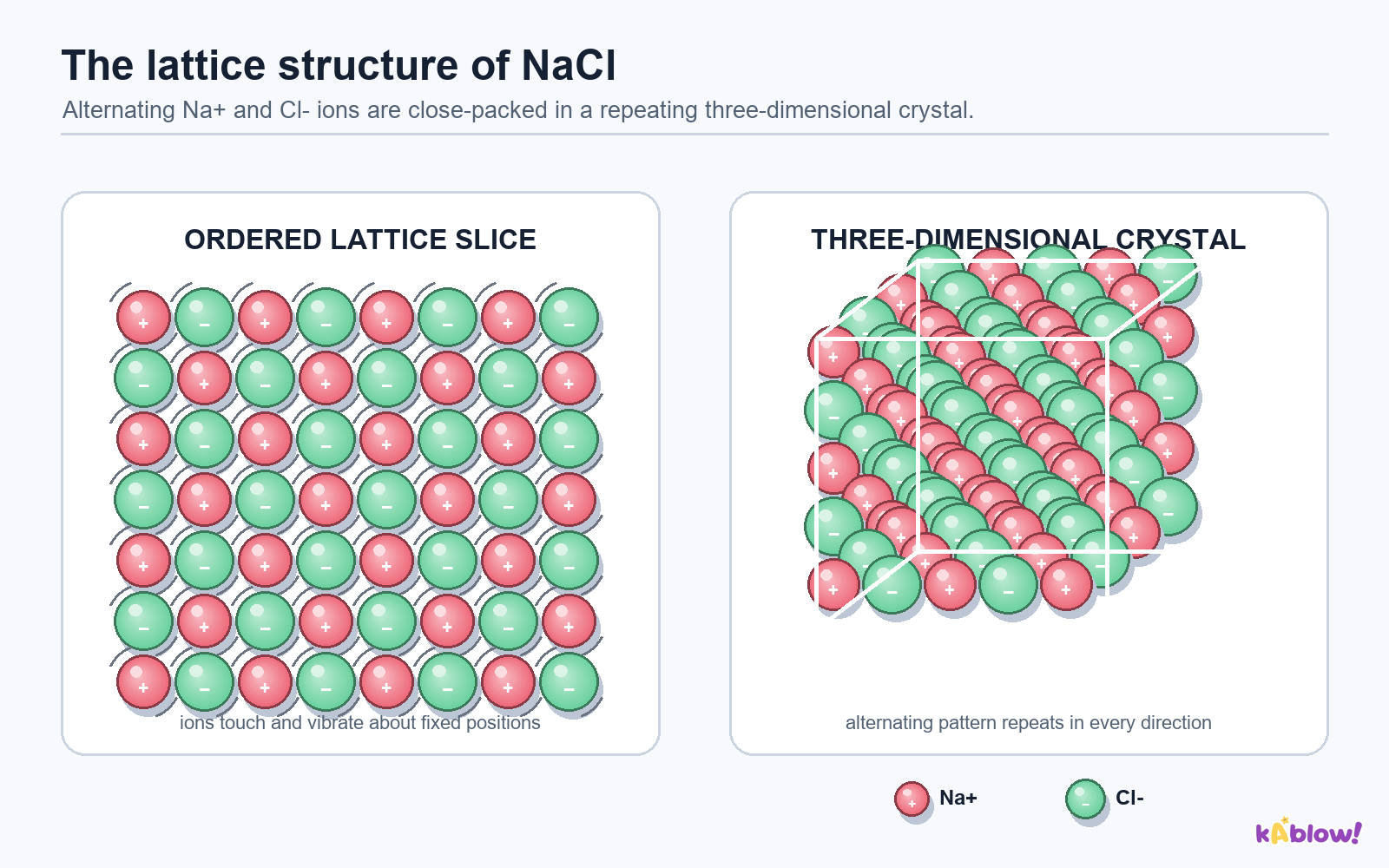
- An ionic lattice is a crystalline structure formed by ions in a regular, repeating pattern.
- The lattice consists of alternating cations and anions, arranged so that positive and negative charges cancel out, making the lattice overall electrically neutral.
- Ionic compounds are represented using empirical formulas, which show the simplest whole-number ratio of ions.
- The strong electrostatic forces of attraction between oppositely charged ions act in all directions and hold the lattice together.
The lattice structure of sodium chloride
Lattice Enthalpy
- Lattice dissociation enthalpy (ΔHlatt) is the standard enthalpy change when 1 mole of gaseous ions is formed from the solid lattice.
- Lattice enthalpy is always endothermic (positive value) because energy is required to break the bonds between ions in the lattice.
- For example: NaCl(s) → Na⁺(g) + Cl⁻(g), ΔHlatt = +790 kJ mol⁻¹.
- Lattice enthalpy increases as ionic charge increases and ionic radius decreases, due to stronger electrostatic attractions.
Properties of Ionic Compounds
- Ionic compounds are hard and brittle; crystals shatter when layers shift and like charges align.
- They have high melting and boiling points because strong electrostatic forces act in all directions and keep ions strongly together.
- Melting and boiling points increase with the charge density of the ions; for example, MgO has a higher melting point than NaCl.
- Ionic compounds are not volatile as large amounts of energy are needed to overcome the strong electrostatic forces.
- They are generally soluble in water because polar water molecules form ion–dipole interactions and hydrate the ions.
- Lower solvent polarity and weaker ion–solvent interactions reduce solubility.
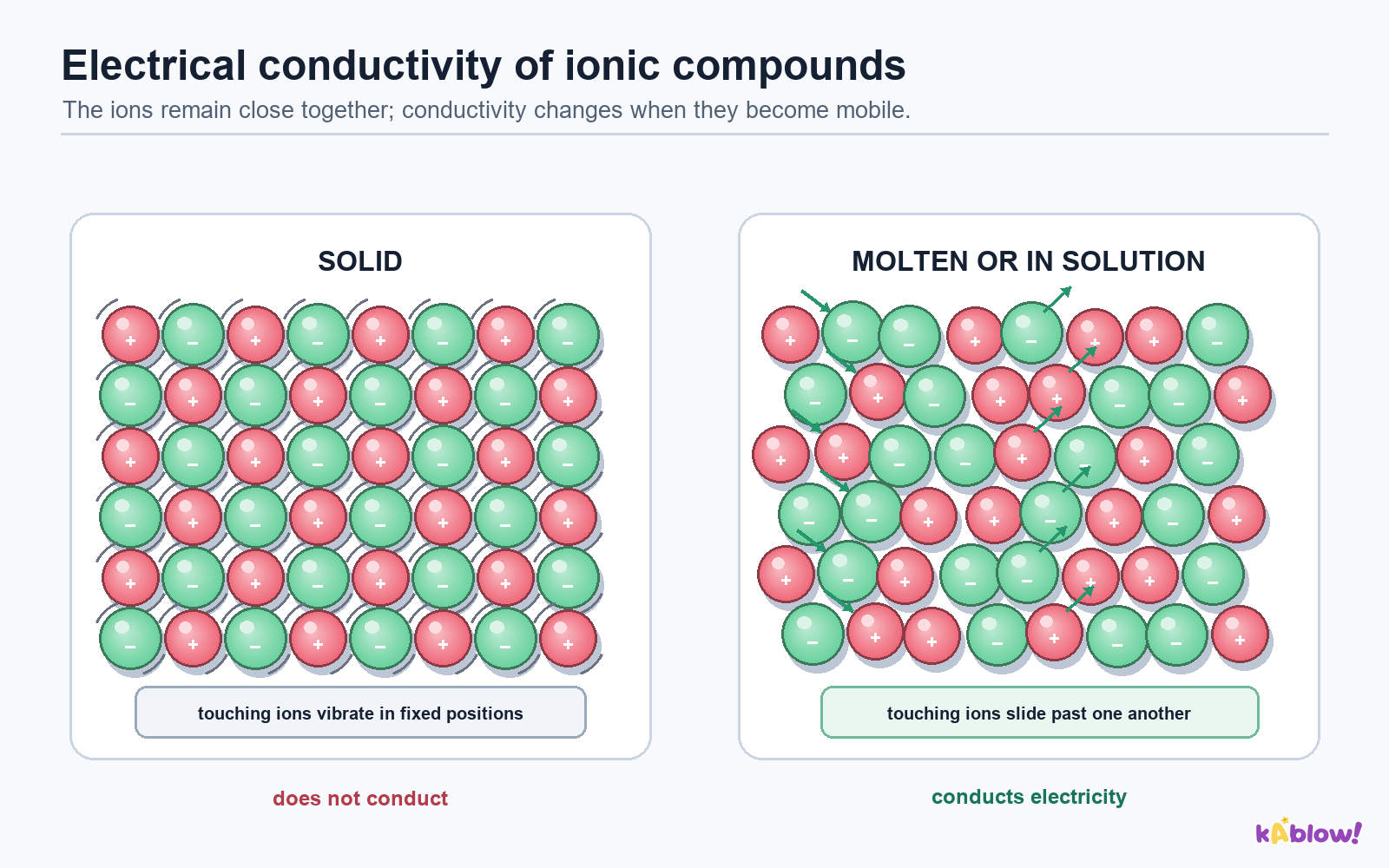
Electrical conductivity of ionic compounds
Electrical Conductivity of Ionic Compounds
- Ionic compounds only conduct electricity when molten or in solution, because the ions are free to move.
- As a solid, the ions are in fixed positions and cannot move, so they do not conduct electricity.
- When molten or aqueous, the ions can freely move around and carry charge.
Comparing Structure Types
- Giant ionic: high melting/boiling points, conduct only when molten or in solution, generally soluble, hard and brittle, solid at room temperature, particles are ions.
- Giant metallic: moderately high to high melting/boiling points, conduct when solid or liquid, insoluble, hard and malleable, solid at room temperature, particles are positive ions in a sea of electrons.
- Simple covalent: low melting/boiling points, do not conduct electricity, usually insoluble unless polar, soft, solid/liquid/gas at room temperature, particles are small molecules.
- Giant covalent: very high melting/boiling points, do not conduct electricity (except graphite), insoluble, very hard (diamond/silica) or soft (graphite), solid at room temperature, particles are atoms.
ஸ்லைடுகள்
Sign up free to view the lesson slides
Step through every slide for this topic — plus flashcards and revision notes — with a free account.
பயிற்சி கேள்விகள்
இலவச முன்னோட்டம் — 60-இல் 8 கேள்விகள். அனைத்தையும் பார்க்க பதிவு செய்யவும்.
1.Which statement best describes ionic bonding?
Easy- AThe electrostatic attraction between oppositely charged ions
- BThe electrostatic attraction between cations and delocalised electrons
- CThe electrostatic attraction of nuclei towards shared electrons
- DThe electrostatic attraction between nuclei
2.What is the correct formula for ammonium carbonate?
Easy- A(NH₄)₂CO₃
- BNH₄CO₃
- C(NH₄)₃CO₃
- DNH₄(CO₃)₂
3.Which crystal structure does not conduct electricity when solid, has a high melting point and can conduct electricity when molten?
Medium- AGiant ionic
- BGiant metallic
- CCovalent network
- DSimple molecular
4.Which of the following compounds is not bonded ionically?
Easy- ACH₃OH
- BCaCO₃
- CNaOH
- DBaCl₂
5.Magnesium oxide has a very high melting temperature. Which of the following is the best description of its structure and bonding?
Easy- AGiant ionic
- BGiant metallic
- CNetwork covalent
- DSimple molecular
6.Which of the following compounds has both covalent and ionic bonds?
Medium- Apotassium carbonate, K₂CO₃
- Bcalcium bromide, CaBr₂
- Cpropanoic acid, CH₃CH₂COOH
- Ddichloromethane, CH₂Cl₂
7.Potassium bromide is an ionic compound. When can potassium bromide conduct electricity?
Medium- AMolten and aqueous only
- BSolid and molten only
- CSolid and aqueous only
- DAqueous only
8.Which of the following substances has the highest melting point?
Hard- AMgO
- BNa₂O
- CO₂
- DC (graphite)
Unlock all 60 questions & more
இந்த தலைப்பிற்கான ஒவ்வொரு கேள்வியையும், ஸ்லைடுகளையும், ஃப்ளாஷ் கார்டுகளையும் மற்றும் திருப்புதல் குறிப்புகளையும் பார்க்க இலவச கணக்கை உருவாக்கவும்.