Electron Transfer Reactions
விளையாடிக் கற்றுக்கொள்ளுங்கள்
ஆற்றல் சம்பாதிக்க இந்த கேள்விகளுக்குப் பதிலளியுங்கள், பின்னர் மீன் பிடித்து ஆராயுங்கள். கணக்கு தேவையில்லை.
பாட குறிப்புகள்
Oxidation and Reduction
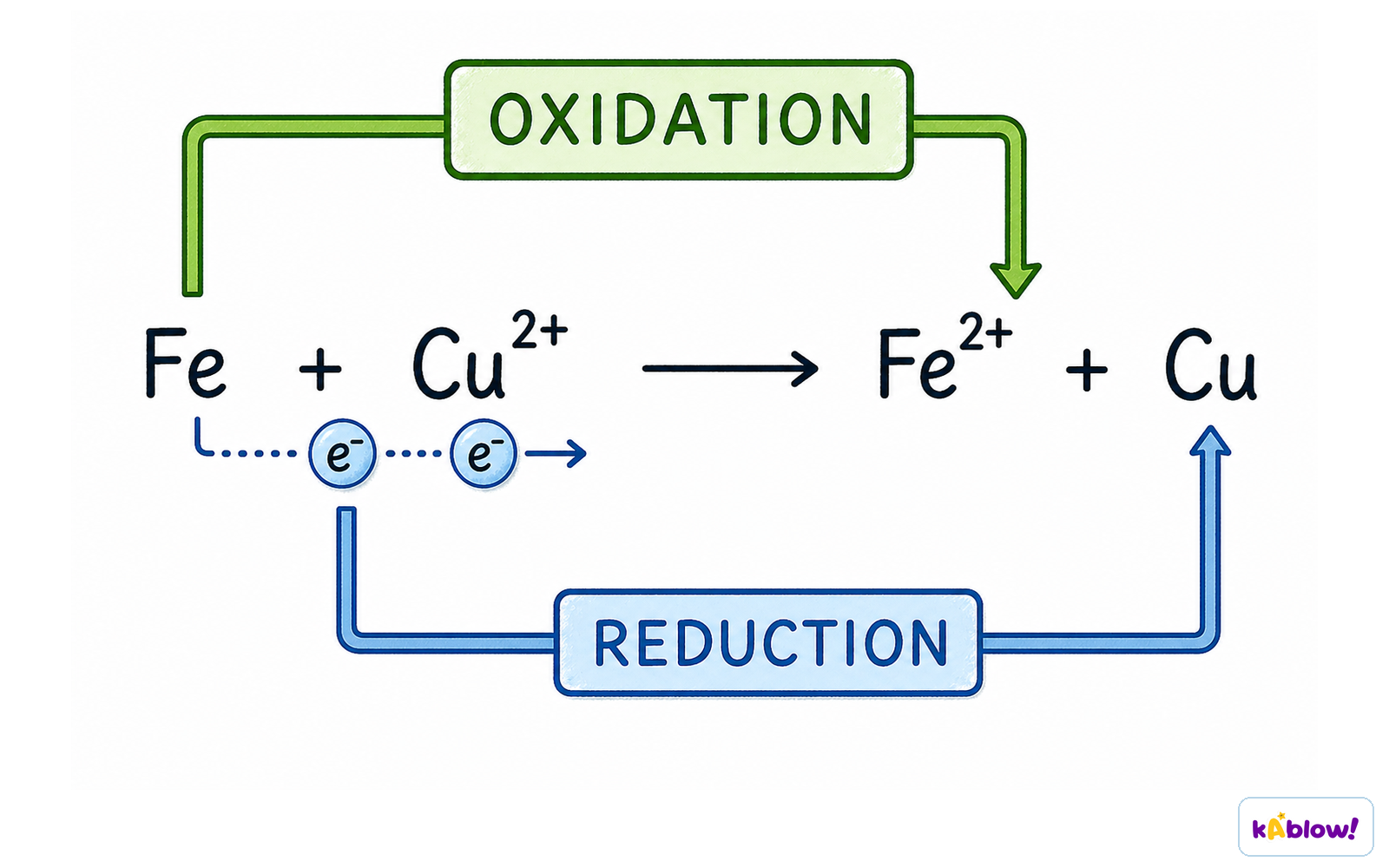
- Oxidation is the loss of electrons and an increase in oxidation number.
- Reduction is the gain of electrons and a decrease in oxidation number.
- An oxidising agent oxidises another species by accepting electrons; it is itself reduced and its oxidation number decreases.
- A reducing agent reduces another species by donating electrons; it is itself oxidised and its oxidation number increases.
- In a redox reaction, both an oxidising agent and a reducing agent are present.
- Some substances can act as either an oxidising or reducing agent depending on what they react with and the reaction conditions.
- Oxidation numbers are used in naming compounds, e.g. iron(II) sulfate contains Fe²⁺ and iron(III) sulfate contains Fe³⁺.
Oxidation and reduction by electron transfer
Half Equations and Redox Titrations
- To balance a redox equation: write the unbalanced equation, deduce oxidation number changes, balance the changes, balance charges, then balance atoms.
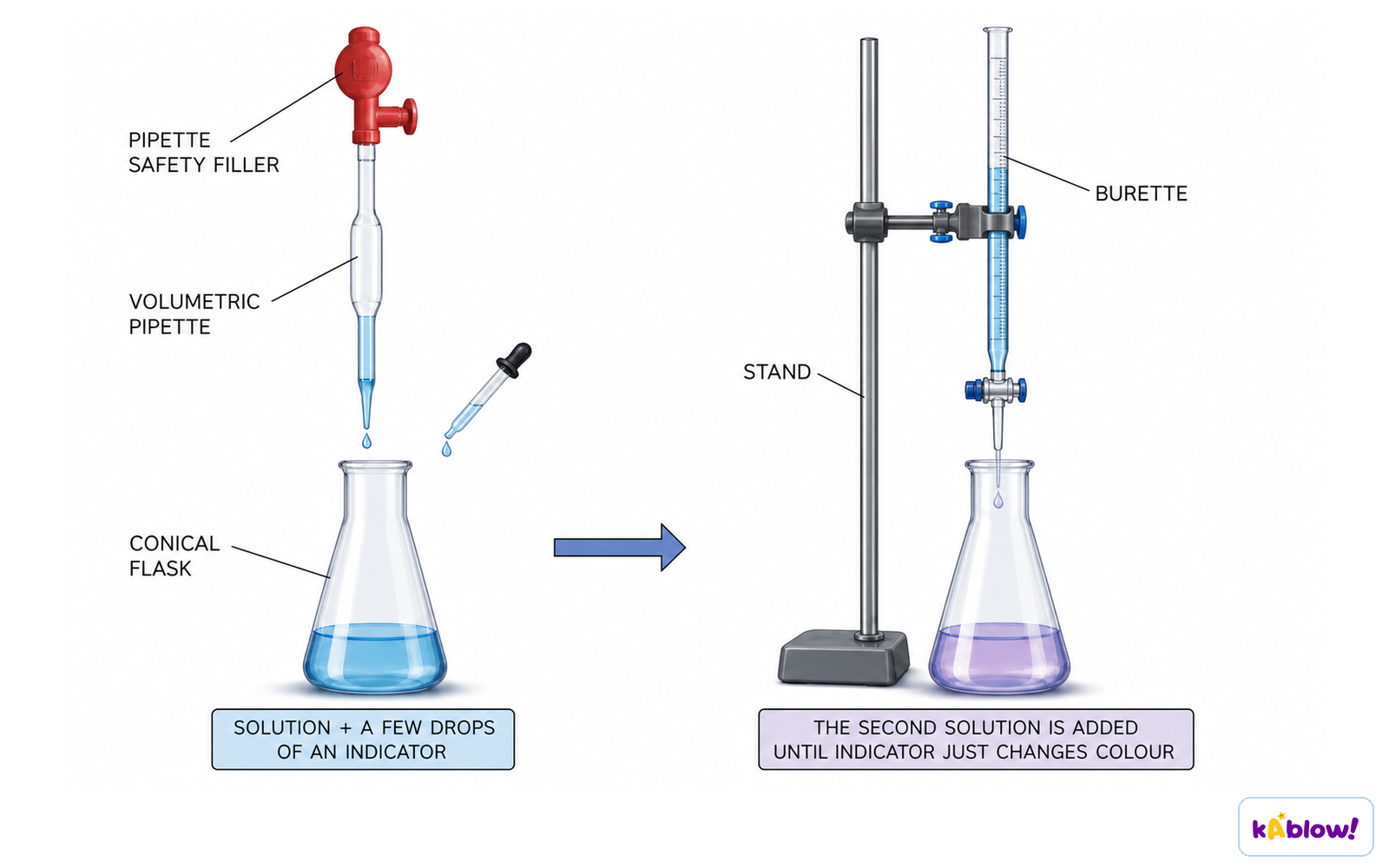
- Redox titrations involve titrating an oxidising agent against a reducing agent; electrons are transferred between species.
- In manganate(VII) titrations, acidified MnO₄⁻ reacts with Fe²⁺: MnO₄⁻ + 8H⁺ + 5Fe²⁺ → Mn²⁺ + 5Fe³⁺ + 4H₂O.
- Manganate(VII) titrations are self-indicating because the purple MnO₄⁻ colour disappears at the endpoint.
- In iodine-thiosulfate titrations, iodine reacts with thiosulfate: 2S₂O₃²⁻ + I₂ → 2I⁻ + S₄O₆²⁻.
- Starch is added near the endpoint in iodine-thiosulfate titrations; the solution turns blue/black until all iodine reacts.
- These titrations can be used for analysis, e.g. iron in tablets or chlorine in bleach.
Titration apparatus
Relative Ease of Oxidation and Reduction
- Down Group 1 and Group 2, the relative ease of oxidation increases; reactions with water become more vigorous.
- Lithium reacts with water: 2Li(s) + 2H₂O(l) → 2LiOH(aq) + H₂(g); Li is oxidised from 0 to +1.
- Magnesium reacts very slowly with water, while calcium reacts much more quickly.
- The oxidising power of halogens decreases down Group 17: F₂ is the strongest oxidising agent and I₂ the weakest.
- A more reactive halogen can displace a less reactive halogen from its halide solution.
- Chlorine displaces bromine from potassium bromide: 2KBr(aq) + Cl₂(aq) → 2KCl(aq) + Br₂(aq).
- Bromine displaces iodine from sodium iodide: Br₂(l) + 2NaI(aq) → 2NaBr(aq) + I₂(aq).
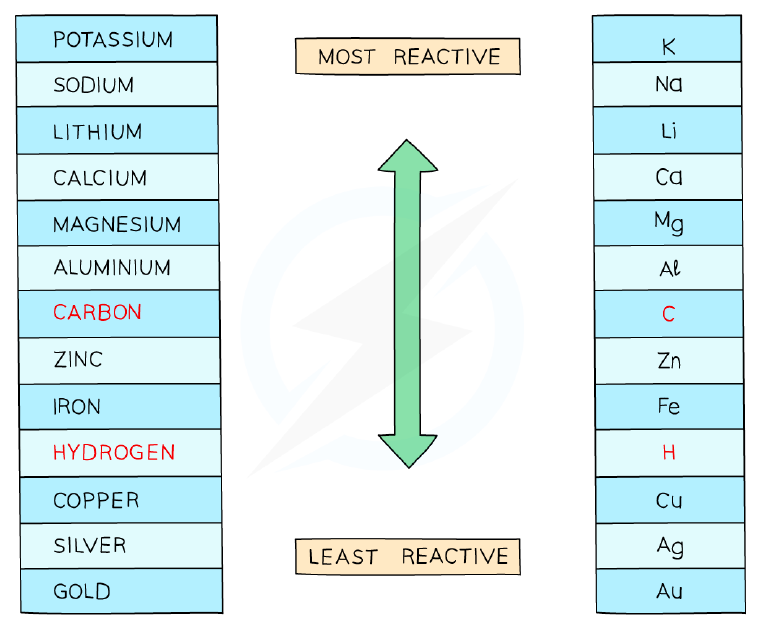
- Metals can be ranked in a reactivity series; more reactive metals displace less reactive metal ions from solution.
The reactivity series of metals
Acids with Reactive Metals
- The general reaction is: acid + metal → salt + hydrogen.
- Example: 2HCl(aq) + Zn(s) → ZnCl₂(aq) + H₂(g).
- Example: H₂SO₄(aq) + Fe(s) → FeSO₄(aq) + H₂(g).
- A salt is an ionic compound formed when the hydrogen of an acid is replaced by a metal or another positive ion.
- The extent of reaction depends on the reactivity of the metal and the strength of the acid.
- Very reactive metals react dangerously with acids; metals low in reactivity, such as copper, do not react with dilute acids.
- Stronger acids react more vigorously, showing faster effervescence and quicker metal dissolution.
- Ionic equation for zinc and hydrochloric acid: 2H⁺(aq) + Zn(s) → Zn²⁺(aq) + H₂(g); Zn is oxidised and H⁺ is reduced.
Primary Cells
- Voltaic (galvanic) cells generate electricity from spontaneous redox reactions.
- A half-cell consists of a metal electrode dipped in a solution of its own ions, setting up an equilibrium and an electrode potential.
- Example equilibrium: Zn(s) ⇌ Zn²⁺(aq) + 2e⁻.
- Electrons flow through the external circuit from the anode (oxidation) to the cathode (reduction).
- A salt bridge completes the circuit; anions migrate toward the anode and cations toward the cathode.
- Cell notation uses a single vertical line for a phase boundary and a double vertical line for a salt bridge.
- Example: Zn(s) | Zn²⁺(aq) ∥ Cu²⁺(aq) | Cu(s) Ecell = +1.10 V.
- Fuel cells continuously generate electricity from a fuel and oxygen; the hydrogen-oxygen fuel cell produces only water: 2H₂(g) + O₂(g) → 2H₂O(l) E = +1.23 V.
Secondary Cells
- Secondary (rechargeable) cells employ reversible chemical reactions; applying a voltage greater than the cell voltage reverses the reaction.
- Lead-acid batteries use lead as the negative electrode, lead(IV) oxide as the positive electrode, and sulfuric acid as the electrolyte.
- A lead-acid cell generates about 2 V; six cells in series give about 12 V.
- Lead-acid batteries are heavy, bulky, contain toxic lead and corrosive sulfuric acid, and pose disposal challenges.
- NiCad cells use cadmium as the negative electrode and a nickel(II) hydroxide-oxide system as the positive electrode; overall E = +1.2 V.
- Cadmium is toxic and NiCad cells can suffer from the memory effect, losing capacity if repeatedly recharged without full discharge.
- Lithium-ion cells use lithium cobalt oxide as the positive electrode, carbon as the negative electrode, and a solid polymer electrolyte.
- Lithium-ion cells are lightweight, deliver high voltage (3.5–4.0 V), contain no toxic heavy metals, but degrade over time and pose fire risks.
Electrolytic Cells
- Electrolysis is the splitting of an ionic compound by electricity when molten or in solution.
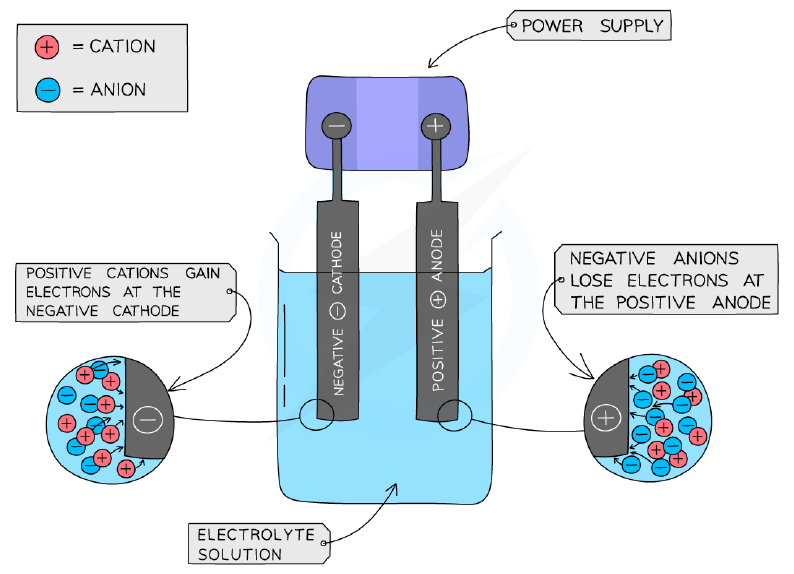
- The electrolyte contains positive and negative ions; cations move to the cathode and anions move to the anode.
- At the cathode, positive ions gain electrons (reduction); at the anode, negative ions lose electrons (oxidation).
- Electrolysis of molten lead bromide: Pb²⁺(aq) + 2e⁻ ⇌ Pb(s) at the cathode; 2Br⁻(l) ⇌ Br₂(l) + 2e⁻ at the anode.
- For molten salts, metals are always formed at the cathode and non-metals at the anode.
- In voltaic cells, the anode is negative and the cathode is positive; in electrolytic cells, the anode is positive and the cathode is negative.
- Uses of electrolysis include purifying copper, plating metals, extracting reactive metals like aluminium, and making chlorine, hydrogen and sodium hydroxide.
The basic set-up of an electrolytic cell
Oxidation of Alcohols
- Alcohols contain at least one hydroxy (-OH) group and have the general formula CₙH₂ₙ₊₁OH.
- Primary alcohols have the -OH carbon attached to one other carbon; secondary alcohols to two; tertiary alcohols to three.
- The oxidising agent for alcohols is acidified potassium dichromate(VI), K₂Cr₂O₇; the colour change is orange to green.
- Primary alcohols can be oxidised to aldehydes and further to carboxylic acids.
- Secondary alcohols are oxidised to ketones only; ketones cannot be further oxidised.
- Tertiary alcohols do not undergo oxidation because there is no hydrogen on the functional group carbon.
- Formation of a carboxylic acid uses reflux; formation of an aldehyde uses distillation to remove the lower-boiling aldehyde as it forms.
- Example: CH₃CH₂OH + 2[O] → CH₃COOH + H₂O (reflux); CH₃CH₂OH + [O] → CH₃CHO + H₂O (distillation).
Reduction of Carbonyl Compounds and Unsaturated Compounds
- Sodium borohydride, NaBH₄, is a reducing agent used to reduce aldehydes and ketones to alcohols.
- Propanone reacts with NaBH₄ to form propan-2-ol.
- Butanone reacts with NaBH₄ to form butan-2-ol.
- Reduction of a carbonyl compound (C=O) converts it to an alcohol (-OH).
- Unsaturated compounds containing C=C bonds can be reduced by addition of hydrogen.
- Example: C₂H₄ + H₂ → C₂H₆ (ethene to ethane).
ஸ்லைடுகள்
Sign up free to view the lesson slides
Step through every slide for this topic — plus flashcards and revision notes — with a free account.
பயிற்சி கேள்விகள்
இலவச முன்னோட்டம் — 60-இல் 8 கேள்விகள். அனைத்தையும் பார்க்க பதிவு செய்யவும்.
1.Which row correctly describes oxidation and reduction in terms of electron transfer and change in oxidation state?
Easy- AOxidation: gain of electrons; oxidation number decreases
- BOxidation: loss of electrons; oxidation number increases
- COxidation: loss of electrons; oxidation number decreases
- DOxidation: gain of electrons; oxidation number increases
2.Which row describes the most common oxidation numbers of fluorine, oxygen and hydrogen in compounds?
Easy- AF = -1, O = -2, H = +1
- BF = +7, O = -1, H = -1
- CF = +1, O = +2, H = +1
- DF = -7, O = -1, H = -1
3.A student added a solution of iodine to a solution of sodium bromide. Which statement correctly describes what happens?
Easy- ANo reaction occurs
- BThe bromide ions are oxidised
- CThe iodine atoms are oxidised
- DBoth the bromide and iodide ions undergo changes in their oxidation state
4.What substance will be obtained at the positive electrode (anode) when molten KBr is electrolysed?
Medium- AK(l)
- BBr(l)
- CBr2(l)
- DK(s)
5.What is the product of the reaction between propanone and sodium borohydride, NaBH4?
Medium- Apropan-1-ol
- Bpropan-2-ol
- Cpropanoic acid
- Dpentanal
6.4-methylpentanal can be formed by the oxidation of 4-methylpentan-1-ol. Which reagent is used as an oxidising agent for this conversion?
Medium- ANaBH4
- BNaOH
- CK2Cr2O7
- DLiAlH4
7.The chemistry of the Group VII elements often involves redox processes. Which of the following statements is correct?
Medium- ABromine can oxidise chloride ions
- BIodide ions are the weakest reducing agent of the first four Group VII ions
- CIn reactions with water, chlorine is oxidised and reduced
- DFluorine is a weaker oxidising agent than chlorine
8.In which of the following reactions is the species shown in bold acting as an oxidising agent?
Medium- ACr2O72- + 8H+ + 3SO32- → 2Cr3+ + 4H2O + 3SO42-
- BMg + Fe2+ → Mg2+ + Fe
- CCl2 + 2Br^- → 2Cl^- + Br2
- DFe2O3 + 3CO → 2Fe + 3CO2
Unlock all 60 questions & more
இந்த தலைப்பிற்கான ஒவ்வொரு கேள்வியையும், ஸ்லைடுகளையும், ஃப்ளாஷ் கார்டுகளையும் மற்றும் திருப்புதல் குறிப்புகளையும் பார்க்க இலவச கணக்கை உருவாக்கவும்.