How Much? The Amount Of Chemical Change
விளையாடிக் கற்றுக்கொள்ளுங்கள்
ஆற்றல் சம்பாதிக்க இந்த கேள்விகளுக்குப் பதிலளியுங்கள், பின்னர் மீன் பிடித்து ஆராயுங்கள். கணக்கு தேவையில்லை.
பாட குறிப்புகள்
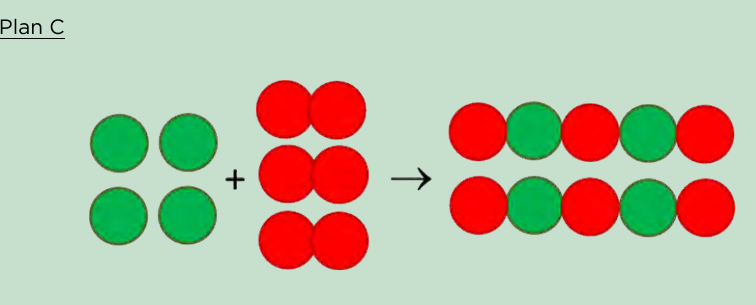
Balancing Equations
- A symbol equation uses chemical symbols to show the number and type of atoms in reactants and products; a word equation uses only words.
- Atoms cannot be created or destroyed in a chemical reaction, so the number of each atom must be the same on both sides — the equation must be balanced.
- When balancing: never change any chemical formulae; put numbers in front of formulae; do not split polyatomic ions (like SO₄²⁻ or NO₃⁻) if they appear unchanged on both sides.
- For combustion of organic compounds, balance carbon first, then hydrogen, then oxygen.
- Use state symbols: (s) solid, (l) liquid, (g) gas, (aq) aqueous.
- Some elements are diatomic in their natural state and must be written with a subscript 2: H₂, N₂, O₂, F₂, Cl₂, Br₂, I₂.
A balanced chemical equation
Reacting Mass Calculations
- The number of moles is calculated using: number of moles = mass of substance (g) / molar mass (g mol⁻¹).
- Be clear about the particle: 1 mole of CaF₂ contains 1 mole of CaF₂ formula units, but 1 mole of Ca²⁺ ions and 2 moles of F⁻ ions.
- The stoichiometry (mole ratio) from the balanced equation links the amounts of reactants and products.
- To find the mass of product: calculate moles of reactant, use the mole ratio, then convert moles to mass using mass = moles × molar mass.
- You can work in any mass unit (grams, tonnes, etc.) as long as you are consistent, because reacting masses are in proportion to the balanced equation.
Avogadro's Law & Molar Volume of Gas
- Avogadro's Law states that equal volumes of gases contain the same number of molecules, so gas volume ratios equal mole ratios.
- At STP (0 °C and 100 kPa), one mole of any gas occupies 22.7 dm³ mol⁻¹.
- Volume of gas = amount of gas (mol) × 22.7 dm³ mol⁻¹; amount of gas (mol) = volume of gas (dm³) / 22.7 dm³ mol⁻¹.
- To convert cm³ to dm³, divide by 1000.
- In gas reactions, identify the limiting reactant first if volumes are not in the same ratio as the coefficients.
- Quick method to find limiting reactant: divide the moles (or volumes) of each reactant by its coefficient; the smallest result is the limiting reactant.
Concentration Calculations
- Volumetric analysis uses a standard solution of known concentration to find the concentration of an unknown solution, usually by titration.
- In a titration, a known volume (e.g. 20 or 25 cm³) is measured with a pipette into a conical flask; the other solution is added from a burette until the indicator changes colour.
- Multiple trials are carried out until concordant results are obtained (within a small range).
- The four steps: write the balanced equation; calculate moles of the known substance; use the mole ratio; calculate the unknown amount/concentration/volume.
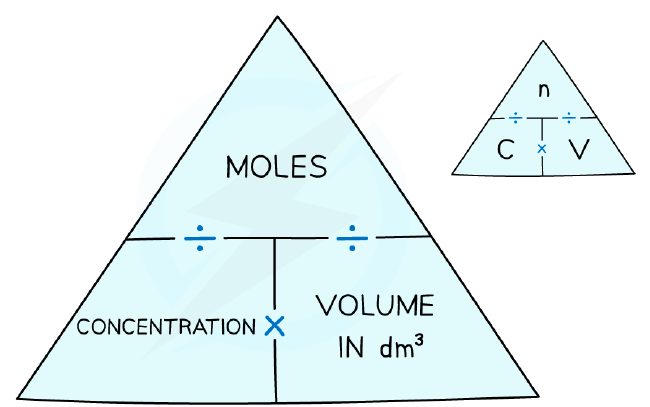
- Concentration (mol dm⁻³) = moles / volume (dm³); moles = concentration × volume (dm³).
- For monoprotic acid–base reactions, the shortcut C₁V₁ = C₂V₂ can be used (volumes in cm³ are fine as units cancel).
- Back titration: react the unknown with an excess of a reagent, then titrate the excess to find the amount of the original substance.
Concentration, moles and volume
Limiting & Excess Reactants
- The limiting reactant is the reactant that is completely used up and determines the amount of product formed.
- The excess reactant is the reactant that is not completely used up and is left over at the end.
- To find the limiting reactant: calculate moles of each reactant, then divide each by its coefficient from the balanced equation; the smallest result is limiting.
- Alternatively, compare the required mole ratio: calculate how much of one reactant is needed to fully react with the other and see which runs out first.
Percentage Yield Calculations
- The theoretical yield is the maximum amount of product possible from the limiting reactant, assuming perfect conversion.
- The experimental (actual) yield is the amount of product actually collected in the lab.
- Percentage yield = (actual yield / theoretical yield) × 100.
- The limiting reactant must be identified first to calculate the correct theoretical yield.
- Differences between theoretical and actual yield arise from side reactions, loss during transfer or purification, and incomplete reaction.
- Ensure actual and theoretical yields are in the same units before calculating percentage yield.
Atom Economy
- Atom economy measures how efficiently reactants are converted into the desired product.
- Atom economy = (molecular mass of desired product / sum of molecular masses of all reactants) × 100.
- Alternatively, atom economy = (mass of desired product / total mass of all products) × 100.
- Addition reactions always have 100% atom economy because all reactant atoms end up in the single product (e.g. CH₂=CH₂ + Br₂ → CH₂BrCH₂Br).
- A low atom economy means more waste and by-products, leading to higher environmental and economic costs.
- Atom economy is calculated from the balanced equation, not from experimental data.
- Other factors for process efficiency include rate, quantities of catalysts and solvents, energy use, and economic efficiency.
ஸ்லைடுகள்
Sign up free to view the lesson slides
Step through every slide for this topic — plus flashcards and revision notes — with a free account.
பயிற்சி கேள்விகள்
இலவச முன்னோட்டம் — 65-இல் 8 கேள்விகள். அனைத்தையும் பார்க்க பதிவு செய்யவும்.
1.Which of the following is the correct definition of the term 'limiting reactant'?
Easy- AThe reactant that is completely used up in a reaction and determines the amount of product formed
- BThe reactant that is left over at the end of a reaction
- CThe reactant that is present in the largest amount by mass
- DThe reactant that is present in the largest amount by moles
2.In a chemical reaction, atoms are created or destroyed.
EasyTrue or false?
3.Which of the following statements about atom economy are correct? (select all that apply)
Easy- AIt is a measure of how efficiently a reaction converts reactants into the desired product.
- BIt is calculated using experimental data.
- CAddition reactions typically have an atom economy of 100%.
- DA low atom economy means less waste is produced.
- EIt can be calculated using the formula: (molecular mass of desired product / sum of molecular masses of all reactants) × 100.
4.A student calculates the percentage yield of a reaction. The theoretical yield is 6.5 g and the actual yield is 5.8 g. What is the percentage yield?
Medium- A89.2%
- B112%
- C10.8%
- D89.2 g
5.A sample of marble contains calcium carbonate. 27.20 cm³ of 0.200 mol dm⁻³ HCl was added to 0.188 g of marble. The excess acid required 23.80 cm³ of 0.100 mol dm⁻³ NaOH for neutralisation. What is the percentage by mass of calcium carbonate in the marble?
Medium- A81.5%
- B18.5%
- C40.8%
- D95.0%
6.In a titration, concordant results are those that are within a small range of each other, typically within 0.10 cm³.
EasyTrue or false?
7.Match each term with its correct definition.
Easy- Limiting reactant
- Theoretical yield
- Atom economy
- The maximum amount of product that can be formed from a given amount of reactants, assuming perfect conversion.
- A measure of how efficiently a reaction converts reactants into the desired product.
- The reactant that is completely used up in a reaction and determines the amount of product formed.
8.Place the following steps in the correct order for carrying out a titration.
Easy- Rinse the burette with the solution it will contain and fill it.
- Measure a known volume of the solution into a conical flask using a pipette.
- Add a few drops of indicator to the conical flask.
- Slowly add the solution from the burette until the indicator changes colour.
- Repeat the titration until concordant results are obtained.
Unlock all 65 questions & more
இந்த தலைப்பிற்கான ஒவ்வொரு கேள்வியையும், ஸ்லைடுகளையும், ஃப்ளாஷ் கார்டுகளையும் மற்றும் திருப்புதல் குறிப்புகளையும் பார்க்க இலவச கணக்கை உருவாக்கவும்.