Gravitational Fields
விளையாடிக் கற்றுக்கொள்ளுங்கள்
ஆற்றல் சம்பாதிக்க இந்த கேள்விகளுக்குப் பதிலளியுங்கள், பின்னர் மீன் பிடித்து ஆராயுங்கள். கணக்கு தேவையில்லை.
பாட குறிப்புகள்
Newton's Law of Gravitation
- Newton's law of gravitation states that the gravitational force between two point masses is proportional to the product of the masses and inversely proportional to the square of their separation.
- Equation: F = Gm₁m₂ / r², where F is the gravitational force (N), G is Newton's gravitational constant, m₁ and m₂ are the masses (kg), and r is the distance between their centres (m).
- The inverse square law means that if the separation is doubled, the force reduces by a factor of (½)² = ¼.
- The law applies to point masses, but planets and stars can be treated as point masses because their separation is much larger than their radii.
- The distance r is always measured from the centre of mass of each body, so for an object on or above a planet's surface, r = planet's radius + height above surface.
Gravitational Field Strength
- A gravitational field is a region of space where a test mass experiences a force due to the gravitational attraction of another mass.
- Gravitational field strength (g) at a point is defined as the force per unit mass experienced by a test mass at that point: g = F / m.
- The unit of g is N kg⁻¹.
- From equating F = mg with Newton's law, g = GM / r², where M is the mass producing the field and r is the distance from its centre.
- The field strength g depends only on the mass M producing the field, so all objects in that field experience the same g regardless of their own mass.
- g is inversely proportional to the square of the radial distance: g ∝ 1/r².
- Factors affecting g at a planet's surface are its radius and its mass (or density).
Gravitational Field Strength
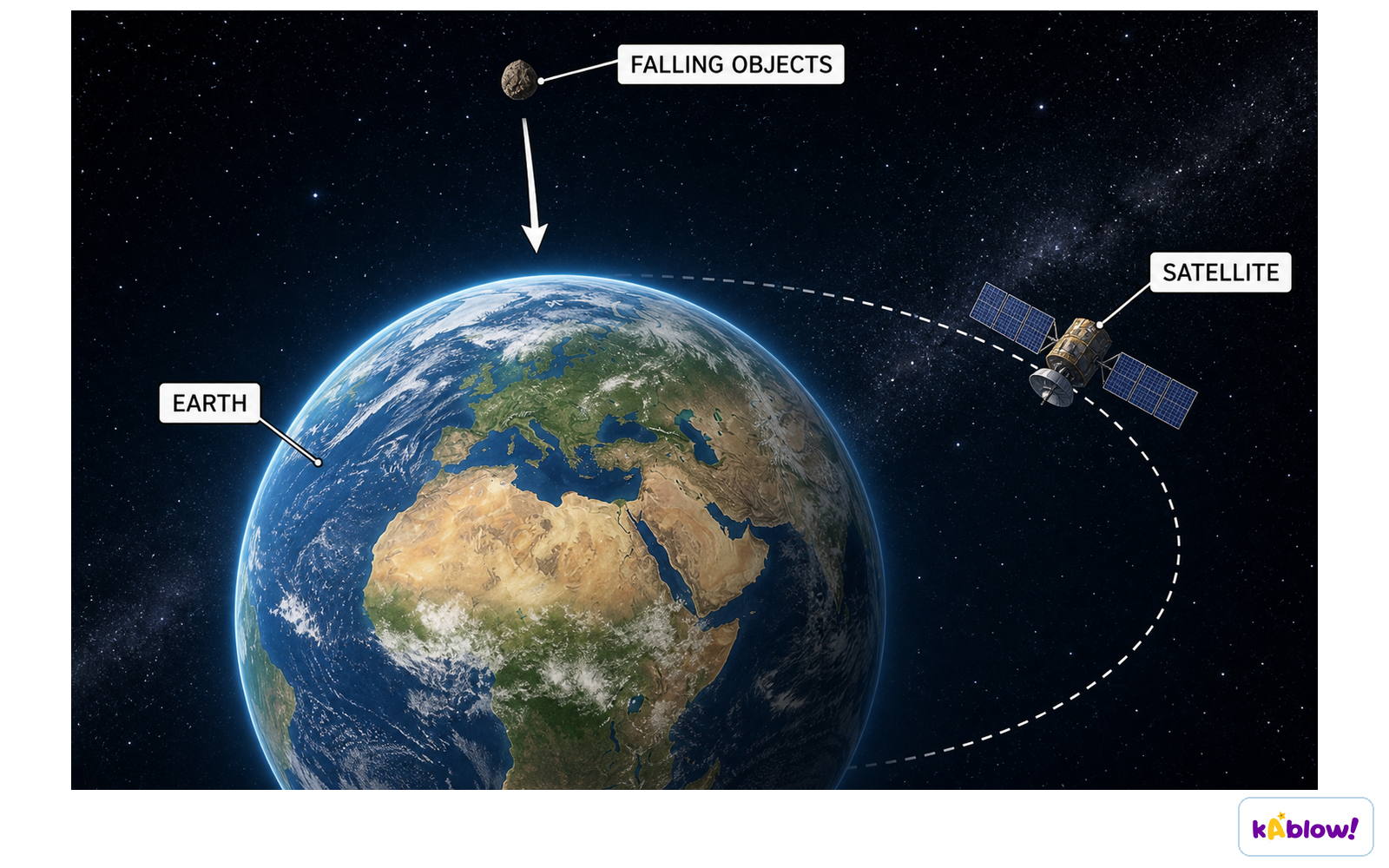
Gravitational Field Lines
- Gravitational field lines show the direction of the gravitational force that would act on a mass placed at that point.
- Field lines are always directed towards the centre of mass of the body because gravitational forces are always attractive.
- The gravitational field around a point mass is radial, with field lines pointing radially inwards.
- A uniform field (e.g. near the Earth's surface) is represented by equally spaced parallel field lines; g is the same throughout.
- Radial fields are non-uniform: g depends on the distance from the centre of mass.
- For a uniform sphere, the field outside it is identical to that of a point mass at its centre.
Gravitational Potential
- Gravitational potential (Vg) at a point is the work done per unit mass in bringing a test mass from infinity to that point.
- Unit: J kg⁻¹.
- Equation: Vg = − GM / r, where M is the mass producing the field and r is the distance from its centre.
- Gravitational potential is always negative because it is defined as zero at infinity, and work must be done to move a mass away from the body towards infinity.
- As r decreases (closer to the planet), Vg becomes more negative (smaller).
- As r increases (further away), Vg becomes less negative (larger), approaching zero at infinity.
- Gravitational potential is a scalar quantity, unlike gravitational field strength which is a vector.
Gravitational Potential Energy
- Gravitational potential energy (Ep) of two point masses is the work done to assemble the system from infinite separation: Ep = − Gm₁m₂ / r.
- Near the Earth's surface, where the field is approximately uniform, Ep = mgΔh.
- The change in GPE when a mass moves between two distances r₁ and r₂ is: ΔEp = Gm₁m₂ (1/r₁ − 1/r₂).
- The change in gravitational potential between two points is: ΔVg = Gm₁ (1/r₁ − 1/r₂).
- The work done in moving a mass m through a potential difference ΔVg is: ΔW = mΔVg.
- The area under a force–distance graph for a gravitational field represents the work done (change in GPE).
- Work is done when a mass moves against the gravitational field lines (away from the planet).
Gravitational Potential Gradient
- The gravitational field strength at a point is equal to the negative gradient of a potential–distance graph at that point: g = − ΔVg / Δr.
- The potential gradient is the rate of change of gravitational potential with respect to displacement in the direction of the field.
- For a planet, the graph of Vg against r follows a −1/r relation and all values of Vg are negative.
- The gradient of the Vg–r graph at any point gives the value of g at that point.
- To find g from the graph, draw a tangent at the point and calculate its gradient.
Gravitational Equipotential Surfaces
- Equipotential lines (2D) or surfaces (3D) join points that have the same gravitational potential.
- They are always perpendicular to the gravitational field lines.
- In a radial field, equipotential lines are concentric circles around the planet and become further apart as distance increases.
- In a uniform field, equipotential lines are horizontal, parallel, and equally spaced.
- No work is done when moving along an equipotential surface; work is only done when moving between different equipotential surfaces (ΔV = 0 along an equipotential).
Kepler's Laws of Planetary Motion
- Kepler's First Law: The orbit of a planet is an ellipse, with the Sun at one of the two foci.
- Kepler's Second Law: A line segment joining the Sun to a planet sweeps out equal areas in equal time intervals; consequently, planets move faster nearer the Sun and slower further away.
- Kepler's Third Law: For planets or satellites in circular orbit about the same central body, the square of the time period is proportional to the cube of the orbital radius: T² ∝ r³.
- The relationship between T and r is: T² = (4π² r³) / (GM), where M is the mass of the central body.
- A graph of log T against log r gives a straight line, since 2 log T ∝ 3 log r.
Escape Speed
- Escape speed is the minimum speed that will allow an object to escape a gravitational field with no further energy input.
- It is the same for all masses in the same gravitational field (e.g. a rocket and a tennis ball on Earth).
- Escape speed is derived by equating kinetic energy to gravitational potential energy: ½ m vesc² = GMm / r.
- The mass m cancels, giving: vesc = √(2GM / r).
- Escape speed depends on the mass and radius of the object creating the field (planet, moon, or black hole).
- Rockets launched from Earth do not need to reach escape velocity to enter orbit; they are continuously given energy by fuel and thrust.
Orbital Motion, Speed & Energy
- For a satellite in circular orbit, the gravitational force provides the centripetal force: GMm / r² = mv² / r.
- The mass of the satellite cancels, giving orbital speed: v = √(GM / r).
- All satellites, regardless of their mass, travel at the same speed in a particular orbit radius.
- An orbiting satellite has both kinetic energy (Ek) and gravitational potential energy (Ep); its total energy is constant.
- For a smaller orbital radius: gravitational force is larger, speed is higher, Ek is greater, Ep is lower, and orbital period T is shorter.
- For a larger orbital radius: gravitational force is smaller, speed is lower, Ek is lower, Ep is greater, and orbital period T is longer.
- Total energy = Ek + Ep; as orbital radius decreases, Ek increases and Ep decreases.
Effects of Drag on Orbital Motion
- Satellites in low orbits (<600 km) may experience viscous drag (air resistance) due to the very low but non-zero density of the upper atmosphere.
- Drag causes a small dissipation of kinetic energy into thermal energy due to friction between air particles and the satellite's surface.
- As a satellite loses energy, its orbital radius decreases and it spirals towards the Earth.
- As the orbit becomes lower, some potential energy is transferred to kinetic energy, so the satellite's speed increases.
- The increased speed in a lower orbit leads to greater air resistance and greater dissipation of kinetic energy.
- The satellite's total energy decreases if the overall decrease in potential energy is larger than the overall increase in kinetic energy: ΔEtotal < 0 if ΔEp > ΔEk.
ஸ்லைடுகள்
Sign up free to view the lesson slides
Step through every slide for this topic — plus flashcards and revision notes — with a free account.
பயிற்சி கேள்விகள்
இலவச முன்னோட்டம் — 58-இல் 8 கேள்விகள். அனைத்தையும் பார்க்க பதிவு செய்யவும்.
1.Which of the following best defines a gravitational field?
Easy- AA region of space where a test mass experiences a force due to the gravitational attraction of another mass
- BA region of space where a test mass experiences a repulsive force
- CThe force per unit mass experienced by a test mass
- DThe work done per unit mass in bringing a test mass from infinity
2.Which equation correctly represents Newton's law of gravitation?
Easy- AF = G m1 m2 / r2
- BF = G m1 m2 / r
- CF = G m1 m2 r2
- DF = m g
3.Which of the following statements about gravitational field lines are correct? (select all that apply)
Medium- AThey point towards the centre of mass of a body
- BThey are always directed radially outwards
- CThey can be used to represent the direction of the gravitational force on a mass placed in the field
- DThey are equally spaced in a uniform field
- EThey are always straight lines
4.Gravitational forces are always attractive.
EasyTrue or false?
5.Gravitational potential is a vector quantity.
EasyTrue or false?
6.Match each term with its correct definition.
Medium- Gravitational field strength
- Gravitational potential
- Escape speed
- The force per unit mass experienced by a test mass at a point
- The work done per unit mass in bringing a test mass from infinity to a point
- The minimum speed that will allow an object to escape a gravitational field with no further energy input
7.Place the following steps in the correct order to derive the equation for escape speed from a planet of mass M and radius r.
Medium- Set kinetic energy equal to gravitational potential energy: 1/2 m vesc2 = GMm/r
- Cancel the mass m from both sides
- Rearrange to make vesc the subject: vesc = √(2GM/r)
8.Match each gravitational quantity with its correct SI unit.
Medium- Gravitational force
- Gravitational field strength
- Gravitational potential
- Gravitational potential energy
- N
- N kg⁻¹
- J kg⁻¹
- J
Unlock all 58 questions & more
இந்த தலைப்பிற்கான ஒவ்வொரு கேள்வியையும், ஸ்லைடுகளையும், ஃப்ளாஷ் கார்டுகளையும் மற்றும் திருப்புதல் குறிப்புகளையும் பார்க்க இலவச கணக்கை உருவாக்கவும்.