Induction
விளையாடிக் கற்றுக்கொள்ளுங்கள்
ஆற்றல் சம்பாதிக்க இந்த கேள்விகளுக்குப் பதிலளியுங்கள், பின்னர் மீன் பிடித்து ஆராயுங்கள். கணக்கு தேவையில்லை.
பாட குறிப்புகள்
Induced Emf
- Electromagnetic induction occurs when an e.m.f. is induced due to relative movement between a conductor and a magnetic field.
- This can happen when a conductor moves relative to a magnetic field, or when a magnetic field varies relative to a conductor.
- When a conductor cuts through magnetic field lines, free electrons experience a magnetic force, work is done to separate charges, and an e.m.f. is induced.
- The induced e.m.f. is defined as the work done per unit charge in separating charges to the ends of a conductor.
- If the conductor is part of a closed circuit, an induced current will flow.
- For a straight conductor of length L moving perpendicular to a uniform magnetic field B at speed v, the induced e.m.f. is ε = BLv.
- For a coil with N turns moving through a magnetic field, the induced e.m.f. is ε = BLvN.
- The magnitude of the induced e.m.f. increases if the conductor length in the field increases, the magnetic field strength increases, or the conductor cuts field lines faster.
Demonstrating Induction
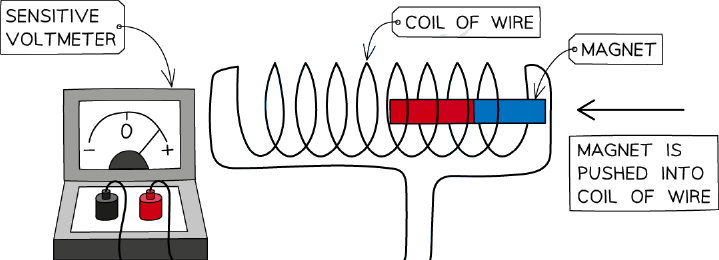
- Experiment 1: Moving a bar magnet through a coil connected to a voltmeter induces an e.m.f. only while the magnet is moving.
- When the magnet is stationary, the voltmeter reads zero because the rate of change of flux is zero.
- When the magnet moves into the coil, a reading is observed; when it is removed, the reading is in the opposite direction.
- Increasing the speed of the magnet increases the magnitude of the induced e.m.f. because the rate of change of flux increases.
- Experiment 2: Moving a wire between two magnets induces an e.m.f. only while the wire is moving.
- The magnitude of the induced e.m.f. increases with the length of wire, the speed of movement, and the strength of the magnets.
Electromagnetic induction
Magnetic Flux
- Magnetic flux is the product of the magnetic flux density and the cross-sectional area perpendicular to the field.
- It is calculated using Φ = BA when the field is perpendicular to the area.
- The unit of magnetic flux is the weber (Wb).
- Magnetic flux is maximum when the field lines are perpendicular to the plane of the area (θ = 0°).
- Magnetic flux is zero when the field lines are parallel to the plane of the area (θ = 90°).
- When the field is not perpendicular, the component of B perpendicular to the area is used: Φ = BA cos θ, where θ is the angle between the field lines and the normal to the area.
Magnetic Flux Linkage
- Magnetic flux linkage is the product of magnetic flux and the number of turns of a coil.
- It is calculated using NΦ = BAN.
- The unit of magnetic flux linkage is the weber turn (Wb turns).
- An e.m.f. is induced when the magnetic flux linkage changes with respect to time.
- This occurs when there is a change in magnetic flux density B, cross-sectional area A, or angle θ.
- For a rotating coil, flux linkage is given by NΦ = BAN cos θ.
Faraday's Law of Induction
- Faraday's law states that the magnitude of an induced e.m.f. is directly proportional to the rate of change of magnetic flux linkage.
- It is expressed as ε = N (ΔΦ / Δt).
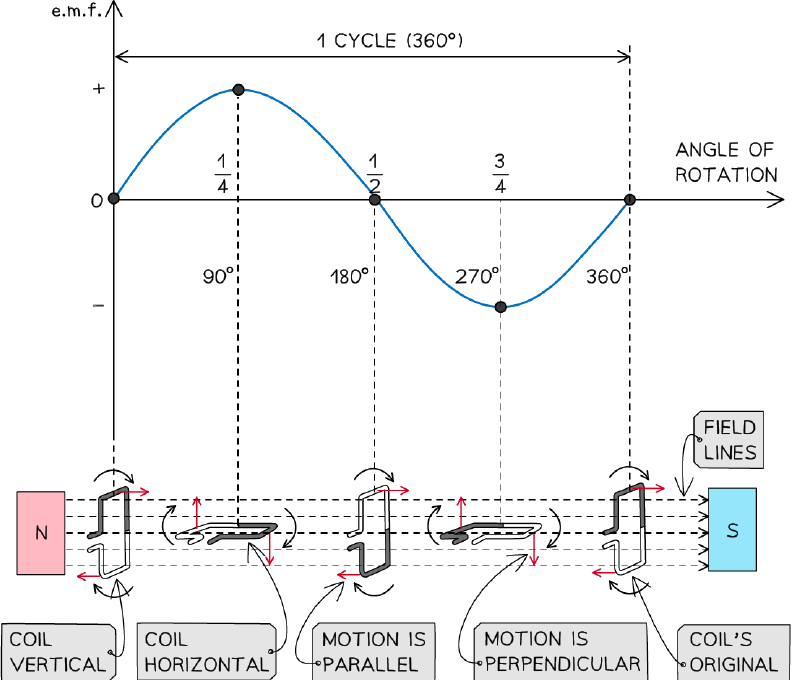
- When a coil is vertical relative to the field lines, flux linkage is maximum and no e.m.f. is induced.
- When a coil is horizontal relative to the field lines, flux linkage is zero and the e.m.f. is maximum.
- The induced e.m.f. varies sinusoidally and is 90° out of phase with the flux linkage.
Lenz's Law
- Lenz's law states that the induced e.m.f. is such that it will oppose the change causing it.
- It is a consequence of the principle of conservation of energy.
- Combined with Faraday's law, it is given by ε = −N (ΔΦ / Δt).
- The negative sign indicates that the induced e.m.f. opposes the change in magnetic flux.
- When a magnet approaches a coil, the coil induces a pole to repel the magnet; when the magnet leaves, the coil induces a pole to attract it.
- Work must be done to overcome the opposing force, which is consistent with energy conservation.
Self Induction and Mutual Induction
- Self-induction is the effect in which a change in current in a circuit induces an e.m.f. that opposes the change in current in the same circuit.
- The induced e.m.f. in self-induction is called a back e.m.f. and is proportional to the negative rate of change of current.
- Mutual induction is the effect in which a change in current in one circuit induces an e.m.f. in a neighbouring circuit.
- An important application of mutual induction is the transformer.
- A transformer changes high alternating voltage at low current to low alternating voltage at high current, and vice versa.
- A transformer consists of a primary coil, a secondary coil, and a soft iron core.
- A step-up transformer has more turns in the secondary coil than the primary; a step-down transformer has more turns in the primary coil.
AC Generators
- An AC generator converts mechanical energy into electrical energy in the form of alternating current.
- It consists of a coil rotating in a uniform magnetic field, connected to a centre-reading meter via slip rings and brushes.
- The induced e.m.f. and current alternate direction as the coil rotates.
- The maximum e.m.f. occurs when the coil cuts through the most field lines (plane parallel to field).
- The flux linkage is given by NΦ = BAN cos ωt, where ω is the angular speed.
- The induced e.m.f. is given by ε = ε₀ sin ωt or ε = BANω sin ωt.
- Increasing the frequency of rotation increases both the frequency and the amplitude of the alternating voltage.
- Doubling the angular speed doubles the maximum induced e.m.f. and doubles the frequency.
The relationship between the rotation of a coil in a magnetic field and the induced e.m.f. in an AC generator
ஸ்லைடுகள்
Sign up free to view the lesson slides
Step through every slide for this topic — plus flashcards and revision notes — with a free account.
பயிற்சி கேள்விகள்
இலவச முன்னோட்டம் — 63-இல் 8 கேள்விகள். அனைத்தையும் பார்க்க பதிவு செய்யவும்.
1.A coil is connected to a galvanometer. A magnet is held at rest inside the coil. What is the reading on the galvanometer?
Easy- AZero, because there is no change in magnetic flux linkage
- BA constant non-zero value, because the magnet is inside the coil
- CA value that increases steadily with time
- DA value that alternates direction
2.An e.m.f. is induced in a conductor whenever it is placed in a magnetic field.
EasyTrue or false?
3.Which of the following will increase the magnitude of the e.m.f. induced in a coil? (select all that apply)
Medium- AMoving the magnet faster through the coil
- BAdding more turns to the coil
- CIncreasing the strength of the bar magnet
- DHolding the magnet still inside the coil
- EUsing a coil with a larger resistance
4.What is the definition of magnetic flux?
Medium- AThe product of the magnetic flux density and the cross-sectional area perpendicular to the magnetic field
- BThe product of the magnetic flux density and the number of turns of a coil
- CThe rate of change of magnetic flux linkage
- DThe force per unit charge on a moving charge in a magnetic field
5.A rectangular coil rotates in a uniform magnetic field. At what orientation is the magnetic flux linkage through the coil a maximum?
Medium- AWhen the plane of the coil is perpendicular to the field lines
- BWhen the plane of the coil is parallel to the field lines
- CWhen the plane of the coil is at 45° to the field lines
- DThe flux linkage is constant at all orientations
6.When the plane of a coil is parallel to the magnetic field lines, the induced e.m.f. in the coil is at a maximum.
EasyTrue or false?
7.A straight conductor of length 0.30 m moves perpendicular to a uniform magnetic field of flux density 2.0 T at a speed of 2.5 m s⁻¹. What is the magnitude of the induced e.m.f.?
Medium- A1.5 V
- B0.15 V
- C6.0 V
- D0.60 V
8.Match each term with its correct definition.
Medium- Magnetic flux
- Magnetic flux linkage
- Faraday's law
- Lenz's law
- The product of magnetic flux density and cross-sectional area perpendicular to the field
- The product of magnetic flux and the number of turns of a coil
- The magnitude of an induced e.m.f. is directly proportional to the rate of change of magnetic flux linkage
- The induced e.m.f. is such that it will oppose the change causing it
Unlock all 63 questions & more
இந்த தலைப்பிற்கான ஒவ்வொரு கேள்வியையும், ஸ்லைடுகளையும், ஃப்ளாஷ் கார்டுகளையும் மற்றும் திருப்புதல் குறிப்புகளையும் பார்க்க இலவச கணக்கை உருவாக்கவும்.