Structure Of The Atom
விளையாடிக் கற்றுக்கொள்ளுங்கள்
ஆற்றல் சம்பாதிக்க இந்த கேள்விகளுக்குப் பதிலளியுங்கள், பின்னர் மீன் பிடித்து ஆராயுங்கள். கணக்கு தேவையில்லை.
பாட குறிப்புகள்
Rutherford's Gold Foil Experiment
- Rutherford's gold foil experiment provided evidence for the structure of the atom by firing high-energy α particles at a thin gold foil and detecting the angles of deflection.
- The apparatus consisted of: a source of α particles in a lead container, a thin gold foil, a movable detector, and an evacuated chamber.
- The lead container produced a collimated beam of α particles because α particles are absorbed by lead, so a narrow hole allowed a concentrated beam to escape.
- The gold foil had to be extremely thin (about 10⁻⁶ m) because a thicker foil would stop the α particles completely; gold was chosen for its malleability.
- The evacuated chamber prevented α particles from colliding with air molecules, as α particles are highly ionising and travel only about 5 cm in air.
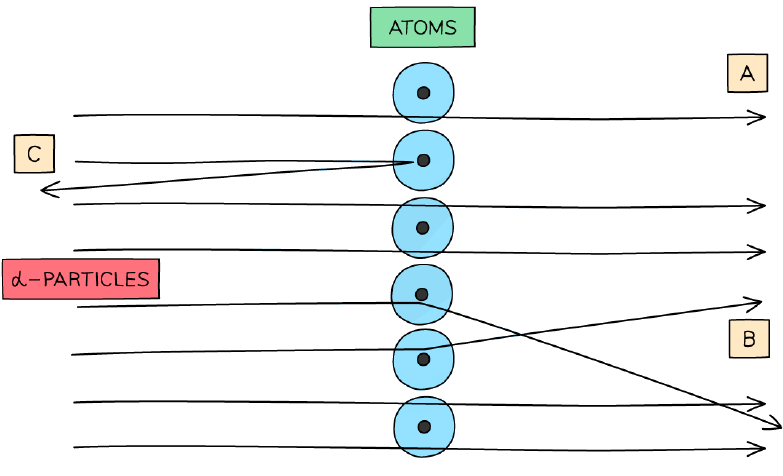
- Observations: most α particles passed straight through (atom is mostly empty space); some deflected through small angles <10° (positive nucleus at centre); a small number deflected back >90° (nucleus is extremely small and contains most mass and charge).
- Conclusion: atoms consist of a small, dense, positively charged nucleus surrounded by negatively charged electrons; the atom is about 100,000 times larger than the nucleus.
Nuclear Notation
- Atoms are made of three subatomic particles: protons, neutrons, and electrons.
- Protons and neutrons are found in the nucleus, while electrons orbit the nucleus.
- Charge can be expressed in coulombs (C) or units of elementary charge (e); mass can be expressed in kilograms (kg) or atomic mass units (u).
- Proton: charge +1.60 × 10⁻¹⁹ C (+1e), mass 1.673 × 10⁻²⁷ kg (1.007276 u).
- Neutron: charge 0, mass 1.675 × 10⁻²⁷ kg (1.008665 u).
- Electron: charge −1.60 × 10⁻¹⁹ C (−1e), mass 9.109 × 10⁻³¹ kg (0.000549 u).
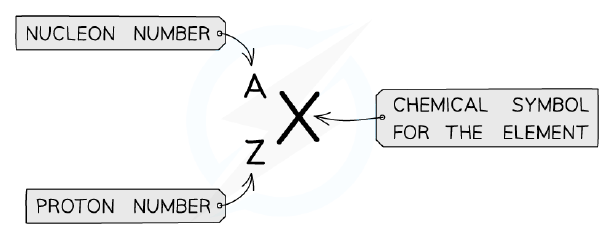
- A nucleus is described using ZA X notation: A is the nucleon (mass) number (total protons + neutrons) and Z is the proton (atomic) number (total protons).
Nuclide notation
Emission & Absorption Spectra
- Atomic spectra are observed when atoms emit or absorb light of certain wavelengths, providing evidence that electrons can only transition between discrete energy levels.
- Emission spectra are produced by heating a low-pressure gas: electrons are excited to higher levels, then emit photons when they transition back down, producing coloured lines on a black background.
- Absorption spectra are produced by passing white light through a cool, low-pressure gas: photons with the exact energy required to excite electrons are absorbed, producing dark lines on a coloured background.
- The dark lines in an absorption spectrum correspond to the same wavelengths as the bright lines in the emission spectrum of the same element.
- Each element produces a unique pattern of spectral lines, so elements can be identified by their atomic spectrum (like a fingerprint).
- Examples: hydrogen has strong red lines at 656 nm; sodium produces yellow lines at 589 nm; mercury has most lines below 450 nm, giving blue light.
- In a fluorescent tube, an electrical discharge excites electrons in vapourised atoms; when electrons return to the ground state, they emit specific wavelengths of light.
Photon Energy
- A photon is defined as a massless "packet" or "quantum" of electromagnetic energy; energy is transferred in discrete packets, not continuously.
- Electrons in an atom occupy certain energy levels; they occupy the lowest possible energy level (ground state) for stability.
- Excitation: an electron moves to a higher energy level by absorbing a photon; the atom is in an excited state.
- De-excitation: an electron moves to a lower energy level by emitting a photon.
- Ionisation: an electron is removed from an atom; the ionisation energy is the minimum energy required to remove an electron from the ground state.
- Energy levels are represented as horizontal lines: the bottom line (most negative energy) is the ground state, lines above are excited states, and the top line (0 V or infinity) represents the ionisation energy.
- Photon energy is calculated using E = hf or E = hc/λ, where h = Planck's constant (J s), c = speed of light (m s⁻¹), f = frequency (Hz), λ = wavelength (m).
- The energy difference between two levels is ΔE = hf = E₂ − E₁; the larger the energy difference, the shorter the wavelength.
Rutherford Scattering & Nuclear Radius
- The nuclear radius R depends on the nucleon number A: R = R₀ A^(1/3), where R₀ = 1.20 × 10⁻¹⁵ m is the Fermi radius (radius of a hydrogen nucleus, A = 1).
- Nuclear volume V = (4/3)πR³ = (4/3)πR₀³ A, so V is proportional to the mass of the nucleus m = Au, where u is the atomic mass unit.
- Nuclear density is given by ρ = 3u / (4πR₀³); since A cancels, density is the same for all nuclei and independent of radius.
- Nuclear density is of the order 10¹⁷ kg m⁻³, significantly larger than atomic density, showing the nucleus contains most of the atom's mass and the atom is predominantly empty space.
- In the Rutherford scattering experiment, α particles are fired at a thin gold foil; some come straight back due to electrostatic repulsion between the α particle and the gold nucleus.
- At the point of closest approach d, the α particle's initial kinetic energy equals the electric potential energy: Ek = Ep = kQq/d = k(2e)(Ze)/d.
- Rearranging gives d = k(2Ze²)/Ek, which gives a value for the radius of the nucleus (assuming high-energy α particles).
- The charge of an α particle is 2e (2 protons); the charge of a target nucleus is Ze, where Z is the proton number.
Deviations from Rutherford Scattering
- Rutherford's model predicted that as the scattering angle increases, the number of α particles scattered at that angle decreases; this holds at low to moderately high energies.
- At very high energies (>27.5 MeV), significant deviations occur: the number of back-scattered α particles sharply decreases to zero instead of following the predicted relationship.
- Rutherford's original model assumed α particles interact only through electrostatic repulsion.
- If α particle energy exceeds 27.5 MeV, they get close enough to interact with the nucleus via the strong nuclear force.
- Factoring in the strong nuclear force explains the observed scattering pattern, so deviations provide evidence for the strong nuclear force.
- Deviations are greatest when α particles have high energies and target nuclei have low nucleon number (e.g., aluminium vs gold).
- At very small separations (<1.5 fm), the strong nuclear force becomes significant.
Rutherford's Alpha Scattering Experiment
The Bohr Model of Hydrogen
- Hydrogen is the simplest atom, ideal for investigating electron energy levels; its line spectra show electrons transition between specific energy levels, producing photons of specific energies.
- Transitions are grouped into series: Lyman series converges on n = 1 (ultraviolet, highest energy photons); Balmer series converges on n = 2; Ritz-Paschen on n = 3; Pfund series converges on n = 5 (infrared, lowest energy photons).
- The Bohr model states that electrons can only move in fixed orbits and the orbital radius is restricted to certain values.
- The discrete energy levels of hydrogen are given by E = −13.6/n² eV, where n is an integer (1, 2, 3, ...).
- Angular momentum is quantised: L = n(h/2π), where n is an integer, h is Planck's constant; angular momentum for an electron in a circular orbit is constant.
- de Broglie proposed that an electron with momentum p = mv has a wavelength λ = h/p; for a circular orbit, the matter wave must form a standing wave with constructive interference.
- The condition for a standing wave is nλ = 2πr, leading to the Bohr condition: nh/2π = mvr.
- A limitation of the Bohr model is that it cannot explain the spectra of atoms with more than one electron.
ஸ்லைடுகள்
Sign up free to view the lesson slides
Step through every slide for this topic — plus flashcards and revision notes — with a free account.
பயிற்சி கேள்விகள்
இலவச முன்னோட்டம் — 63-இல் 8 கேள்விகள். அனைத்தையும் பார்க்க பதிவு செய்யவும்.
1.Which of the following is the correct definition of an isotope?
Easy- AAtoms of the same element with the same number of protons but different numbers of neutrons
- BAtoms of different elements with the same nucleon number
- CAtoms of the same element with the same number of neutrons but different numbers of protons
- DAtoms that have lost or gained electrons to become charged
2.In the notation for a nuclide, what does the top number A represent?
Easy- AThe total number of protons and neutrons in the nucleus
- BThe total number of protons in the nucleus
- CThe total number of neutrons in the nucleus
- DThe total number of electrons in the atom
3.Which subatomic particle has a relative charge of +1 and a mass of approximately 1 u?
Easy- AProton
- BNeutron
- CElectron
- Dα particle
4.In Rutherford's gold foil experiment, what observation led him to conclude that the atom is mostly empty space?
Medium- AMost α particles passed straight through the foil undeflected.
- BA small number of α particles were deflected through angles greater than 90°.
- CSome α particles were deflected through small angles of less than 10°.
- Dα particles were absorbed by the gold foil.
5.Which statement about nuclear density is correct?
Medium- AIt is the same for all nuclei and independent of the nuclear radius.
- BIt increases as the nucleon number increases.
- CIt decreases as the nucleon number increases.
- DIt is proportional to the volume of the nucleus.
6.An emission spectrum consists of:
Medium- ABright coloured lines on a dark background
- BDark lines on a continuous coloured background
- CA continuous spectrum of all wavelengths
- DA single bright line
7.Which of the following gives the energy of a photon in terms of its wavelength λ?
Medium- AE = hc/λ
- BE = hλ/c
- CE = hf
- DE = λ/hc
8.In the Bohr model of the hydrogen atom, the energy of an electron in level n is given by E = −13.6/n² eV. What is the energy of the electron in the ground state?
Medium- A−13.6 eV
- B−3.4 eV
- C−1.51 eV
- D0 eV
Unlock all 63 questions & more
இந்த தலைப்பிற்கான ஒவ்வொரு கேள்வியையும், ஸ்லைடுகளையும், ஃப்ளாஷ் கார்டுகளையும் மற்றும் திருப்புதல் குறிப்புகளையும் பார்க்க இலவச கணக்கை உருவாக்கவும்.