Wave Phenomena
விளையாடிக் கற்றுக்கொள்ளுங்கள்
ஆற்றல் சம்பாதிக்க இந்த கேள்விகளுக்குப் பதிலளியுங்கள், பின்னர் மீன் பிடித்து ஆராயுங்கள். கணக்கு தேவையில்லை.
பாட குறிப்புகள்
Wavefronts & Rays
- Wavefronts are lines joining all points that oscillate in phase and are perpendicular to the direction of motion and energy transfer.
- Rays are lines showing the direction of motion and energy transfer of the wave, perpendicular to the wavefront.
- A surface wave propagates in two dimensions and has circular wavefronts, like ripples on water.
- A spherical wave propagates in three dimensions and has spherical wavefronts, such as sound or light.
- The distance between successive peak wavefronts (or trough wavefronts) equals the wavelength of the waves.
- In diagrams, peaks are often shown with a darker line and troughs with a fainter line; some diagrams show only peak wavefronts.
Reflection, Refraction & Transmission
- When waves meet a boundary between two media, they can be reflected, refracted, transmitted or absorbed.
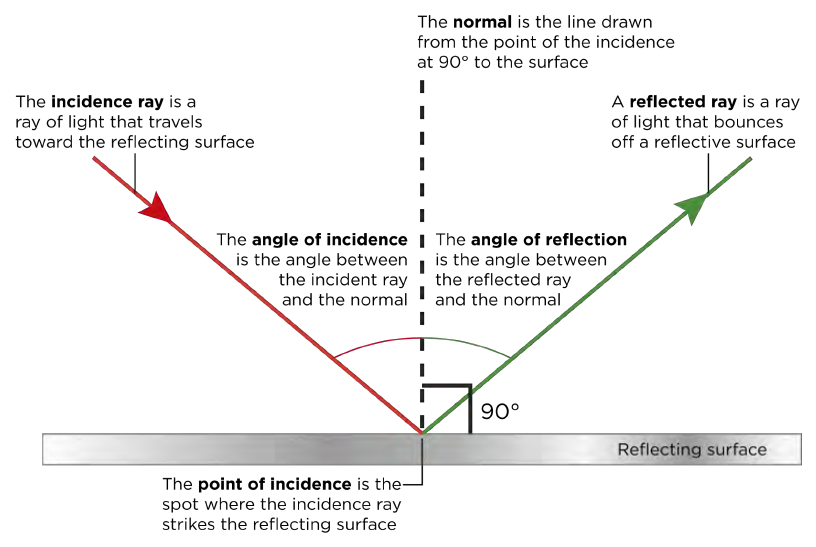
- Reflection occurs when a wave bounces back into the original medium; the law of reflection states angle of incidence = angle of reflection.
- The angle of incidence is measured between the incident ray and the normal (a line at 90° to the boundary).
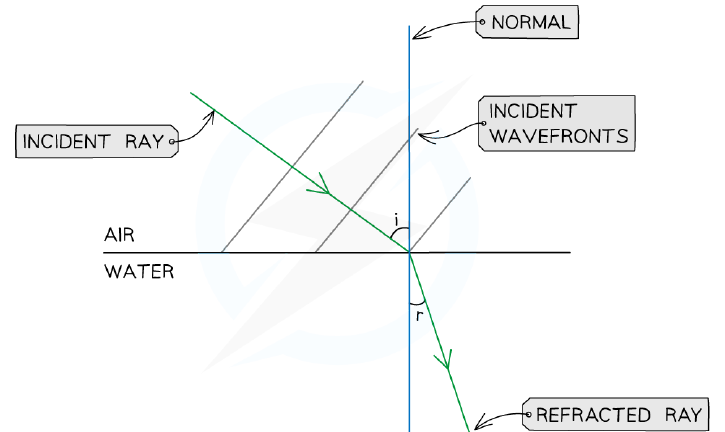
- Refraction is the change in direction of a wave when it crosses a boundary between media of different densities, caused by a change in wave speed.
- When light passes from a less dense to a more dense medium (e.g. air → glass), it slows down, has a shorter wavelength, and bends towards the normal.
- When light passes from a more dense to a less dense medium (e.g. glass → air), it speeds up, has a longer wavelength, and bends away from the normal.
- During refraction, speed and wavelength change but frequency remains the same (the colour of light does not change).
- Transmission is the general term for a wave passing through a substance; refraction is a type of transmission. During transmission, frequency and speed do not change, but amplitude may decrease if absorption occurs.
Reflection of light
Diffraction of Waves
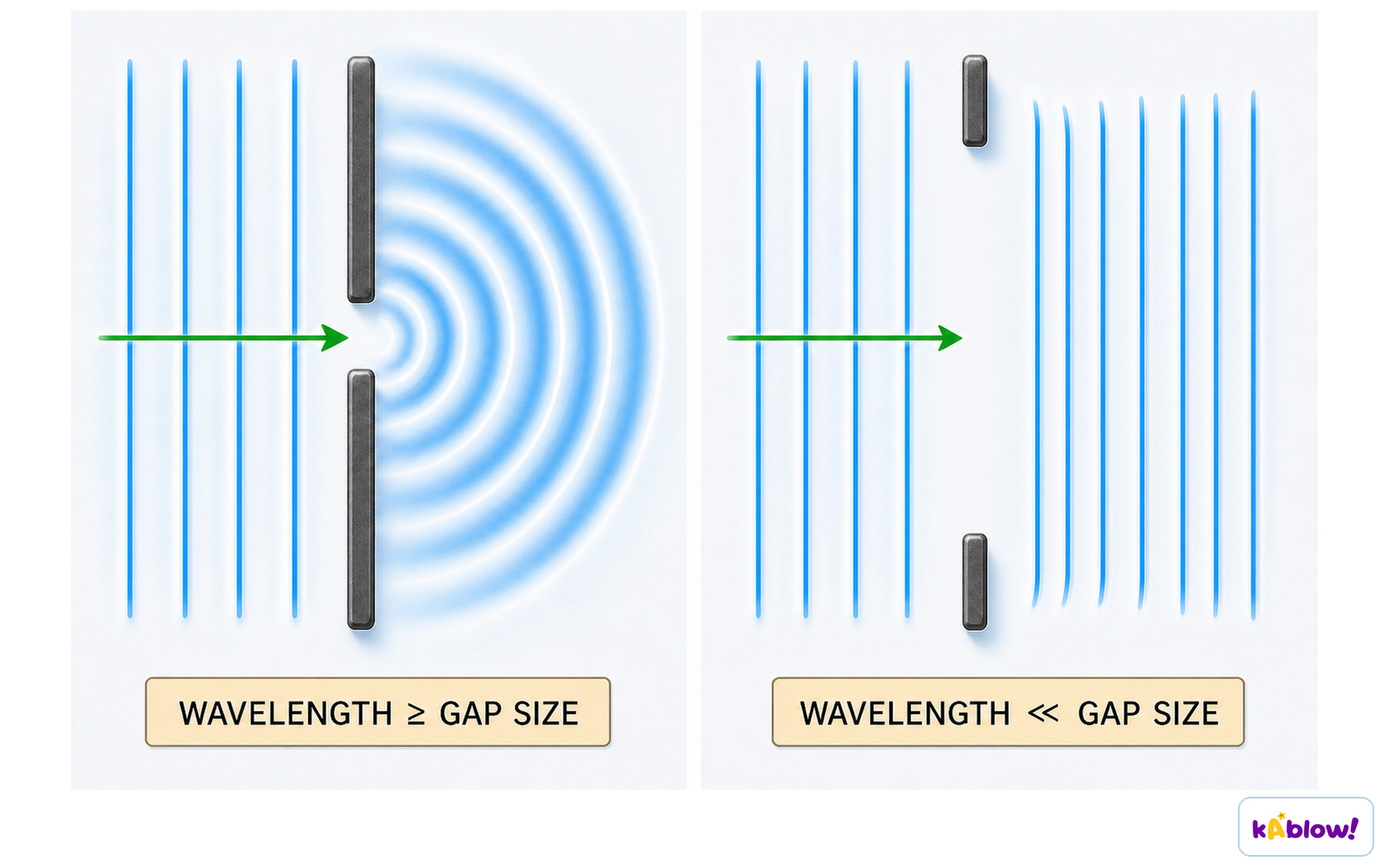
- Diffraction is the spreading out of waves after they pass through a narrow gap or around an obstruction.
- Diffraction occurs when waves pass through an aperture or around a barrier.
- Diffraction effects are most noticeable when the wavelength is similar in size to the gap width or barrier.
- For gaps much smaller than the wavelength, the wave spreads out significantly; for gaps much bigger than the wavelength, there is little diffraction.
- When a wave passes through a gap, its amplitude decreases because the barrier absorbs some wave energy.
- When a wave goes past a barrier, the greater the wavelength, the greater the diffraction; shorter wavelengths undergo less diffraction.
- For a barrier larger than the wavelength, there is some diffraction, a lot of reflection, and a 'shadow' region behind the barrier.
- For a barrier smaller than the wavelength, no diffraction occurs around it and the 'shadow' region is very small.
Diffraction through a gap
Refraction of Waves
- The refractive index n of a material tells us how optically dense it is; n = c / v, where c is the speed of light in a vacuum and v is the speed in the medium.
- The refractive index of air is approximately n = 1; more optically dense media have n > 1.
- The higher the refractive index, the more optically dense the material and the slower light travels through it.
- Snell's law relates the angles of incidence and refraction to the refractive indices and speeds: n₁ sin θ₁ = n₂ sin θ₂, or n₁/n₂ = sin θ₂ / sin θ₁ = v₂ / v₁.
- The critical angle θc is the angle of incidence for which the angle of refraction is exactly 90°; it is found using sin θc = n₂ / n₁.
- The larger the refractive index of a material, the smaller its critical angle.
- Total internal reflection occurs when the angle of incidence exceeds the critical angle and the refractive index of the first medium is greater than that of the second (n₁ > n₂).
- Total internal reflection follows the law of reflection: angle of incidence = angle of reflection.
Refraction of light
Superposition of Waves
- Superposition occurs when two or more waves overlap at a point; the resultant displacement is the sum of the individual displacements.
- The principle of superposition states that when waves overlap, the displacement at a point equals the algebraic sum of the displacements of the individual waves.
- Individual wave displacements may be positive or negative and are combined like vector quantities.
- When two pulses meet, the resultant displacement is the algebraic sum of their displacements; after interacting, they carry on as normal.
- Superposition can be analysed using displacement–position or displacement–time graphs.
Interference of Waves
- Interference is the effect observed due to the superposition of two or more waves.
- Constructive interference occurs when waves meet in phase (peak-to-peak or trough-to-trough), producing a resultant wave of larger amplitude.
- Destructive interference occurs when waves meet in antiphase (peak-to-trough), cancelling each other out.
- For waves to be coherent, they must have the same frequency and a constant phase difference.
- Path difference is the difference in distance travelled by two waves from their sources to the point where they meet.
- Constructive interference occurs when path difference = nλ (n = 0, 1, 2, ...).
- Destructive interference occurs when path difference = (n + ½)λ (n = 0, 1, 2, ...).
- On a wavefront diagram, count the number of wavelengths from each source to a point to determine the path difference and hence the type of interference.
Young's Double-Slit Experiment
- Young's double-slit experiment produces a diffraction and interference pattern using a single wave source passing through a double slit.
- Lasers are commonly used because the light must be coherent (constant phase difference and frequency) and monochromatic (single wavelength).
- The light source is placed behind a single slit; light diffracts to produce two coherent sources at the double slit, which then diffract to form an interference pattern on a screen.
- The pattern consists of bright fringes (maxima) from constructive interference and dark fringes (minima) from destructive interference.
- Each bright fringe is identical in width and intensity; each dark fringe has zero intensity.
- The double-slit equation gives the fringe spacing: s = λD / d, where s is the separation between successive fringes, λ is the wavelength, D is the distance from slits to screen, and d is the slit separation.
- The fringe spacing s increases if the wavelength increases, the screen distance D increases, or the slit separation d decreases.
- The order n of a maximum or minimum represents its position away from the central maximum: n = 0 is the central maximum, n = 1 the first maximum on either side, and so on.
ஸ்லைடுகள்
Sign up free to view the lesson slides
Step through every slide for this topic — plus flashcards and revision notes — with a free account.
பயிற்சி கேள்விகள்
இலவச முன்னோட்டம் — 62-இல் 8 கேள்விகள். அனைத்தையும் பார்க்க பதிவு செய்யவும்.
1.Which statement defines a wavefront?
Easy- AA line joining all points that oscillate in phase, perpendicular to the direction of energy transfer
- BA line showing the direction of motion and energy transfer of the wave
- CA line joining points that are in antiphase
- DA line parallel to the direction of wave travel
2.In a reflection ray diagram, the angle of incidence is the angle between:
Easy- Athe incident ray and the boundary surface
- Bthe incident ray and the normal
- Cthe incident ray and the reflected ray
- Dthe reflected ray and the boundary surface
3.A ray of light refracts as it passes from one medium into another. Which property of the light wave remains the same?
Easy- AFrequency
- BWavelength
- CWave speed
- DAmplitude
4.Light from a monochromatic laser beam is incident on the surface of a body of water. What changes to the speed, wavelength, and frequency of the light wave would be observed as it passes from the air to the water?
Easy- ASpeed decreases, wavelength decreases, frequency no change
- BSpeed no change, wavelength increases, frequency decreases
- CSpeed increases, wavelength decreases, frequency no change
- DSpeed decreases, wavelength no change, frequency increases
5.Which row correctly describes the conditions for constructive and destructive interference in a double-slit diffraction pattern?
Medium- AConstructive: crest + crest; Destructive: trough + trough
- BConstructive: crest + trough; Destructive: trough + trough
- CConstructive: trough + trough; Destructive: crest + crest
- DConstructive: crest + crest; Destructive: crest + trough
6.For fringes to be observed in a double-slit interference experiment, the light emitted from each slit must be:
Easy- Amonochromatic
- Bin phase
- Cof equal intensity
- Dcoherent
7.Which of the following processes changes the frequency of a wave?
Easy- AReflection
- BRefraction
- CDiffraction
- DNone of the above
8.What is the purpose of the single slit in a Young's double-slit experiment?
Medium- ATo make sure there is equal intensity in the double-slits
- BTo make sure the light is coherent upon the double-slits
- CTo decrease intensity for the double-slits
- DTo reduce the wavelength of the light
Unlock all 62 questions & more
இந்த தலைப்பிற்கான ஒவ்வொரு கேள்வியையும், ஸ்லைடுகளையும், ஃப்ளாஷ் கார்டுகளையும் மற்றும் திருப்புதல் குறிப்புகளையும் பார்க்க இலவச கணக்கை உருவாக்கவும்.