Transformations
விளையாடிக் கற்றுக்கொள்ளுங்கள்
ஆற்றல் சம்பாதிக்க இந்த கேள்விகளுக்குப் பதிலளியுங்கள், பின்னர் மீன் பிடித்து ஆராயுங்கள். கணக்கு தேவையில்லை.
பாட குறிப்புகள்
Translations
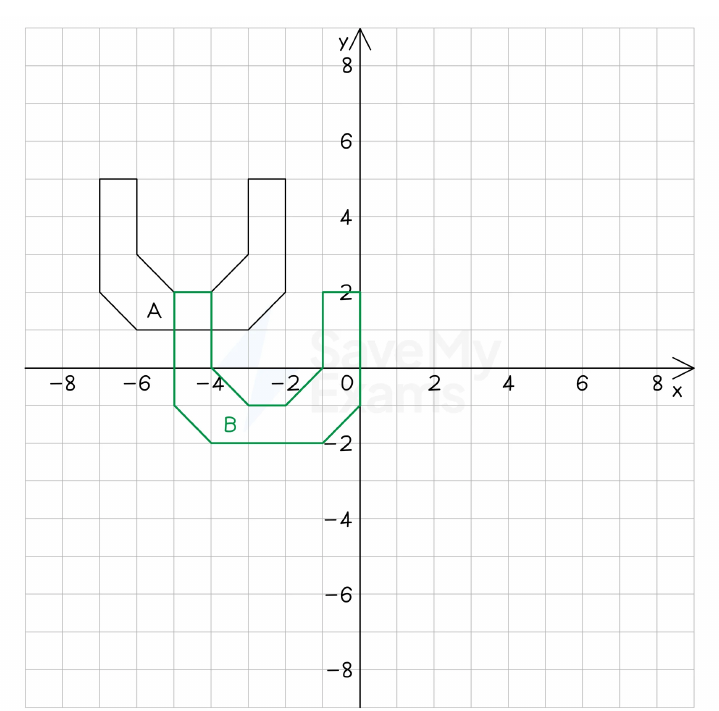
- A translation moves a shape without changing its size or orientation; the object and image are congruent.
- Movement is described by a column vector \begin{pmatrix} x \\ y \end{pmatrix} where x is horizontal (right positive, left negative) and y is vertical (up positive, down negative).
- To translate a shape, move each vertex by the vector and join the new vertices.
- To describe a translation, state 'translation' and give the vector.
- To reverse a translation, use the same vector with both signs changed.
The object shape and its image after a translation
Reflections
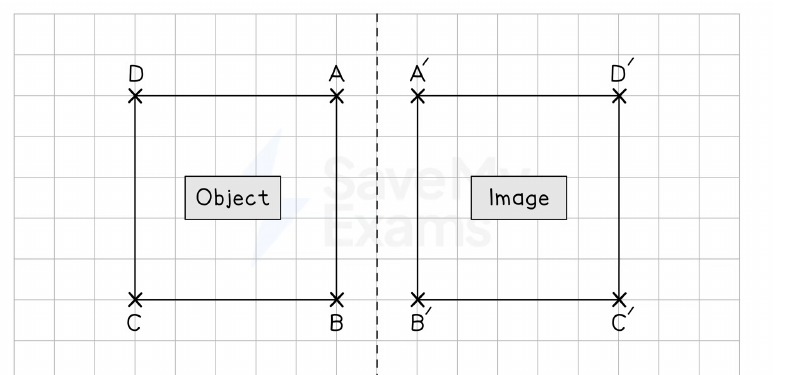
- A reflection flips a shape across a mirror line (line of reflection); the image is congruent and the same distance from the line as the object.
- Points on the mirror line are invariant (do not move).
- To reflect a shape, measure perpendicular distance from each vertex to the mirror line and plot the same distance on the opposite side.
- To describe a reflection, state 'reflection' and give the equation of the mirror line (e.g., x = k, y = k, y = x, y = -x).
- To reverse a reflection, apply the same reflection again.
Reflecting a shape in a mirror line
Rotations
- A rotation turns a shape about a fixed centre of rotation; the image is congruent.
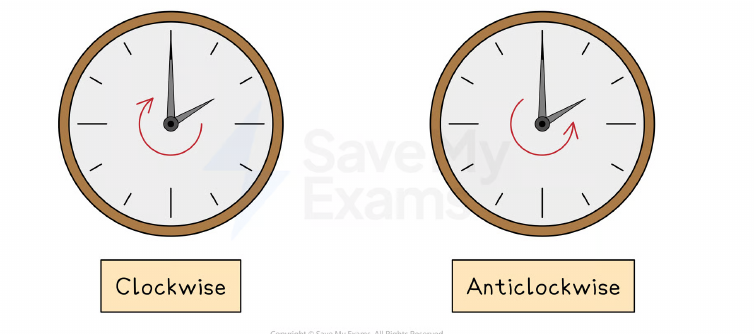
- You need the centre, angle (90°, 180°, 270°), and direction (clockwise or anti-clockwise). For 180°, direction is not needed.
- To rotate a shape, use tracing paper: trace the shape, place pencil on centre, rotate by the angle, and draw the image.
- To describe a rotation, state 'rotation', centre, angle, and direction.
- To reverse a rotation, rotate by the same angle in the opposite direction about the same centre.
Clockwise and anticlockwise rotation
Enlargements
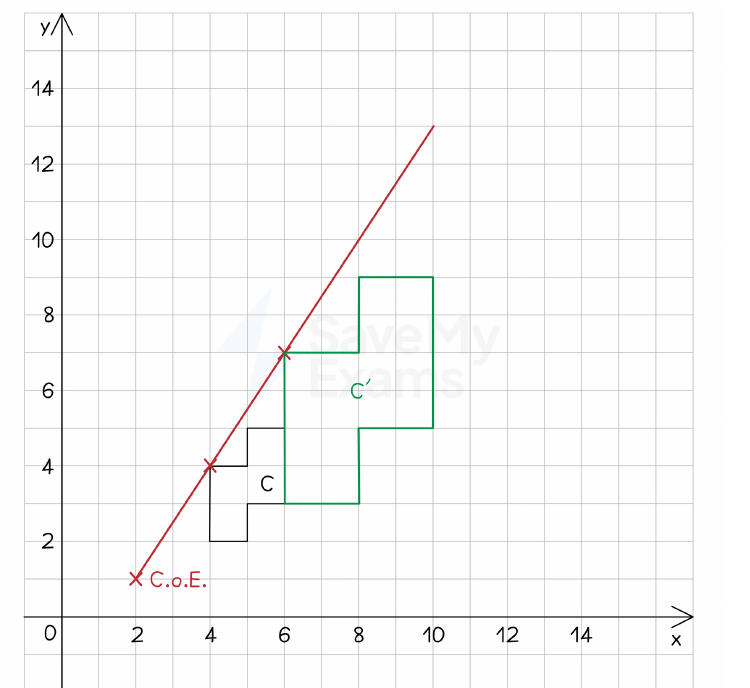
- An enlargement changes the size of a shape by a scale factor (SF) from a centre of enlargement (CoE).
- If SF > 1, the image is larger; if 0 < SF < 1, the image is smaller (fractional enlargement).
- To enlarge a shape, multiply horizontal and vertical distances from CoE to each vertex by SF, then plot the new vertices.
- To describe an enlargement, state 'enlargement', SF, and CoE coordinates.
- To reverse an enlargement, use the reciprocal SF with the same CoE.
Describing an enlargement
Combined Transformations & Describing Fully
- A single transformation maps one shape to another; you must state the type and all required details (vector, mirror line, centre/angle/direction, or SF and CoE).
- When describing, always include: type of transformation, and the specific parameters (e.g., 'translation by vector \begin{pmatrix} 3 \\ -2 \end{pmatrix}').
- Use tracing paper to check rotations and reflections; draw lines from CoE through vertices to verify enlargements.
ஸ்லைடுகள்
Sign up free to view the lesson slides
Step through every slide for this topic — plus flashcards and revision notes — with a free account.
பயிற்சி கேள்விகள்
இலவச முன்னோட்டம் — 52-இல் 8 கேள்விகள். அனைத்தையும் பார்க்க பதிவு செய்யவும்.
1.What is the name of the transformation that flips a shape across a line?
Easy- AReflection
- BRotation
- CTranslation
- DEnlargement
2.Under a translation, what remains the same about the shape?
Easy- ASize and orientation
- BSize only
- COrientation only
- DPosition
3.What is the scale factor if a shape is enlarged to twice its original size?
Easy- A2
- B1/2
- C1
- D4
4.A translation is described by a vector of the form \begin{pmatrix} x \\ y \end{pmatrix}. What does a negative value of x represent?
Easy- AMove left
- BMove right
- CMove down
- DMove up
5.When rotating a shape, what is the point about which the shape turns called?
Easy- ACentre of rotation
- BCentre of enlargement
- CMirror line
- DTranslation vector
6.A shape is translated by vector \begin{pmatrix} 3 \\ -2 \end{pmatrix}. Which of the following describes the reverse translation?
Easy- A\begin{pmatrix} -3 \\ 2 \end{pmatrix}
- B\begin{pmatrix} 3 \\ 2 \end{pmatrix}
- C\begin{pmatrix} -3 \\ -2 \end{pmatrix}
- D\begin{pmatrix} 2 \\ -3 \end{pmatrix}
7.A shape is reflected in the line y = x. What is the image of the point (2, 5)?
Easy- A(5, 2)
- B(2, -5)
- C(-2, 5)
- D(-5, -2)
8.A triangle with vertices at (1, 2), (3, 2), (2, 5) is rotated 90° clockwise about the origin. What are the coordinates of the image of (1, 2)?
Medium- A(2, -1)
- B(-2, 1)
- C(-1, -2)
- D(1, -2)
Unlock all 52 questions, flashcards & more
இந்த தலைப்பிற்கான ஒவ்வொரு கேள்வியையும், ஸ்லைடுகளையும், ஃப்ளாஷ் கார்டுகளையும் மற்றும் திருப்புதல் குறிப்புகளையும் பார்க்க இலவச கணக்கை உருவாக்கவும்.