Sine Cosine Rule And Area Of Triangles
விளையாடிக் கற்றுக்கொள்ளுங்கள்
ஆற்றல் சம்பாதிக்க இந்த கேள்விகளுக்குப் பதிலளியுங்கள், பின்னர் மீன் பிடித்து ஆராயுங்கள். கணக்கு தேவையில்லை.
பாட குறிப்புகள்
The Sine Rule
- Used in non-right-angled triangles to find missing side lengths or angles.
- States: a / sin A = b / sin B = c / sin C, where a is opposite A, etc.
- To find a missing length, use two equal parts of the rule and solve.
- To find a missing angle, rearrange to sin A / a = sin B / b = sin C / c.
- Ambiguous case: given two sides and a non-included angle, there may be two possible triangles (acute and obtuse).
- If the required angle is obtuse, use: obtuse angle = 180° – acute angle from calculator.
Triangle ABC
The Cosine Rule
- Used in non-right-angled triangles when you have two sides and the included angle (to find the third side) or all three sides (to find an angle).
- For a side: a² = b² + c² – 2bc cos A, where A is the angle between b and c.
- For an angle: cos A = (b² + c² – a²) / (2bc).
- No ambiguous case – the cosine rule gives a unique angle.
- Label sides carefully: side a is opposite angle A.
Triangle ABC
Area of a Triangle
- For any triangle: Area = ½ ab sin C, where C is the angle between sides a and b.
- If C = 90°, sin 90° = 1, so Area = ½ × base × height (right-angled triangle).
- Ensure all lengths are in the same units before calculating area.
- If the included angle is not given, use sine or cosine rule first to find it.
Triangle ABC
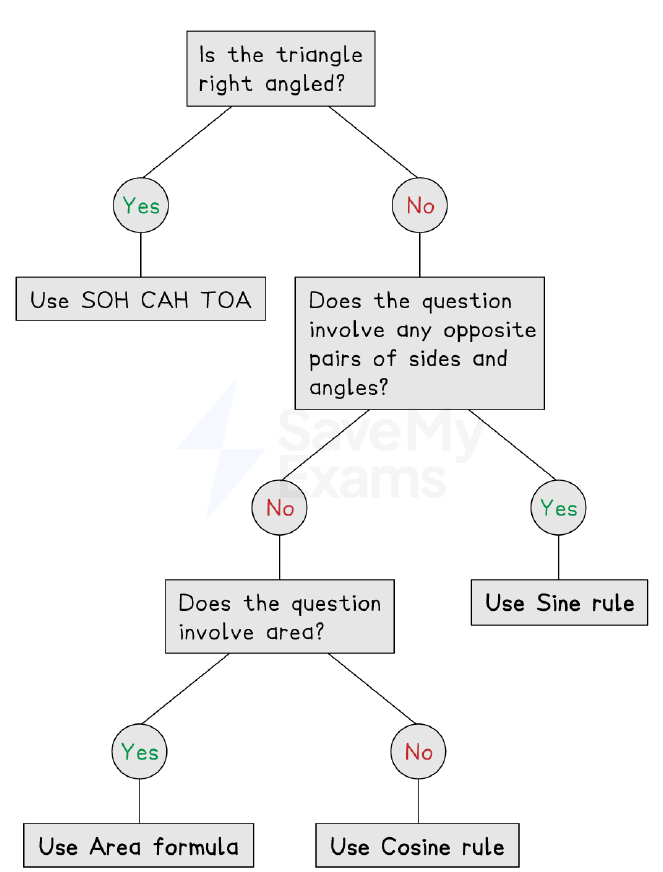
Deciding the Trig Rule
- Sine rule: use when you have an opposite pair (side and angle) and need another side or angle.
- Cosine rule: use when you have two sides and the included angle (to find the third side) or all three sides (to find an angle).
- Area rule: use when you have two sides and the included angle (to find area).
- If no rule fits directly, use angles in a triangle sum to 180° to find a missing angle.
- Harder questions may require multiple trig rules in sequence.
Deciding the Trig Rule
Worked Example – Sine Rule
- Given triangle ABC with AB = 8.1 cm, BC = 12.3 cm, angle BCA = 27°.
- Find angle x (at A): use sin x / 12.3 = sin 27° / 8.1 → x = sin⁻¹(12.3 sin 27° / 8.1) ≈ 43.6°.
- Find side y (AC): first find angle ABC = 180° – 27° – 43.6° = 109.4°, then y / sin 109.4° = 8.1 / sin 27° → y ≈ 16.8 cm.
Triangle ABC
Worked Example – Cosine Rule
- Given triangle ABC with AB = 4.2 km, BC = 3.8 km, AC = 7.1 km.
- Find angle ABC: use cos θ = (4.2² + 3.8² – 7.1²) / (2 × 4.2 × 3.8) → θ = cos⁻¹(...) ≈ 125.0°.
Triangle ABC
Worked Example – Area of a Triangle
- Given triangle ABC with AB = 32 cm, AC = 1.1 m, angle BAC = 74°.
- Convert to same units: AB = 0.32 m, AC = 1.1 m.
- Area = ½ × 1.1 × 0.32 × sin 74° ≈ 0.169 m² (3 s.f.).
Triangle ABC
Worked Example – Multiple Rules
- Find area of triangle with sides 4.4 cm, 7.4 cm, 4.8 cm.
- Use cosine rule to find an angle: cos ABC = (4.4² – 7.4² – 4.8²) / (–2 × 7.4 × 4.8) → ABC ≈ 34.65°.
- Then area = ½ × 4.8 × 7.4 × sin 34.65° ≈ 10.1 cm² (3 s.f.).
Triangle ABC
ஸ்லைடுகள்
Sign up free to view the lesson slides
Step through every slide for this topic — plus flashcards and revision notes — with a free account.
பயிற்சி கேள்விகள்
இலவச முன்னோட்டம் — 34-இல் 8 கேள்விகள். அனைத்தையும் பார்க்க பதிவு செய்யவும்.
1.What is the formula for the area of a triangle given two sides and the included angle?
Easy- AArea = 1/2 ab sin C
- BArea = 1/2 ab cos C
- CArea = ab sin C
- DArea = 1/2 ab tan C
2.The sine rule states that for any triangle ABC:
Easy- Aa/sin A = b/sin B = c/sin C
- Ba/sin B = b/sin C = c/sin A
- Csin A/a = sin B/b = sin C/c
- Da sin A = b sin B = c sin C
3.Which rule should be used to find a side when you know two sides and the included angle?
Easy- ACosine rule
- BSine rule
- CArea rule
- DPythagoras' theorem
4.In the cosine rule a² = b² + c² - 2bc cos A, what does angle A represent?
Easy- AThe angle opposite side a
- BThe angle between sides b and c
- CThe angle opposite side b
- DThe angle between sides a and c
5.Triangle ABC has AB = 8 cm, AC = 5 cm and angle BAC = 30°. Find the area of the triangle.
Medium- A10 cm²
- B20 cm²
- C40 cm²
- D34.6 cm²
6.In triangle XYZ, XY = 7 cm, XZ = 9 cm and angle YXZ = 60°. Use the cosine rule to find YZ.
Medium- A√(49 + 81 - 2×7×9×cos 60°) = √(130 - 63) = √67 ≈ 8.19 cm
- B√(49 + 81 - 2×7×9×sin 60°) = √(130 - 108.9) = √21.1 ≈ 4.59 cm
- C√(49 + 81 - 2×7×9×cos 30°) = √(130 - 108.9) = √21.1 ≈ 4.59 cm
- D√(49 + 81 - 2×7×9×tan 60°) = √(130 - 218.2) = negative
7.In triangle PQR, PQ = 10 cm, PR = 14 cm and angle PQR = 40°. Which rule can be used to find angle PRQ?
Medium- ASine rule
- BCosine rule
- CArea rule
- DPythagoras' theorem
8.A triangle has sides of lengths 5 cm, 6 cm and 7 cm. Find the angle opposite the side of length 7 cm.
Medium- A78.5°
- B44.4°
- C57.1°
- D101.5°
Unlock all 34 questions & more
இந்த தலைப்பிற்கான ஒவ்வொரு கேள்வியையும், ஸ்லைடுகளையும், ஃப்ளாஷ் கார்டுகளையும் மற்றும் திருப்புதல் குறிப்புகளையும் பார்க்க இலவச கணக்கை உருவாக்கவும்.