Binary addition and binary–decimal conversion
விளையாடிக் கற்றுக்கொள்ளுங்கள்
ஆற்றல் சம்பாதிக்க இந்த கேள்விகளுக்குப் பதிலளியுங்கள், பின்னர் மீன் பிடித்து ஆராயுங்கள். கணக்கு தேவையில்லை.
பாட குறிப்புகள்
Binary Numbers
- Binary is a base-2 numeral system using only two digits: 0 and 1.
- Each binary digit is called a bit.
- In binary, each position represents a power of 2, starting from 20 on the right.
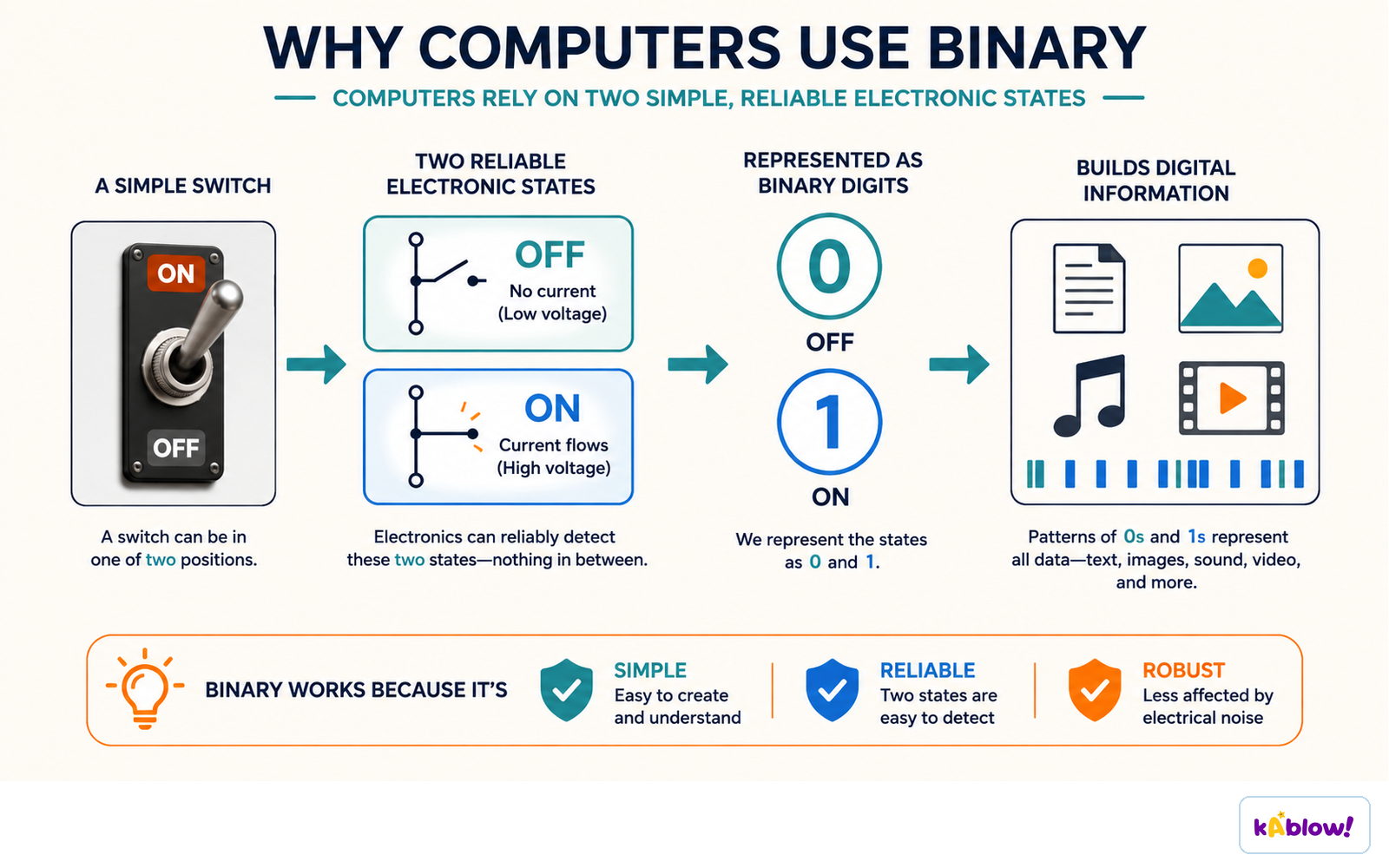
- Binary is used by computers because it is easy to implement with electronic circuits.
Computers use binary because a switch has two reliable states, easy to detect and hard to confuse.
Converting Binary to Decimal
- To convert binary to decimal, write the binary number with place values (powers of 2) above each bit.
- Multiply each bit by its place value (0 or 1 times the power of 2).
- Add all the products together to get the decimal value.
- Example: 1011₂ = 1×8 + 0×4 + 1×2 + 1×1 = 11₁₀.
Converting Decimal to Binary
- One method is division by 2: repeatedly divide the decimal number by 2, recording the remainder.
- Read the remainders from bottom to top to get the binary equivalent.
- Example: 13₁₀ → 13÷2=6 r1, 6÷2=3 r0, 3÷2=1 r1, 1÷2=0 r1 → 1101₂.
- Another method is to subtract the largest power of 2 that fits, and mark that bit as 1.
Binary Addition
- Binary addition follows rules similar to decimal, but with only 0 and 1.
- Rules: 0+0=0, 0+1=1, 1+0=1, 1+1=0 with a carry of 1.
- When adding multiple bits, include any carry from the previous column.
- Example: 1011₂ + 1101₂ = 11000₂.
Carrying in Binary Addition
- A carry occurs when the sum in a column is 2 or more.
- In binary, 1+1=2, so write 0 and carry 1 to the next column.
- If a carry is added to an existing 1, the sum becomes 2 again, so write 0 and carry 1 again.
- Carries can propagate through multiple columns.
Overflow
- Overflow happens when the result of binary addition is too large to fit in the fixed number of bits.
- For example, adding two 4-bit numbers may produce a 5-bit result.
- If only 4 bits are allowed, the extra bit is lost, causing an incorrect result.
- Overflow can be detected when there is a carry out of the most significant bit.
Example: Binary Addition with Carries
- Add 0111₂ (7) and 0101₂ (5) using 4 bits.
- Column 1 (20): 1+1=0 carry 1.
- Column 2 (21): 1+0+carry1 = 0 carry 1.
- Column 3 (22): 1+1+carry1 = 1 carry 1.
- Column 4 (23): 0+0+carry1 = 1, no carry out.
- Result: 1100₂ (12). No overflow.
Example: Overflow in Binary Addition
- Add 1001₂ (9) and 0111₂ (7) using 4 bits.
- Column 1: 1+1=0 carry 1.
- Column 2: 0+1+carry1 = 0 carry 1.
- Column 3: 0+1+carry1 = 0 carry 1.
- Column 4: 1+0+carry1 = 0 carry 1.
- There is a carry out of the most significant bit, so overflow occurs; the 4-bit result 0000₂ is incorrect (should be 16).
Practical Applications
- Binary addition is fundamental to computer arithmetic.
- Overflow detection is important in programming and hardware design.
- Understanding binary–decimal conversion helps in debugging and data representation.
- These skills are essential for working with low-level computer systems.
In an 8-bit number each position is a power of two, from 128 down to 1.
Binary addition works column by column from the right, carrying whenever a column totals two or more.
Fixed-width storage has a maximum range; a result needing more bits than are available overflows.
ஸ்லைடுகள்
Sign up free to view the lesson slides
Step through every slide for this topic — plus flashcards and revision notes — with a free account.
பயிற்சி கேள்விகள்
இலவச முன்னோட்டம் — 15-இல் 8 கேள்விகள். அனைத்தையும் பார்க்க பதிவு செய்யவும்.
1.A binary digit is also known as a bit.
EasyTrue or false?
2.What is the decimal value of the binary number 1010?
Easy- A8
- B10
- C12
- D14
3.Complete the sentence.
EasyThe base-2 numeral system uses only the digits ____ and ____.
4.Convert the decimal number 13 to binary. Enter your answer as a binary number (e.g. 101).
Easy5.What is the result of adding the binary numbers 0110 and 0011?
Easy- A1001
- B1010
- C1100
- D0111
6.What is the binary representation of the decimal number 25?
Medium7.What is the decimal value of the binary number 1111?
Medium- A14
- B15
- C16
- D17
8.When adding two 4-bit binary numbers, if the result requires 5 bits, an overflow has occurred.
MediumTrue or false?
Unlock all 15 questions, flashcards & more
இந்த தலைப்பிற்கான ஒவ்வொரு கேள்வியையும், ஸ்லைடுகளையும், ஃப்ளாஷ் கார்டுகளையும் மற்றும் திருப்புதல் குறிப்புகளையும் பார்க்க இலவச கணக்கை உருவாக்கவும்.