Fields and forces at a distance
விளையாடிக் கற்றுக்கொள்ளுங்கள்
ஆற்றல் சம்பாதிக்க இந்த கேள்விகளுக்குப் பதிலளியுங்கள், பின்னர் மீன் பிடித்து ஆராயுங்கள். கணக்கு தேவையில்லை.
பாட குறிப்புகள்
Non-Contact Forces and Fields
- Non-contact forces act over a distance without objects touching.
- A field is a region in space where an object with certain properties experiences a force.
- Common field forces: gravitational, magnetic, and electrostatic forces.
- Field forces cause attraction or repulsion rather than pushes or pulls.
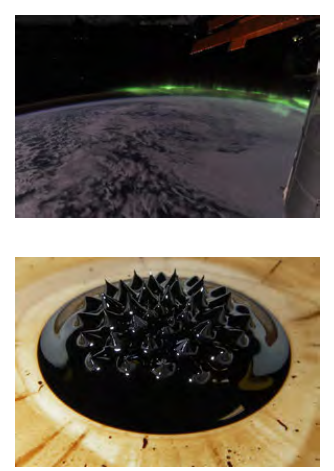
The Southern Lights viewed from the International Space Station, and a ferrofluid demonstrating magnetic properties.
Magnetic Force and Magnetic Field
- Magnetic force is exerted by magnets on certain materials and other magnets without contact.
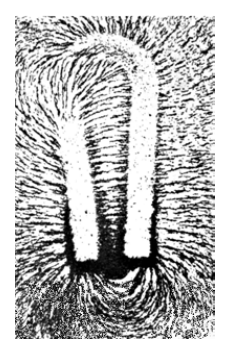
- A magnet is surrounded by a magnetic field, which can be visualized with iron filings.
- Iron filings align along lines of force; concentration near the poles indicates stronger force.
- Like poles repel; opposite poles attract.
- Magnetic force can act through materials like paper and wood.
- Only certain materials are magnetic: iron, nickel, cobalt, and alloys containing them (e.g., steel).
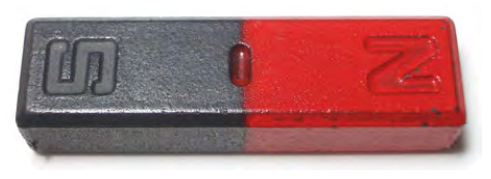
A bar magnet painted to show its north and south poles.
Visualizing Magnetic Fields
- Magnetic fields are represented by field lines.
- Field lines go from north pole to south pole.
- Closer field lines indicate a stronger field.
- The field is strongest near the magnet and weakens with distance.
- Earth acts like a bar magnet with a magnetic field; compasses use this to point north.
Iron filings tracing the magnetic field around a horseshoe magnet.
Electric Charge and Electric Force
- Electric charge is a physical property causing attraction or repulsion between particles.
- Protons have positive charge; electrons have negative charge.
- Opposite charges attract; like charges repel.
- Electric force strength depends on the amount of charge and distance between charges.
- Static electricity is a buildup of charge, often from rubbing materials (friction transfers electrons).
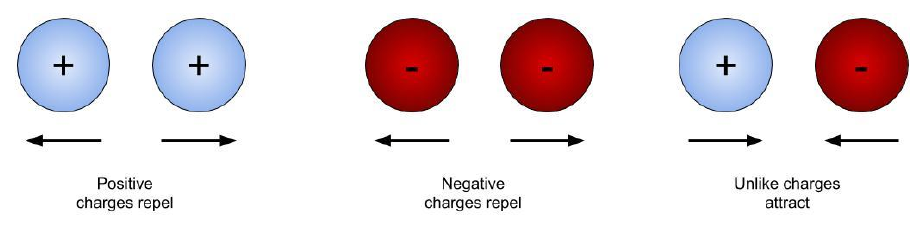
Like charges repel and unlike charges attract.
Electrostatic Forces and Charging
- Rubbing objects transfers electrons, leaving one object positively charged and the other negatively charged.
- Objects with more electrons than protons are negatively charged; fewer electrons means positively charged.
- Charged objects exert electrostatic forces on each other without contact.
- Like charges repel; unlike charges attract.
- The closer charged objects are, the stronger the electrostatic force.
A balloon rubbed on hair picks up electrons, charging the balloon and the hair oppositely.

Gravitational Force and Weight
- Gravitational force attracts objects with mass toward each other.
- The force is stronger with greater mass and weaker with greater distance.
- Weight is the gravitational force on an object, measured in newtons (N).
- Mass is the amount of matter, measured in kilograms (kg), and stays constant.
- Weight = mass × gravitational acceleration (W = m × g); on Earth, g = 9.8 m/s².
A Jersey cow, illustrating a problem about mass and weight.

Free-Fall and Weightlessness
- Free-fall occurs when only gravity acts on an object.
- Objects in free-fall feel weightless but still have weight.
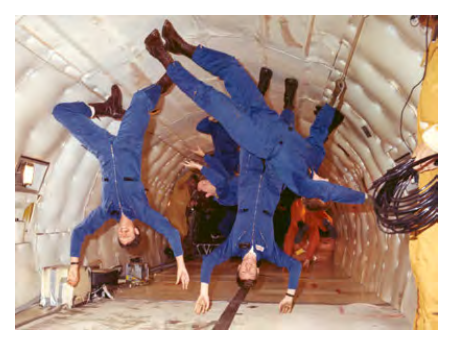
- Astronauts float because they and their spacecraft are in free-fall together.
- Gravitational acceleration varies by planet; on the Moon it's 1.6 m/s², on Jupiter 26 m/s².
Astronauts experiencing weightlessness in free-fall.
Cause and Effect in Field Forces
- Bringing like poles of magnets together causes repulsion.
- Bringing opposite poles together causes attraction.
- Bringing like charges together causes repulsion; opposite charges cause attraction.
- The cause is the property (charge or pole) and the effect is the force (attraction or repulsion).
- Models can show fields and forces even when objects are not touching.
Applications and Phenomena
- The floating paperclip trick works because the magnet's magnetic field exerts a force on the paperclip without contact.
- A child's hair standing up on a slide is due to static electricity from friction.
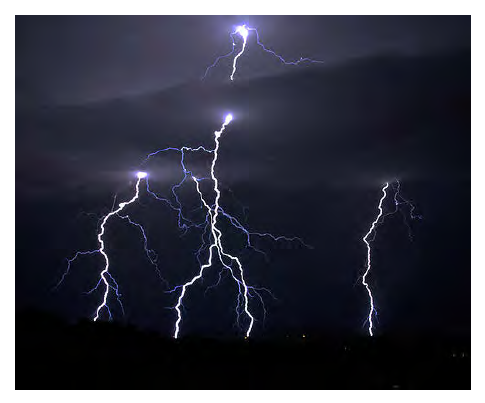
- Lightning is a massive electrostatic discharge between charged clouds and the ground.
- Earth's magnetic field causes phenomena like the Northern and Southern Lights.
- Compasses work because of Earth's magnetic field.
Lightning is a huge electrostatic discharge.
ஸ்லைடுகள்
Sign up free to view the lesson slides
Step through every slide for this topic — plus flashcards and revision notes — with a free account.
பயிற்சி கேள்விகள்
இலவச முன்னோட்டம் — 44-இல் 8 கேள்விகள். அனைத்தையும் பார்க்க பதிவு செய்யவும்.
1.Which of the following is a non-contact force?
Easy- AFriction
- BTension
- CMagnetic force
- DNormal force
2.What is the region around a magnet where it exerts a force called?
Easy- AMagnetic field
- BGravitational field
- CElectric field
- DForce field
3.Field forces require objects to be in direct contact.
EasyTrue or false?
4.Which of the following materials is magnetic?
Easy- AIron
- BWood
- CPlastic
- DAluminium
5.Like magnetic poles attract each other.
EasyTrue or false?
6.As the distance between two magnets increases, the magnetic force between them:
Easy- AIncreases
- BDecreases
- CStays the same
- DDisappears completely
7.Match each force with its correct type (contact or non-contact).
Easy- Friction
- Gravitational force
- Tension
- Contact
- Non-contact
8.Arrange the steps in order to visualize a magnetic field using iron filings:
Easy- Place magnet on table
- Put paper over magnet
- Shake iron filings onto paper
- Observe pattern

Unlock all 44 questions, flashcards & more
இந்த தலைப்பிற்கான ஒவ்வொரு கேள்வியையும், ஸ்லைடுகளையும், ஃப்ளாஷ் கார்டுகளையும் மற்றும் திருப்புதல் குறிப்புகளையும் பார்க்க இலவச கணக்கை உருவாக்கவும்.