How bonding and structure are related to the properties of substances
Học bằng cách chơi
Trả lời những câu hỏi này để kiếm năng lượng, rồi câu cá và khám phá. Không cần tài khoản.
Ghi chú bài học
The Three States of Matter
- The three states of matter are solid, liquid and gas.
- In a solid, particles are very close together in a regular arrangement and vibrate about fixed positions.
- In a liquid, particles are close together and randomly arranged, and they move around each other.
- In a gas, particles are far apart and randomly arranged, and they move quickly in all directions.
- The simple particle model represents particles as small solid spheres.
- A substance can usually exist in all three states depending on temperature (and pressure).
Changes of State
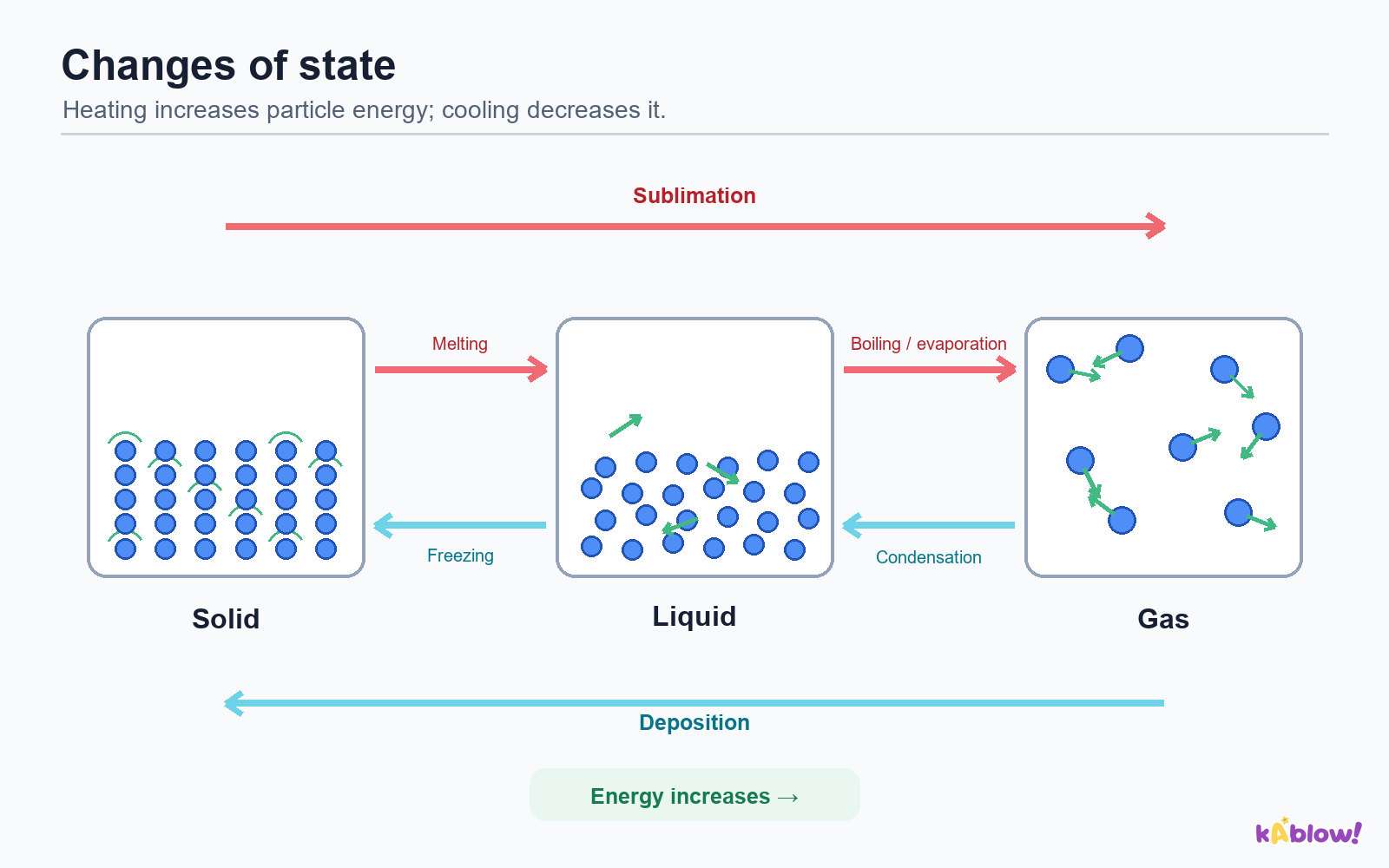
- Melting is a solid changing into a liquid; freezing is the reverse, liquid to solid.
- Melting and freezing occur at the melting point; boiling and condensing occur at the boiling point.
- Boiling is a liquid changing into a gas throughout the liquid, forming bubbles.
- Evaporation is a liquid changing into a gas only at the surface, and it occurs over a range of temperatures below the boiling point.
- Condensation is a gas changing into a liquid on cooling.
- Sublimation is a solid changing directly into a gas (e.g. iodine, solid carbon dioxide); the reverse is called deposition or desublimation.
- Changes of state are physical changes: the particles themselves remain the same, only the forces between them change, and the change is easily reversed.
The state changes
Energy and Interconversions
- The amount of energy needed to change state depends on the strength of the forces between the particles.
- The stronger the forces between particles, the more energy is needed to overcome them, so the higher the melting point and boiling point.
- When a substance is heated, particles absorb thermal energy and convert it into kinetic energy, so they vibrate or move more.
- On a heating or cooling curve, horizontal sections show a change of state where temperature stays constant as energy is absorbed or released.
- The sloped sections show the substance heating up or cooling down in a single state.
- The interconversion of states can be shown with a reversible arrow: ⇌.
Predicting Physical State
- Below the melting point, a substance is a solid.
- Between the melting point and the boiling point, a substance is a liquid.
- Above the boiling point, a substance is a gas.
- For example, a substance with melting point −7 °C and boiling point 59 °C is a liquid at 20 °C and a gas at 100 °C.
- Individual atoms do not have the bulk properties of the material they make up.
State Symbols
- State symbols show the physical state of each substance in a chemical equation.
- (s) = solid, (l) = liquid, (g) = gas, (aq) = aqueous (dissolved in water).
- State symbols are written after each formula in brackets.
- Example: CuCO₃(s) + 2HCl(aq) → CuCl₂(aq) + CO₂(g) + H₂O(l).
- Aqueous means the substance is dissolved in water to form a solution.
Properties of Ionic Compounds
- Ionic compounds form giant ionic lattices with strong electrostatic forces of attraction in all directions between oppositely charged ions.
- They have high melting and boiling points because a large amount of energy is needed to overcome the many strong electrostatic forces.
- The greater the charge on the ions, the stronger the electrostatic forces and the higher the melting point (e.g. MgO has a higher melting point than NaCl).
- Solid ionic compounds do not conduct electricity because the ions are in fixed positions and cannot move.
- When molten or dissolved in water, ionic compounds conduct electricity because the ions are free to move and carry charge.
Properties of Small Molecules
- Substances made of small molecules are usually gases or liquids with relatively low melting and boiling points.
- They have strong covalent bonds between the atoms within each molecule, but only weak intermolecular forces between molecules.
- When a simple molecular substance melts or boils, it is the intermolecular forces that are overcome, not the covalent bonds.
- The intermolecular forces increase with the size of the molecules, so larger molecules have higher melting and boiling points.
- Small molecular substances do not conduct electricity because there are no free ions or electrons to carry charge.
Polymers
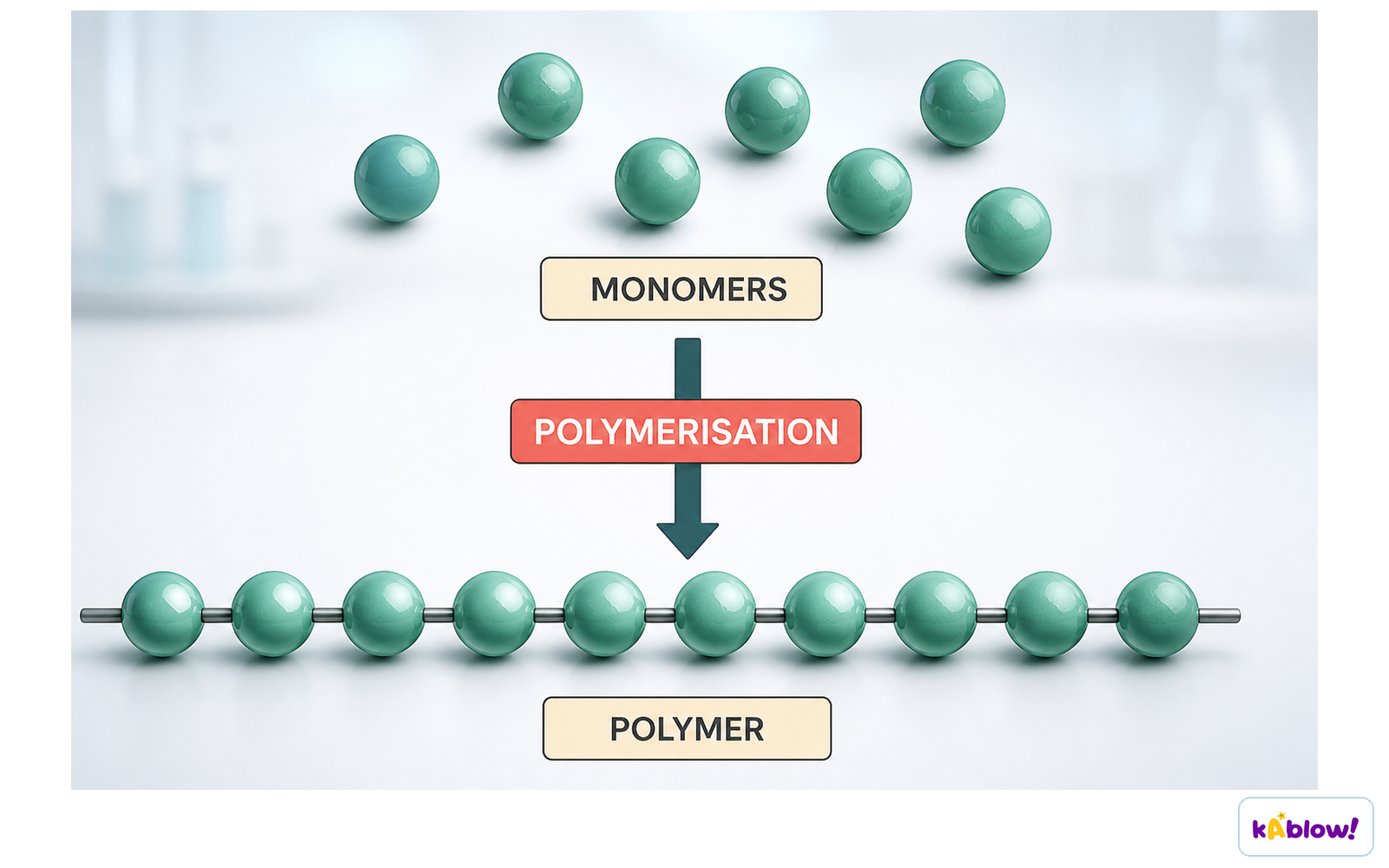
- Polymers consist of very large molecules made by linking many small molecules called monomers.
- The atoms in polymer molecules are linked by strong covalent bonds.
- The intermolecular forces between polymer chains are relatively strong compared with those between simple molecules.
- Because of these stronger intermolecular forces, polymers are usually solids at room temperature.
- Examples include polythene and poly(chloroethene), commonly known as PVC.
Monomers joining to form a polymer
Giant Covalent Structures
- Giant covalent structures are solids with very high melting points, made of many non-metal atoms bonded by strong covalent bonds.
- All the atoms are linked by strong covalent bonds, and these bonds must be overcome to melt or boil the substance.
- Examples include diamond, graphite and silicon dioxide (silica).
- Diamond: each carbon atom bonds to four others in a tetrahedron; it is extremely hard, has a very high melting point, and does not conduct electricity.
- Graphite: each carbon atom bonds to three others in layers of hexagons, leaving one free electron per carbon atom, so graphite conducts electricity and is soft and slippery.
- Silicon dioxide is made from silicon and oxygen atoms and also has a giant covalent structure.
Properties of Metals and Alloys
- Metals have giant structures with strong metallic bonding – the attraction between positive metal ions and negative delocalised electrons.
- Most metals have high melting and boiling points because the metallic bonds are strong and need lots of energy to break.
- Pure metals are malleable because the atoms are arranged in layers that can slide over each other when a force is applied.
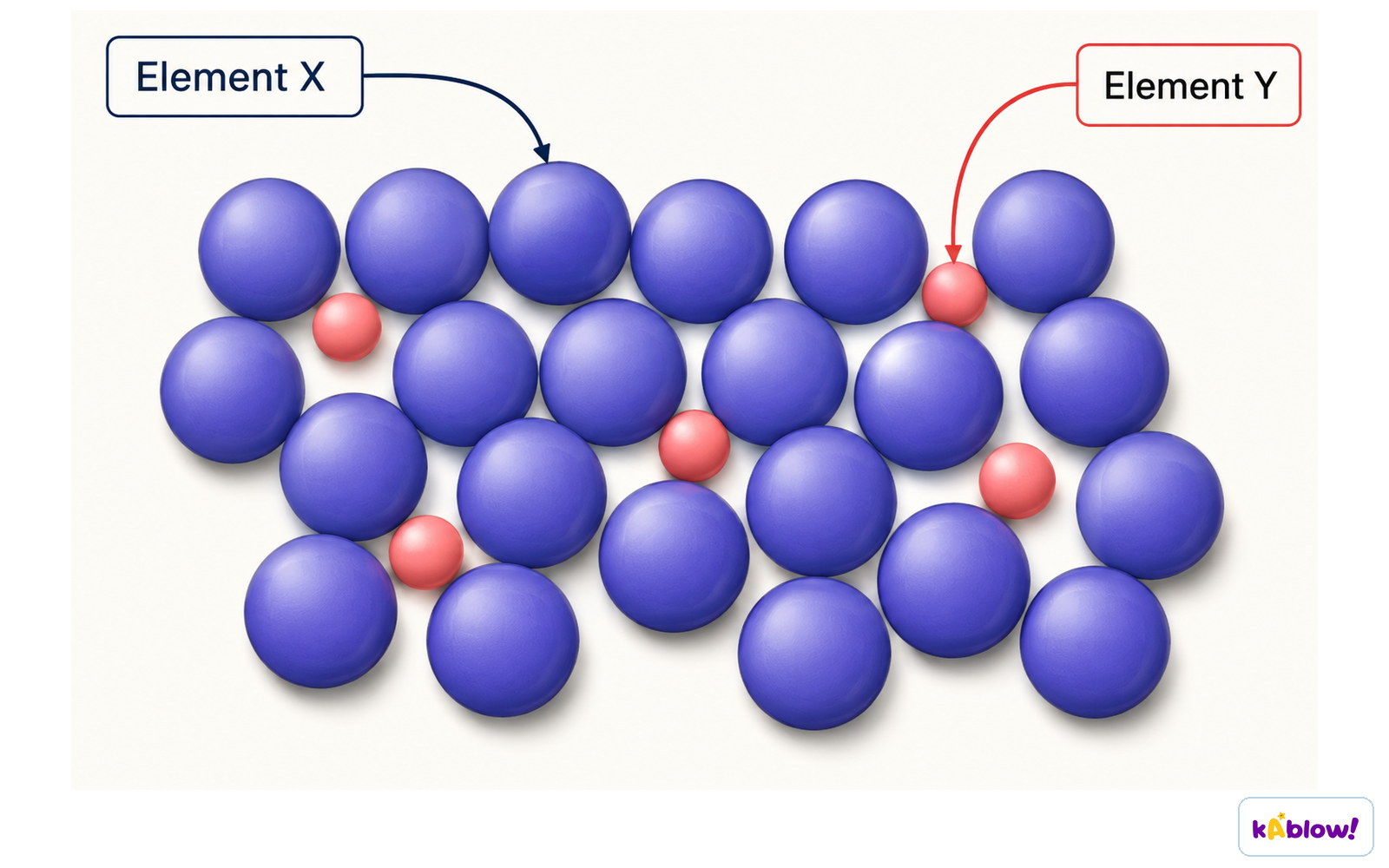
- An alloy is a mixture of two or more metals, or a metal with a non-metal such as carbon (e.g. steel is iron and carbon).
- Alloys are harder than pure metals because the different-sized atoms distort the layers, making it more difficult for the layers to slide over each other.
- Metals are good conductors of electricity because the delocalised electrons are free to move through the structure and carry charge.
- Metals are good conductors of thermal energy because the delocalised electrons transfer energy through the structure.
In an alloy, atoms of a different size (Element Y) are scattered among the host metal's atoms (Element X), distorting the regular layered arrangement that a pure metal has.
Slide
Sign up free to view the lesson slides
Step through every slide for this topic — plus flashcards and revision notes — with a free account.
Câu hỏi luyện tập
Xem trước miễn phí — 8 trên 51 câu hỏi. Đăng ký để xem tất cả.
1.Which of the following is the name of the change of state when a liquid changes into a solid?
Easy- Acondensation
- Bevaporation
- Cfreezing
- Dmelting
2.Substance Y melts at -101 °C and boils at -35 °C. What is the state of substance Y at -110 °C?
Easy- Asolid
- Bliquid
- Cgas
- Daqueous
3.Substance Z has a melting point of -7 °C and a boiling point of 59 °C. What is the state of Z at 0 °C and at 100 °C?
Medium- Asolid at 0 °C and gas at 100 °C
- Bgas at 0 °C and liquid at 100 °C
- Cliquid at 0 °C and solid at 100 °C
- Dliquid at 0 °C and gas at 100 °C
4.Substances exist as solids, liquids or gases. What change of state occurs at Y?
Medium- Amelting
- Bfreezing
- Cboiling
- Dcondensation
5.A balloon is filled with helium gas. What is true about the gas particles inside the balloon?
Medium- AThey have little energy
- BThey vibrate in fixed positions
- CThey fall to the bottom of the balloon
- DThey move in random directions
6.Which of the following is not a chemical change?
Medium- AIron railings becoming rusty
- BBurning a piece of wood
- CNeutralising an acid with alkali
- DDissolving salt in water
7.The three states of matter are solid, liquid and gas.
EasyTrue or false?
8.In a solid, the particles are arranged randomly and move quickly in all directions.
EasyTrue or false?
Unlock all 51 questions, flashcards & more
Tạo tài khoản miễn phí để xem mọi câu hỏi, slide, thẻ ghi nhớ và ghi chú ôn tập cho chủ đề này.