Identification of ions by chemical and spectroscopic means
Học bằng cách chơi
Trả lời những câu hỏi này để kiếm năng lượng, rồi câu cá và khám phá. Không cần tài khoản.
Ghi chú bài học
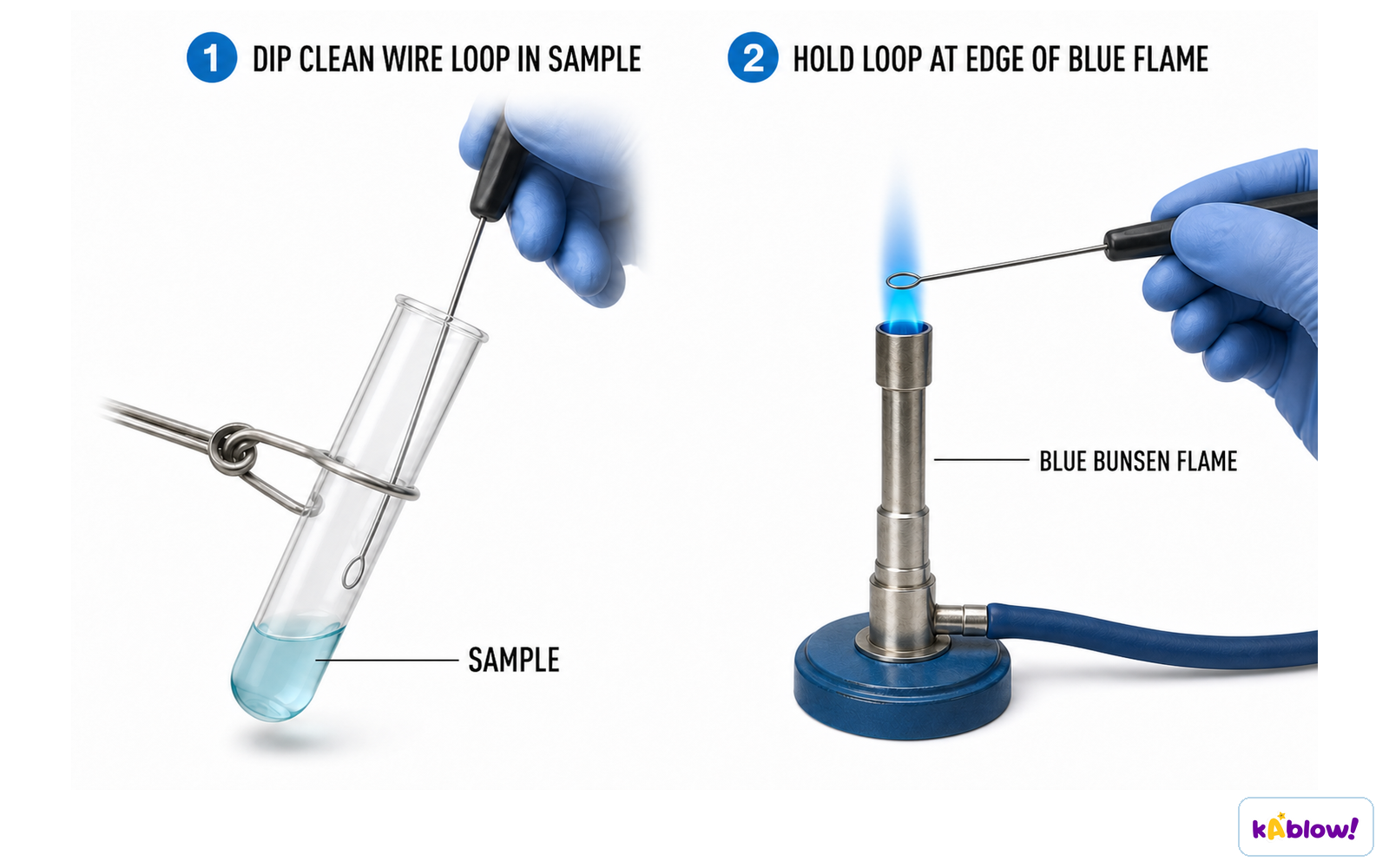
Flame Tests
- Metal ions produce a characteristic colour when heated strongly in a flame, so flame tests identify metal cations.
- Clean the wire by dipping it in dilute acid and holding it in a blue Bunsen flame until no colour is seen; this prevents contamination.
- Dip the clean wire into the sample, then place it in the edge of the blue flame and note the colour.
- Flame colours: lithium crimson, sodium yellow, potassium lilac, calcium orange-red, copper green.
- If a mixture of ions is present, colours can mask each other, making identification unreliable.
- Use a blue flame because the sample must be heated strongly; avoid overheating the wire until it glows red.
Diagram showing the technique for carrying out a flame test
Metal Hydroxides
- Adding sodium hydroxide solution to metal cations forms coloured precipitates of metal hydroxides.
- Add a few drops of NaOH first, then add excess, because some precipitates dissolve in excess NaOH.
- Copper(II) gives a blue precipitate; iron(II) gives a green precipitate; iron(III) gives a brown precipitate.
- Calcium, magnesium and aluminium ions form white precipitates with NaOH.
- Aluminium hydroxide dissolves in excess NaOH to give a colourless solution, but calcium and magnesium hydroxides do not dissolve.
- A flame test can distinguish between calcium and magnesium ions.
Testing for Ammonium Ions
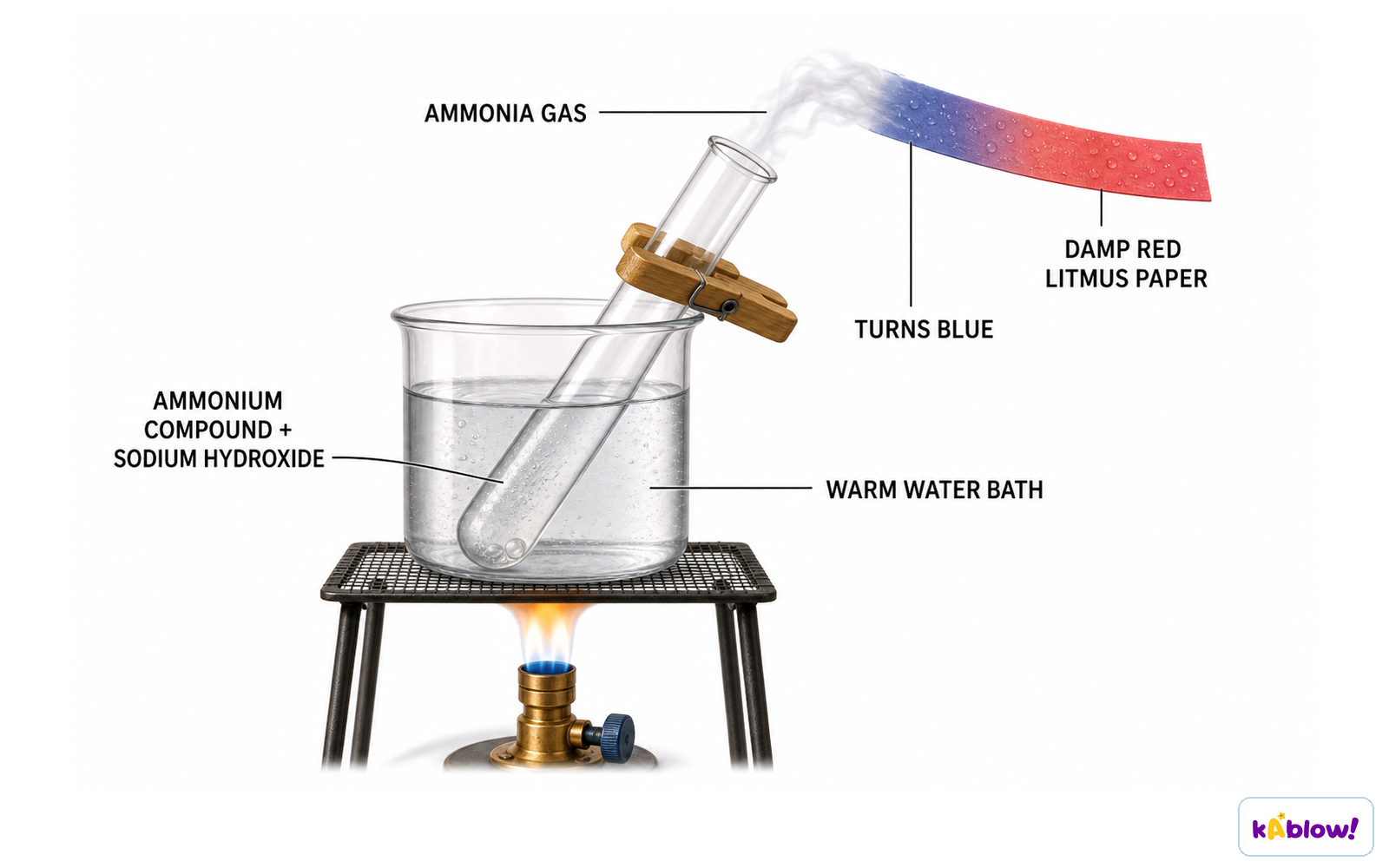
- Test for ammonium ions (NH₄⁺) by adding sodium hydroxide solution and gently heating.
- If ammonium ions are present, ammonia gas is produced.
- Ammonia gas turns damp red litmus paper blue; hold the paper near the mouth of the test tube without touching the sides.
- Ammonia also reacts with hydrogen chloride gas to form a white smoke of ammonium chloride.
- The ionic equation is: NH₄⁺(aq) + OH⁻(aq) → NH₃(g) + H₂O(l).
- Ammonium (NH₄⁺) is the aqueous cation; ammonia (NH₃) is the gas.
Testing for ammonium ions
Test for Carbonates
- Carbonates contain the carbonate ion, CO₃²⁻.
- Add dilute acid to the sample; if a carbonate is present, effervescence occurs and carbon dioxide gas is released.
- Bubble the gas through limewater; carbon dioxide turns limewater cloudy/milky due to formation of insoluble calcium carbonate.
- Equation: CO₃²⁻(aq) + 2H⁺(aq) → CO₂(g) + H₂O(l).
- Equation: CO₂(g) + Ca(OH)₂(aq) → CaCO₃(s) + H₂O(l).
- Connect the test tube to the limewater quickly so no carbon dioxide escapes.
Test for Halides
- Halide ions are the negative ions formed by Group 7 elements: Cl⁻, Br⁻, I⁻.
- Acidify the sample with dilute nitric acid, then add silver nitrate solution.
- A silver halide precipitate forms: silver chloride white, silver bromide cream, silver iodide yellow.
- Ionic equation: Ag⁺(aq) + X⁻(aq) → AgX(s).
- Use nitric acid, not hydrochloric acid, because HCl contains chloride ions that would interfere.
- Example: KCl(aq) + AgNO₃(aq) → KNO₃(aq) + AgCl(s).
Test for Sulfates
- Acidify the sample with dilute hydrochloric acid, then add barium chloride solution.
- A white precipitate of barium sulfate is a positive result for sulfate ions.
- Ionic equation: Ba²⁺(aq) + SO₄²⁻(aq) → BaSO₄(s).
- The test can also be carried out using barium nitrate solution.
- HCl is added first to remove any carbonates, which would also produce a precipitate and interfere.
- State symbols for the reaction are aq, aq, s.
Core Practical: Identifying Ions
- The aim is to use chemical tests to identify the ions in unknown single ionic compounds.
- Common tests include flame tests and tests for sulfate, carbonate and halide ions.
- Tests can be carried out in any order; you may not need to do all tests on one sample.
- Use only small amounts of sample and reagent; dissolve solid samples in distilled water if needed.
- Record observations carefully in a results table and repeat any tests that give unclear results.
- Identify the salt from the cation and anion present, balancing charges in the formula.
- Example: a positive test for Fe²⁺ and sulfate ions means the salt is FeSO₄.
- Hazards: limewater, dilute nitric acid and sodium hydroxide are harmful; ammonia gas is toxic if inhaled.
Instrumental Methods of Analysis
- Instrumental methods include X-ray, infra-red and mass spectroscopy, gas chromatography and flame photometry.
- They are more accurate, faster and easier to use, and more sensitive than traditional chemical tests.
- They can be automated and can perform multiple simultaneous sampling and testing.
- Modern instruments can work with very small sample sizes.
- Advantages should be described in terms of sensitivity, speed and accuracy.
Flame Emission Spectroscopy
- Flame emission spectroscopy is an instrumental method used to analyse metal ions in solution.
- The sample is put into a flame and the light emitted is passed through a spectroscope.
- The output is a line spectrum; different elements produce lines in different parts of the spectrum.
- The spectrum identifies the metal ions present and can measure their concentrations.
- The intensity of light is proportional to the number of ions vaporised, so a calibration curve can determine concentration.
- It works for mixtures of ions, unlike a flame test which can only analyse one ion at a time.
- Unknown samples are identified by comparing their spectrum to reference spectra.
Slide
Sign up free to view the lesson slides
Step through every slide for this topic — plus flashcards and revision notes — with a free account.
Câu hỏi luyện tập
Xem trước miễn phí — 8 trên 62 câu hỏi. Đăng ký để xem tất cả.
1.What colour flame is produced by potassium ions in a flame test?
Easy- AYellow
- BLilac
- CCrimson
- DOrange-red
2.A student adds sodium hydroxide solution to a solution containing iron(II) ions. What is observed?
Easy- AA blue precipitate
- BA green precipitate
- CA brown precipitate
- DA white precipitate that dissolves in excess
3.Which reagent is used to test for sulfate ions in solution?
Easy- ASilver nitrate
- BBarium chloride
- CSodium hydroxide
- DLimewater
4.What is the correct test for ammonium ions?
Easy- AAdd sodium hydroxide and warm gently; test the gas with damp red litmus
- BAdd silver nitrate; look for a white precipitate
- CAdd barium chloride; look for a white precipitate
- DAdd dilute acid; test the gas with limewater
5.Which instrumental method is used to analyse metal ions in solution by measuring the intensity and wavelength of light emitted?
Medium- AGas chromatography
- BFlame emission spectroscopy
- CMass spectrometry
- DInfra-red spectroscopy
6.Which statements about testing for halide ions are correct? (select all that apply)
Medium- ADilute nitric acid is added before silver nitrate solution
- BSilver chloride forms a white precipitate
- CSilver bromide forms a yellow precipitate
- DSilver iodide forms a yellow precipitate
- EDilute hydrochloric acid is used to acidify the solution
7.Sodium ions produce a yellow flame in a flame test.
EasyTrue or false?
8.Instrumental methods are less accurate than traditional chemical tests.
EasyTrue or false?
Unlock all 62 questions, flashcards & more
Tạo tài khoản miễn phí để xem mọi câu hỏi, slide, thẻ ghi nhớ và ghi chú ôn tập cho chủ đề này.