Reactions of acids
Học bằng cách chơi
Trả lời những câu hỏi này để kiếm năng lượng, rồi câu cá và khám phá. Không cần tài khoản.
Ghi chú bài học
Reactions of Acids with Metals
- Acids react with some metals to produce a salt and hydrogen gas.
- General equation: metal + acid → salt + hydrogen.
- Only metals above hydrogen in the reactivity series react with dilute acids; copper does not react.
- The more reactive the metal, the more vigorous the reaction; potassium and sodium react explosively.
- The salt produced depends on the acid: hydrochloric acid gives chlorides, sulfuric acid gives sulfates.
- Example: Mg (s) + 2HCl (aq) → MgCl₂ (aq) + H₂ (g).
- Test for hydrogen: a lit splint gives a squeaky pop.
Metal-Acid Reactions as Redox (Higher Tier)
- Metal-acid reactions are redox reactions: reduction and oxidation occur together.
- Oxidation is loss of electrons; reduction is gain of electrons.
- In the reaction Zn + 2HCl → ZnCl₂ + H₂, the ionic equation is Zn + 2H⁺ → Zn²⁺ + H₂.
- Oxidation half-equation: Zn → Zn²⁺ + 2e⁻ (zinc is oxidised).
- Reduction half-equation: 2H⁺ + 2e⁻ → H₂ (hydrogen ions are reduced).
- Metal atoms tend to lose electrons and are usually the species oxidised.
Neutralisation and Salt Production
- A base neutralises an acid; examples include metal oxides, hydroxides and carbonates.
- An alkali is a soluble base; all alkalis are bases, but not all bases are alkalis.
- General neutralisation: acid + base → salt + water.
- With a metal carbonate: acid + carbonate → salt + water + carbon dioxide.
- The salt name has two parts: the metal (from the base) and the acid ending (chloride, sulfate, nitrate).
- Hydrochloric acid → chlorides; sulfuric acid → sulfates; nitric acid → nitrates.
- Example: 2HCl + CuO → CuCl₂ + H₂O.
- Test for carbon dioxide: bubble through limewater; it turns milky/cloudy.
Soluble Salts and Their Preparation
- Soluble salts can be made by reacting an acid with an insoluble base (metal, oxide, hydroxide or carbonate).
- The solid is added in excess to ensure all the acid reacts; otherwise unreacted acid would become dangerously concentrated during evaporation.
- The excess solid is removed by filtration, leaving a solution of salt and water.
- The solution is heated to evaporate water until small crystals begin to appear (about half the water removed).
- Slow evaporation over days gives larger crystals.
- Example: CuO (s) + H₂SO₄ (aq) → CuSO₄ (aq) + H₂O (l).
- Acids can also react with metals if the metal is above hydrogen but not too reactive.
Required Practical: Preparation of a Soluble Salt
- Aim: prepare a pure, dry sample of a soluble salt from an insoluble oxide or carbonate.
- Add dilute acid to a beaker and warm gently.
- Add the insoluble oxide slowly until it is in excess (no more dissolves).
- Filter to remove excess solid, collecting the filtrate in an evaporating basin.
- Heat gently (water bath or electric heater) to evaporate water and make the solution saturated.
- Test saturation by dipping a cold glass rod; crystals form on it.
- Leave to crystallise, then decant excess solution and dry the crystals.
- Expected result: bright blue, regularly shaped hydrated copper(II) sulfate crystals.
The pH Scale and Neutralisation
- Acids produce hydrogen ions (H⁺) in aqueous solution; alkalis produce hydroxide ions (OH⁻).
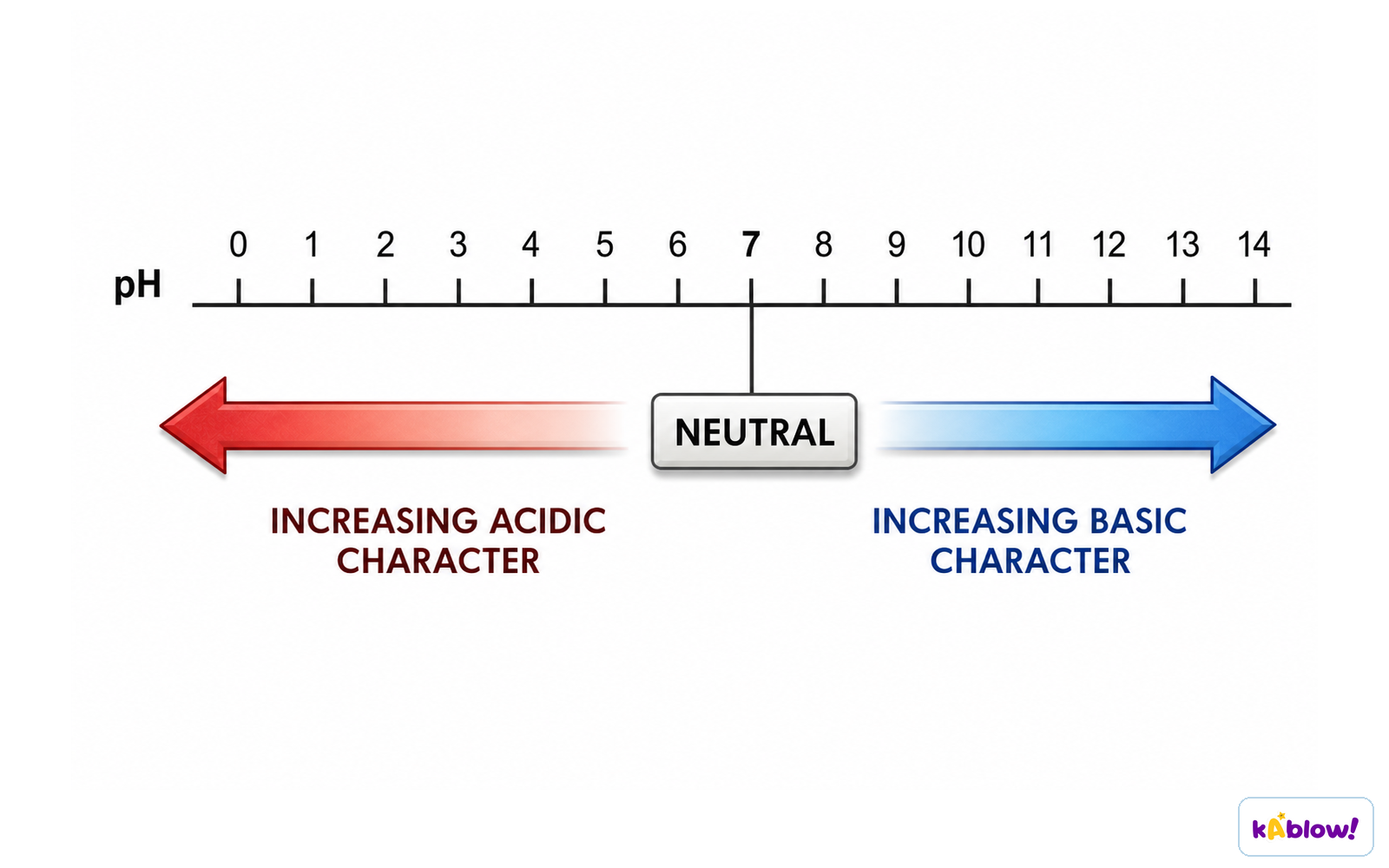
- The pH scale runs from 0 to 14; pH 7 is neutral.
- Acids have pH below 7; alkalis have pH above 7.
- pH 1–3 = strong acid; pH 4–6 = weak acid; pH 8–11 = weak alkali; pH 12–14 = strong alkali.
- pH can be measured with universal indicator (approximate) or a pH probe (more accurate).
- Neutralisation: H⁺ (aq) + OH⁻ (aq) → H₂O (l).
- Not all acid reactions are neutralisations: metal + acid produces a salt but no water.
The pH scale
Strong and Weak Acids
- Strong acids are completely ionised in water, giving a high concentration of H⁺ and low pH (1–3).
- Examples of strong acids: hydrochloric, nitric and sulfuric acids.
- Weak acids are only partially ionised in water, giving a lower concentration of H⁺ and pH 4–6.
- Examples of weak acids: ethanoic, citric and carbonic acids.
- Weak acids set up an equilibrium, e.g. CH₃CH₂COOH ⇌ H⁺ + CH₃CH₂COO⁻; the equilibrium lies to the left.
- Concentration (dilute/concentrated) is different from strength (strong/weak).
- A dilute strong acid can have a lower pH than a concentrated weak acid.
- pH is logarithmic: a change of 1 unit means a tenfold change in H⁺ concentration.
Titrations
- Titrations measure the volume of one solution that reacts exactly with a known volume of another.
- Acid-base titrations can determine the concentration of an acid or alkali.
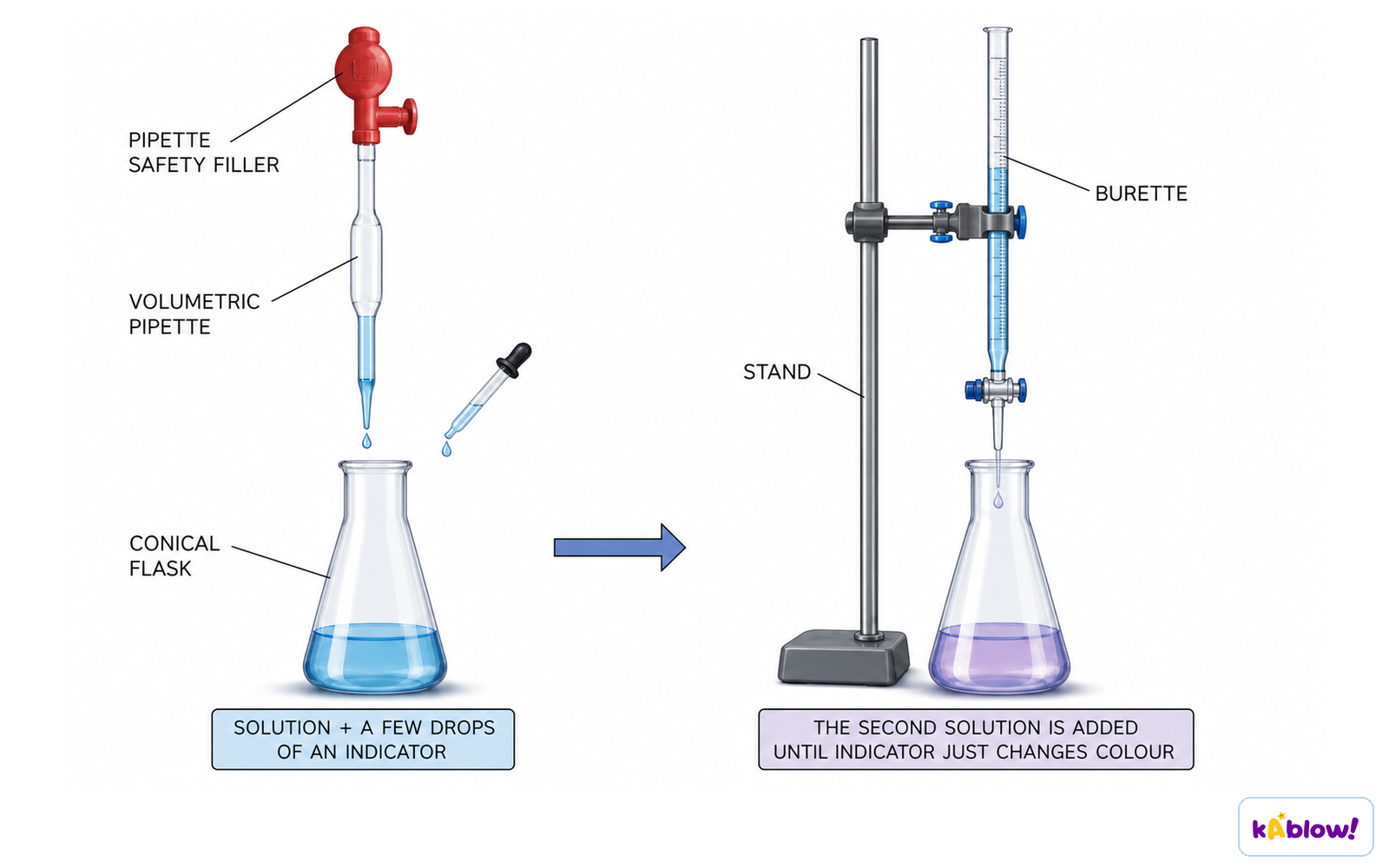
- A pipette measures a fixed volume (e.g. 25.0 cm³) of one solution into a conical flask.
- A burette delivers the other solution; the volume used is the titre.
- A suitable indicator (e.g. phenolphthalein or methyl orange) shows the end-point by a sharp colour change.
- Universal indicator is not suitable for titrations because its colour change is not sharp.
- Concordant results are within 0.1 cm³ of each other; only these are used to calculate the mean titre.
Titration apparatus set-up
Required Practical: Strong Acid & Strong Alkali Titration
- Aim: determine the reacting volumes of a strong acid and a strong alkali by titration.
- Use a pipette to place exactly 25.0 cm³ of alkali into a conical flask.
- Add a few drops of a suitable indicator (e.g. phenolphthalein).
- Perform a rough titration, then repeat accurately, adding dropwise near the end-point.
- Record the volume to the nearest 0.05 cm³, reading the bottom of the meniscus at eye level.
- Repeat until two concordant results are obtained.
- Calculate the mean titre, ignoring anomalous results.
Titration Calculations (Higher Tier)
- Use the relationship: moles = concentration × volume (in dm³).
- Convert cm³ to dm³ by dividing by 1000.
- Use the balanced equation to find the mole ratio between acid and alkali.
- Calculate moles of the known solution, then use the ratio to find moles of the unknown.
- Concentration = moles ÷ volume (in dm³).
- Example: 25.00 cm³ of 0.15 mol/dm³ Ba(OH)₂ neutralises 12.80 cm³ HNO₃; moles Ba(OH)₂ = 0.15 × 0.025 = 3.75 × 10⁻³ mol; moles HNO₃ = 7.5 × 10⁻³ mol; concentration = 7.5 × 10⁻³ ÷ 0.0128 = 0.59 mol/dm³.
Slide
Sign up free to view the lesson slides
Step through every slide for this topic — plus flashcards and revision notes — with a free account.
Câu hỏi luyện tập
Xem trước miễn phí — 8 trên 57 câu hỏi. Đăng ký để xem tất cả.
1.Which ion is present in aqueous solutions of all acids?
Easy- AHydroxide ion, OH⁻
- BHydrogen ion, H⁺
- CChloride ion, Cl⁻
- DHydroxide ion, OH⁺
2.Which ions make a solution alkaline?
Easy- AHydrogen ions, H⁺
- BHydroxide ions, OH⁻
- COxide ions, O²⁻
- DHydroxide ions, OH⁺
3.All alkalis are bases, but not all bases are alkalis.
EasyTrue or false?
4.Which acid should be used to produce magnesium sulfate from magnesium?
Easy- AHydrochloric acid
- BNitric acid
- CSulfuric acid
- DEthanoic acid
5.Which salt is formed when zinc carbonate reacts with nitric acid?
Easy- AZinc
- BZinc chloride
- CZinc nitrate
- DZinc oxide
6.Which of the following statements about neutralisation reactions are correct? (select all that apply)
Medium- ANeutralisation always produces water.
- BThe reaction between an acid and a metal is a neutralisation reaction.
- CAcid + base → salt + water is the general equation for neutralisation.
- DWhen the base is a metal carbonate, carbon dioxide is also produced.
- ENeutralisation always produces hydrogen gas.
7.Match each acid to the type of salt it produces.
Medium- Hydrochloric acid
- Sulfuric acid
- Nitric acid
- Chlorides
- Sulfates
- Nitrates
8.Which statement correctly describes a strong acid?
Medium- AIt is completely ionised in aqueous solution.
- BIt is partially ionised in aqueous solution.
- CIt always has a high concentration.
- DIt always contains a high number of acid molecules per dm³.
Unlock all 57 questions, flashcards & more
Tạo tài khoản miễn phí để xem mọi câu hỏi, slide, thẻ ghi nhớ và ghi chú ôn tập cho chủ đề này.