Structure and bonding of carbon
Học bằng cách chơi
Trả lời những câu hỏi này để kiếm năng lượng, rồi câu cá và khám phá. Không cần tài khoản.
Ghi chú bài học
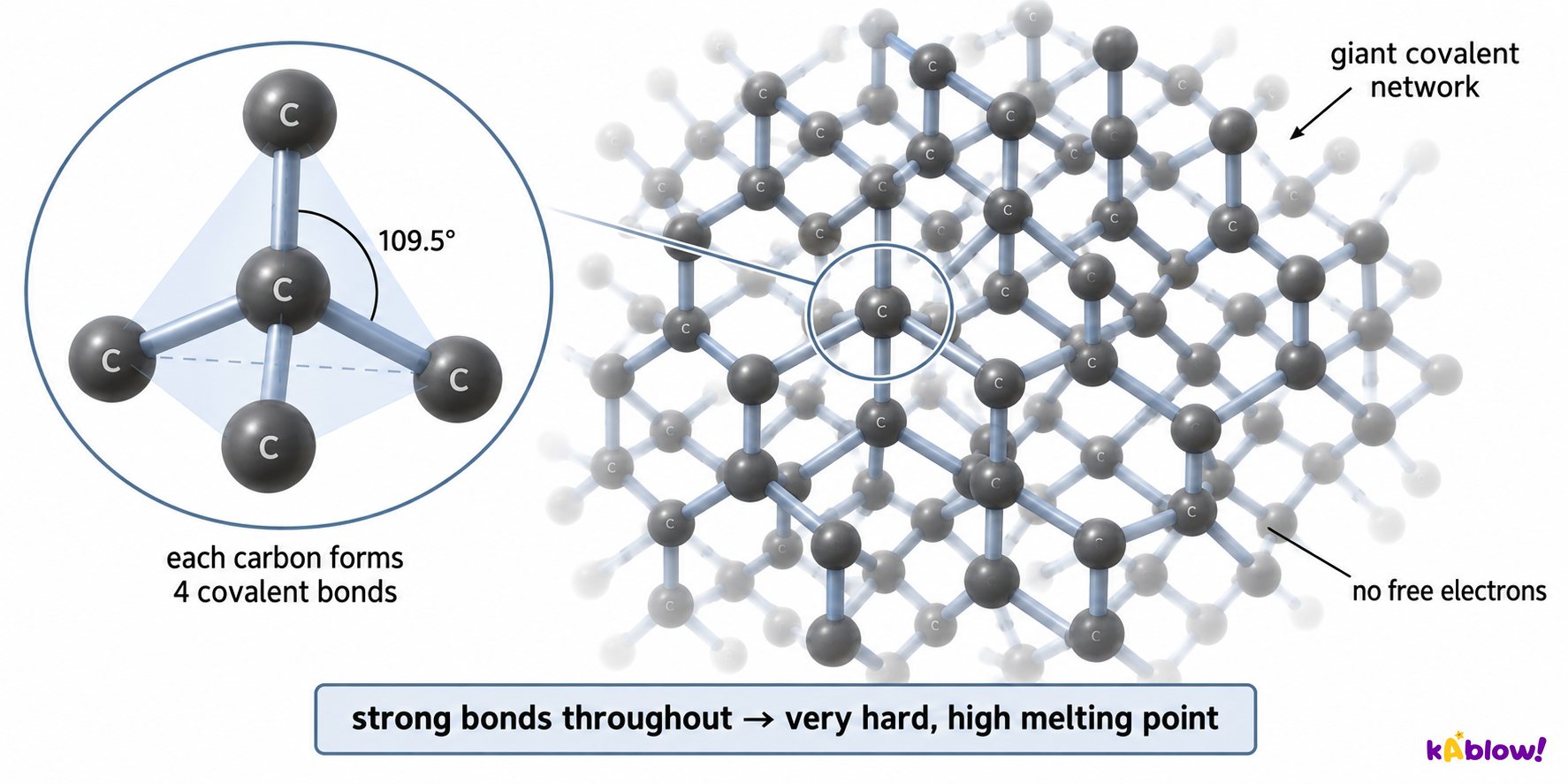
Diamond: Structure and Bonding
- Diamond and graphite are allotropes of carbon: both contain only carbon atoms but have different bonding arrangements, making them physically completely different.
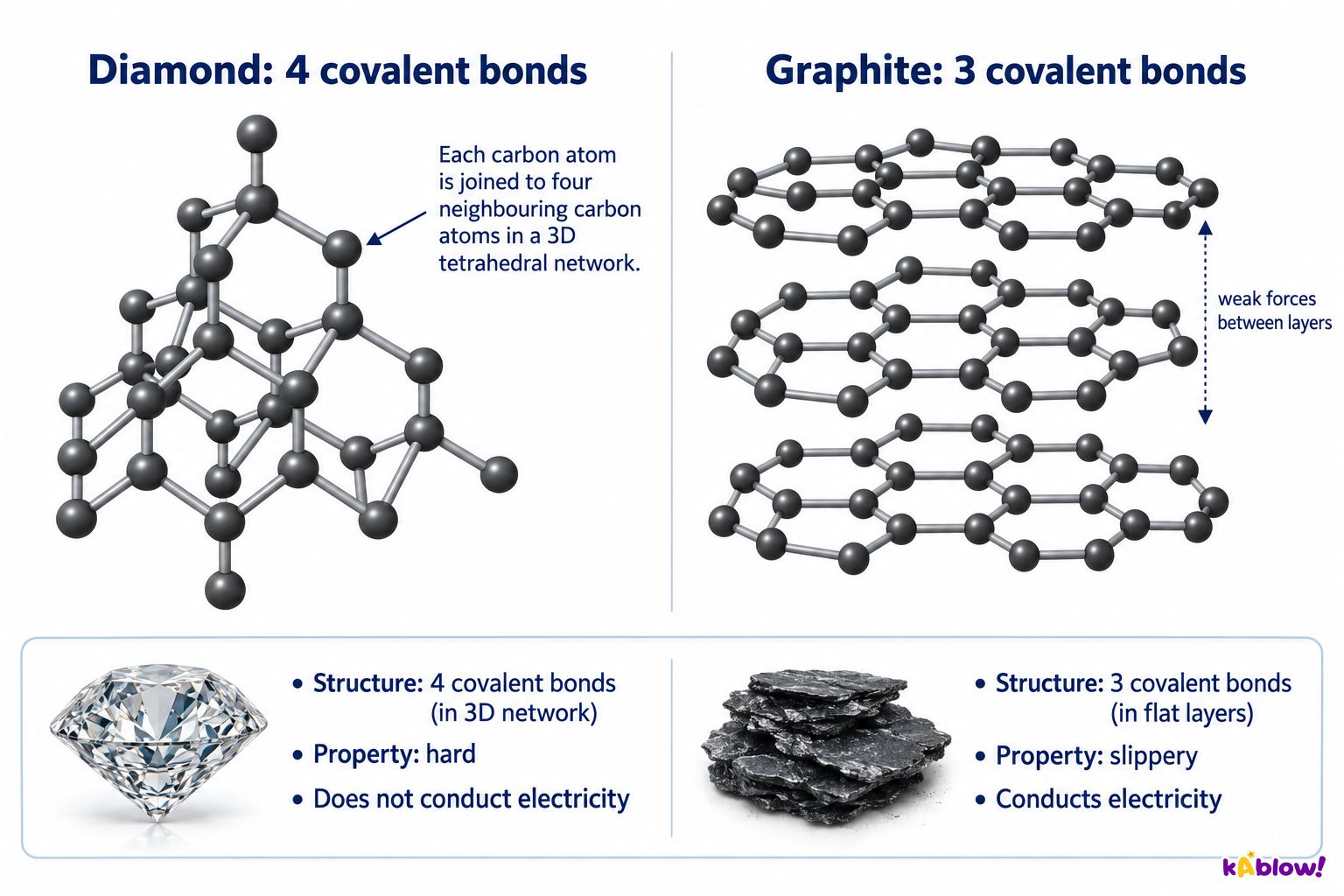
- In diamond, each carbon atom forms four covalent bonds with four other carbon atoms, creating a giant covalent tetrahedral structure.
- All the covalent bonds in diamond are identical, very strong, and there are no intermolecular forces between separate molecules.
- All outer shell electrons of each carbon atom are held in the four covalent bonds, so there are no freely moving particles to carry charge.
- Diamond has a very high melting point because its giant covalent structure has strong covalent bonds that need lots of energy to break.
- Diamond is extremely hard and dense due to its strong covalent bonds and each carbon atom being bonded to four others.
- Diamond's hardness makes it useful in cutting tools like drills; it is the hardest naturally occurring mineral but is brittle and can be smashed with a hammer.
Diamond's giant covalent network
Graphite: Structure and Bonding
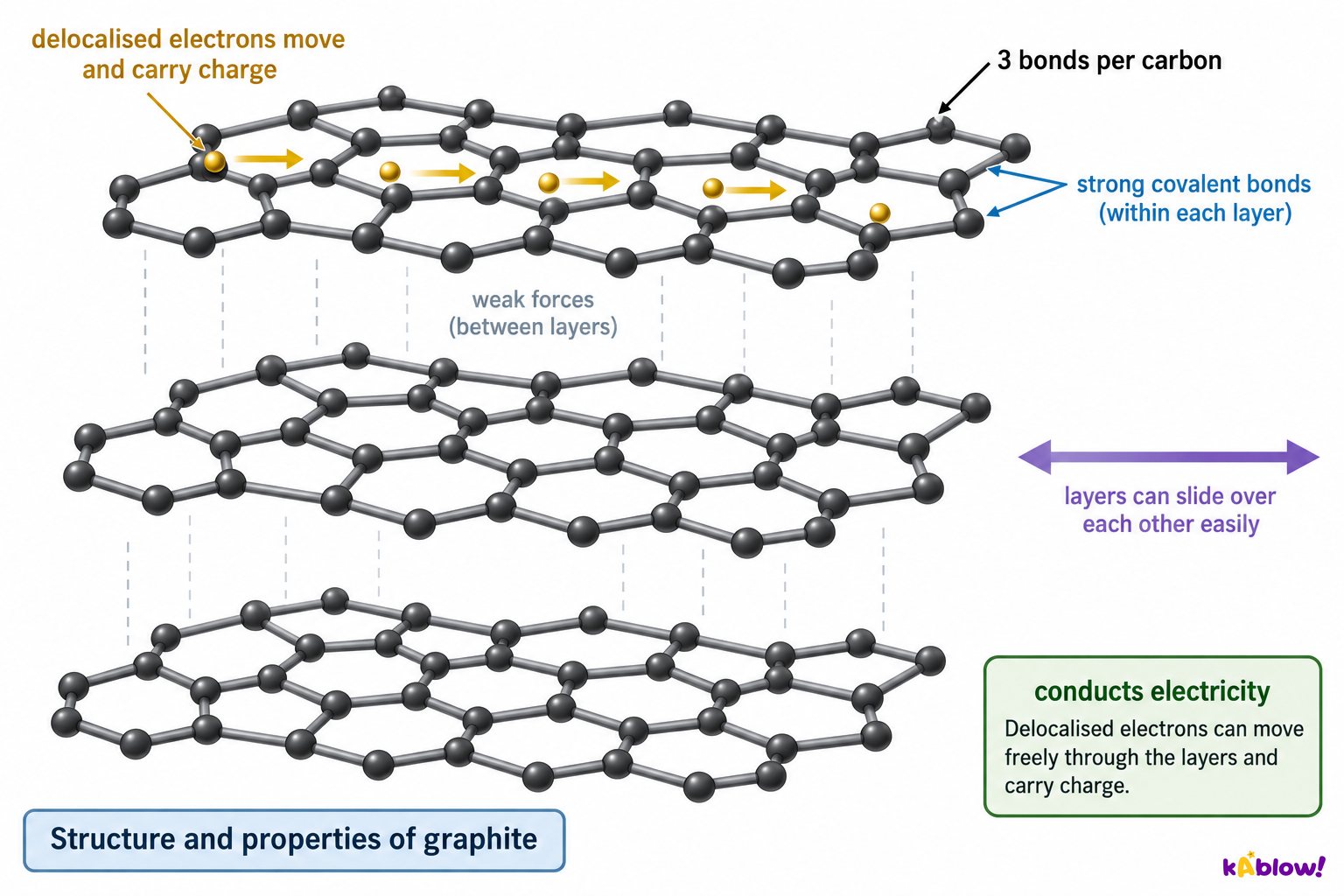
- In graphite, each carbon atom forms three covalent bonds with three other carbon atoms, forming layers of hexagonal rings.
- One electron per carbon atom is delocalised (free to move) and exists between the layers, allowing graphite to conduct electricity.
- The covalent bonds within the layers are very strong, but the layers are held together by weak intermolecular forces, so they can slide over each other.
- Graphite is soft and slippery because its layers can slide over each other, making it useful as a lubricant and in pencils.
- Graphite has a high melting point because it has a giant covalent structure with strong covalent bonds needing lots of energy to break.
- Graphite can be used to make inert electrodes for electrolysis, important in the extraction of metals such as aluminium.
- Graphite is similar to metals in that it has delocalised electrons; it does not conduct because of free ions.
Graphite layers and delocalised electrons
Graphene: Structure and Properties
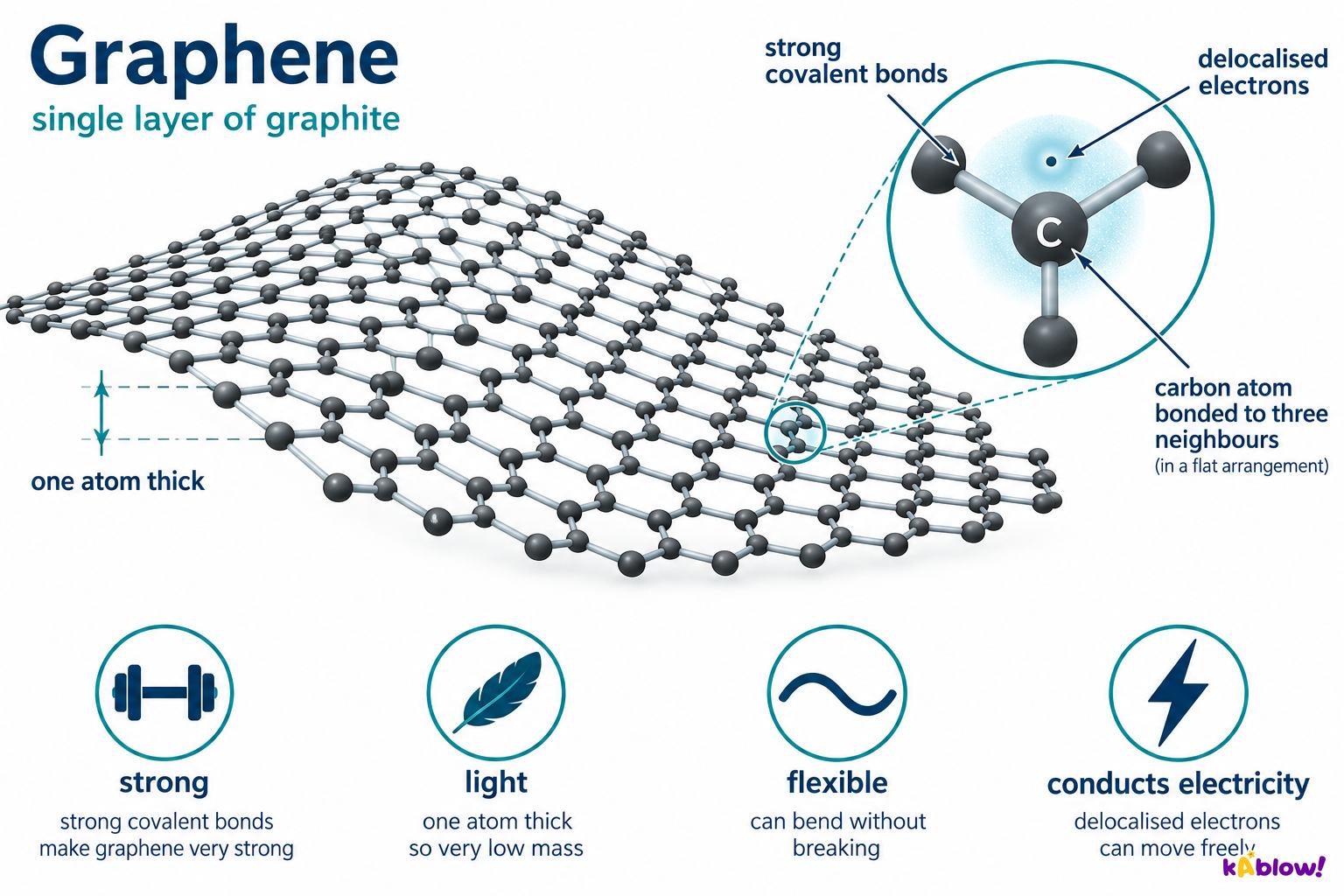
- Graphene is a single layer of graphite, just one atom thick, consisting of a sheet of carbon atoms covalently bonded in a continuous hexagonal layer.
- It is essentially a 2D molecule and has very unusual properties that make it useful in composites and electronics.
- Graphene is extremely strong due to its unbroken pattern and strong covalent bonds between carbon atoms; even stitched patches remain the strongest material.
- It is also amazingly light, transparent (absorbs 2.3% of visible light), and flexible—it can be twisted, pulled and curved without breaking.
- Graphene conducts heat and electricity because it has delocalised electrons that can move along its surface; it moves electrons 200 times faster than silicon.
- Its transparency gives it potential for making computer screens of the future.
Graphene: one carbon layer
Fullerenes: Structure and Uses
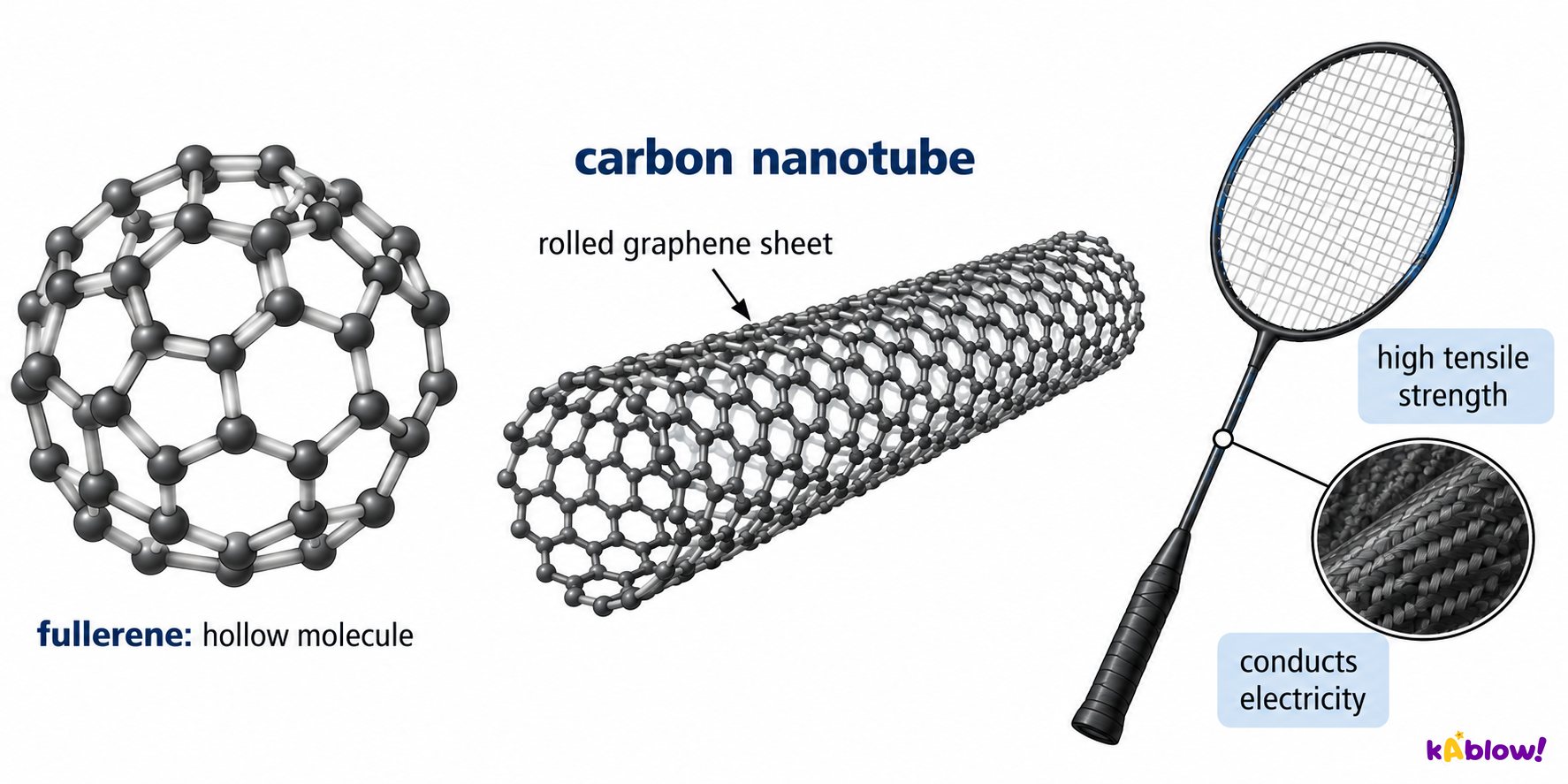
- Fullerenes are carbon allotropes consisting of molecules with hollow tubes or spheres.
- Their structures are based on interlocking hexagonal rings, but may also contain rings of five or seven carbon atoms.
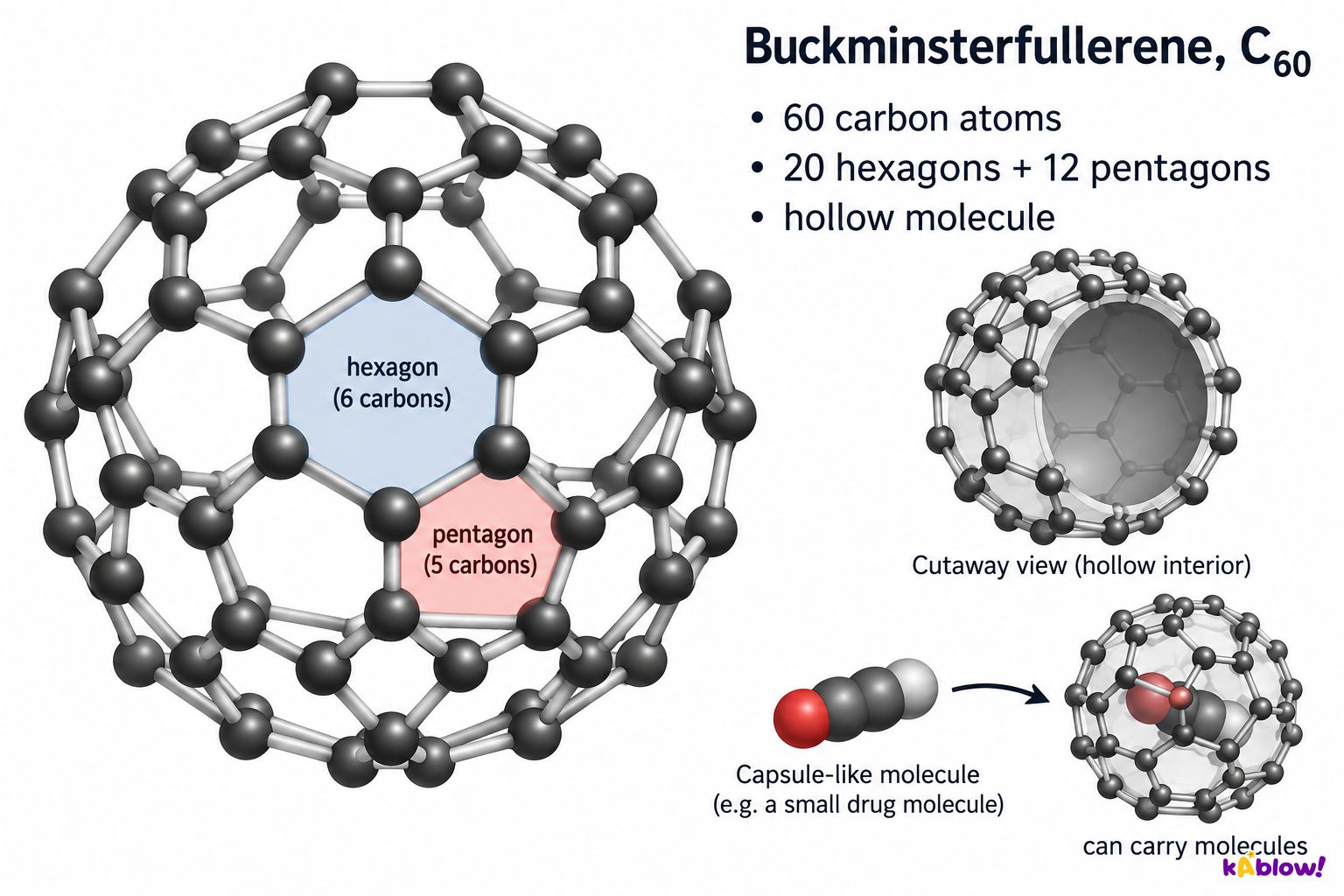
- Fullerenes can trap other molecules by forming around them, making them useful for targeted drug delivery systems.
- They have a huge surface area, useful for trapping catalyst molecules so catalysis can take place.
- Some fullerenes are excellent lubricants and are used in industrial processes.
- The first fullerene discovered was Buckminsterfullerene (C60), a hollow sphere of 60 carbon atoms forming 20 hexagons and 12 pentagons, shaped like a football.
- Buckminsterfullerene was discovered as a component of soot and its discovery won the 1996 Nobel Prize in Chemistry.
Buckminsterfullerene C60
Carbon Nanotubes
- Carbon nanotubes are cylindrical fullerenes made by rolling a sheet of graphene into a cylinder.
- They have very high length to diameter ratios and high tensile strength, resisting breaking or stretching.
- Like graphene, nanotubes can conduct electricity, making them useful in composites, specialised materials, electronics and nanotechnology.
- Their properties make them useful for nanotechnology, electronics and materials.
Carbon nanotubes
Comparing Diamond, Graphite and Graphene
- Diamond is hard and does not conduct; graphite is soft, slippery and conducts; graphene is a single layer of graphite that is strong, flexible and conducts.
- Diamond has a giant covalent structure with each carbon bonded to four others; graphite has layers with each carbon bonded to three others.
- Graphite conducts because of delocalised electrons between layers; diamond does not because all outer electrons are held in covalent bonds.
- Graphite is soft because its layers slide over each other (weak intermolecular forces); diamond is hard because its rigid covalent network prevents movement.
- Graphene is similar to graphite in that it is a layer of hexagonal carbon rings, but different because it is only one atom thick.
- Both diamond and graphite have high melting points due to strong covalent bonds needing lots of energy to break.
Carbon allotropes: diamond and graphite
Common Misconceptions to Avoid
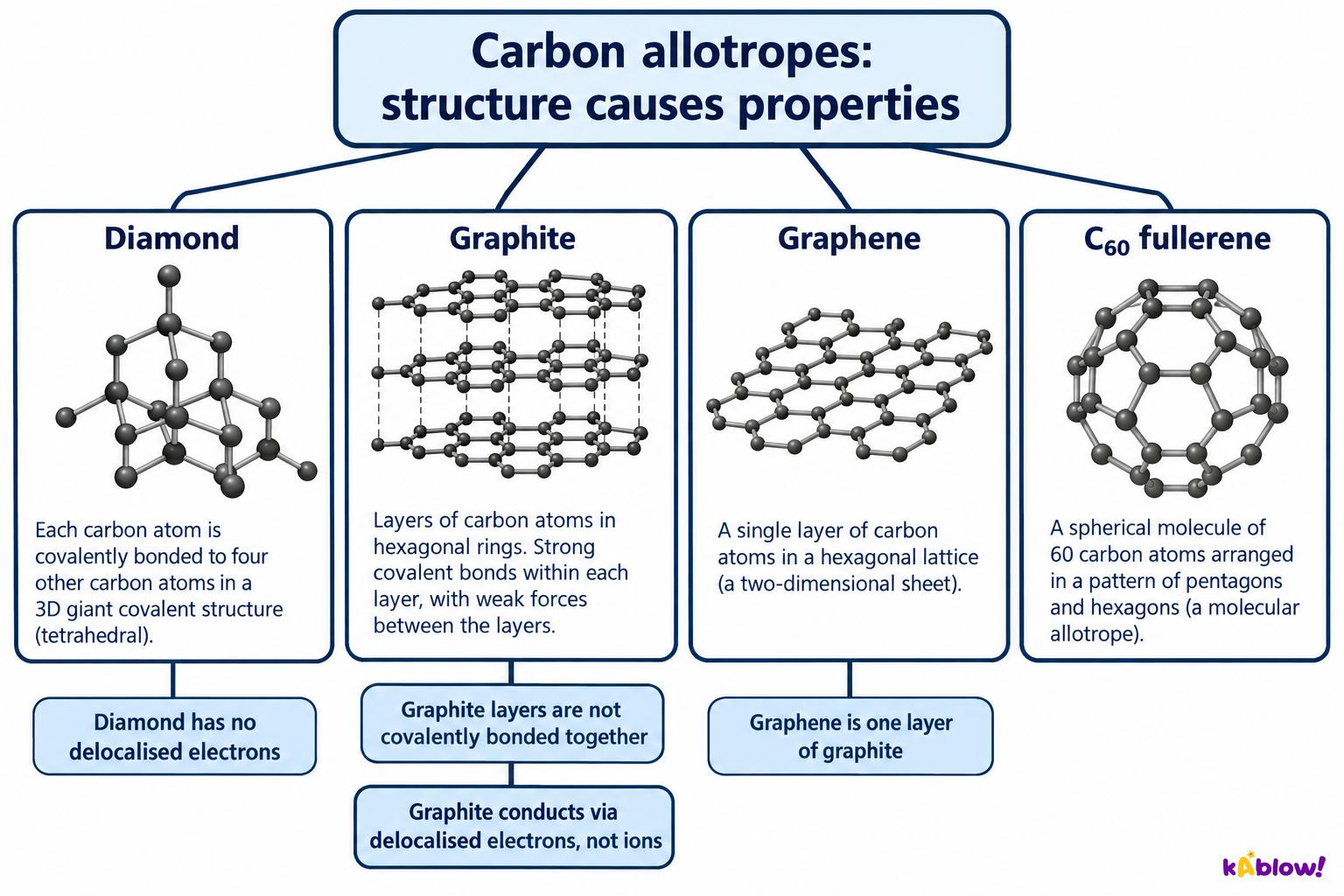
- Graphite does not conduct because of free ions; it conducts because of delocalised electrons.
- Each carbon atom in graphite forms three bonds, not four.
- Graphene is a single layer of graphite, not the same as bulk graphite.
- Diamond does not conduct electricity even though it is a giant structure.
- The layers in graphite are not held together by covalent bonds; they are held by weak intermolecular forces.
Carbon allotropes: common misconceptions
Slide
Sign up free to view the lesson slides
Step through every slide for this topic — plus flashcards and revision notes — with a free account.
Câu hỏi luyện tập
Xem trước miễn phí — 8 trên 63 câu hỏi. Đăng ký để xem tất cả.
1.Which bonding is found in diamond, graphite and fullerenes?
Easy- AIonic
- BCovalent
- CMetallic
- DCoordinate
2.Which substance cannot conduct electricity?
Easy- ADiamond
- BBuckminsterfullerene
- CGraphite
- DNanotubes
3.In graphite, each carbon atom is bonded to how many other carbon atoms?
Medium- ATwo
- BThree
- CFour
- DFive
4.Why can graphite conduct electricity?
Medium- AGraphite has delocalised electrons
- BGraphite has layers of atoms that can slide over each other
- CGraphite has a giant structure
- DGraphite has strong covalent bonds
5.Which statement about diamond is correct?
Medium- AIt is a hard substance with a low melting point
- BEach carbon atom is bonded to three others with strong covalent bonds
- CIt has a giant structure and conducts electricity
- DIt has a high melting point with each carbon bonded to four others
6.Which of the following is not a property of carbon nanotubes?
Medium- AHigh tensile strength
- BHigh melting point
- CPoor conductor of electricity
- DStrong covalent bonds
7.Which of the following are properties of Buckminsterfullerene? (select all that apply)
Medium- AStrong metallic bonds
- BA hollow shape
- CEach carbon is bonded to four other carbon atoms
- DHigh melting point
- EStrong covalent bonds
- FPoor conductor of electricity
8.Graphite is slippery because it has weak covalent bonds between its layers.
EasyTrue or false?
Unlock all 63 questions, flashcards & more
Tạo tài khoản miễn phí để xem mọi câu hỏi, slide, thẻ ghi nhớ và ghi chú ôn tập cho chủ đề này.