The periodic table
Học bằng cách chơi
Trả lời những câu hỏi này để kiếm năng lượng, rồi câu cá và khám phá. Không cần tài khoản.
Ghi chú bài học
Arranging the Elements
- Elements are arranged in order of increasing atomic number; each element has one proton more than the one before it.
- The table is arranged in vertical columns called groups and horizontal rows called periods.
- The period number tells you the number of electron shells an atom has (e.g. Period 3 elements have 3 shells).
- The group number tells you the number of electrons in the outer shell (e.g. Group 1 elements have 1 outer electron).
- Elements in the same group have similar chemical properties because they have the same number of outer electrons.
- The group number can be used to predict how an element will react; elements in the same group react similarly.
History of the Periodic Table
- Early periodic tables were arranged in order of atomic weight, before subatomic particles were discovered.
- Early tables were incomplete: some elements were forced into gaps or placed in the wrong group because chemical properties were ignored.
- In 1869 Dmitri Mendeleev arranged elements by increasing atomic weight but also considered their properties and those of their compounds.
- Mendeleev left gaps in his table for elements that had not yet been discovered, rather than forcing elements to fit.
- He used the properties of neighbouring elements to predict the properties of undiscovered elements, e.g. eka-silicon (now germanium).
- When these predicted elements were later discovered and fitted the pattern, it confirmed his theories.
- Mendeleev did not know about isotopes, which caused some inaccuracy in his table.
- The modern Periodic Table uses atomic number to order elements, which fits Mendeleev's patterns.
Metals and Non-Metals
- Elements can be divided into metals and non-metals; most elements are metals.
- Metals react by losing electrons to form positive ions (cations).
- Non-metals do not form positive ions; they gain electrons to form negative ions (anions) or are Group 0 elements.
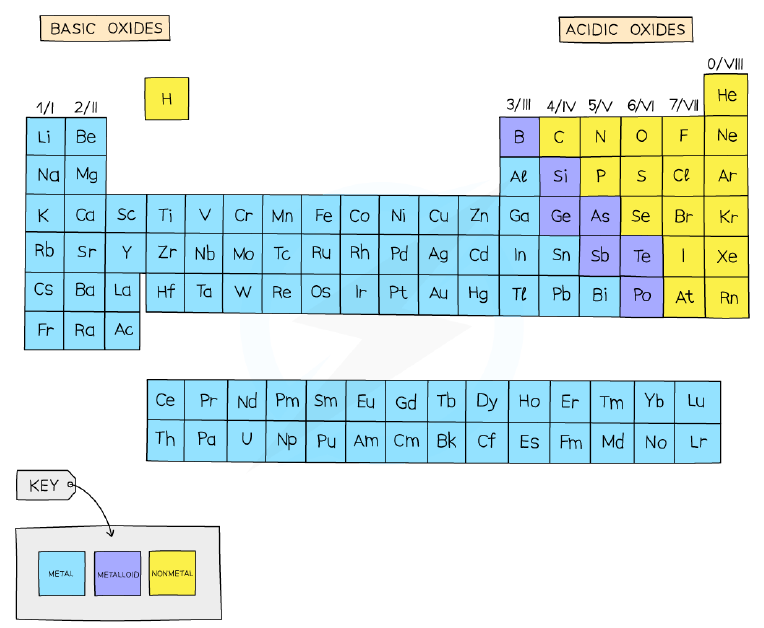
- Metalloids (semi-metals) display properties of both metals and non-metals.
- Metallic character decreases across a period from left to right and increases down a group.
- Metals have 1–3 outer shell electrons, are good conductors, form basic oxides and usually react with acids.
- Non-metals have 4–7 outer shell electrons, are poor conductors, form acidic (or neutral) oxides and usually do not react with acids.
- Metals are usually lustrous, malleable and have high melting points; non-metals are dull, brittle and have low melting points.
The metal/non-metal divide, with basic and acidic oxide regions
Group 0: The Noble Gases
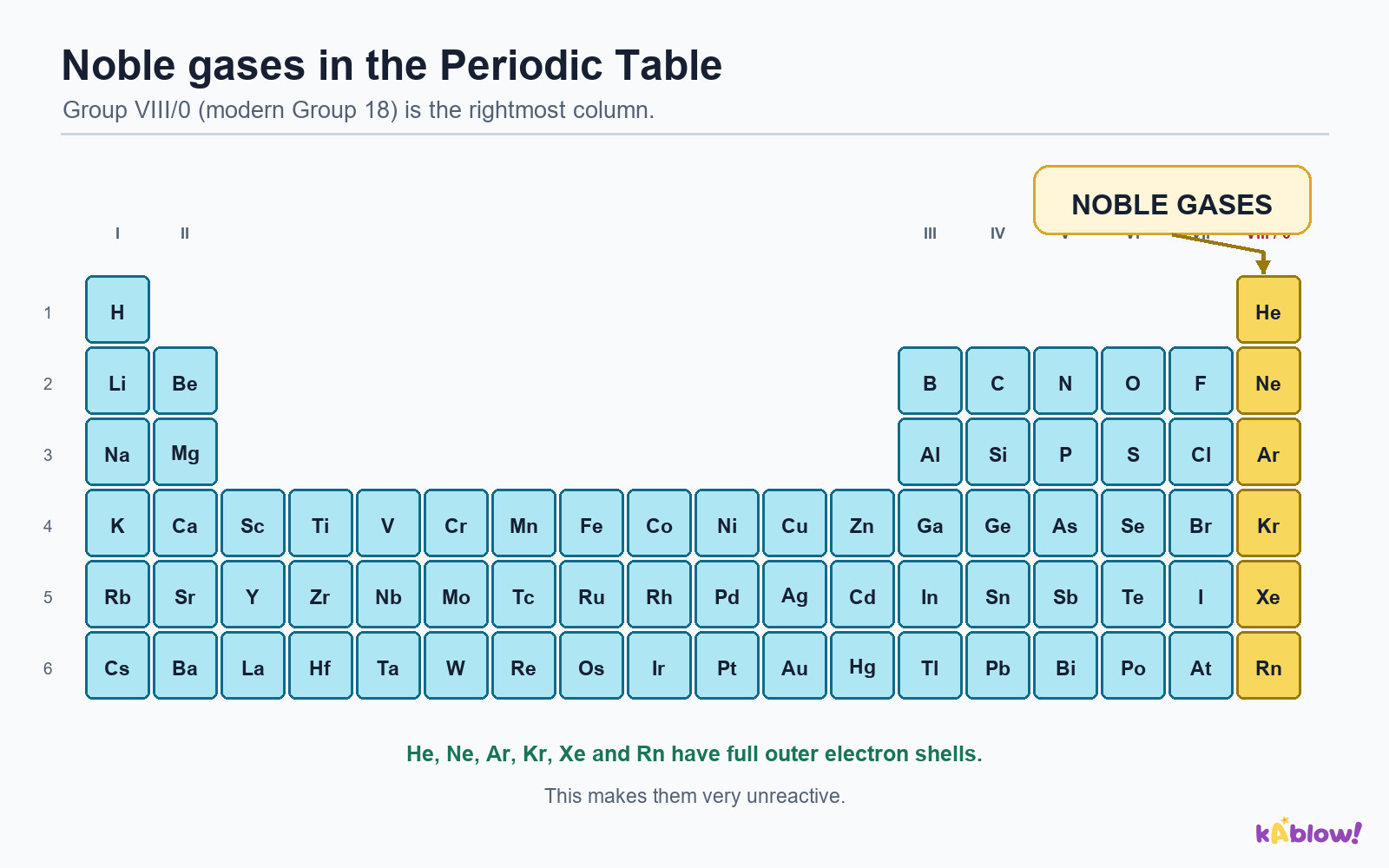
- Group 0 elements are called the noble gases; they are non-metals, monatomic, colourless and non-flammable gases at room temperature.
- They have full outer shells of electrons, making them stable, unreactive and inert.
- Helium has 2 outer electrons; the other noble gases have 8 outer electrons (so Group 0 is sometimes labelled Group 8).
- Electronic configurations: He = 2, Ne = 2.8, Ar = 2.8.8, Kr = 2.8.18.8, Xe = 2.8.18.18.8.
- Noble gases have very low melting and boiling points, which increase down the group as relative atomic mass increases.
- The increase in boiling point is due to larger atoms having stronger intermolecular forces, so more energy is needed to overcome them.
- Helium has the lowest boiling point of all elements (-269 ºC); radon boils at about -60 ºC.
- Uses: helium fills balloons (less dense than air, does not burn); argon provides an inert atmosphere for welding and fills light bulbs; neon, argon and xenon are used in advertising signs.
The Periodic Table showing the location of the noble gases
Group 1: The Alkali Metals
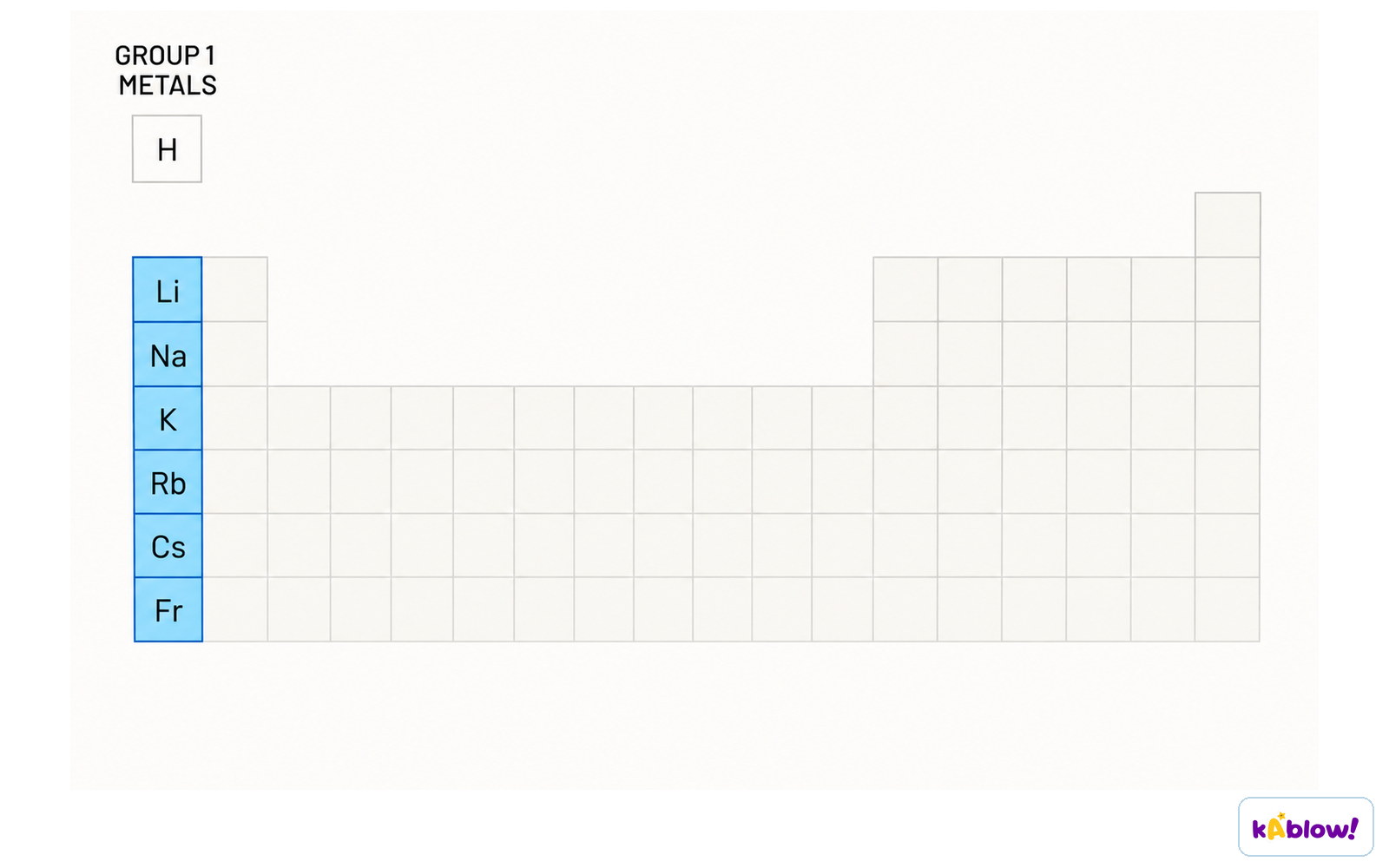
- Group 1 elements are known as the alkali metals: lithium, sodium, potassium, rubidium, caesium and francium.
- They form alkaline solutions when they react with water (pH > 7).
- They have similar chemical properties because they each have one electron in their outermost shell.
- Physical properties: soft (can be cut with a knife), relatively low density and low melting points.
- They are very reactive because they only need to lose one electron to become highly stable.
- Softness increases down the group; melting points decrease down the group due to decreasing attractive forces between outer electrons and positive ions.
- The first three alkali metals are less dense than water; potassium is an exception as it has a lower density than sodium.
- They are stored in oil because they react readily with oxygen and water vapour in air.
Alkali metals occupy the far-left column; hydrogen is not presented as a Group 1 metal.
Reactions of the Alkali Metals
- General reaction with water: group 1 metal + water → metal hydroxide + hydrogen.
- Equation: 2M(s) + 2H₂O(l) → 2MOH(aq) + H₂(g), where M is Li, Na, K, Rb or Cs.
- Lithium: relatively slow reaction, fizzes, moves on the surface of the water.
- Sodium: more vigorous fizzing, moves rapidly on the surface, dissolves quickly.
- Potassium: reacts more vigorously than sodium, burns with a lilac flame, moves very rapidly, dissolves very quickly.
- Reaction with oxygen: alkali metals tarnish in air forming a dull metal oxide coating, e.g. 4Na(s) + O₂(g) → 2Na₂O(s).
- Reaction with chlorine: alkali metals react vigorously when heated with chlorine to form metal chlorides, e.g. 2Na(s) + Cl₂(g) → 2NaCl(s).
- Reactions become more vigorous down the group; rubidium, caesium and francium react even more vigorously with air and water.
Group 1: Reactivity and Electronic Configurations
- Reactivity of Group 1 metals increases as you go down the group.
- When a Group 1 atom reacts, it loses its single outer electron to form a 1+ ion.
- The next shell down becomes the outermost shell and is already full, so the ion obtains noble gas configuration.
- Going down the group, the number of electron shells increases by 1, so the outermost electron is further from the nucleus.
- This means there are weaker forces of attraction between the outermost electron and the nucleus.
- Less energy is required to overcome the weaker attraction, so the outer electron is lost more easily.
- Therefore, the alkali metals get more reactive as you descend the group.
Group 7: The Halogens
- Group 7 elements are the halogens: fluorine, chlorine, bromine, iodine and astatine.
- They are non-metals that are poisonous and have seven electrons in their outermost shell.
- Halogens are diatomic, forming molecules of pairs of atoms sharing electrons (single covalent bond), e.g. F₂, Cl₂.
- When halogen atoms gain an electron they form -1 ions called halide ions.
- At room temperature: fluorine and chlorine are gases, bromine is a liquid, iodine is a crumbly solid.
- Colours become darker down the group: fluorine (yellow gas), chlorine (pale yellow-green gas), bromine (red-brown liquid), iodine (grey solid).
- Melting and boiling points increase down the group due to increasing intermolecular forces as atoms get larger.
- Test for chlorine: damp blue litmus paper is bleached white (it may turn red briefly); chlorine should be handled in a fume cupboard.
Group 7: Reactivity and Displacement
- Reactivity of Group 7 non-metals decreases as you go down the group.
- Going down the group, the number of shells increases, so the outer shell is further from the nucleus.
- Halogens form negative ions by gaining an electron; the increased distance makes it harder to attract an electron.
- Fluorine is the smallest halogen, so its outermost shell is closest to the nucleus, making it the most reactive.
- A displacement reaction occurs when a more reactive halogen displaces a less reactive halogen from an aqueous solution of its halide.
- Chlorine displaces bromine (solution becomes orange) and iodine (solution becomes brown); bromine displaces iodine (brown).
- Example equations: Cl₂ + 2KBr → 2KCl + Br₂; Cl₂ + 2KI → 2KCl + I₂; Br₂ + 2KI → 2KBr + I₂.
- Fluorine will displace all other halogens; astatine will be displaced by all halogens.
Halogen Displacement and Redox
- Halogen displacement reactions are redox reactions: oxidation and reduction occur together.
- Oxidation is loss of electrons; reduction is gain of electrons.
- In Cl₂ + 2KI → 2KCl + I₂, the net ionic equation is Cl₂ + 2I⁻ → 2Cl⁻ + I₂.
- Chlorine is reduced: Cl₂ + 2e⁻ → 2Cl⁻ (gain of electrons).
- Iodide ions are oxidised: 2I⁻ → I₂ + 2e⁻ (loss of electrons).
- The more reactive halogen undergoes reduction; the less reactive one undergoes oxidation.
- Halogens react with metals to form ionic metal halide salts, e.g. 2Na + Cl₂ → 2NaCl; Ca + Br₂ → CaBr₂.
- Halogens react with non-metals to form simple molecular covalent structures, e.g. hydrogen halides such as hydrogen chloride.
Slide
Sign up free to view the lesson slides
Step through every slide for this topic — plus flashcards and revision notes — with a free account.
Câu hỏi luyện tập
Xem trước miễn phí — 8 trên 62 câu hỏi. Đăng ký để xem tất cả.
1.What is the name given to the elements in Group 0 of the periodic table?
Easy- AAlkali metals
- BHalogens
- CNoble gases
- DTransition metals
2.What is the name given to the elements in Group 1 of the periodic table?
Easy- ANoble gases
- BHalogens
- CTransition metals
- DAlkali metals
3.Which statement explains why Group 1 metals get more reactive further down the group?
Medium- AThere is an increasing attraction between the outer electron and the nucleus
- BThere is less shielding of the outer electron so it is easier to lose
- CThere is a decreasing attraction between the outer electron and the nucleus so the electron is more easily lost
- DThe outer electron is closer to the nucleus and harder to lose
4.Which of the following is not true for the Group 1 metals?
Medium- AThey are very reactive
- BThey have low melting points
- CThey have high densities
- DThey are soft
5.The noble gases are monatomic, meaning they exist as single atoms.
EasyTrue or false?
6.The reactivity of the halogens increases as you go down Group 7.
EasyTrue or false?
7.Which halogen is a red-brown liquid at room temperature?
Medium- AFluorine
- BChlorine
- CBromine
- DIodine
8.Which of the following are properties of Group 1 metals? (select all that apply)
Medium- AThey are soft and can be cut with a knife
- BThey have high melting points
- CThey have low densities
- DThey are very reactive
- EThey are poor conductors of electricity
Unlock all 62 questions, flashcards & more
Tạo tài khoản miễn phí để xem mọi câu hỏi, slide, thẻ ghi nhớ và ghi chú ôn tập cho chủ đề này.