Using concentrations of solutions in mol/dm3
Học bằng cách chơi
Trả lời những câu hỏi này để kiếm năng lượng, rồi câu cá và khám phá. Không cần tài khoản.
Ghi chú bài học
Concentration in mol/dm³
- Concentration can be measured in mol/dm³ (also written as mol/dm³ or mol/dm³).
- It is often more useful to express concentration in moles per unit volume rather than mass per unit volume.
- The formula is: concentration (mol/dm³) = number of moles of solute (mol) ÷ volume of solution (dm³).
- The units in the answer can be written as mol dm⁻³ or mol / dm³.
- You may need to convert between g/dm³ and mol/dm³ depending on the question.
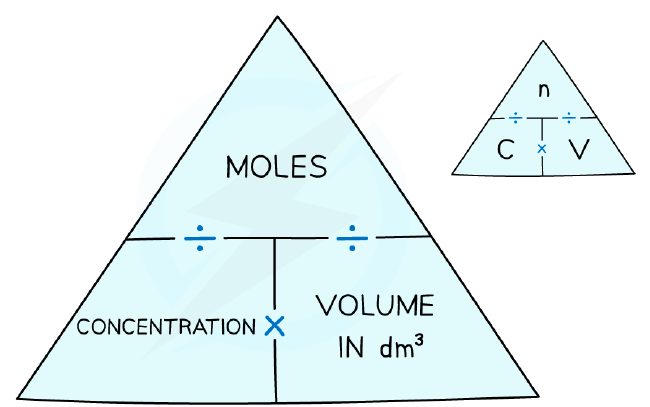
Concentration, moles and volume formula triangle
Converting between cm³ and dm³
- To go from cm³ to dm³, divide by 1000.
- To go from dm³ to cm³, multiply by 1000.
- For example, 500 cm³ ÷ 1000 = 0.5 dm³.
- A common mistake is forgetting to convert units, which gives an answer a thousand times out.
Calculating moles from concentration and volume
- Rearrange the formula to find moles: moles = concentration × volume.
- Make sure the volume is in dm³ before substituting into the equation.
- A formula triangle can help you rearrange the relationship between concentration, moles and volume.
- You are not given the formula triangle in exams, so you must learn it.
- It is a good idea to write the formula down before starting a problem.
Worked example: moles from concentration
- Calculate the moles in 2.5 dm³ of a solution of concentration 0.2 mol/dm³.
- Moles = concentration × volume = 0.2 × 2.5.
- The answer is 0.5 mol.
Worked example: concentration from mass
- Calculate the concentration of sodium hydroxide, NaOH, when 80 g is dissolved in 500 cm³ of water (Na = 23, H = 1, O = 16).
- First find the relative formula mass: Mᵣ(NaOH) = 23 + 16 + 1 = 40.
- So 40 g NaOH = 1 mole, and 80 g NaOH = 2 moles.
- Convert volume: 500 cm³ ÷ 1000 = 0.5 dm³.
- Concentration = moles ÷ volume = 2 ÷ 0.5 = 4 mol/dm³.
Titration calculations
- If the concentration of one reactant is known, the exact volumes from a titration and the balanced equation can be used to find the concentration of the other reactant.
- Use the equation for the reaction to find the mole ratio between the acid and the base.
- Calculate moles of the known solution using moles = (volume ÷ 1000) × concentration.
- Use the mole ratio to deduce the moles of the unknown solution.
- Finally, calculate concentration using concentration = moles ÷ volume (dm³).
Worked example: titration calculation
- 25.0 cm³ of hydrochloric acid was titrated against 0.100 mol/dm³ NaOH; 12.1 cm³ of NaOH was required.
- Equation: HCl (aq) + NaOH (aq) → NaCl (aq) + H₂O (l).
- Moles of NaOH = 0.012 dm³ × 0.100 mol/dm³ = 1.21 × 10⁻³ mol.
- The acid reacts in a 1:1 ratio, so moles of HCl = 1.21 × 10⁻³ mol.
- This is present in 25.0 cm³ = 0.025 dm³.
- Concentration of HCl = 1.21 × 10⁻³ ÷ 0.025 = 0.0484 mol/dm³.
Key terminology and practical skills
- Titration is used to determine the concentration of a strong acid or alkali.
- A pipette is used to measure a precise volume of one solution into a conical flask.
- A burette is used to add the other solution until the end-point is reached.
- A standard solution is one whose concentration is accurately known.
- Concordant results are titres within a small range (e.g. 0.10 cm³) of each other; only these should be averaged.
- Neutralisation occurs when an acid and alkali react completely.
Common misconceptions and errors
- Failing to convert cm³ to dm³ gives answers a thousand times out.
- Do not confuse g/dm³ with mol/dm³ — they are different units.
- Do not average non-concordant titres; only use concordant results.
- A more concentrated solution is not necessarily a stronger acid.
- When reading a burette, read from the correct end of the scale (top to bottom).
Slide
Sign up free to view the lesson slides
Step through every slide for this topic — plus flashcards and revision notes — with a free account.
Câu hỏi luyện tập
Xem trước miễn phí — 8 trên 66 câu hỏi. Đăng ký để xem tất cả.
1.Which equation correctly gives concentration in mol/dm³?
Easy- Aconcentration = moles of solute ÷ volume of solution in dm³
- Bconcentration = volume of solution in dm³ ÷ moles of solute
- Cconcentration = moles of solute × volume of solution in dm³
- Dconcentration = moles of solute ÷ volume of solution in cm³
2.A solution of sulfuric acid, H₂SO₄, contains 9.8 g of the acid in 250 cm³ of solution. What is the concentration in mol/dm³? (Ar: H = 1, S = 32, O = 16)
Medium- A0.10 mol/dm³
- B0.20 mol/dm³
- C0.40 mol/dm³
- D0.80 mol/dm³
3.Which of the following statements about concentration and titration are correct? (select all that apply)
Medium- AConcentration can be expressed in mol/dm³ or in g/dm³.
- BA more concentrated acid is always a stronger acid.
- CConcordant titres are within 0.10 cm³ of each other.
- DA burette is read from the top of the scale downwards.
- EThe pipette is used to deliver the solution of unknown concentration into the conical flask.
4.The concentration of a solution in mol/dm³ is the number of moles of solute dissolved in 1 dm³ of solution.
EasyTrue or false?
5.Match each piece of titration apparatus or term with its correct description.
Medium- pipette
- burette
- conical flask
- concordant results
- delivers a fixed volume of solution accurately
- delivers variable volumes and is read from the bottom of the meniscus
- used to hold the solution during titration and swirled
- titres that are within 0.10 cm³ of each other
6.Place the steps of a titration in the correct order.
Medium- Pipette a known volume of the solution into a conical flask.
- Add a few drops of indicator to the conical flask.
- Fill the burette with the other solution and record the initial reading.
- Add the solution from the burette until the indicator changes colour.
- Record the final burette reading and repeat until concordant results are obtained.
7.How many moles of solute are present in 2 dm³ of a 0.5 mol/dm³ solution of potassium iodide?
Medium- A0.5 mol
- B1.0 mol
- C2.0 mol
- D10 mol
8.In a titration, 25.00 cm³ of 0.20 mol/dm³ sodium hydroxide reacted with 26.50 cm³ of hydrochloric acid. What is the concentration of the acid? (HCl + NaOH → NaCl + H₂O)
Medium- A0.19 mol/dm³
- B0.23 mol/dm³
- C0.55 mol/dm³
- D0.82 mol/dm³
Unlock all 66 questions, flashcards & more
Tạo tài khoản miễn phí để xem mọi câu hỏi, slide, thẻ ghi nhớ và ghi chú ôn tập cho chủ đề này.