Energy changes in a system, and the ways energy is stored before and after such changes
Học bằng cách chơi
Trả lời những câu hỏi này để kiếm năng lượng, rồi câu cá và khám phá. Không cần tài khoản.
Ghi chú bài học
Energy Stores
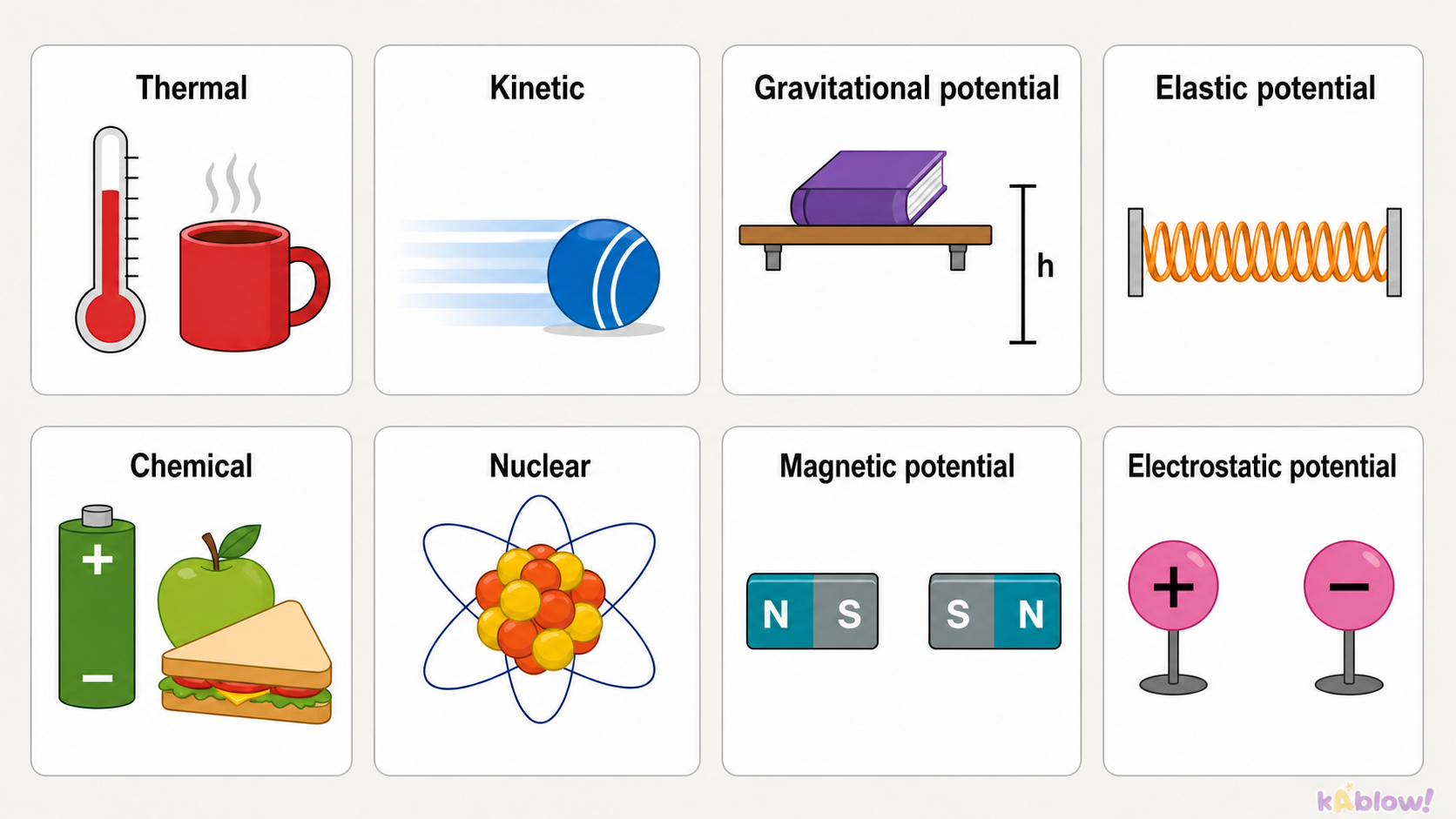
- Energy is stored in objects in different energy stores.
- Kinetic store: moving objects have energy in their kinetic store.
- Gravitational potential store: objects gain energy here when lifted through a gravitational field.
- Elastic potential store: stretched, squashed or bent objects have energy here.
- Thermal store: all objects have energy here; the hotter the object, the more energy it has.
- Other stores include chemical, nuclear, magnetic and electrostatic.
Eight energy stores, each shown with one everyday example.
Energy Transfer Pathways
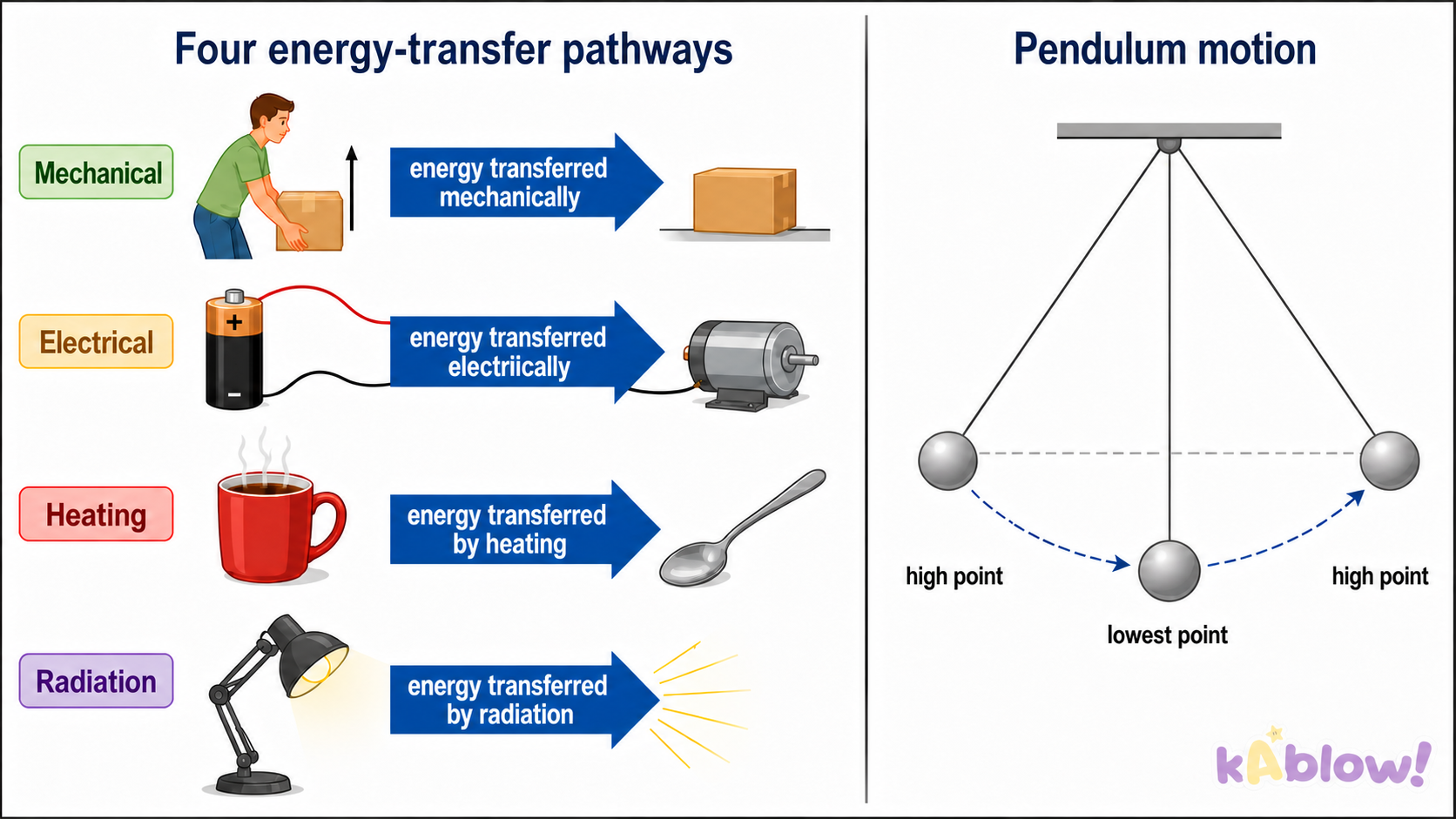
- Energy is transferred between stores by different energy transfer pathways.
- The four pathways are mechanical working, electrical working, heating and radiation.
- Mechanical working: a force acts on an object (e.g. pulling, pushing, stretching, squashing).
- Electrical working: a charge moves through a potential difference (e.g. current).
- Heating: energy is transferred from a hotter object to a colder one (e.g. conduction).
- Radiation: energy is transferred by electromagnetic waves (e.g. visible light).
Energy-transfer pathways and pendulum motion
Systems and Conservation of Energy
- A system is an object or a group of objects.
- When there is a change in a system, energy is transferred.
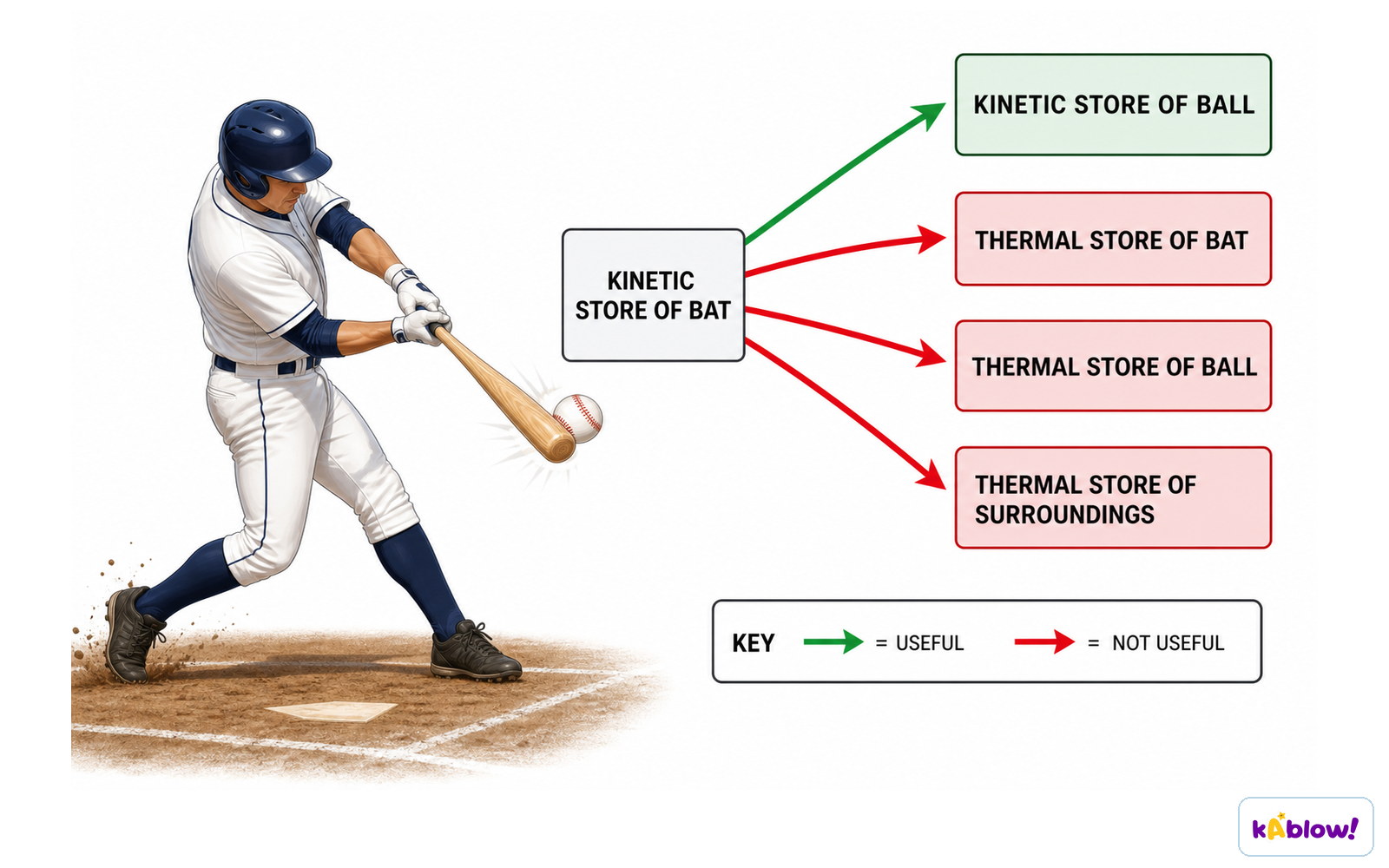
- The principle of conservation of energy states that energy cannot be created or destroyed, only transferred from one store to another.
- In a closed system, the total amount of energy remains constant.
- Total energy in = useful energy out + wasted energy.
- Energy is never 'lost'; it can be dissipated (spread out) to the surroundings, often by heating and radiation.
Conservation of energy: a bat hitting a ball
Energy Transfer Diagrams
- Energy flow diagrams show the stores and the transfer pathways taking place within a system.
- Sankey diagrams represent energy transfers using arrows whose widths are proportional to the amount of energy transferred.
- The flat left-hand end of the arrow represents the energy transferred into the system.
- The straight arrow pointing right represents the useful energy output.
- Arrows that bend away represent the wasted energy.
- A more efficient device has less wasted energy, shown by a smaller arrow bending away.
Changes in Energy
- Energy can be transferred by heating, by mechanical work done by forces, or by electrical work done when a current flows.
- Heating increases the energy in the kinetic store of the particles, which increases the thermal store of the object; this can raise temperature or cause a change of state.
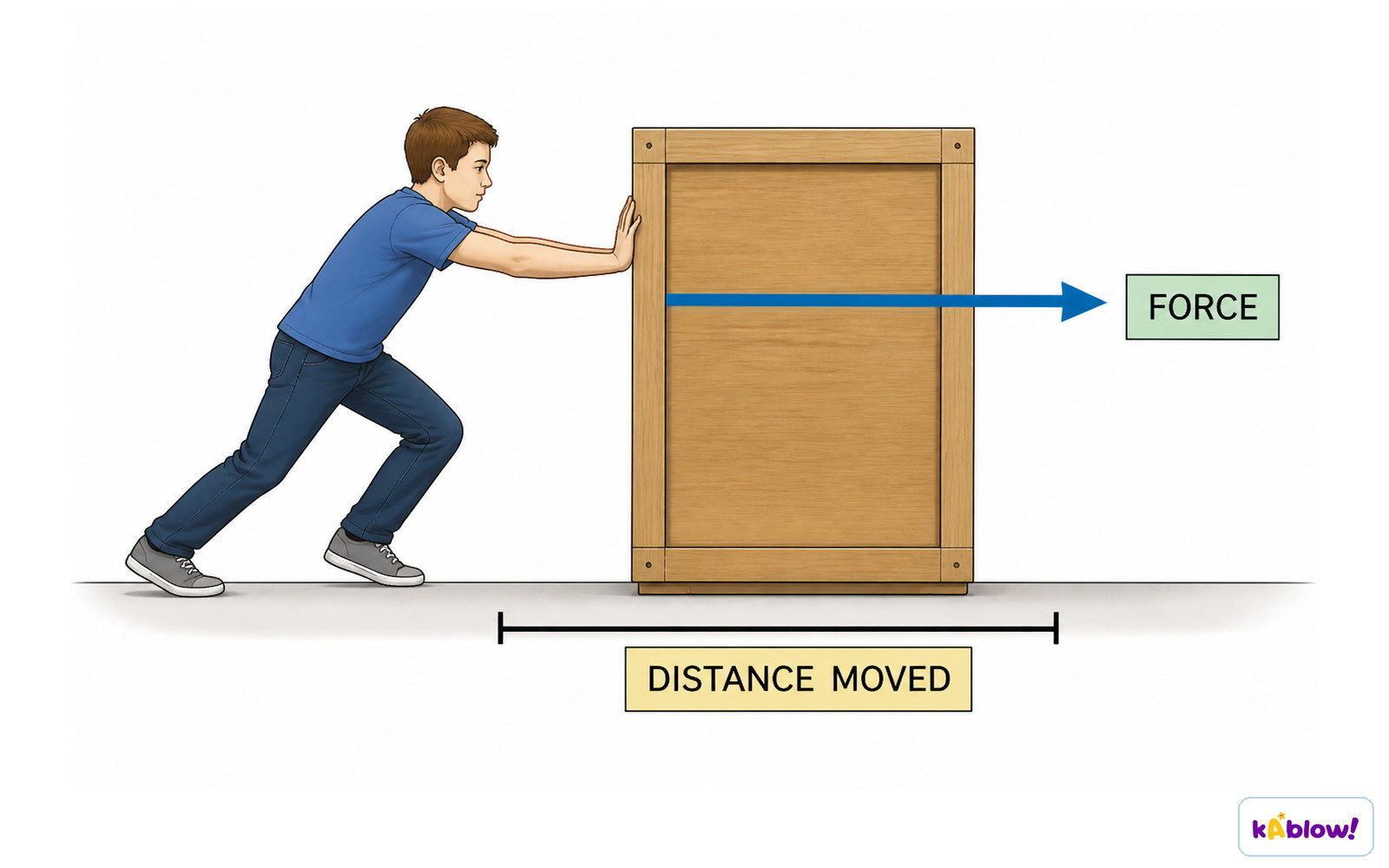
- Mechanical work is done when a force acts over a distance, e.g. pushing a box across the floor.
- When a current flows, energy is transferred electrically from the power supply to the components in the circuit.
- Changes in speed are related to kinetic energy; changes in height are related to gravitational potential energy; changes in shape are related to elastic potential energy.
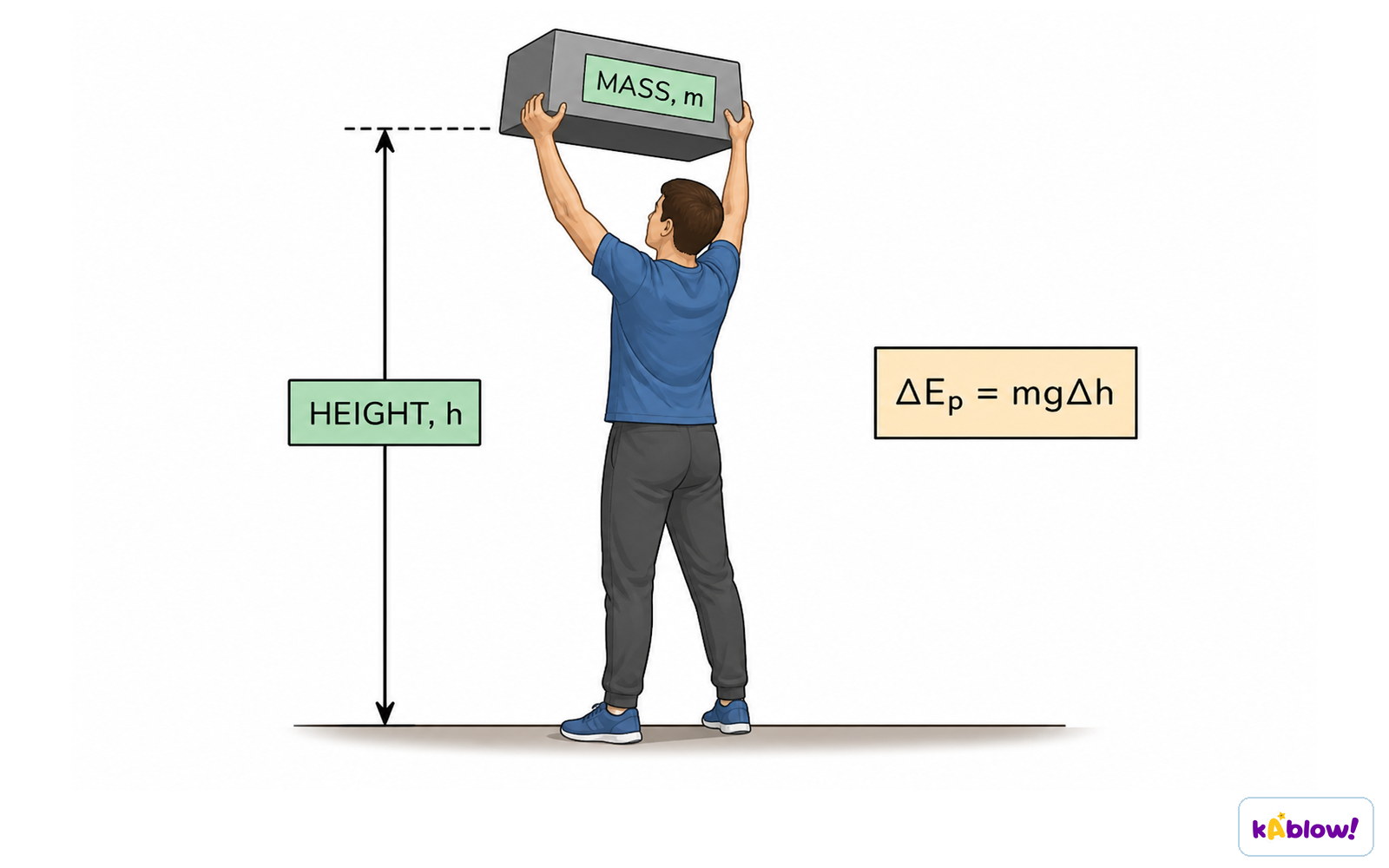
Energy is transferred to an object's gravitational store as it is lifted through a height: ΔEp = mgΔh.
Work Done and Energy
- Work is done when an object is moved over a distance by a force applied in the direction of its displacement.
- If a force is applied but there is no movement, no work is done.
- Work done = energy transferred.
- The equation is E = F × d, where E is work done or energy transferred in joules (J), F is force in newtons (N), and d is distance in metres (m).
- Example: a car's brakes apply a force of 500 N to stop the car over 23 m; work done = 500 × 23 = 11 500 J.
Work is done when a force moves an object over a distance: W = Fd
Gravitational Potential Energy and Kinetic Energy
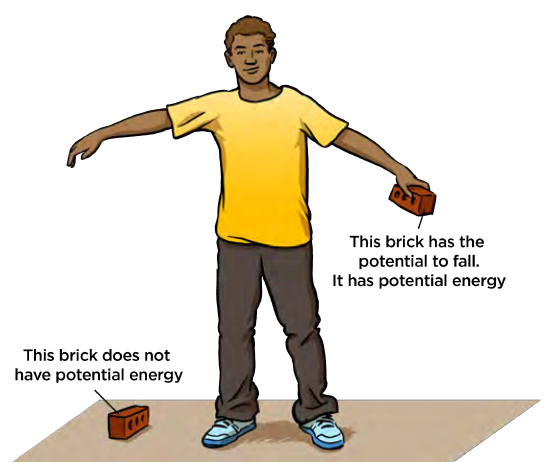
- Gravitational potential energy is the energy an object has due to its height in a gravitational field.
- The change in gravitational potential energy is calculated using ΔGPE = m × g × Δh, where m is mass in kg, g is gravitational field strength in N/kg, and Δh is change in vertical height in m.
- Kinetic energy is the energy an object has as a result of its mass and speed.
- Kinetic energy is calculated using KE = ½ × m × v², where m is mass in kg and v is speed in m/s.
- In a perfect energy transfer (no wasted energy), ΔGPE = KE; this is useful for finding speed or height when resistance is ignored.
A boy holding a brick out at arm's length has given it potential energy; the brick on the ground has none.
Dissipation of Energy
- Wasted energy transfers are inevitable; there is no such thing as a perfect energy transfer.
- Most wasted energy transfers result in heating of the objects and the surroundings.
- Energy that is spread out to the thermal store of the surroundings is said to be dissipated.
- Work done against air resistance, friction, and resistance in wires all result in heating.
- Once energy is in the thermal store of the surroundings, it cannot be gathered for any specific use, so it is called wasted energy.
- Friction is a major cause of wasted energy in machines; it can be reduced by lubrication.
Reducing Unwanted Energy Transfers
- Unwanted energy transfers include keeping a house warm, keeping a hot drink hot or cold, and friction of mechanical parts.
- Insulation reduces energy transfers by conduction.
- The effectiveness of an insulator depends on its thermal conductivity (lower is better), its density (lower is better), and its thickness (thicker is better).
- In a denser material, particles are closer together so they transfer energy more easily.
- Loft insulation is often made from fibreglass; the air trapped between the fibres makes it a good insulator.
- Cavity wall insulation fills the gap between external walls with foam, lowering conduction of heat through the walls.
Power and Efficiency
- Power is the rate of energy transfer, or the rate of work done.
- Power is calculated using P = E / t, where P is power in watts (W), E is energy transferred or work done in joules (J), and t is time in seconds (s).
- 1 watt = 1 joule per second (1 W = 1 J/s); 1 kilowatt (kW) = 1000 W.
- Efficiency is the ratio of useful energy output to total energy output.
- Efficiency = useful energy transferred by the device / total energy supplied to the device, or useful power output / total power input.
- Efficiency can be a decimal (0 to 1) or a percentage (0 to 100%); it has no units.
- A system with high efficiency transfers most of its energy usefully; a system with low efficiency wastes most of it.
Slide
Sign up free to view the lesson slides
Step through every slide for this topic — plus flashcards and revision notes — with a free account.
Câu hỏi luyện tập
Xem trước miễn phí — 8 trên 64 câu hỏi. Đăng ký để xem tất cả.
1.Which energy store is associated with the position of an object in a gravitational field?
Easy- AGravitational potential store
- BKinetic store
- CThermal store
- DElastic potential store
2.Energy can be created and destroyed.
EasyTrue or false?
3.A ball is thrown upwards. Which energy transfer takes place as the ball rises?
Medium- AKinetic store → gravitational potential store
- BGravitational potential store → kinetic store
- CKinetic store → thermal store
- DGravitational potential store → elastic potential store
4.A car of mass 1200 kg is travelling at 15 m/s. Calculate its kinetic energy.
Medium- A135 000 J
- B270 000 J
- C18 000 J
- D9 000 J
5.Which of the following are energy transfer pathways? (Select all that apply)
Medium- AMechanical working
- BElectrical working
- CHeating by radiation
- DKinetic store
- EGravitational potential store
6.Put the energy transfers in order for a ball being dropped from a height and bouncing back up (ignoring air resistance).
Medium- Gravitational potential store at the top
- Kinetic store as it falls
- Elastic potential store as it deforms on impact
- Kinetic store as it bounces back up
- Gravitational potential store at the top of the bounce
7.Match each energy store with its correct description.
Medium- Kinetic store
- Gravitational potential store
- Elastic potential store
- Thermal store
- Energy of a moving object
- Energy due to height in a gravitational field
- Energy of a stretched or squashed object
- Energy related to the temperature of an object
8.Which of the following statements about energy stores are correct? (Select all that apply)
Medium- AA moving object has energy in its kinetic store
- BA stretched spring has energy in its elastic potential store
- CA hot object has more energy in its thermal store than a cold object
- DEnergy can be created when a force acts
- EMagnetic materials interacting have energy in a magnetic store
Unlock all 64 questions, flashcards & more
Tạo tài khoản miễn phí để xem mọi câu hỏi, slide, thẻ ghi nhớ và ghi chú ôn tập cho chủ đề này.