Energy transfers
Học bằng cách chơi
Trả lời những câu hỏi này để kiếm năng lượng, rồi câu cá và khám phá. Không cần tài khoản.
Ghi chú bài học
Heating in Circuits
- When charge flows through a component, some energy is transferred from the electrons to the component, causing its temperature to rise.
- This heating effect occurs because electrons collide with the ions in the metal lattice, making the ions vibrate more.
- The energy is dissipated into the surroundings by thermal conduction, convection and radiation.
- The amount of heat produced depends on the current and the resistance: greater current or higher resistance produces more heat.
- Reducing resistance can increase current, which may actually increase the heat produced.
Reducing Heating in Circuits
- In many appliances, heat is unwanted and can be dangerous.
- To reduce heating, use a lower current or use wires with lower resistance.
- Copper is commonly used for wiring because it has low resistance and is relatively cheap.
- Lower resistance alternatives exist but are more expensive.
Uses and Dangers of Electric Heating
- The heating effect is useful in devices designed to heat things, such as kettles, ovens, toasters and domestic heaters.
- For example, a kettle converts electrical work to a thermal energy store.
- Unwanted heating reduces efficiency, e.g. waste heat in a light bulb or overheating in a computer.
- Excessive heating can cause fires, sparks or damage to components.
- Many domestic fires are caused by too much current in low-quality wiring.
Calculating Electric Energy
- Work is done when charge flows through a circuit; work done equals energy transferred.
- The energy transferred by electrical work depends on current, potential difference and time.
- The equation is: E = P × t, where E is energy in joules (J), P is power in watts (W) and t is time in seconds (s).
- Since P = IV, the equation can also be written as E = I × V × t.
- The energy transferred can also be calculated using E = Q × V, where Q is charge in coulombs (C) and V is potential difference in volts (V).
- When charge flows around a circuit, the energy supplied by the battery equals the energy transferred to all components.
- Always convert time to seconds before using these equations.
Energy and Power
- Power is defined as the energy transferred per second.
- Power is measured in watts (W); 1 W = 1 J/s.
- 1 kilowatt (kW) = 1000 W = 1000 J/s.
- Power can also be defined as work done per unit time.
- The equation is P = E / t (or E = Pt), where E is energy in joules (J) and t is time in seconds (s).
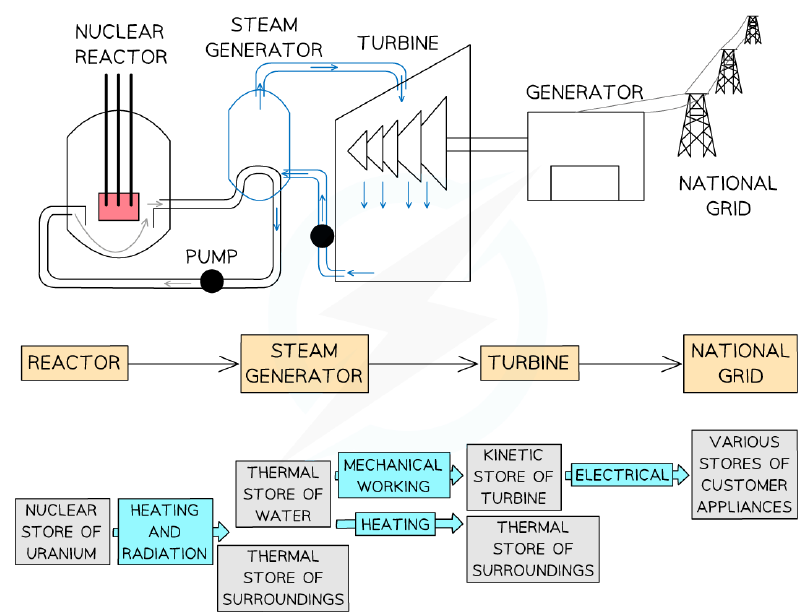
Energy flow diagram: a nuclear power plant
Electrical Power
- The power of an electrical device depends on its potential difference (voltage) and current.
- The equation is P = V × I, where P is power in watts (W), V is potential difference in volts (V) and I is current in amperes (A).
- Using V = IR, power can also be written as P = I²R or P = V² / R.
- For example, a 20 Ω resistor with a current of 6 A has a power of (6)² × 20 = 720 W.
- The unit of power is the watt (W), which is the same as a joule per second (J/s).
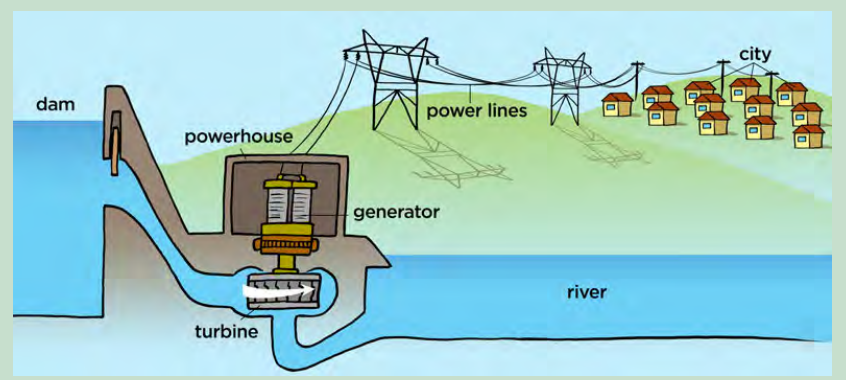
A hydropower plant: dam, powerhouse, turbine, generator, power lines and city
Energy Transfers in Appliances
- Everyday appliances transfer energy electrically from the mains supply to energy stores within the appliance.
- The amount of energy transferred depends on the time the appliance is switched on for and the power of the appliance.
- For example, a 1 kW iron uses the same energy in 1 hour as a 2 kW iron in 30 minutes.
- Energy can be transferred to the kinetic store of an electric motor (e.g. in vacuum cleaners, washing machines, refrigerators).
- Energy can be transferred to the thermal store of heating devices (e.g. toasters, kettles, radiators).
- Some appliances use DC cells or batteries, transferring energy from a chemical store.
Power Ratings
- The power rating of an appliance tells you how much energy it transfers by electrical work every second.
- Power ratings are usually given on a label, along with the required potential difference (e.g. 230 V in the UK) and frequency (e.g. 50 Hz).
- The higher the power rating, the faster the energy is transferred.
- For example, a 2000 W kettle transfers 2000 J of energy per second.
- Plugging an appliance into a mains supply with a much higher voltage than stated can cause it to fuse, set fire or become damaged.
The National Grid
- The National Grid is a system of cables and transformers linking power stations to consumers.
- Electrical power is transferred from power stations to consumers using the National Grid.
- Step-up transformers increase the potential difference (and reduce the current) for transmission.
- Step-down transformers decrease the potential difference (and increase the current) for domestic use.
- Transmitting at high potential difference reduces the current, which reduces heating in the cables and wasted energy.
- This makes the National Grid an efficient way to transfer energy.
Use of Transformers
- Transformers are used to increase or decrease the potential difference of an alternating current (AC).
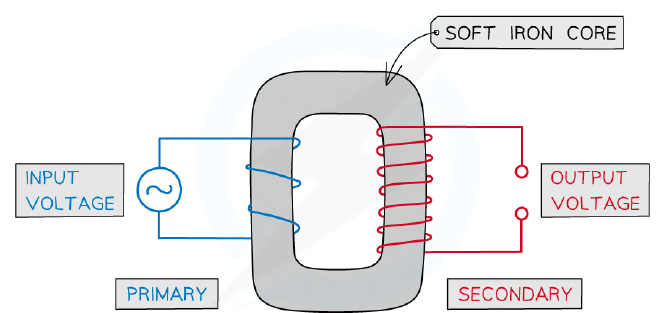
- They consist of two coils of wire (primary and secondary) around a magnetic iron core.
- A step-up transformer has more turns on the secondary coil than the primary coil.
- A step-down transformer has more turns on the primary coil than the secondary coil.
- Step-up transformers are used between power stations and transmission cables.
- Step-down transformers are used to reduce the potential difference to a much lower value for domestic use.
A step-up transformer: fewer turns on the primary coil than the secondary coil, wound on a soft iron core.
Slide
Sign up free to view the lesson slides
Step through every slide for this topic — plus flashcards and revision notes — with a free account.
Câu hỏi luyện tập
Xem trước miễn phí — 8 trên 63 câu hỏi. Đăng ký để xem tất cả.
1.What is the unit Watts (W) equivalent to?
Easy- AJ/A
- BJ/s²
- CJ/s
- DJ/V
- 2.Medium
Table 1 shows the power rating for some domestic electrical appliances.
Electrical Appliance Power (W) Kettle 2400 Clock 10 Lamp 50 Iron 1250 Which appliance transfers stored energy to other types of energy at the fastest rate?
- AKettle
- BClock
- CLamp
- DIron
- 3.Medium
Table 1 shows the power rating for some domestic electrical appliances.
Electrical Appliance Power (W) Kettle 2400 Clock 10 Lamp 50 Iron 1250 Which appliance transfers stored energy to other types of energy at the slowest rate?
- AKettle
- BClock
- CLamp
- DIron
4.There is a current of 2.3 A in the radio when the radio is working correctly. Which of these should the technician choose to protect the radio circuit?
Medium- AA 2 A fuse
- BA 5 A fuse
- CA 10 A fuse
- DA 13 A fuse
5.Which of the following is the correct equation for the power of a component in terms of current and resistance?
Medium- AP = I²R
- BP = IR
- CP = I/R
- DP = R/I
6.Which of the following statements about the National Grid are correct? (select all that apply)
Medium- AStep-up transformers increase the voltage before transmission.
- BStep-down transformers decrease the voltage for domestic use.
- CTransformers change the power so that less energy is wasted.
- DHigh voltage transmission reduces the current in the cables.
- EThe National Grid uses direct current (DC) from power stations.
7.Power is the same as energy.
EasyTrue or false?
8.A step-up transformer has more turns on the secondary coil than on the primary coil.
EasyTrue or false?
Unlock all 63 questions, flashcards & more
Tạo tài khoản miễn phí để xem mọi câu hỏi, slide, thẻ ghi nhớ và ghi chú ôn tập cho chủ đề này.