Forces and elasticity
Học bằng cách chơi
Trả lời những câu hỏi này để kiếm năng lượng, rồi câu cá và khám phá. Không cần tài khoản.
Ghi chú bài học
Changing Shape
- To change the shape of a stationary object, more than one force must be applied.
- Objects can be stretched, bent, or compressed, or a combination of these.
- Stretching: forces act in opposite directions, away from the object (e.g., weight of a mass and tension in a spring).
- Compression: forces act in opposite directions, towards the object (e.g., weight of a mass on a spring and reaction force from the surface).
- Bending: forces act in opposing directions at different points on the object (e.g., weight of a swimmer and reaction force from the block on a diving board).
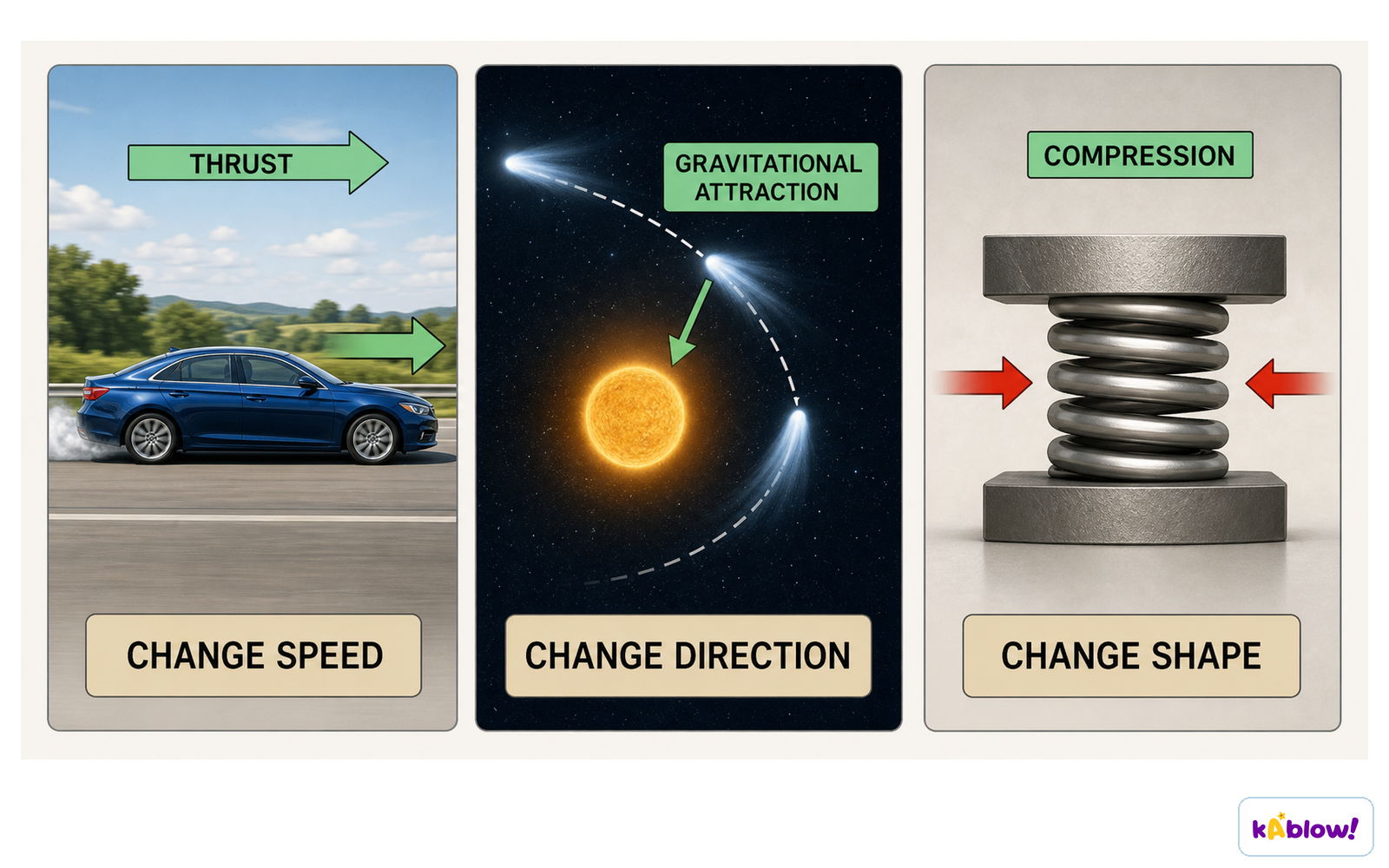
A thrust force can cause a car to speed up, a gravitational force can cause a comet to change direction, compression forces can cause a spring to change shape.
Elastic and Inelastic Deformation
- Elastic deformation: the object returns to its original shape and length when the deforming force is removed.
- Examples of elastic materials: rubber bands, fabrics, steel springs.
- Inelastic deformation: the object does not return completely to its original shape when the force is removed (permanent distortion).
- Examples of inelastic materials: plastic, clay, glass.
- In an exam, always state what happens when the force is removed to distinguish between elastic and inelastic.
Hooke's Law
- Hooke's Law: the extension of an elastic object is directly proportional to the force applied, provided the limit of proportionality is not exceeded.
- Directly proportional means if force doubles, extension doubles; if force halves, extension halves.
- The limit of proportionality is the point beyond which force and extension are no longer directly proportional.
- Equation: F = k × e (or F = k × x), where F = force (N), k = spring constant (N/m), e = extension (m).
- The spring constant k is a measure of stiffness; a higher k means a stiffer spring.
- Extension = final length – original length. Compression is treated similarly, with e representing compression.
Force–Extension Graphs
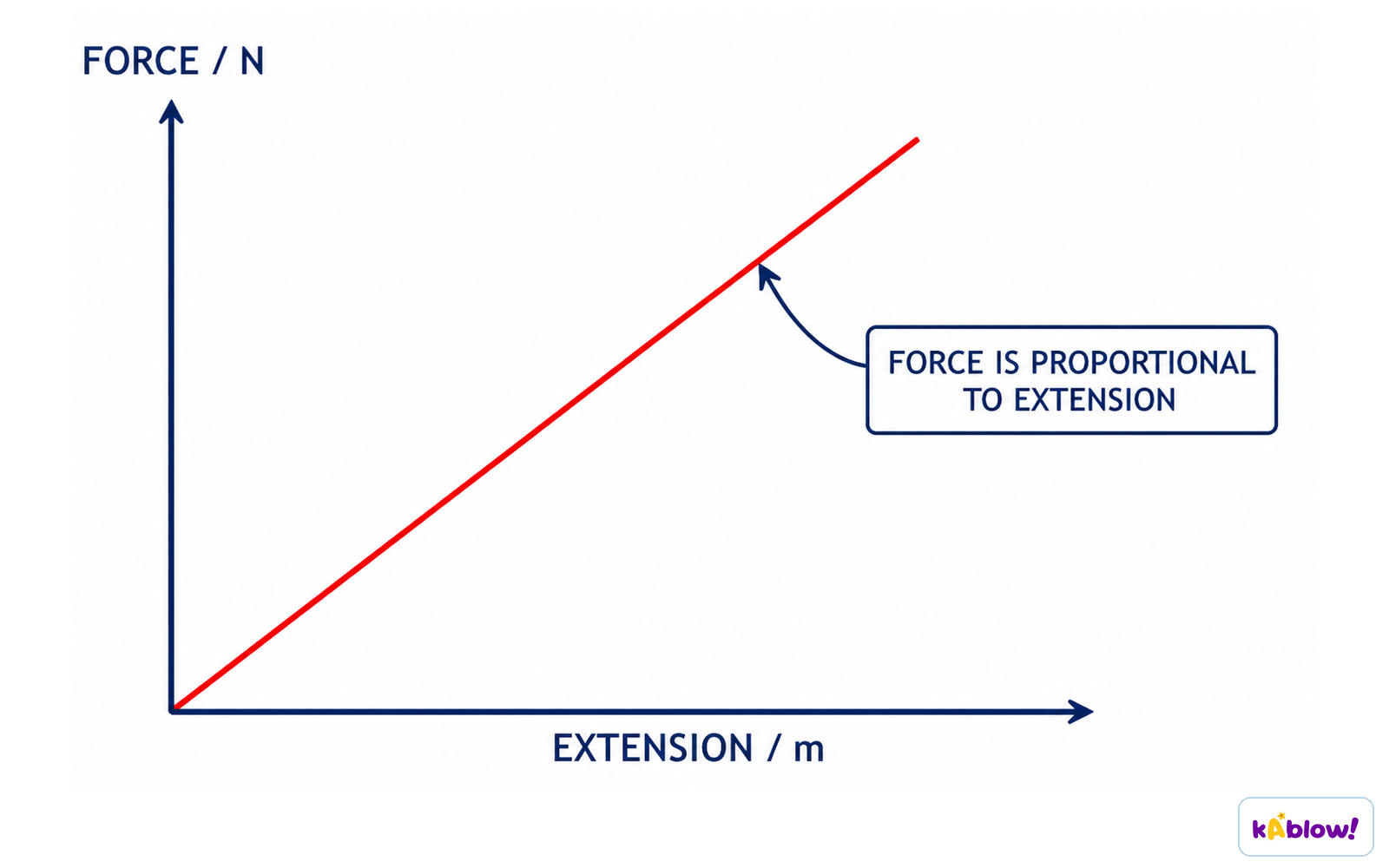
- A straight line through the origin shows a linear relationship (Hooke's law obeyed).
- A curve shows a non-linear relationship (limit of proportionality exceeded).
- The spring constant is the gradient of the straight-line region if force is on the y-axis and extension on the x-axis.
- If extension is on the y-axis and force on the x-axis, the spring constant is 1 ÷ gradient.
- A steeper straight line means a larger spring constant when force is on the y-axis; but if axes are reversed, a steeper line means a smaller spring constant.
- Always check which variable is on which axis before interpreting the gradient.
Force-extension graph for a spring
Work Done and Elastic Potential Energy
- When a spring is stretched or compressed, work is done and energy is transferred to its elastic potential energy store.
- Provided the limit of proportionality is not exceeded, work done on the spring equals the elastic potential energy stored.
- Equation: Ee = ½ × k × e² (or E = ½ k x²), where Ee = elastic potential energy (J), k = spring constant (N/m), e = extension (m).
- The extension is squared, so doubling the extension quadruples the work done (since 2² = 4).
- This equation is only valid for springs that have not been stretched beyond their limit of proportionality.
Required Practical: Investigating Force and Extension
- Aim: investigate the relationship between force and extension for a spring.
- Independent variable: force (weight of masses); dependent variable: extension; control variable: spring constant (same spring used).
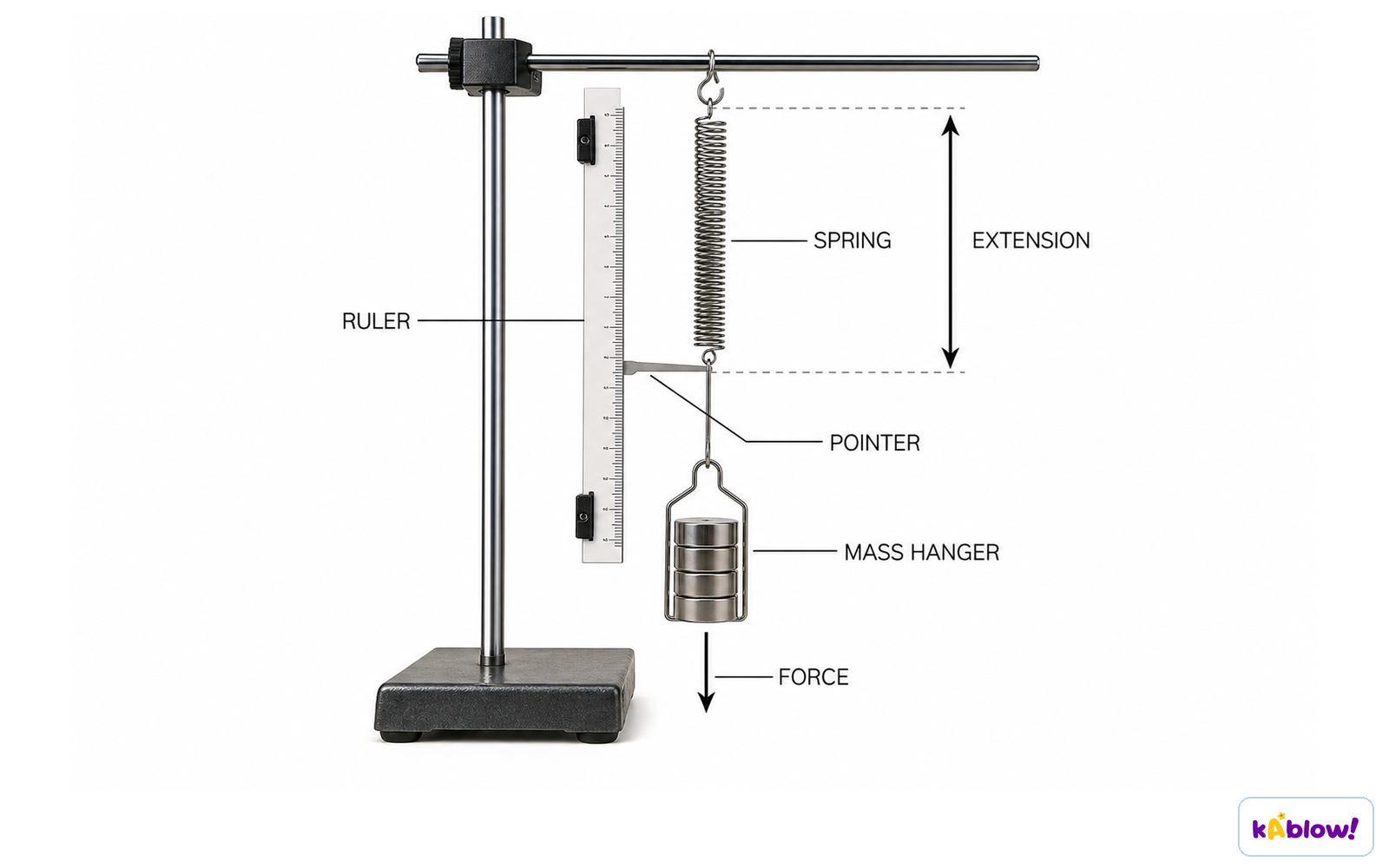
- Equipment: spring, ruler, mass hanger, 100 g masses, clamp stand, G clamp, fiducial marker.
- Method: measure original length; add masses one at a time; record new length; repeat for each mass; remove masses and repeat to get averages.
- Calculate force using W = mg (take g = 10 N/kg); calculate extension as final length – original length.
- Plot a graph of force against extension; a straight line through the origin shows Hooke's law is obeyed.
- Improve accuracy: use a fiducial marker, take readings at eye level to avoid parallax, wait for spring to stop moving before reading.
- Safety: wear goggles, secure clamp stand with G clamp, place a mat below masses, stand up and keep feet clear.
Equipment for investigating the extension of a spring
Common Misconceptions and Exam Tips
- Do not confuse extension with total length: extension = final length – original length.
- The limit of proportionality is not the same as the breaking point.
- A stiffer spring has a larger spring constant, not smaller.
- Not all deformation is elastic; some materials deform inelastically.
- When using F = k e or E = ½ k e², ensure extension is in metres (convert from cm by ÷ 100).
- The unit of spring constant is N/m; do not forget it in answers.
Slide
Sign up free to view the lesson slides
Step through every slide for this topic — plus flashcards and revision notes — with a free account.
Câu hỏi luyện tập
Xem trước miễn phí — 8 trên 64 câu hỏi. Đăng ký để xem tất cả.
1.Which of the following statements is correct about inelastic distortion?
Easy- AThe object returns to its original length when the force is removed
- BThe object does not return to its original shape when the force is removed
- CThe object requires only one force to be distorted
- DThe object returns to its original shape but not its original length
2.What is the correct unit for the force applied to a spring which makes it elastically distort?
Easy- Am
- BN m
- CN / m
- DN
3.Which of the following options is the correct equation linking force (F), spring constant (k) and extension (x)?
Easy- AF = kx²
- BF = ½ kx
- CF = kx
- DF = 2kx
4.A spring has a spring constant k. The force exerted on the spring is increased so that the extension doubles. How does this affect the work done on the spring?
Medium- AWork done doubles
- BWork done halves
- CWork done increases by a factor of 4
- DWork done decreases by a factor of 4
5.A single force is enough to change the shape of a stationary object.
EasyTrue or false?
6.A stiffer spring has a smaller spring constant.
EasyTrue or false?
7.The limit of proportionality is the same as the breaking point of a spring.
MediumTrue or false?
8.Which of the following statements about elastic deformation are correct? (Select all that apply.)
Medium- AThe object returns to its original shape when the deforming force is removed
- BThe object remains permanently stretched when the force is removed
- CA steel spring can undergo elastic deformation
- DA plastic bag can undergo elastic deformation
- EA rubber band can undergo elastic deformation
Unlock all 64 questions, flashcards & more
Tạo tài khoản miễn phí để xem mọi câu hỏi, slide, thẻ ghi nhớ và ghi chú ôn tập cho chủ đề này.