Hazards and uses of radioactive emissions and of background radiation
Học bằng cách chơi
Trả lời những câu hỏi này để kiếm năng lượng, rồi câu cá và khám phá. Không cần tài khoản.
Ghi chú bài học
Background Radiation
- Background radiation is around us all of the time and comes from both natural and man-made sources.
- Natural sources include rocks and cosmic rays from space.
- Man-made sources include fallout from nuclear weapons testing and nuclear accidents.
- The level of background radiation and the radiation dose a person receives can be affected by their occupation and/or location.
- Some areas of the world have higher background radiation because they are closer to sources of radiation.
- All living things emit a small amount of radiation — the amount within a banana is tiny and not at all dangerous.
- Background count rate must be subtracted from measured count rates to give the corrected count rate.
Radiation Dose and Regulation
- The amount of radiation received by a person is called the dose, measured in sieverts (Sv).
- One sievert is a very big dose and would cause acute radiation poisoning.
- People normally receive about 3 mSv (0.003 Sv) in one year.
- The UK limit for nuclear industry employees is 20 mSv in one year.
- A dosemeter (radiation badge) is worn by radiographers and anyone working with radiation to track the dose they receive.
- Exposure is regulated because ionising radiation can damage cells and tissues.
Dangers of Radiation
- Ionising radiation can damage human cells and tissues, causing tissue damage and mutations.
- High-energy radiation such as gamma rays and X-rays can damage healthy tissue if not properly targeted.
- If atoms in a DNA strand are ionised, the DNA can be damaged; the cell may die or the DNA may be mutated when it reforms.
- If a mutated cell replicates, a tumour may form — this is cancer, a significant danger of radiation exposure.
- Acute radiation exposure can cause skin burns and reduce white blood cells, lowering the immune system and making a person more susceptible to infections.
Handling Radiation Safely
- Radioactive sources should be kept in a shielded container when not in use, such as a lead-lined box.
- Sources should be handled with gloves and tongs to increase the distance from the body.
- Protective clothing may be worn to prevent the body becoming contaminated.
- The time a radioactive source is used for should be limited.
- After using a source, hands should be washed, and the date and time of use recorded.
Contamination and Irradiation
- Contamination is the unwanted presence of materials containing radioactive atoms on other materials — the material becomes radioactive.
- Contamination often happens due to a radiation leak, and is almost always a mistake or accident.
- Irradiation is the process of exposing a material to α, β or gamma radiation; it does not make the material radioactive.
- Irradiation can kill living cells, so it is used to sterilise surgical equipment and food.
- Contamination is more dangerous than irradiation because it causes continuous exposure to radiation.
- Contamination is especially dangerous if a source gets inside the body, irradiating internal organs as it moves through.
- Lead-lined suits reduce irradiation by absorbing radiation, while airtight suits prevent contamination by stopping radioactive atoms entering the body.
Half-Life and Risk
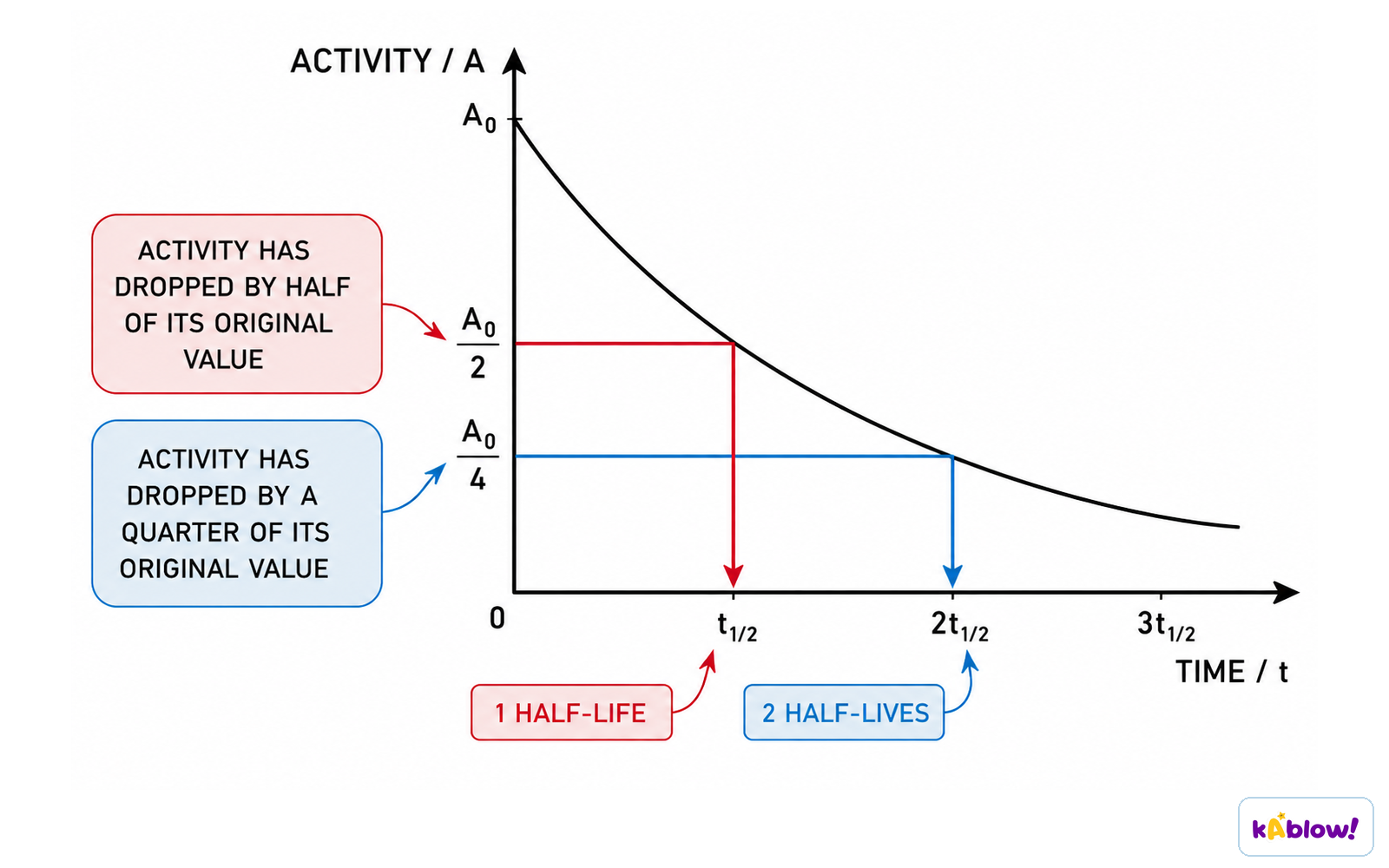
- The half-life is the time taken for the activity of a radioactive source to decrease to half of its original value.
- Different isotopes have very different half-lives: francium-218 is about 1 millisecond, polonium-210 about 140 days, and uranium-235 about 700 million years.
- A short half-life means nuclei decay quickly, emitting a lot of radiation in a short time — a greater risk of irradiation.
- If only a small amount is used, a short half-life is advantageous because the material quickly loses its radioactivity.
- A long half-life means a sample decays slowly but stays radioactive for a very long time — a greater risk of contamination.
- Radioactive waste with a long half-life is buried underground to prevent release into the environment.
A half-life graph
Medical Tracers
- A tracer is a radioactive isotope used to track the movement of substances, such as blood, around the body.
- Gamma emitters are usually used because gamma rays are highly penetrating and can pass out of the body to be detected externally, creating an internal image.
- Iodine-131 is an example of a radioactive tracer.
- Gamma rays are less ionising than some other radiation, so harm to the patient is minimised.
- The amount of isotope used is kept to a minimum to reduce exposure.
- Isotopes are chosen with short half-lives of around a few hours — long enough for the procedure but not so long as to cause long-term harm.
- Because of short half-lives, isotopes must be produced nearby or they would decay too much before reaching the hospital.
PET Scanning
- In PET scanning, positrons are emitted by the decay of the tracer.
- The positrons travel a small distance and annihilate when they interact with electrons in the tissue.
- This annihilation produces a pair of gamma rays (gamma photons) which can be detected outside the body.
- PET scanners are used to diagnose cancer and determine the location of a tumour.
Radiotherapy
- Radiotherapy is the treatment of cancer using radiation (chemotherapy uses chemicals).
- Radiation can kill living cells, and some cells — such as bacteria and cancer cells — are more susceptible than others.
- During external radiotherapy, beams of gamma rays are directed at the tumour; gamma is used because it can penetrate the body to reach the tumour.
- The beams are moved around to minimise harm to healthy tissue while still targeting the tumour.
- Surrounding healthy tissue is often shielded to avoid damage.
- During internal radiotherapy, small pellets of radioactive material are inserted into the tumour, exposing it directly to radiation.
Other Uses of Radiation
- α particles are used in smoke detectors: they ionise the air to create a current, and when smoke blocks the α emitter the current stops and the alarm triggers.
- β particles are used to measure the thickness of thin materials such as paper, cardboard or aluminium foil.
- β is used because it is partially absorbed — if α were used it would all be absorbed, and if gamma were used almost all would pass through with no detectable difference.
- As material gets thicker, more β particles are absorbed and fewer reach the detector; if it gets thinner, the opposite happens, allowing thickness to be kept constant.
- Gamma radiation is used to sterilise medical equipment because it is the most penetrating, irradiating all sides of instruments — even through packaging.
- Food can be irradiated to kill microorganisms, making it last longer and reducing food-borne infections.
- Radiation is also used to determine the age of ancient artefacts.
Evaluating Risk and Peer Review
- The hazards of radioactive material differ according to the half-life involved.
- The use of radiation in medicine carries risk, but the benefits can outweigh the risks — the risks from radiation are smaller than the risks of leaving a condition untreated.
- When evaluating risk, compare the potential dangers with the benefits, using given data.
- Some people worry about the safety and nutritional value of irradiated food.
- Scientific communities must be independent of government influence so their conclusions are trusted.
- Restaurants must clearly mark meals containing irradiated ingredients so people can make informed choices.
- Peer review is important when publishing findings on radiation risk.
Slide
Sign up free to view the lesson slides
Step through every slide for this topic — plus flashcards and revision notes — with a free account.
Câu hỏi luyện tập
Xem trước miễn phí — 8 trên 63 câu hỏi. Đăng ký để xem tất cả.
1.What is meant by the term 'background radiation'?
Easy- ARadiation that is present in the environment all of the time
- BRadiation emitted only by nuclear power stations
- CRadiation given to a patient during a medical scan
- DRadiation that is deliberately released during a nuclear accident
2.Which of the following are sources of background radiation? (select all that apply)
Medium- ARocks
- BCosmic rays from space
- CFallout from nuclear weapons testing
- DA medical tracer injected into a patient
- EA smoke detector in a home
3.All background radiation is man-made.
EasyTrue or false?
4.Which of the following is a man-made source of background radiation?
Easy- ARadon gas from rocks
- BCosmic rays from space
- CFallout from nuclear weapons testing
- DFood and drink
5.Which statement correctly describes contamination?
Medium- AThe unwanted presence of materials containing radioactive atoms on other materials
- BThe process of exposing a material to α, β or gamma radiation
- CThe time taken for the activity of a radioactive source to halve
- DThe amount of radiation received by a person
6.Irradiating a material makes that material radioactive.
EasyTrue or false?
7.Which of the following is the correct definition of irradiation?
Medium- AThe process of exposing a material to α, β or gamma radiation
- BThe unwanted presence of radioactive atoms on a material
- CThe time taken for the activity of a source to halve
- DThe amount of radiation a person receives
8.Match each term to its correct definition.
Medium- Contamination
- Irradiation
- Half-life
- The process of exposing a material to α, β or gamma radiation
- The time taken for the activity of a radioactive source to halve
- The unwanted presence of materials containing radioactive atoms on other materials
Unlock all 63 questions, flashcards & more
Tạo tài khoản miễn phí để xem mọi câu hỏi, slide, thẻ ghi nhớ và ghi chú ôn tập cho chủ đề này.