Pressure and pressure differences in fluids
Học bằng cách chơi
Trả lời những câu hỏi này để kiếm năng lượng, rồi câu cá và khám phá. Không cần tài khoản.
Ghi chú bài học
Pressure in Fluids
- A fluid is either a liquid or a gas.
- Pressure is the concentration of a force, or the force per unit area.
- Pressure is calculated using p = F / A, where p is in pascals (Pa), F in newtons (N) and A in metres squared (m²).
- The area used is always the cross-sectional area — the area where the force acts at right angles.
- A fluid exerts pressure evenly across the whole surface of an immersed object and in all directions.
- The forces created by fluid pressure act at 90° (normal) to the surface.
- Spreading a force over a large area gives a small pressure; concentrating it over a small area gives a large pressure.
- Examples: tractor tyres are wide to reduce pressure and stop sinking into mud; nails and high heels have small areas to create large pressures.
Atmospheric Pressure
- The atmosphere is a thin layer of air around the Earth, extending more than 100 km into space.
- At sea level, atmospheric pressure is about 100–101 kPa.
- Atmospheric pressure is caused by air molecules colliding with a surface, creating a force per unit area.
- The atmosphere becomes less dense with increasing altitude, so pressure decreases as height increases.
- The number of air molecules (and so the weight of air) above a surface decreases as the surface's height above ground increases.
- As height increases there is always less air above a surface than at a lower height, so atmospheric pressure decreases with height.
- Atmospheric pressure varies slightly from day to day with the weather; fine clear weather is usually linked to high pressure.
Pressure in a Liquid
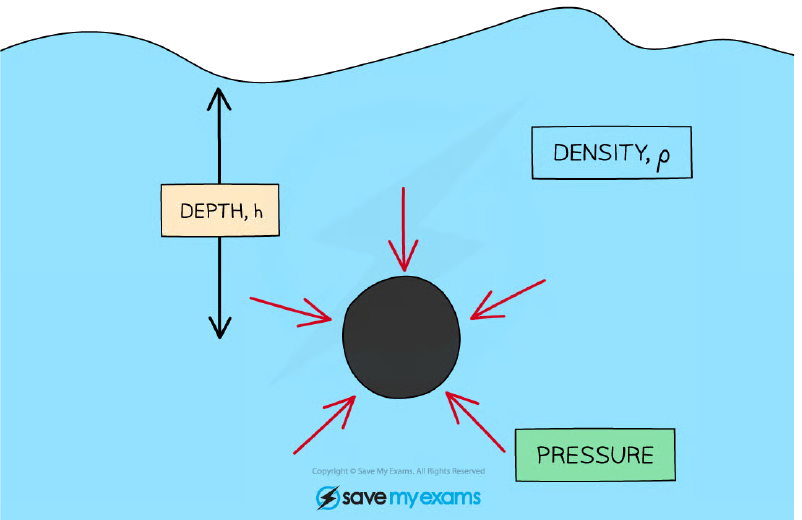
- The greater the depth of the liquid, the greater the pressure.
- The greater the density of the liquid, the greater the pressure.
- Liquid pressure is caused by the weight of the liquid pushing against objects immersed in it.
- As depth increases, the amount (and weight) of liquid above a point increases, so pressure increases.
- A more dense liquid has a greater weight, so it exerts a higher pressure.
- In a column of water, the highest pressure is at the bottom — a hole there produces a strong jet, while a hole near the top produces a weak jet.
- The pressure on the seabed is far higher than at the surface of the ocean.
- Liquid pressure does not depend on the shape of the container or the total volume of liquid.
Pressure in a liquid increases with depth and density, and acts equally in all directions.
Calculating Pressure in a Liquid
- The pressure due to a column of liquid is calculated using p = h × ρ × g.
- p = pressure in pascals (Pa); h = height of the column in metres (m).
- ρ = density of the liquid in kg/m³; g = gravitational field strength in N/kg.
- The value of g will be given in any calculation.
- This equation is given on the Physics equation sheet, but you must be able to rearrange it for h, ρ or g.
- The equation gives the difference in pressure at different depths, since pressure changes with depth.
- Example: at a depth of 10 m in water, the extra pressure is about 100 kPa; adding the 101 kPa atmospheric pressure gives a total of 201 kPa.
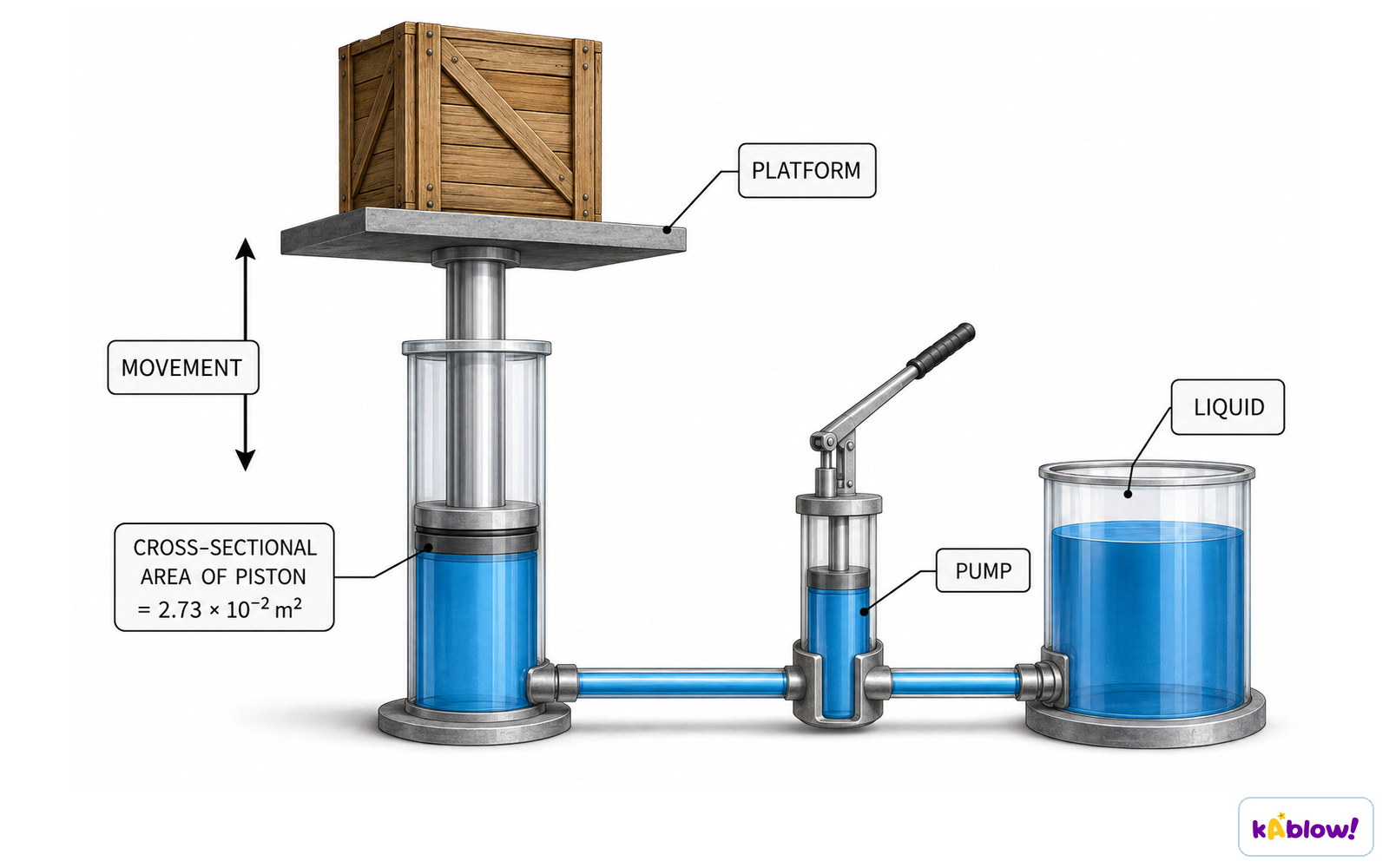
A hydraulic lift: a pump creates pressure in the liquid, transmitted to a piston of known cross-sectional area to raise the platform.
Upthrust
- Upthrust is a force that pushes upwards on an object submerged in a fluid.
- It always acts in the opposite direction to the object's weight.
- Upthrust arises because a submerged object experiences greater pressure on its bottom surface than on its top surface.
- This is because pressure is proportional to depth, so the difference in pressure creates a resultant force upwards.
- The size of the upthrust depends on the density of the fluid and the volume of fluid displaced (equal to the volume of the object).
- The denser the liquid, the greater the upthrust it exerts.
- Upthrust equals the weight of fluid displaced.
- Upthrust is why objects appear to weigh less when immersed in a liquid.
Floating and Sinking
- If the upthrust equals (or is greater than) the object's weight, the object floats.
- If the upthrust is smaller than the weight, the object sinks.
- An object less dense than the fluid will float; an object more dense than the fluid will sink.
- A denser-than-fluid object can never displace enough fluid to create an upthrust that supports its weight.
- Polystyrene (0.05 g/cm³) floats in water (1.0 g/cm³); a wooden block (0.9 g/cm³) floats partially submerged; an iron block (7.9 g/cm³) sinks.
- Objects float because upthrust balances weight, not simply because they are light.
Calculating Upthrust
- To find upthrust, first calculate the volume of the object immersed in the fluid.
- Use mass = density × volume (m = ρV) to find the mass of fluid displaced.
- Use weight = mass × gravitational field strength (W = mg) to find the weight of displaced fluid.
- The upthrust equals this weight of displaced fluid.
- Example: a cube 40 cm × 40 cm × 40 cm submerged to 20 cm displaces 32 000 cm³ of water, giving a mass of 32 kg and an upthrust of 320 N (with g = 10 N/kg).
Key Equations and Units
- p = F / A — pressure equals force normal to a surface divided by the area of that surface.
- p = h ρ g — pressure due to a column of liquid.
- Pressure is measured in pascals (Pa); 1 kPa = 1000 Pa.
- Force is measured in newtons (N); large forces may be quoted in kN (1 kN = 1000 N).
- Density is measured in kg/m³; gravitational field strength in N/kg.
- Always convert areas from cm² to m² before substituting into equations.
Slide
Sign up free to view the lesson slides
Step through every slide for this topic — plus flashcards and revision notes — with a free account.
Câu hỏi luyện tập
Xem trước miễn phí — 8 trên 65 câu hỏi. Đăng ký để xem tất cả.
1.What is the correct definition of pressure?
Easy- AThe force per unit area
- BThe total force acting on a surface
- CThe weight of an object
- DThe volume of a fluid
2.Which of the following is the correct unit for pressure?
Easy- ANewton (N)
- BPascal (Pa)
- CJoule (J)
- DKilogram (kg)
3.The pressure in a fluid acts at right angles to any surface it contacts.
EasyTrue or false?
4.Which of the following statements about atmospheric pressure are correct? (Select all that apply)
Medium- AAtmospheric pressure decreases as altitude increases.
- BAtmospheric pressure is caused by air molecules colliding with a surface.
- CAtmospheric pressure increases as the density of air decreases.
- DAtmospheric pressure at sea level is about 101 kPa.
- EAtmospheric pressure is greater at the top of a mountain than at sea level.
5.How does the pressure beneath the surface of a liquid change with depth and density?
Easy- AIt increases with depth and increases with density.
- BIt increases with depth and decreases with density.
- CIt decreases with depth and increases with density.
- DIt decreases with depth and decreases with density.
6.A diver swims deeper into a lake. What happens to the pressure of the water on the diver?
Medium- AIt increases.
- BIt decreases.
- CIt stays the same.
- DIt first increases then decreases.
7.Why is the total pressure on a diver greater than just the pressure due to the water above the diver?
Medium- ABecause the atmosphere also exerts pressure on the diver.
- BBecause the diver's body creates additional pressure.
- CBecause water pressure acts in all directions.
- DBecause the diver is moving.
8.An aeroplane gains height after take-off. Which two factors affect the atmospheric pressure on the aeroplane as it rises?
Medium- AThe density of the air and the height above the surface
- BThe speed of the aeroplane and the temperature of the air
- CThe weight of the aeroplane and the volume of air displaced
- DThe gravitational field strength and the density of the aeroplane
Unlock all 65 questions, flashcards & more
Tạo tài khoản miễn phí để xem mọi câu hỏi, slide, thẻ ghi nhớ và ghi chú ôn tập cho chủ đề này.