Series and parallel circuits
Học bằng cách chơi
Trả lời những câu hỏi này để kiếm năng lượng, rồi câu cá và khám phá. Không cần tài khoản.
Ghi chú bài học
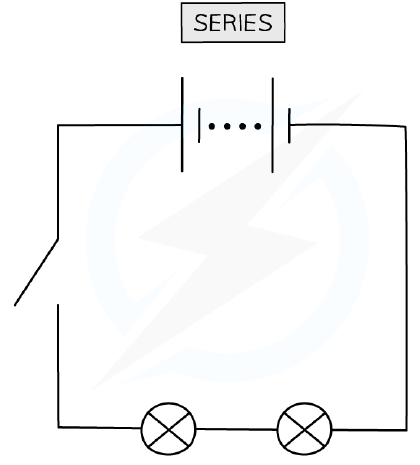
Series Circuits
- A series circuit has components connected end to end in a single loop.
- The current is the same at all points in a series circuit.
- The total potential difference of the power supply is shared between the components.
- The total resistance is the sum of the individual resistances: R = R₁ + R₂ + R₃ ...
- Adding more resistors in series increases the overall resistance because charge must pass through more components.
- If one component breaks, the whole circuit stops working, and components cannot be controlled separately.
A simple series circuit
Parallel Circuits
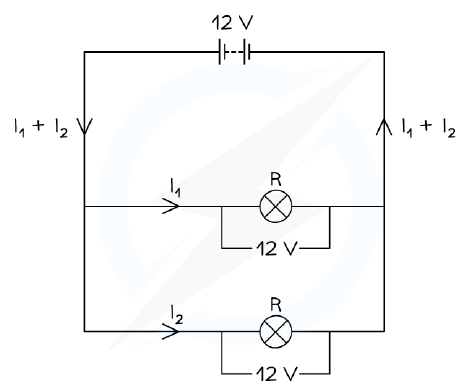
- A parallel circuit has components connected on separate branches.
- The potential difference across each component is the same.
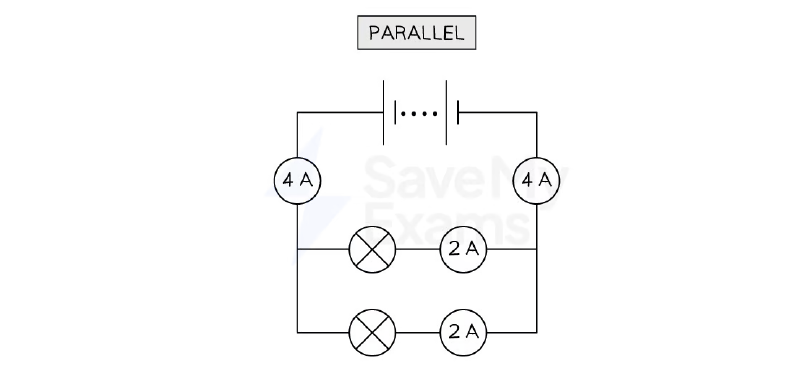
- The total current from the supply is the sum of the currents through the separate branches.
- The total resistance of two resistors in parallel is less than the resistance of the smallest individual resistor.
- Adding more resistors in parallel decreases the overall resistance because each resistor provides an extra path for charge to flow.
- Components can be controlled individually, and if one stops working, the others continue to function.
Potential difference in a parallel circuit
Comparing Series and Parallel Circuits
- In series, current is the same everywhere; in parallel, current splits at junctions.
- In series, potential difference is shared; in parallel, potential difference is the same across each branch.
- In series, total resistance increases with more components; in parallel, total resistance decreases.
- The current in each parallel branch is only identical if the resistance of each branch is identical.
- Some circuits include both series and parallel parts.
Calculation of current splitting at a junction in a parallel circuit
Resistors in Series and Parallel
- For resistors in series, the combined resistance is the sum of individual resistances.
- For resistors in parallel, the combined resistance is less than the smallest individual resistance.
- In parallel, each resistor creates an extra path for charge, allowing more charge to flow overall and reducing resistance.
- Increasing the number of resistors in series increases resistance because charge has more components to pass through.
- In a series circuit, the total voltage is the sum of the voltages across each component.
Electrical Components and I-V Graphs
- Fixed resistors: current is directly proportional to potential difference; the I-V graph is a straight line through the origin.
- Filament lamps: resistance increases as temperature increases; the I-V graph curves, showing current increasing at a slower rate.
- Diodes: allow current in one direction only (forward bias); in reverse bias, resistance is very high and no current flows.
- LDRs: resistance decreases as light intensity increases.
- Thermistors: resistance decreases as temperature increases.
- LDRs and thermistors are sensory resistors used in light sensors and temperature sensors.
Testing Components
- To investigate resistance variation, use a circuit with an ammeter in series and a voltmeter in parallel with the component.
- A variable resistor changes the current through the component.
- For filament lamps and diodes, vary current and measure voltage; calculate resistance using R = V/I.
- For LDRs, vary light intensity; for thermistors, vary temperature; record voltage and current to calculate resistance.
- Ensure the component is connected to a low voltage supply (below 15 V) to avoid overheating.
- Wait a few seconds before taking readings to allow the component to react.
Core Practical: Investigating Circuits
- Investigate the relationship between potential difference, current and resistance for a resistor and a filament lamp.
- Vary voltage using a variable resistor and record current for each voltage; take multiple readings and calculate averages.
- Switch off the circuit between readings to prevent heating.
- Plot an I-V graph: straight line through origin for fixed resistor; curve for filament lamp.
- Test series and parallel circuits: measure voltage and current, calculate resistance.
- In series, total resistance is the sum of individual resistances; in parallel, total resistance is less than either individual resistance.
AC and DC
- Direct current (d.c.): current flows steadily in one direction; cells and batteries produce d.c.
- Alternating current (a.c.): current continuously changes direction; mains electricity is a.c.
- In the UK, mains electricity has a frequency of 50 Hz and a potential difference of about 230 V.
- A.c. is represented by a sine wave on an oscilloscope; d.c. is a straight line.
- A d.c. power supply has fixed positive and negative terminals; an a.c. supply has two identical terminals.
Mains Electricity and Safety
- Mains electricity is an a.c. supply with live, neutral and earth wires.
- Live wire (brown) carries the alternating potential difference; it is the most dangerous.
- Neutral wire (blue) completes the circuit and is close to 0 V.
- Earth wire (green and yellow stripes) is a safety wire that prevents the appliance from becoming live.
- If a fault occurs, the earth wire provides a low resistance path, causing a surge of current that melts the fuse and cuts off the supply.
- The live wire has a potential difference of about 230 V, so contact can be lethal.
Slide
Sign up free to view the lesson slides
Step through every slide for this topic — plus flashcards and revision notes — with a free account.
Câu hỏi luyện tập
Xem trước miễn phí — 8 trên 61 câu hỏi. Đăng ký để xem tất cả.
1.In a series circuit, how does the current at one point compare with the current at another point?
Easy- AThe current is the same at all points
- BThe current is larger near the power supply
- CThe current splits between the components
- DThe current is smaller after each component
2.In a parallel circuit, what happens to the current at a junction?
Easy- AIt splits into the separate branches
- BIt stays the same in every branch
- CIt is destroyed at the junction
- DIt is shared equally whatever the resistances are
3.A 12 V battery is connected to two identical lamps in series. What is the potential difference across each lamp?
Easy- A12 V
- B6 V
- C24 V
- D0 V
4.A 12 V battery is connected to two identical lamps in parallel. What is the potential difference across each lamp?
Easy- A12 V
- B6 V
- C24 V
- D0 V
5.Which statement about the total resistance of two resistors in parallel is correct?
Medium- AIt is less than the resistance of the smallest individual resistor
- BIt is the sum of the two resistances
- CIt is greater than either individual resistance
- DIt is equal to the larger of the two resistances
6.Which of the following are true for components connected in series? (select all that apply)
Medium- AThe current is the same through each component
- BThe total potential difference of the supply is shared between the components
- CThe total resistance is the sum of the individual resistances
- DThe potential difference is the same across each component
- EThe current splits between the components
7.Which of the following are true for components connected in parallel? (select all that apply)
Medium- AThe potential difference across each component is the same
- BThe total current is the sum of the currents through the separate components
- CThe total resistance is less than the resistance of the smallest individual resistor
- DThe current is the same through each component
- EThe total resistance is the sum of the individual resistances
8.In a series circuit, the potential difference of the power supply is shared between the components.
EasyTrue or false?
Unlock all 61 questions, flashcards & more
Tạo tài khoản miễn phí để xem mọi câu hỏi, slide, thẻ ghi nhớ và ghi chú ôn tập cho chủ đề này.