Static electricity
Học bằng cách chơi
Trả lời những câu hỏi này để kiếm năng lượng, rồi câu cá và khám phá. Không cần tài khoản.
Ghi chú bài học
Electric Charge and Particles
- The charge of a particle can be positive, negative, or neutral (no charge).
- Electrons are negatively charged, protons are positive, and neutrons are neutral.
- In a neutral atom, the number of electrons equals the number of protons, so the overall charge is zero.
- An object becomes negatively charged when it gains electrons and positively charged when it loses electrons.
- When two charged objects are close, they exert a force on each other: attractive if opposite charges, repulsive if like charges.
- Attraction and repulsion between charged objects are examples of non-contact forces.
Charging by Friction
- When certain insulating materials are rubbed together, they become electrically charged – this is charging by friction.
- The charges remain on the insulators and cannot easily flow away.
- Charging by friction happens because negatively charged electrons are transferred from one material to the other.
- The material that gains electrons becomes negatively charged; the material that loses electrons becomes positively charged.
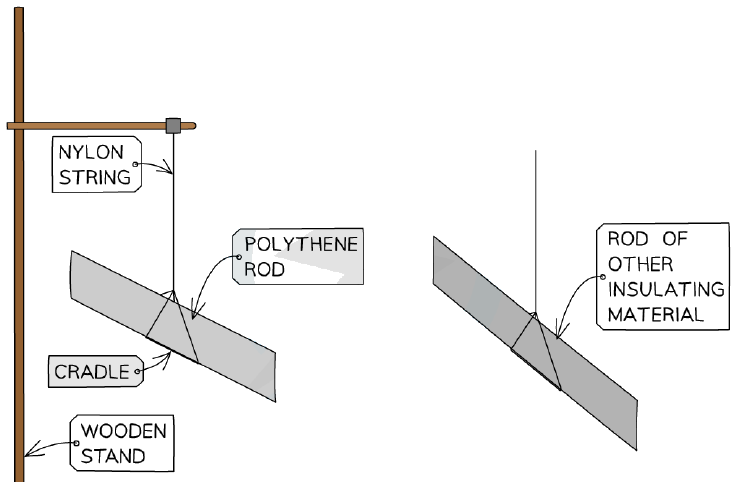
- For example, rubbing an acetate rod with a cloth transfers electrons from the rod to the cloth: the rod becomes positive, the cloth negative.
- If a polythene rod is rubbed with a cloth, electrons transfer from the cloth to the rod: the rod becomes negative, the cloth positive.
- Only electrons move – positive charge is not transferred.
Apparatus for demonstrating charging by friction using a polythene rod and another insulating material.
Static Electricity and Sparking
- Static electricity is caused by a build-up of stationary charge on the surface of insulators.
- A spark occurs when there is a large potential difference between two objects, causing a current to flow between them.
- Sparking can happen when a charged person touches an earthed metal object, like a door handle.
- An earthed conductor is a wire (often copper) that allows current to flow to the Earth; current takes the path of lower resistance.
- If the electric field becomes strong enough, it can force charges through insulators like air, causing an electrical discharge (spark).
- Examples include the small shock from a car door and lightning.
Examples of Static Electricity
- Rubbing a balloon on a woolly jumper transfers electrons to the balloon, making it negatively charged and the jumper positively charged.
- The balloon sticks to a neutral wall because the negative balloon repels electrons in the wall, leaving a positive region that attracts the balloon.
- A charged comb can pick up small pieces of paper: the comb repels negative charges in the paper, leaving a positive surface that is attracted to the comb.
- Hair sticks up after combing with a plastic comb because strands gain the same charge and repel each other.
- Dust accumulation on surfaces is another example of static electricity.
Dangers of Static Electricity
- A spark near flammable gases or liquids can cause a fire or explosion.
- When refuelling aeroplanes, friction between fuel and pipes can build up static charge; a spark could ignite the fuel.
- The risk is reduced by connecting the fuel tank to the Earth with a bonding line – a copper wire that carries excess charge to the ground.
- Lightning is an extreme example of sparking: charge builds up in clouds and discharges to the ground.
- Electrocution is another danger of static electricity.
Uses of Static Electricity
- Photocopiers use static electricity: an image is projected onto a positively charged plate, which loses charge in light areas.
- Negatively charged toner powder sticks to the remaining positive areas and is then transferred to paper and heated to fix it.
- Inkjet printers work similarly, using negatively charged ink droplets attracted to the correct place on the page.
- Insecticide sprayers give droplets an electrostatic charge so they repel each other, forming a fine mist that covers a large area.
- The charged droplets are also attracted to the Earth, reducing drift.
- Spray painting of cars uses the same principle.
Electric Fields
- A charged object creates an electric field around itself – a region where a charged object experiences a force.
- Electric field lines point away from positive charges and towards negative charges.
- The field is strongest close to the charged object (field lines closer together) and weaker further away (field lines further apart).
- Around an isolated charged sphere, field lines are radial: away from a positive sphere, towards a negative sphere.
- Between two parallel plates, the field is uniform: straight, parallel lines from positive to negative.
- The force on a charged object in a field is stronger when the distance between the objects is smaller.
Fields and Static Phenomena
- The electric field explains the non-contact force between charged objects: a second charged object in the field experiences a force.
- If the charges are the same, the force is repulsive; if opposite, the force is attractive.
- The force becomes stronger as the distance between the charged objects decreases.
- If an electric field becomes strong enough, charges are forced through insulators like air, creating a spark.
- This explains sparking when a charged person touches a conductor.
- Earthing removes excess charge: a positively charged object attracts electrons from Earth, while a negatively charged object sends electrons to Earth.
Slide
Sign up free to view the lesson slides
Step through every slide for this topic — plus flashcards and revision notes — with a free account.
Câu hỏi luyện tập
Xem trước miễn phí — 8 trên 61 câu hỏi. Đăng ký để xem tất cả.
1.Which particle is transferred when an insulating material becomes charged by friction?
Easy- AElectron
- BProton
- CNeutron
- DAtom
2.An object becomes negatively charged when it:
Easy- Agains electrons
- Bloses electrons
- Cgains protons
- Dloses protons
3.Two charged objects are brought close together and attract each other. Which statement about their charges is correct?
Easy- AThey carry opposite charges
- BThey carry the same charge
- CBoth must be neutral
- DBoth must be positive
4.Which of the following statements about electric field lines is correct?
Easy- AThey point away from positive charges and towards negative charges
- BThey point away from negative charges and towards positive charges
- CThey point from negative to positive charges
- DThey have no direction
5.A positively charged object is connected to earth by a wire. What happens to the charge on the object?
Medium- AElectrons flow from earth to the object and neutralise it
- BElectrons flow from the object to earth
- CProtons flow from earth to the object
- DNothing happens because the object is an insulator
6.A negatively charged rod is held near a small piece of paper. The paper is attracted to the rod. Why?
Medium- AThe rod repels electrons in the paper, leaving a positive region that is attracted
- BThe paper has a positive charge
- CThe rod transfers electrons to the paper
- DThe paper is an insulator so it cannot be attracted
7.A student rubs a polythene rod with a cloth. The rod becomes negatively charged. Which row correctly describes the charge on the cloth?
Medium- APositive, equal in size
- BPositive, larger
- CNegative, equal in size
- DNegative, smaller
8.Which of these is a correct definition of an electric field?
Medium- AA region where a charged object experiences a force
- BA region where a magnetic material experiences a force
- CA region where only positive charges can exist
- DA region where electrons are always stationary
Unlock all 61 questions, flashcards & more
Tạo tài khoản miễn phí để xem mọi câu hỏi, slide, thẻ ghi nhớ và ghi chú ôn tập cho chủ đề này.