Work done and energy transfer
Học bằng cách chơi
Trả lời những câu hỏi này để kiếm năng lượng, rồi câu cá và khám phá. Không cần tài khoản.
Ghi chú bài học
What is Work Done?
- Work is done when a force causes an object to move over a distance.
- The force must act in the direction of the object's displacement for work to be done.
- If a force is applied but the object does not move, no work is done.
- Work is done on a ball when it is lifted to a height above the ground.
- Air resistance (drag) does work against a bird as it flies through the air.
Work is done when a force is used to move an object over a distance
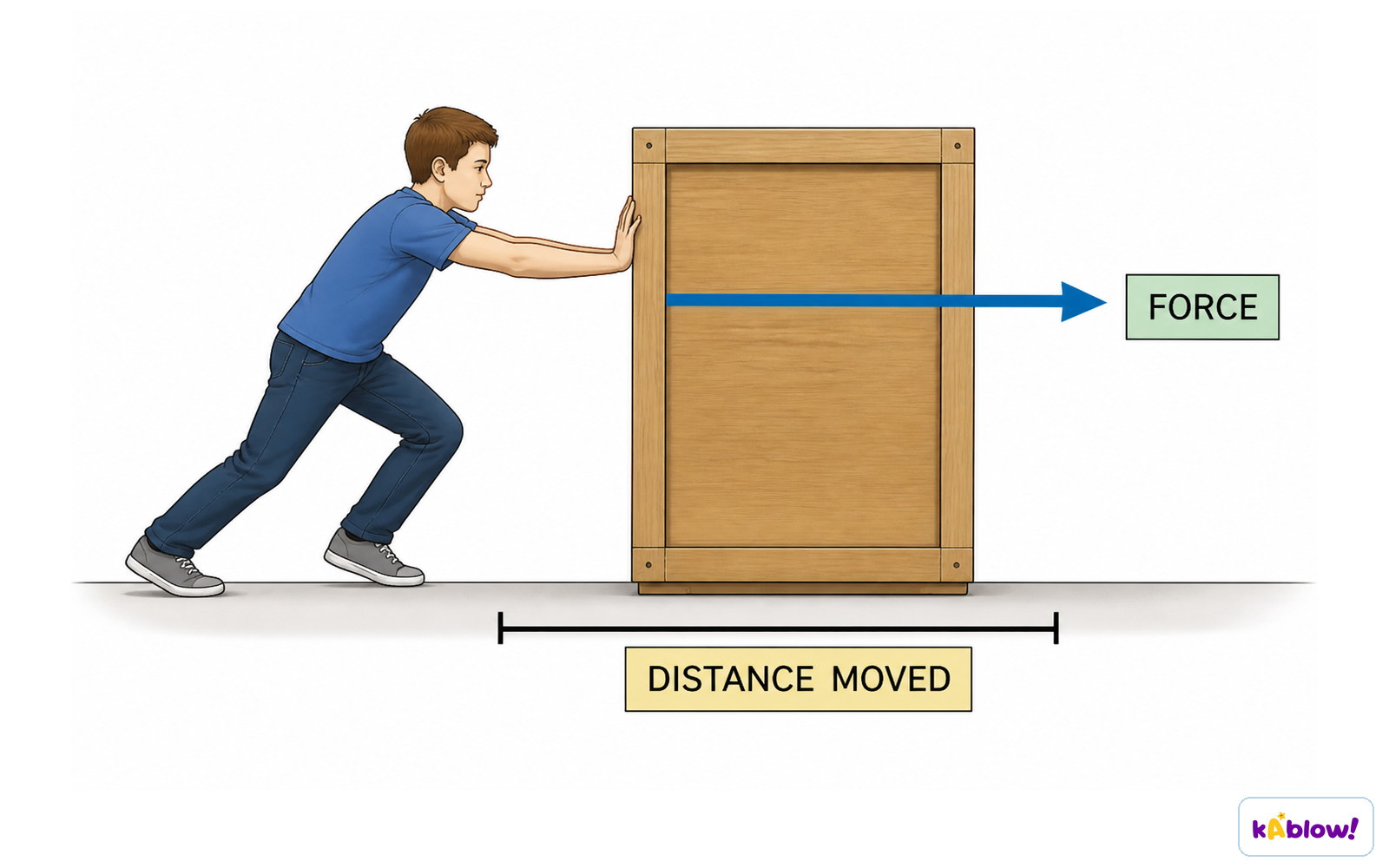
Calculating Work Done
- The equation for work done is: W = F × s
- W = work done in joules (J) or newton-metres (N m)
- F = force in newtons (N)
- s = distance moved in the direction of the force, in metres (m)
- Example: A force of 500 N moves an object 23 m, so work done = 500 × 23 = 11 500 J.
Units for Work and Energy
- Work is measured in joules (J) or newton-metres (N m).
- 1 J = 1 N m – the number of joules equals the number of newton-metres.
- One joule is the work done by a force of one newton acting through one metre.
- Conversions are straightforward: 1000 J = 1000 N m.
- Always include the correct units in your answer – you may use either J or N m.
Work Done and Energy Transfer
- Whenever work is done, energy is transferred from one store to another.
- Mechanical working (or electrical working) is an energy transfer pathway.
- The amount of energy transferred (in joules) is equal to the work done (also in joules): energy transferred = work done.
- If a force acts in the direction of motion, the object gains energy (transferred to its kinetic store).
- If a force acts opposite to the motion, the object loses energy (transferred to the thermal store of the object and surroundings).
Work Done and Gravitational Potential Energy
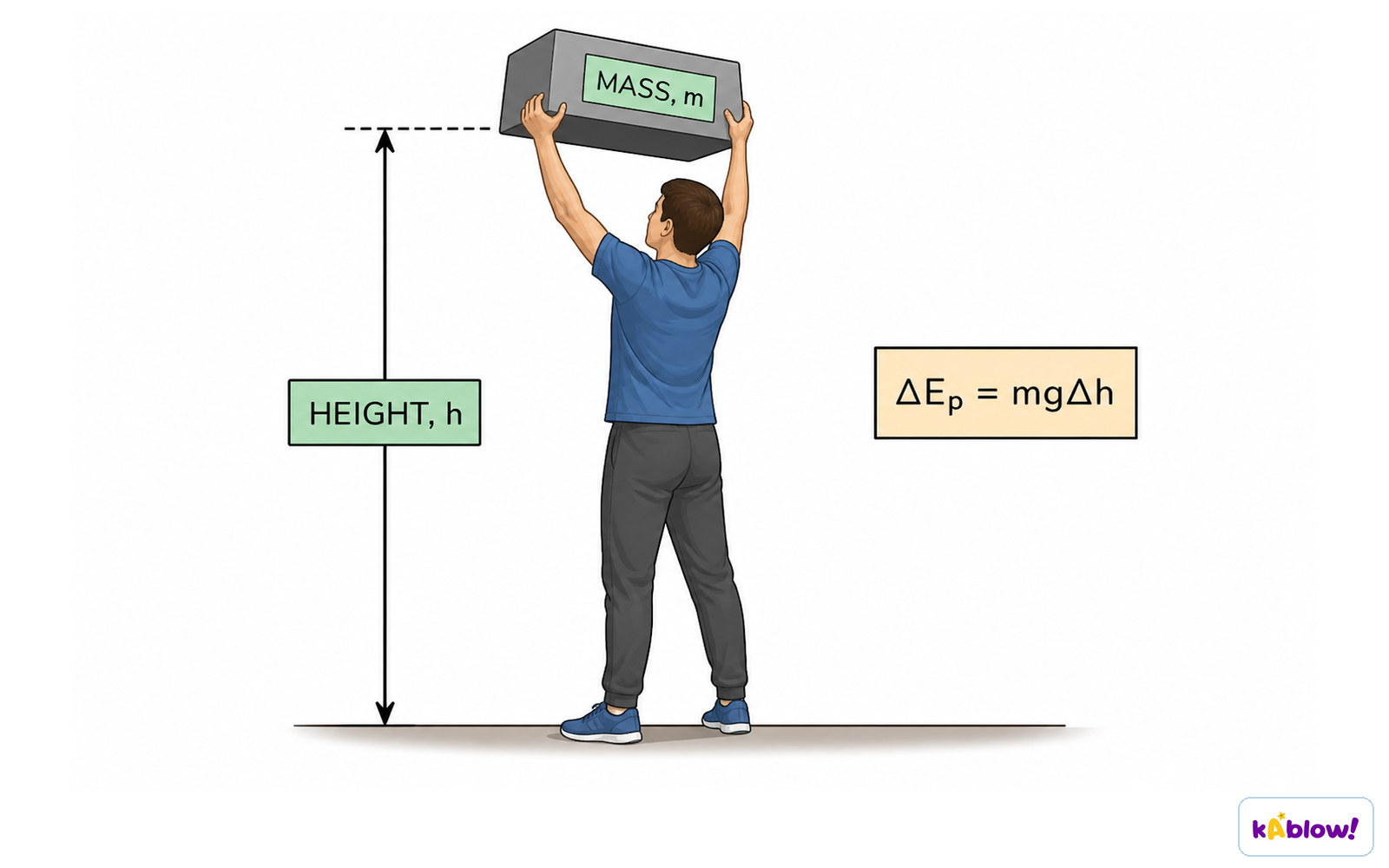
- When an object is lifted, work is done against gravity and energy is transferred to its gravitational potential store.
- The work done in lifting an object equals m × g × h (mass × gravitational field strength × height).
- This is the same as the equation for gravitational potential energy: E = m g h.
- Example: Lifting a 10 kg bucket 15 m with g = 9.8 N/kg gives work done = 10 × 9.8 × 15 = 1470 J.
- The bucket gains 1470 J of gravitational potential energy.
Gravitational potential energy of a lifted mass
Work Done and Friction
- Friction is a force that opposes the motion of an object, slowing it down.
- When friction is present, energy is transferred by heating – raising the temperature of the object and its surroundings.
- The work done against frictional forces causes this temperature rise.
- Imperfections at the interface between surfaces bump and rub against each other, transferring energy to thermal stores.
- Air resistance is a type of friction that slows objects moving through air; particles bump into the object, transferring energy by heating.
Work Done and Energy Transfer in Context
- A car braking: the brakes apply a force opposite to motion, doing work and transferring kinetic energy to thermal energy in the brakes.
- A sledge sliding down a slope: friction does work against the sledge, transferring energy to thermal stores.
- When a force moves an object, the energy transferred equals the work done – this links work, force, distance and energy.
- Changes in speed relate to kinetic energy; changes in height relate to gravitational potential energy; changes in shape relate to elastic potential energy.
Key Points to Remember
- Work done = force × distance moved in the direction of the force.
- No movement means no work done, even if a force is applied.
- Use the distance along the line of action of the force, not total distance.
- Work done and energy transferred are equal and both measured in joules.
- Work done against friction is not destroyed – it is transferred to thermal stores.
Slide
Sign up free to view the lesson slides
Step through every slide for this topic — plus flashcards and revision notes — with a free account.
Câu hỏi luyện tập
Xem trước miễn phí — 8 trên 63 câu hỏi. Đăng ký để xem tất cả.
1.What are the correct units for work done?
Easy- AN
- Bm
- CN/m
- DN m
2.Which equation correctly links work done (W), force (F), and distance moved (s)?
Easy- AW = F s
- BW = F / s
- CW = F − s
- DW = s / F
3.Which of the following expressions is correct for the relationship between work done and energy?
Easy- AWork done = energy transferred
- BWork done = energy transferred × distance
- CWork done = energy transferred + distance
- DWork done = energy transferred ÷ time
4.Which of the following statements about friction are correct? (select all that apply)
Medium- AFriction always acts against motion
- BEnergy is transferred by heating
- CFriction is not a force
- DThe units for friction are watts
- EAir resistance is a type of friction
5.Work is done when a force is applied to an object but the object does not move.
EasyTrue or false?
6.Match each quantity to its correct unit.
Medium- Work done
- Force
- Distance
- Joule
- Newton
- Metre
7.Which of the following is the correct conversion between joules and newton-metres?
Easy- A1 J = 1 N m
- B1 J = 1 N/m
- C1 J = 1 N/m²
- D1 J = 1 N m²
8.Which of the following are examples of work being done? (select all that apply)
Medium- AA ball is lifted to a height above the ground.
- BA bird flies through the air, experiencing air resistance.
- CA person holds a heavy box stationary.
- DA car applies brakes and comes to a stop.
- EA force is applied to a wall but it does not move.
Unlock all 63 questions, flashcards & more
Tạo tài khoản miễn phí để xem mọi câu hỏi, slide, thẻ ghi nhớ và ghi chú ôn tập cho chủ đề này.