Plant organs and transport
Học bằng cách chơi
Trả lời những câu hỏi này để kiếm năng lượng, rồi câu cá và khám phá. Không cần tài khoản.
Ghi chú bài học
Big idea: a plant is a system of organs
- Big idea (key concept): Systems. A plant is made of parts that work together. The roots, stem and leaves are linked by transport tissues, so a change in one part affects the others.
- Related concept: Function. Each organ and each tissue has a structure that suits its job. Asking “what is this part for?” helps you understand its shape.
- Global context: Scientific and technical innovation. Farmers and plant scientists use what we know about plant transport to design irrigation, greenhouses and drought-resistant crops.
- A plant has four main organs: roots (anchor the plant and take in water and minerals), stems (hold leaves up to the light and carry substances), leaves (make food by photosynthesis) and flowers (reproduction).
- Each organ is made of tissues, such as xylem and phloem, and each tissue is made of specialised cells.
- Plants have a transport system because their parts are far apart. Roots cannot photosynthesise, and leaves cannot take up water, so each needs the other.
Roots and root hair cells
- Roots anchor the plant in the soil and absorb water and dissolved mineral ions such as nitrate and magnesium.
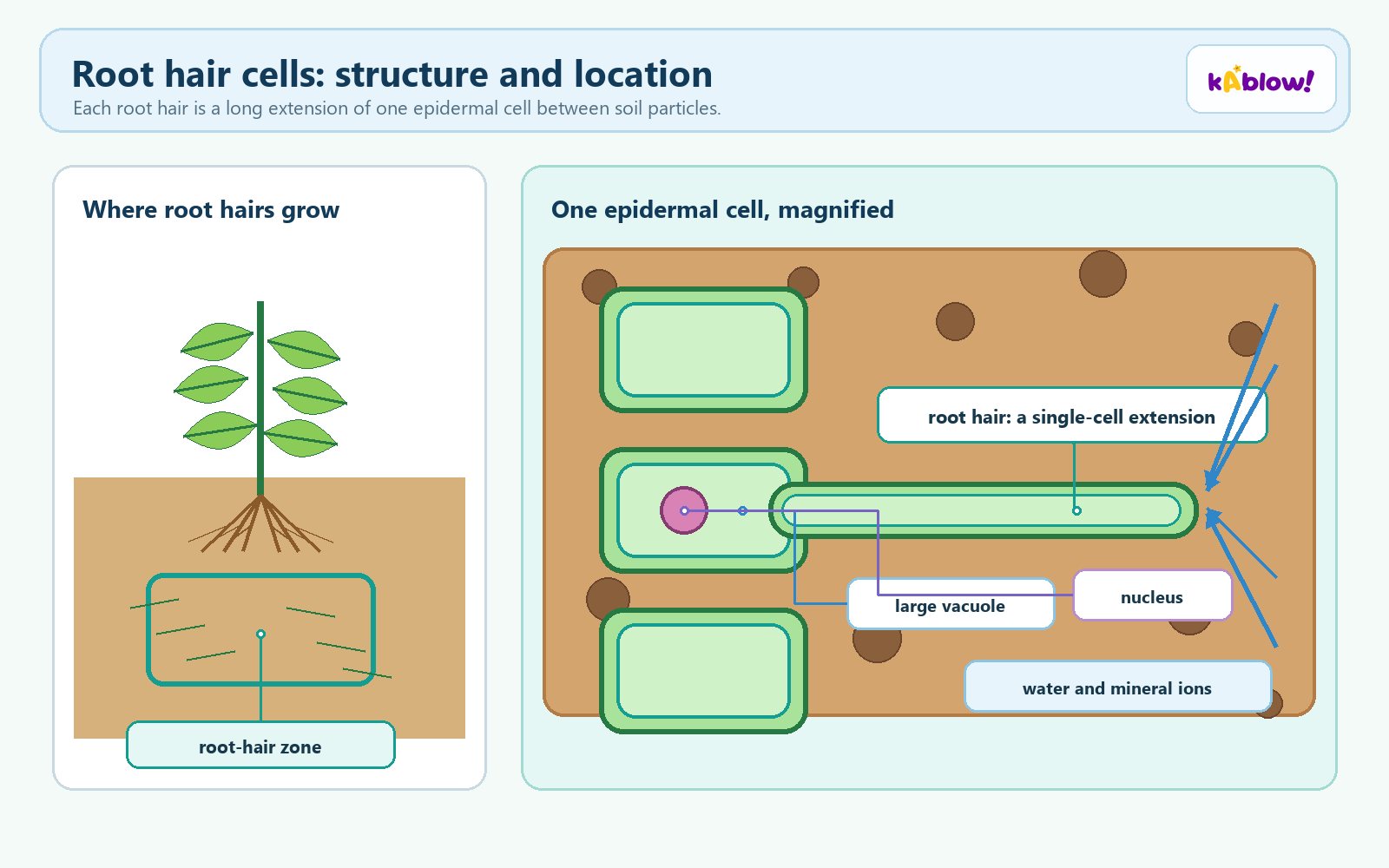
- Near the tip of a root, many root hair cells grow out between the soil particles. Each root hair is a long thin extension of one cell on the surface of the root.
- The long, thin shape gives the cell a very large surface area, so more water and minerals can be absorbed in the same time.
- Water enters by osmosis: it moves from where there is more water, in the soil, to where there is less, inside the root hair cell. Mineral ions are taken in by active transport, which uses energy.
- Root hair cells have no chloroplasts, as they are underground and get no light. They do have many mitochondria to release the energy needed.
- Root hairs are fragile. If a plant is dug up and moved carelessly, many are torn off, and the plant may wilt until new ones grow.
A root hair cell and where root hairs grow
Xylem and phloem: the transport tissues
- Xylem carries water and mineral ions from the roots up to the stem and leaves. It moves in one direction only.
- Xylem vessels are hollow tubes made of dead cells joined end to end, with no end walls, so water flows freely. Their walls are strengthened with a tough substance called lignin, which also helps to support the plant.
- Phloem carries sucrose and amino acids from where they are made or stored to where they are needed. Substances can move up or down, so we say phloem moves things in both directions.
- Phloem is made of living cells called sieve tubes, with small holes in their end walls, and companion cells that provide the energy.
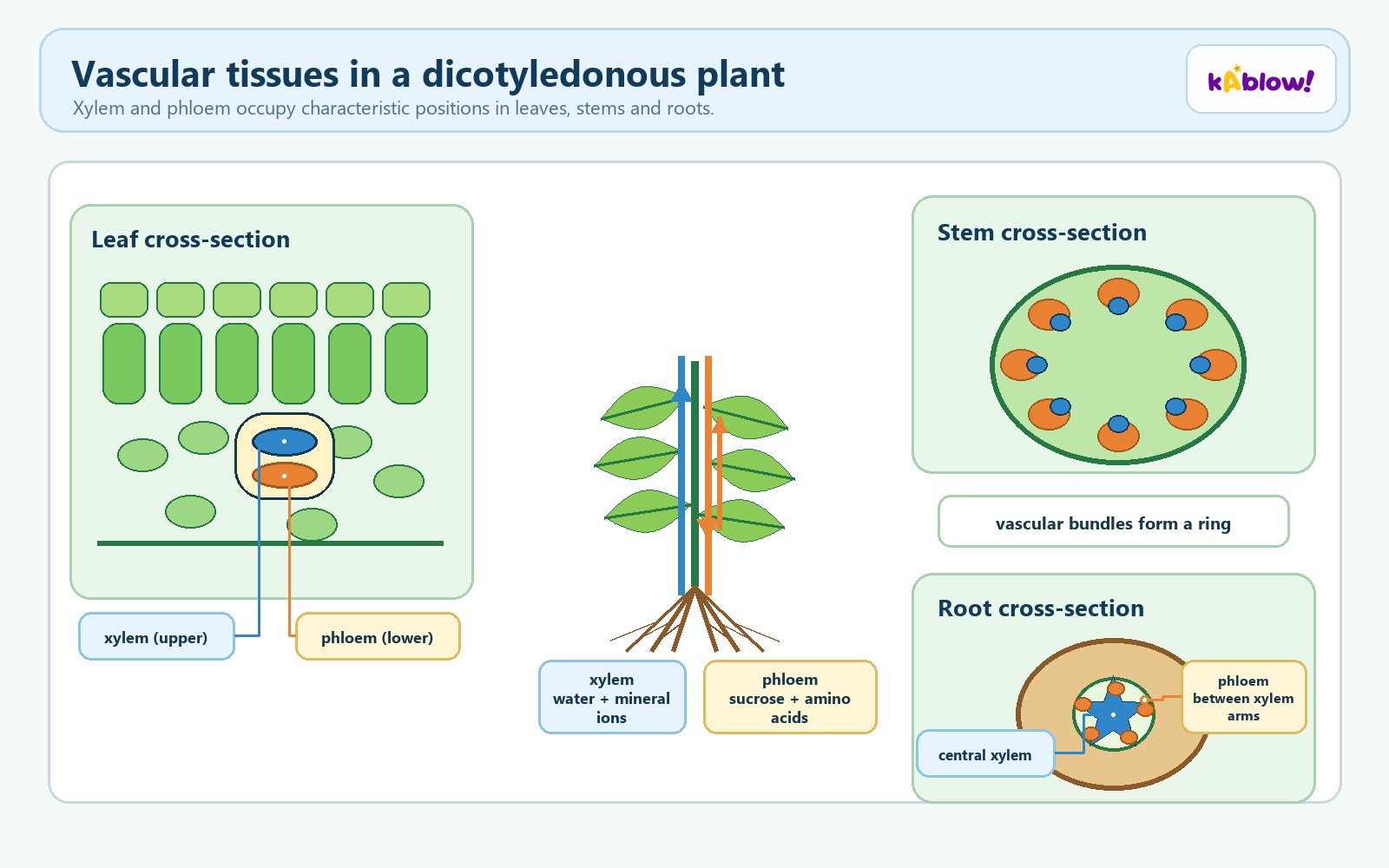
- Xylem and phloem lie side by side in vascular bundles. In a leaf the xylem is on the upper side of each vein. In a stem the bundles form a ring. In a root the xylem is in the centre.
- Do not mix them up: xylem takes water up; phloem moves products of photosynthesis (sugars) around.
Where xylem and phloem sit in a leaf, stem and root
The journey of water: transpiration
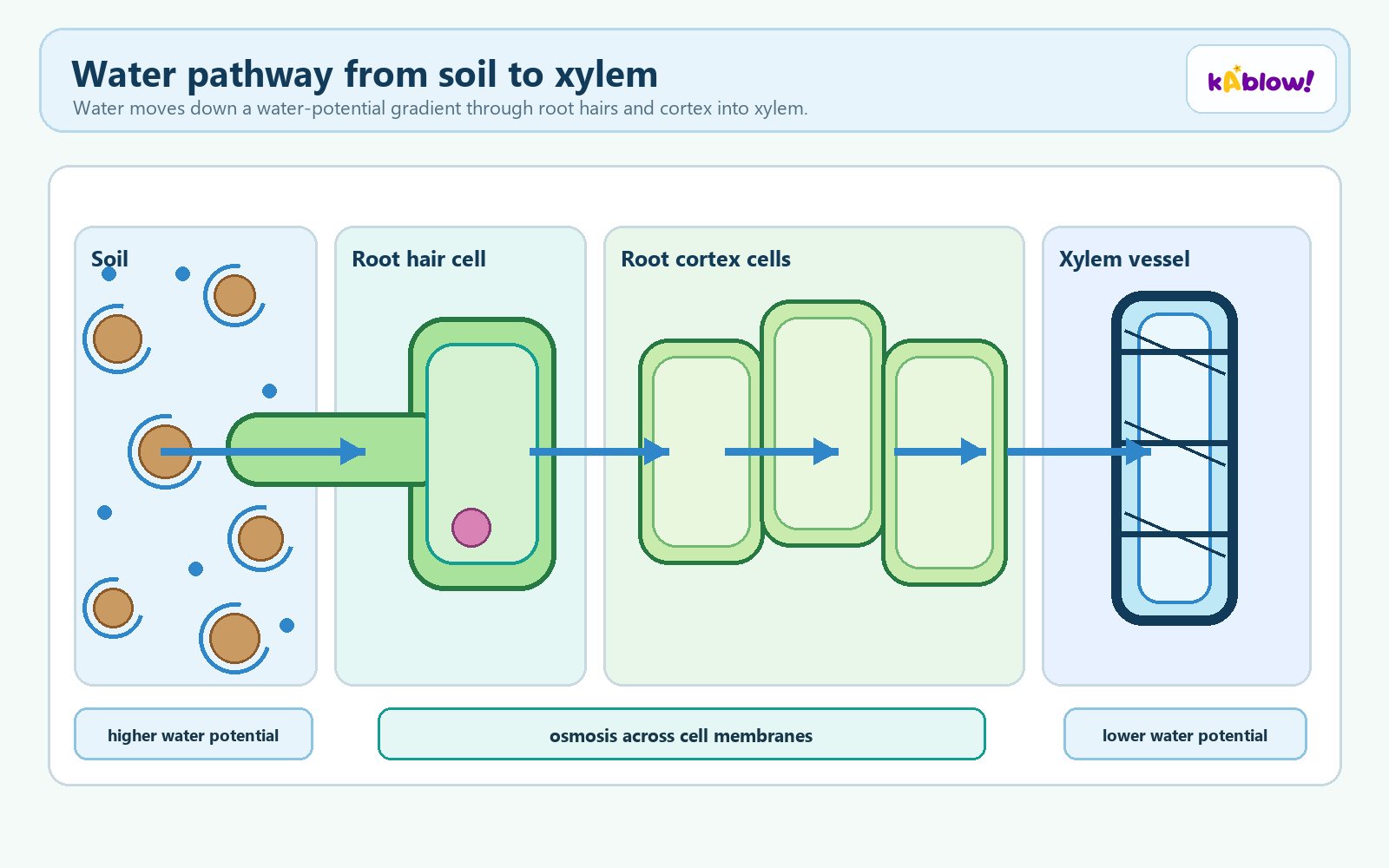
- Water travels from the soil through a root hair cell, across the root cortex cells by osmosis, into a xylem vessel, up the stem, and into the leaf.
- In the leaf, water evaporates from the surface of the spongy mesophyll cells into the air spaces. The water vapour then diffuses out through the open stomata.
- Transpiration is the loss of water vapour from a plant, mainly through the stomata of the leaves.
- As water leaves the leaf, more is pulled up the xylem behind it. This continuous flow is called the transpiration stream. Water molecules stick together, so the water is pulled up like a chain.
- Transpiration is not just waste. It brings mineral ions up to the leaves, keeps the leaves cool as the water evaporates, and keeps the cells full of water so the plant stays firm.
- Each stoma is controlled by two guard cells. When they take in water they swell and open the stoma. When they lose water they go limp and the stoma closes, which saves water but stops carbon dioxide getting in.
The path of water from soil to xylem
What changes the rate of transpiration, and what goes wrong
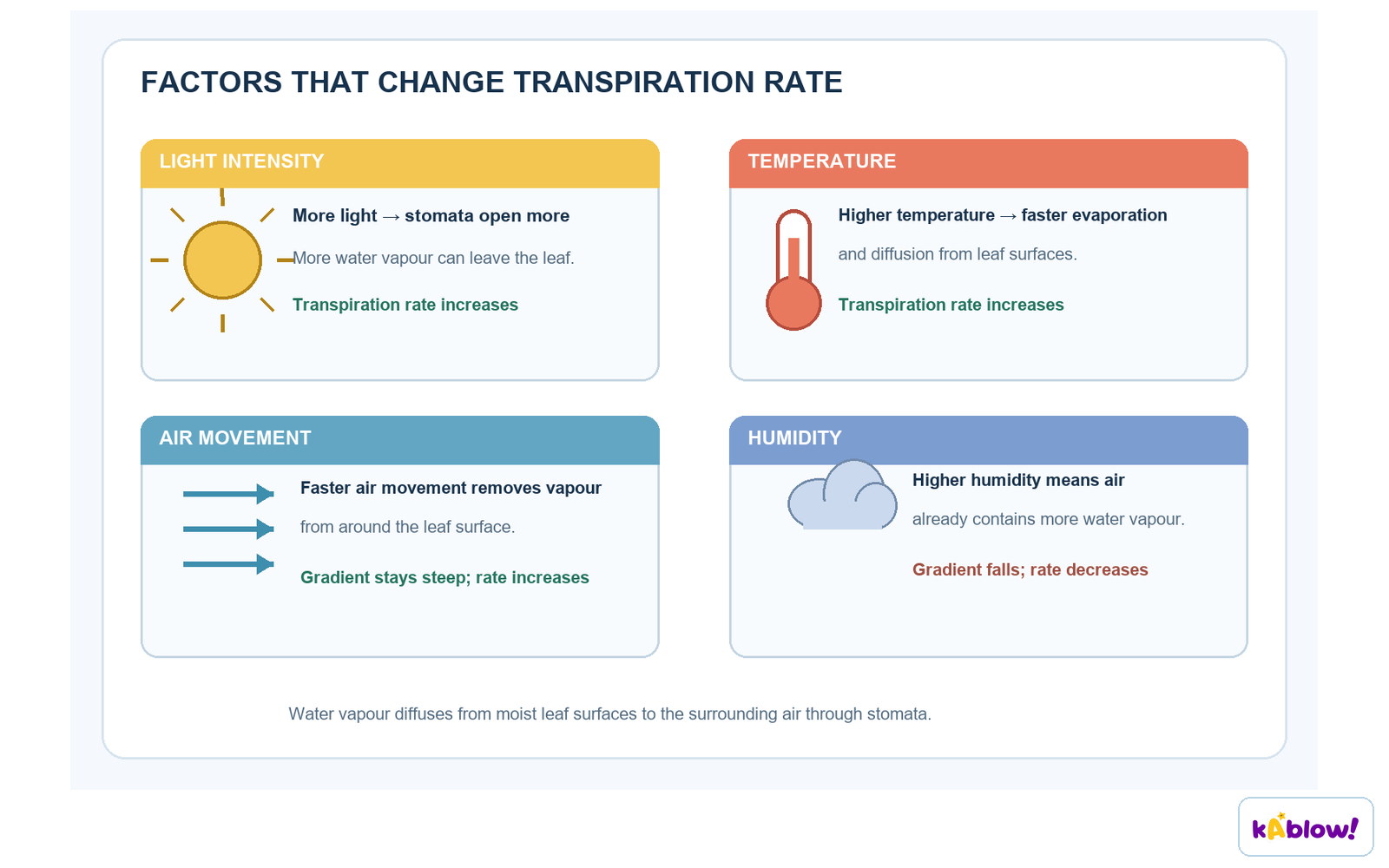
- Higher temperature: water evaporates faster and diffuses faster, so transpiration speeds up.
- More light: stomata open wider in the light so that carbon dioxide can get in, so more water vapour escapes. At night they are mostly closed.
- More wind: moving air sweeps water vapour away from the leaf, so the gradient stays steep and transpiration is faster.
- Higher humidity: the air already holds a lot of water vapour, so there is less difference between the leaf and the air, and transpiration slows down.
- If a plant loses water faster than the roots can replace it, its cells lose water and are no longer firm. The leaves and stem droop: this is wilting. A wilted plant usually recovers when watered.
- Plants cut their water loss in dry places with a thick waxy cuticle, fewer stomata, hairy leaves or leaves rolled up. These are adaptations to the environment.
Four factors that change the rate of transpiration
Think like a scientist: measuring water loss with a potometer
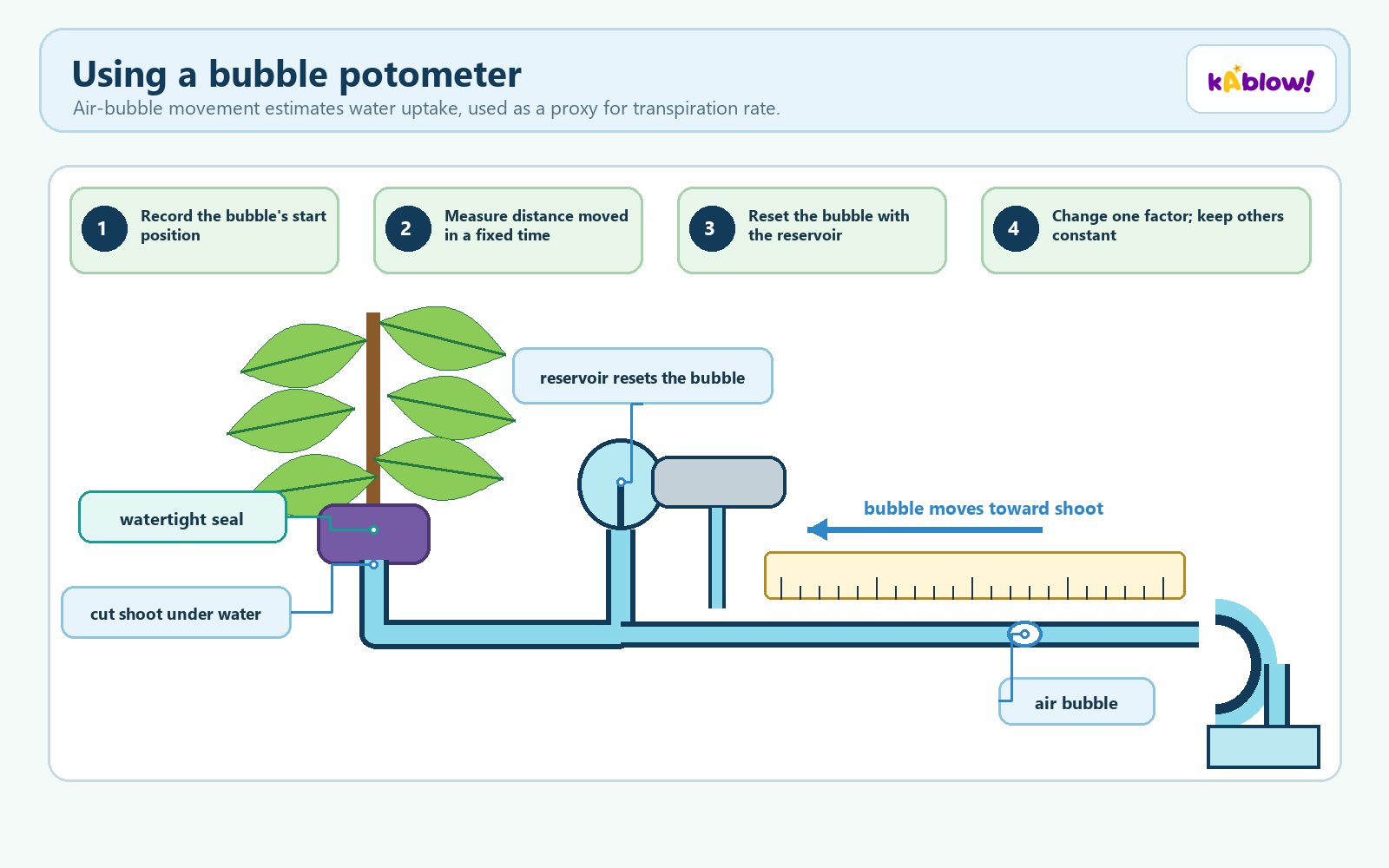
- A potometer measures how fast a cut shoot takes up water. Most of the water taken up is lost by transpiration, so water uptake is a good estimate of the transpiration rate.
- Method: cut the shoot under water so no air gets in, fit it into the apparatus with a watertight seal, let one air bubble into the capillary tube, and record how far the bubble moves in a fixed time.
- It is only an estimate, because the plant also uses a little water for photosynthesis, and some water stays in its cells.
- Inquiry task: plan an investigation into whether wind speed changes the rate of transpiration. The independent variable is the wind speed (for example a fan at different distances); the dependent variable is the distance the bubble moves in 5 minutes.
- Control the other variables: the same shoot or plant, the same temperature, the same light, the same humidity (as far as you can) and the same time.
- Evaluate: how could you make the results more reliable (repeat each speed and take a mean)? Which variable is hardest to control? Would a different species of plant give the same results?
Using a bubble potometer
Slide
Sign up free to view the lesson slides
Step through every slide for this topic — plus flashcards and revision notes — with a free account.
Câu hỏi luyện tập
Xem trước miễn phí — 8 trên 47 câu hỏi. Đăng ký để xem tất cả.
1.Which plant organ takes in water and minerals from the soil?
Easy- AThe roots
- BThe leaves
- CThe flowers
- DThe stem
2.Which plant organ is the main site of photosynthesis?
Easy- AThe stem
- BThe root
- CThe leaf
- DThe flower
3.What is one job of the stem?
Easy- ATo absorb water from the soil
- BTo hold leaves up to the light
- CTo make new seeds for the plant
- DTo take in carbon dioxide for the plant
4.What is the main job of a flower?
Easy- ATo make glucose
- BTo anchor the plant
- CReproduction
- DTo absorb water
5.Xylem vessels carry water and minerals up the plant.
EasyTrue or false?
6.Phloem carries dissolved sugars to the parts of the plant that need them.
EasyTrue or false?
7.What is a root hair cell?
Easy- AA leaf cell that makes a lot of sugar
- BA root surface cell with a thin extension
- CA stem cell that carries water upwards
- DA tiny hair that protects the root tip
8.Why do root hair cells have a long, thin extension?
Easy- AIt makes the whole root grow straight downwards
- BIt lets the cell make sugar in the light
- CIt gives a large surface area
- DIt stops the cell from drying out in the soil
Unlock all 47 questions, flashcards & more
Tạo tài khoản miễn phí để xem mọi câu hỏi, slide, thẻ ghi nhớ và ghi chú ôn tập cho chủ đề này.