DNA, genes and chromosomes
Học bằng cách chơi
Trả lời những câu hỏi này để kiếm năng lượng, rồi câu cá và khám phá. Không cần tài khoản.
Dành cho nhà giáo dục: slide bài học, ghi chú ôn tập sẵn dùng cho DNA, genes and chromosomes (MYP Biology, Year 3) — dùng trong bài giảng của bạn, hoặc chạy chủ đề như một hoạt động lớp học tương tác để người học chơi như một trò chơi trực tiếp.
Ghi chú bài học
Big idea: the instructions inside every cell
- Big idea (key concept): Systems. A cell is a system of parts working together. The nucleus holds the cell's instructions, and those instructions are written in a molecule called DNA.
- Related concept: Structure. The way DNA is built, as a twisted ladder, explains how it stores information and how it can be copied exactly.
- Global context: Scientific and technical innovation. In 1953 two scientists built a model of DNA. Since then, scientists have read the whole human genome, solved crimes with DNA evidence and made new medicines.
- DNA (short for deoxyribonucleic acid) is a very long molecule that stores the instructions for building and running an organism. Think of it as a recipe book written in a four-letter alphabet.
- Almost every cell in your body contains a full copy of the recipe book. A skin cell and a nerve cell look very different, but they hold the same DNA. They are different because they use different parts of the instructions.
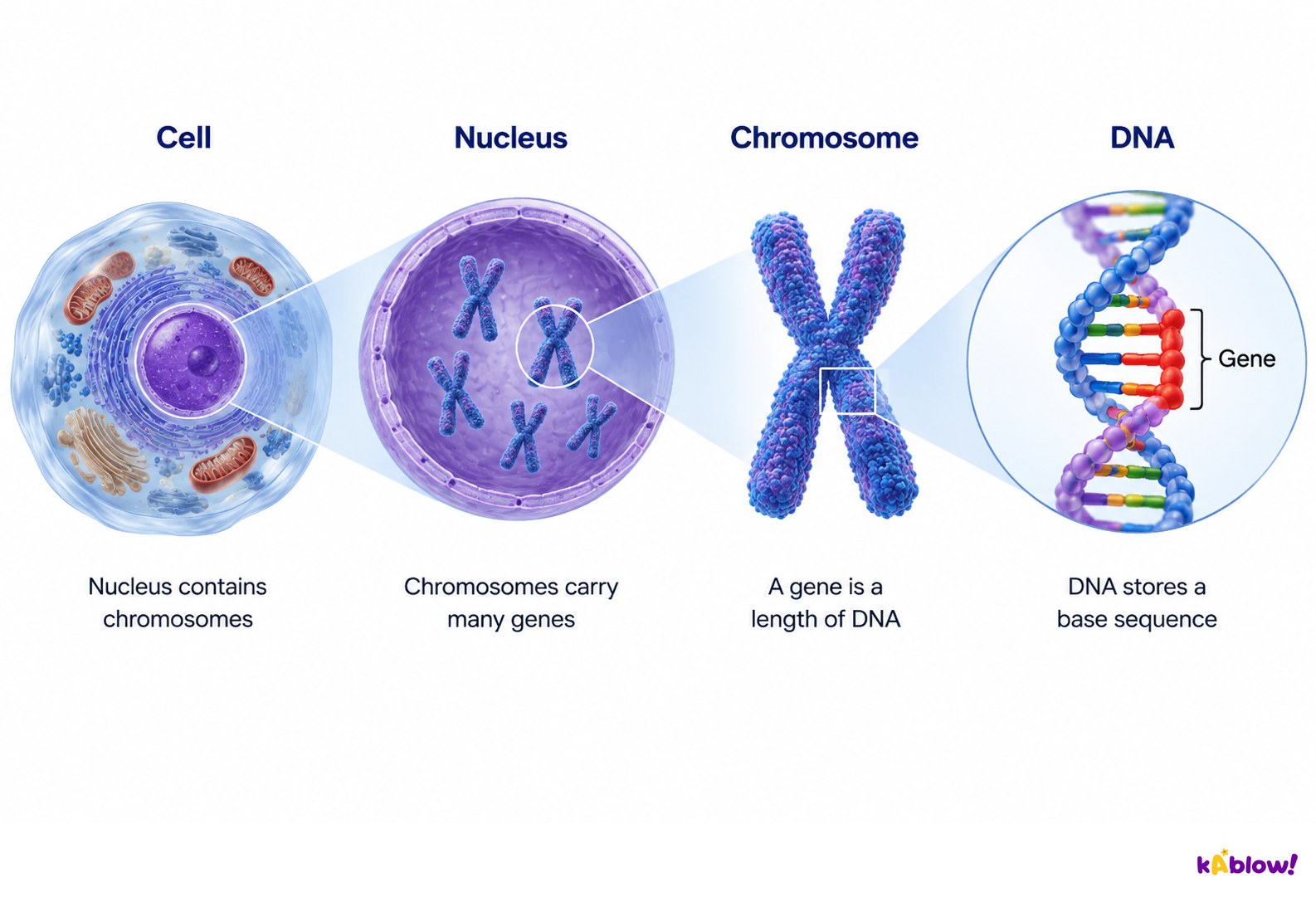
- Scientists describe the instructions at several levels, from big to small: cell, nucleus, chromosome, gene, DNA and its bases.
Zooming in from a cell to the DNA inside it
The structure of DNA: a twisted ladder
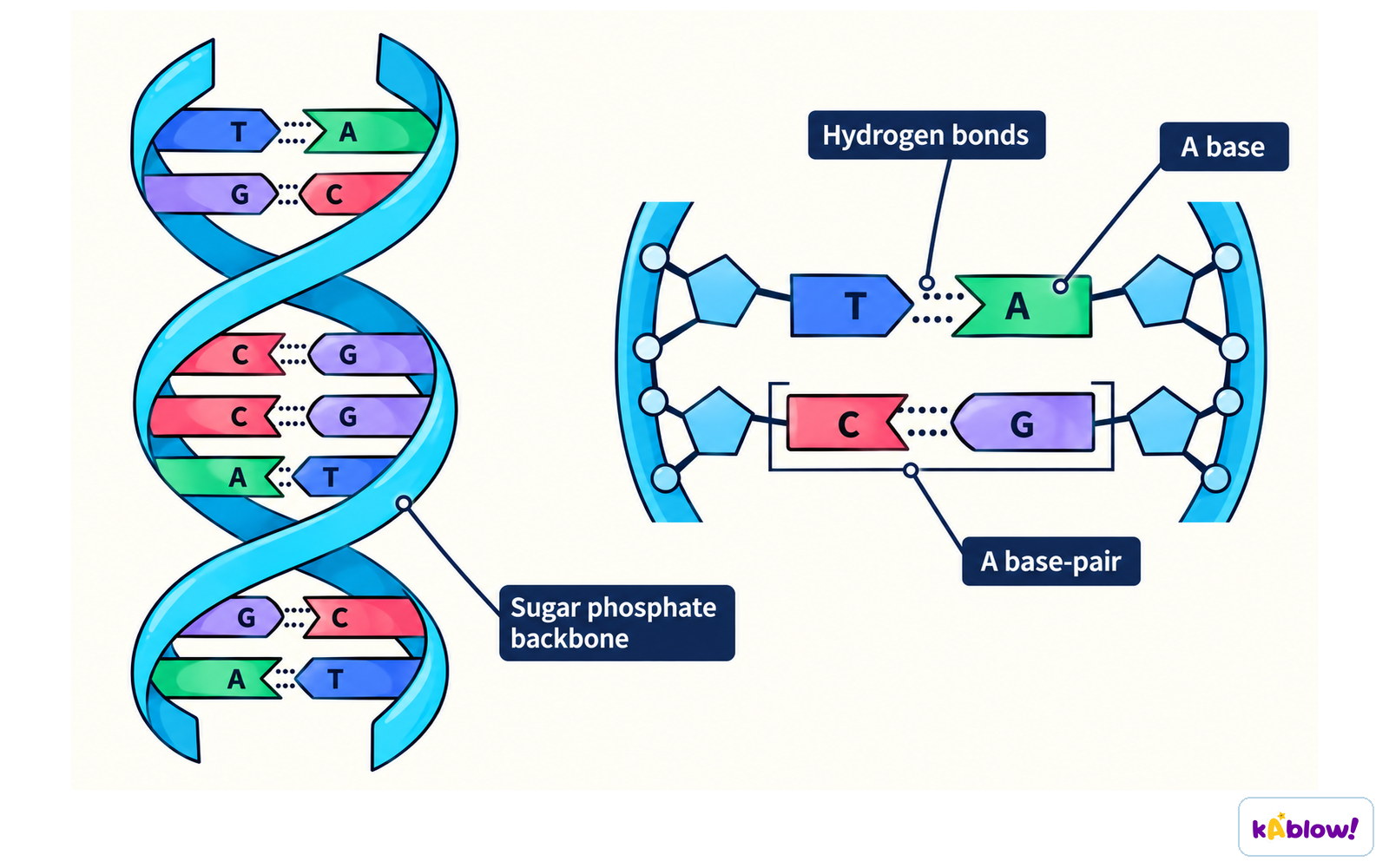
- A DNA molecule is made of two strands twisted together into a spiral called a double helix. It looks like a ladder that has been twisted.
- Each strand is built from small units called nucleotides. A nucleotide has three parts: a sugar, a phosphate group and one of four bases. The sugars and phosphates join up to form the two sides of the ladder, called the backbone.
- The four bases are adenine (A), thymine (T), cytosine (C) and guanine (G). The bases stick out from the backbone and meet in the middle, forming the rungs of the ladder.
- The bases pair up in a fixed way, called complementary base pairing: A always pairs with T, and C always pairs with G. Each pair is held together by weak hydrogen bonds.
- Because of this rule, if you know the order of bases on one strand, you know the other. A strand reading A-T-G-C is matched by a strand reading T-A-C-G.
- The double helix was worked out in 1953 by James Watson and Francis Crick, using X-ray images made by Rosalind Franklin and Maurice Wilkins. Franklin's pictures showed the spiral shape.
The DNA double helix and how its bases pair up
Genes, the genetic code and proteins
- A gene is a section of DNA that carries the instructions for making one protein. Proteins do most of the work in a cell. Some are enzymes, some build structures such as hair, and some, like haemoglobin, carry oxygen.
- The instructions are in the order of the bases. The cell reads them in groups of three, called triplets. Each triplet codes for one amino acid, and amino acids are the building blocks of proteins.
- There are four bases, so there are 4 x 4 x 4 = 64 possible triplets. That is more than enough to code for the 20 different amino acids that make proteins. Pairs of bases would give only 4 x 4 = 16, which is not enough.
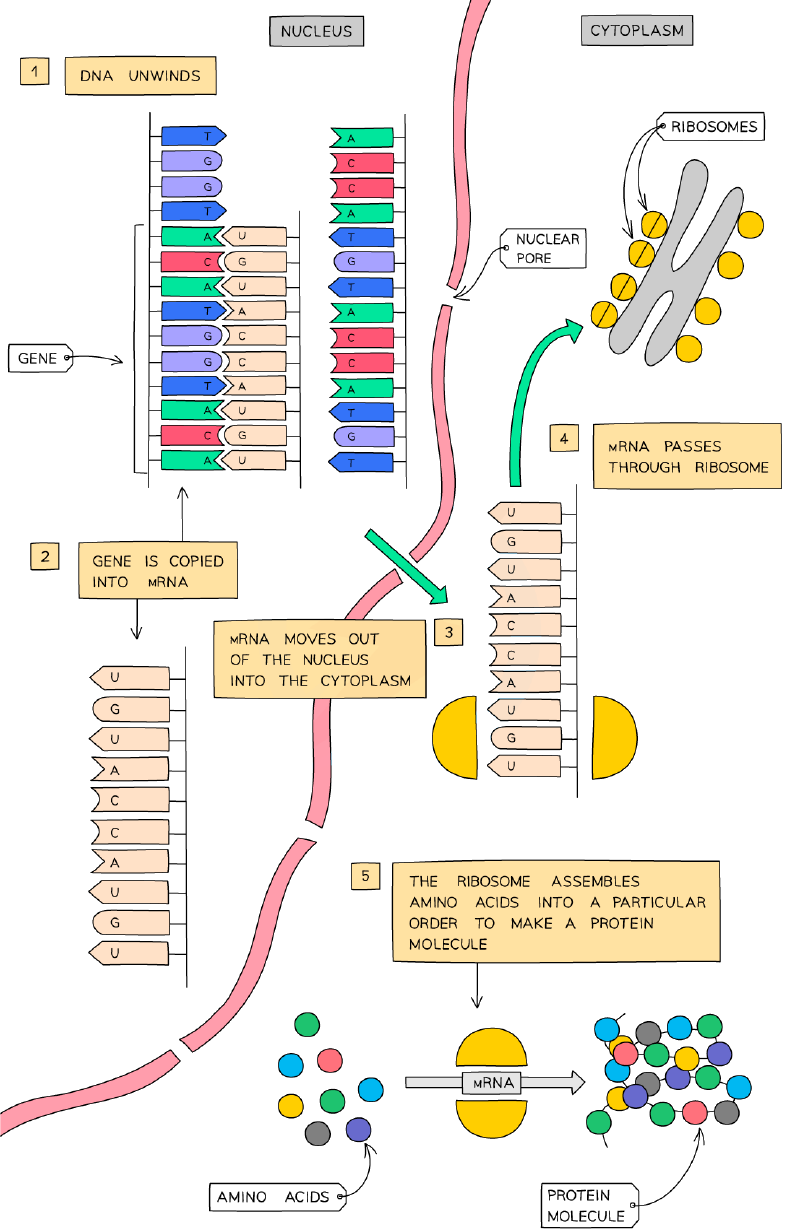
- The DNA stays safe inside the nucleus, so a copy of the gene is made. This copy is a similar molecule called messenger RNA (mRNA). In RNA, the base uracil (U) is used in place of thymine, so A in the DNA is copied as U.
- The mRNA leaves the nucleus through a pore and reaches a ribosome in the cytoplasm. The ribosome reads the triplets and joins the correct amino acids together, in order, to make the protein.
- A change in the order of bases can change the protein, and so change a characteristic of the organism. This is how genes control characteristics such as blood group or eye colour.
How a gene is copied into mRNA and used to build a protein
Chromosomes and the nucleus
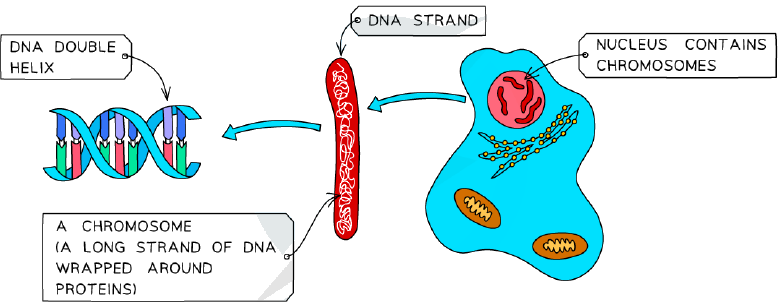
- DNA molecules are extremely long. To fit inside the tiny nucleus, each DNA molecule is wound tightly around proteins and coiled up. A coiled package of DNA is a chromosome.
- Each chromosome carries hundreds or thousands of genes. The genes are arranged one after another along the DNA.
- Human body cells have 46 chromosomes, arranged as 23 pairs. In each pair, one chromosome came from your mother and one from your father. One of the 23 pairs is the sex chromosomes (XX or XY).
- Sperm and egg cells (gametes) have only 23 chromosomes, one from each pair. At fertilisation the two gametes join, which restores the number to 46.
- Different species have different numbers of chromosomes: a fruit fly has 8, a pea plant 14, a chimpanzee 48 and a dog 78. The number does not show how complex the organism is.
- Before a cell divides, it copies all its DNA, so each new cell gets a full set of chromosomes.
- The nucleus is surrounded by a nuclear membrane with tiny nuclear pores. Inside it, the DNA is spread out as thin threads, and a dark region called the nucleolus helps to make ribosomes.
From a cell to a chromosome to the DNA double helix
Alleles and the genome
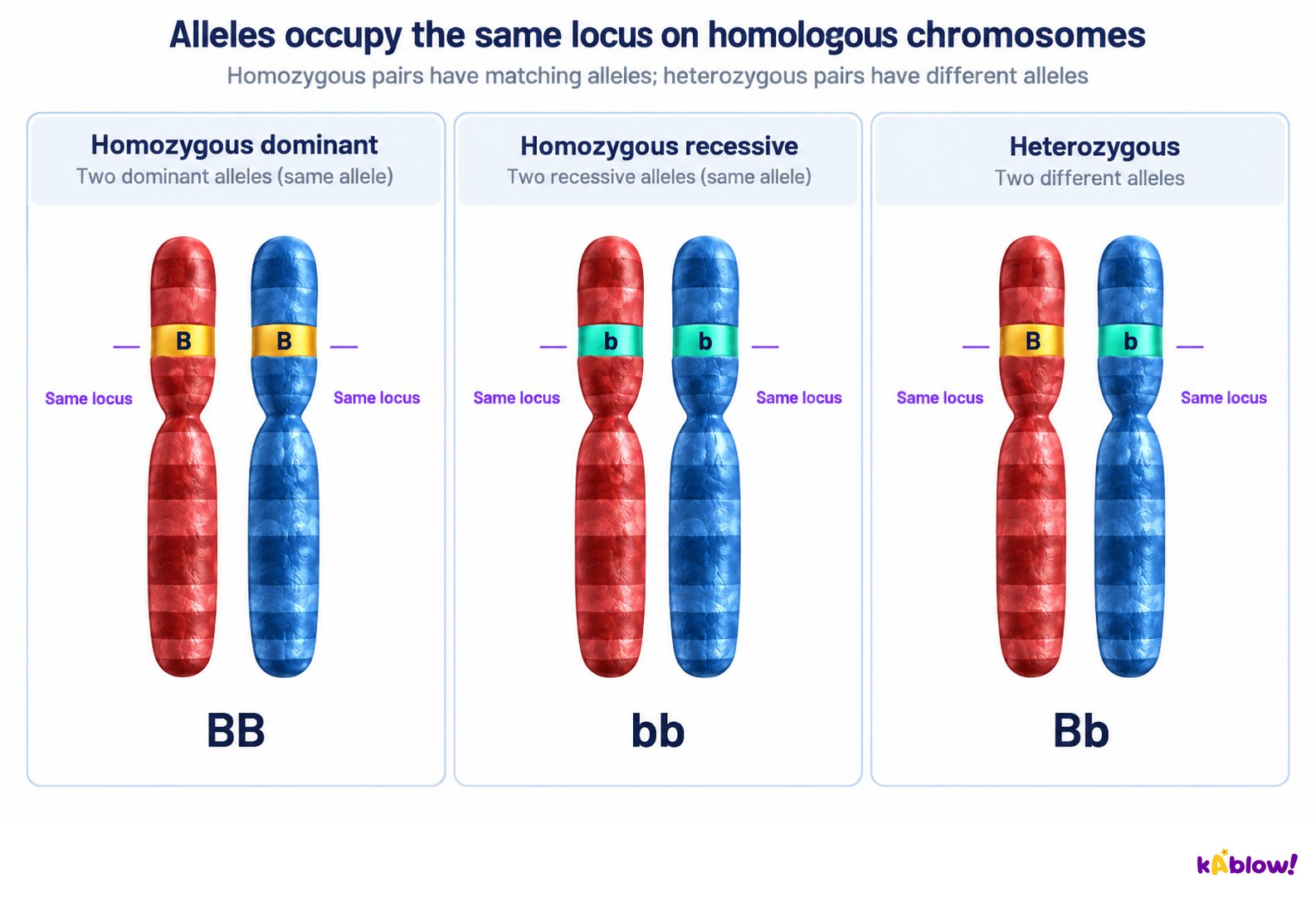
- You have two copies of most genes, one on each chromosome of a pair. The two copies may be slightly different. Different versions of the same gene are called alleles.
- Both copies sit at the same position on the chromosome pair. This position is called the gene's locus. For a gene for ear lobe shape, one allele might code for attached lobes and another for free lobes.
- Your genome is the complete set of DNA in a cell. The human genome has about 3 billion base pairs and about 20 000 genes. Only a small fraction of the DNA, about 1 to 2 per cent, codes for proteins.
- The Human Genome Project read the order of the bases in human DNA and was declared finished in 2003. It showed that any two people have DNA that is about 99.9% the same.
- Why is DNA the same shape in all organisms? Bacteria, plants, fungi and animals all use a double helix built from the same four bases, and all read the code in triplets. Most scientists take this as strong evidence that all living things share a common ancestor.
- Because the code is shared, a gene from one species can often work in another. This is the basis of genetic engineering, such as bacteria that make human insulin.
Alleles at the same locus on a pair of chromosomes
Think like a scientist: extracting DNA from fruit
- You can see DNA with simple equipment. Mash a ripe strawberry in a bag with a detergent and salt solution. The detergent breaks open the cell and nuclear membranes, and the salt helps the DNA clump together.
- Filter the mixture to remove the lumps. Then very slowly pour ice-cold ethanol (an alcohol) down the side of the tube, so it forms a layer on top. Your teacher should handle the ethanol, because it is flammable.
- DNA does not dissolve in cold ethanol. After a minute, white, stringy clumps of DNA appear where the two liquids meet, and you can lift them out with a stick.
- The independent variable is the one you change on purpose, such as the type of fruit or the temperature of the solution. The dependent variable is what you measure, such as the length of the DNA clump or its mass. A fair test controls everything else: mass of fruit, volume of solution, mashing time and the volume of ethanol.
- A single trial can be misleading. Repeating the experiment and calculating a mean makes the results more reliable.
- Inquiry task: plan an investigation to find out which fruit, strawberry or banana, gives more DNA. State what you will change and measure, name three variables you will control, explain how you will make your results reliable, and suggest one limitation of judging the amount of DNA by eye.
Slide
Sign up free to view the lesson slides
Step through every slide for this topic — plus flashcards and revision notes — with a free account.
Câu hỏi luyện tập
Xem trước miễn phí — 8 trên 49 câu hỏi. Đăng ký để xem tất cả.
1.In an animal cell, where is most of the DNA found?
Easy- AIn the cell membrane
- BIn the nucleus
- CIn the cytoplasm
- DIn the ribosomes
2.What does DNA stand for?
Easy- ADouble nucleic atom
- BDioxygen nitrogen acid
- CDeoxyribose nuclear agent
- DDeoxyribonucleic acid
3.What shape is a DNA molecule?
Easy- AA double helix
- BA single straight chain
- CA flat sheet of bases
- DA hollow sphere
4.Chromosomes are made of DNA.
EasyTrue or false?
5.In DNA, which base pairs with adenine (A)?
Easy- ACytosine (C)
- BGuanine (G)
- CThymine (T)
- DUracil (U)
6.In DNA, which base pairs with cytosine (C)?
Easy- AAdenine (A)
- BThymine (T)
- CGuanine (G)
- DCytosine (C)
7.What is a gene?
Easy- AA section of DNA that codes for a protein
- BA whole chromosome made only of protein
- CA cell that stores DNA for the body
- DA sugar that links the DNA strands
8.How many chromosomes are there in a normal human body cell?
Easy- A23
- B44
- C92
- D46
Unlock all 49 questions, flashcards & more
Tạo tài khoản miễn phí để xem mọi câu hỏi, slide, thẻ ghi nhớ và ghi chú ôn tập cho chủ đề này.
Đề thi cũ
Luyện đề thi cũ cho chủ đề này sắp ra mắt.
Sắp ra mắt