Epidemics and public health
Học bằng cách chơi
Trả lời những câu hỏi này để kiếm năng lượng, rồi câu cá và khám phá. Không cần tài khoản.
Ghi chú bài học
Big idea: patterns in how diseases spread
- Big idea (key concept): Relationships. Pathogens, hosts, vectors and the environment depend on each other. How fast a disease spreads depends on the relationships between all of them, and between people and their communities.
- Related concept: Patterns. Epidemics follow patterns in time (a rise, a peak and a fall) and in place (clusters around a source). Public-health scientists look for these patterns and use them to decide what to do.
- Global context: Globalization and sustainability. Air travel, trade and cities connect the world, so a new disease can reach many countries in weeks. Controlling disease needs cooperation between countries and fair access to clean water, vaccines and medicines.
- Words to use exactly. A communicable disease is caused by a pathogen that can pass from host to host. Endemic means present at a steady level in an area. An epidemic is a sudden rise in cases above the number expected in an area. A pandemic is an epidemic across many countries. Incidence is the number of new cases in a population in a set time, often given as cases per 100 000 people so that places of different size can be compared.
- Using patterns as evidence. In 1854 John Snow mapped the homes of people who died in a cholera outbreak in London. Most were close to one water pump, which pointed to contaminated water as the source. The pattern did not show which pathogen was responsible, but it helped to decide what to do.
How diseases spread and how to break the chain
- A pathogen has to leave one host, travel by a route, and enter a new host where it multiplies. This is the chain of transmission. Breaking any link stops the spread.
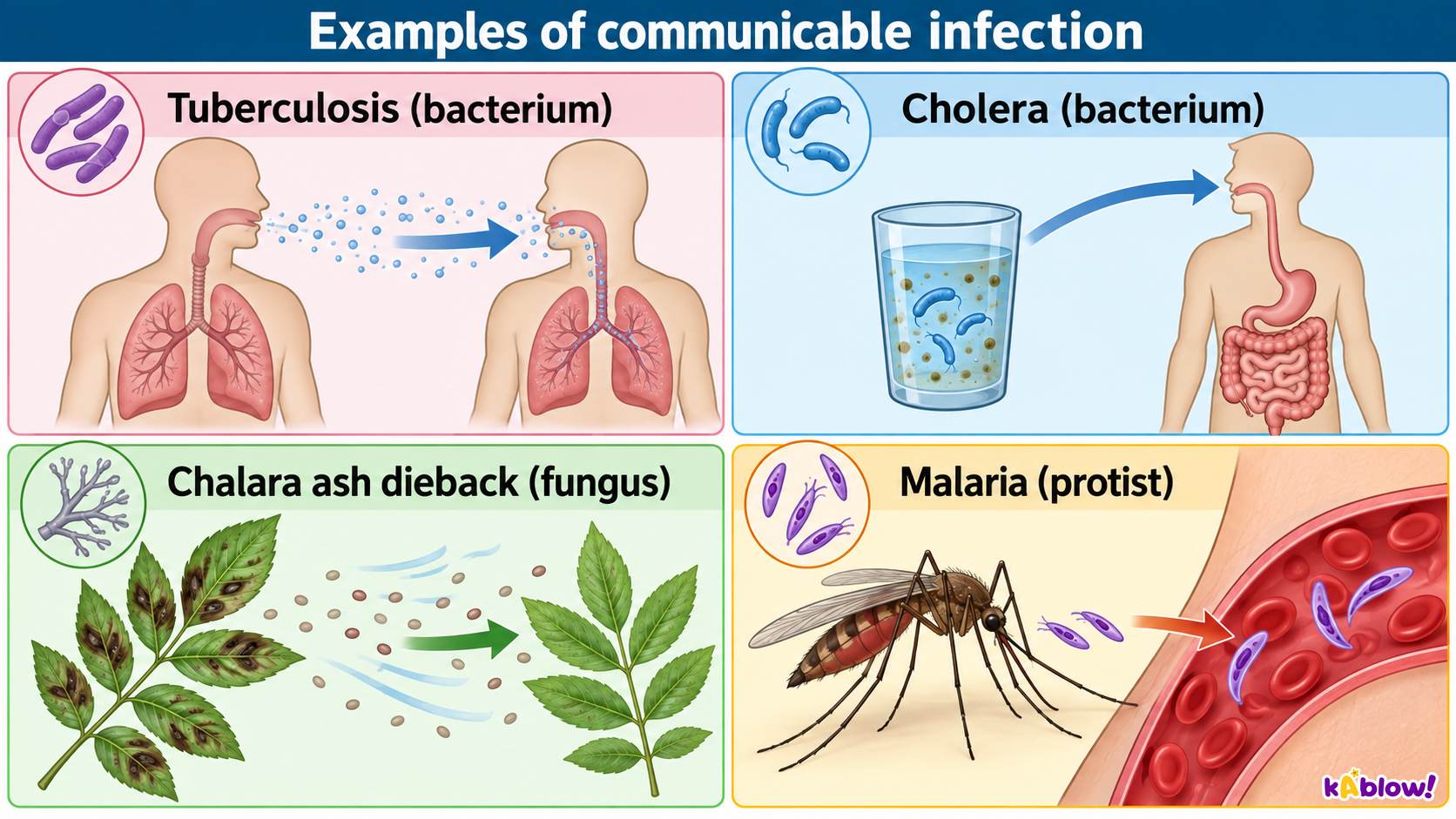
- Main routes: droplets and aerosols from coughs and sneezes (tuberculosis, influenza); contaminated water or food (cholera); vectors such as mosquitoes (malaria); direct contact and body fluids (HIV); and spores carried on the wind (ash dieback in trees).
- A vector is an organism that carries a pathogen from one host to another. The Anopheles mosquito carries the malaria protist. Vectors breed in warm, wet places, which is why vector-borne diseases are more common there.
- What speeds spread: crowded living and working, regular long-distance travel, poor sanitation and unsafe water, people who are infectious before they feel ill, and low immunity in the population.
- Breaking the chain: clean water and safe sewage disposal (cholera), handwashing and food hygiene, covering coughs, isolating people known to be ill, controlling vectors (nets, draining standing water), and vaccination. The best measure depends on the route, so it matters to know how the disease spreads.
How four infectious diseases spread
R number, epidemic curves and surveillance
- The R number is the average number of people one infected person goes on to infect. R0 is the value when nobody is immune. If R is greater than 1, cases grow. If R = 1, cases stay steady. If R is less than 1, the epidemic shrinks.
- Growth is repeated multiplication. If R = 3, one case gives 3 new cases, then 9, then 27, then 81. Small differences in R make a huge difference after only a few rounds of spread.
- R changes when people change what they do (fewer contacts lowers R) and as more people become immune. Effective R = R0 x the fraction still susceptible. For example, R0 = 3 with 40% immune gives 3 x 0.6 = 1.8.
- Herd immunity threshold = (1 - 1/R0) x 100%. For R0 = 2 it is 50%, for R0 = 4 it is 75%, and for measles (R0 about 12 to 18) it is about 95%. If a vaccine protects only some of those who receive it, the share vaccinated must be higher: threshold / effectiveness.
- An epidemic curve plots new cases against time. It usually has a slow start, a rapid rise, a peak and a decline. Measures that reduce contacts can lower and widen the peak (flattening the curve), so health services are less likely to be overwhelmed. Compare rates (cases per 100 000), not raw numbers, when places differ in size.
- Surveillance is the continuous collecting and analysing of health data to notice outbreaks early: doctors and labs report notifiable diseases, contact tracing finds people who may have been exposed, testing tracks cases, and genome sequencing shows how closely pathogens from different cases are related.
Vaccination programmes and evaluating public-health measures
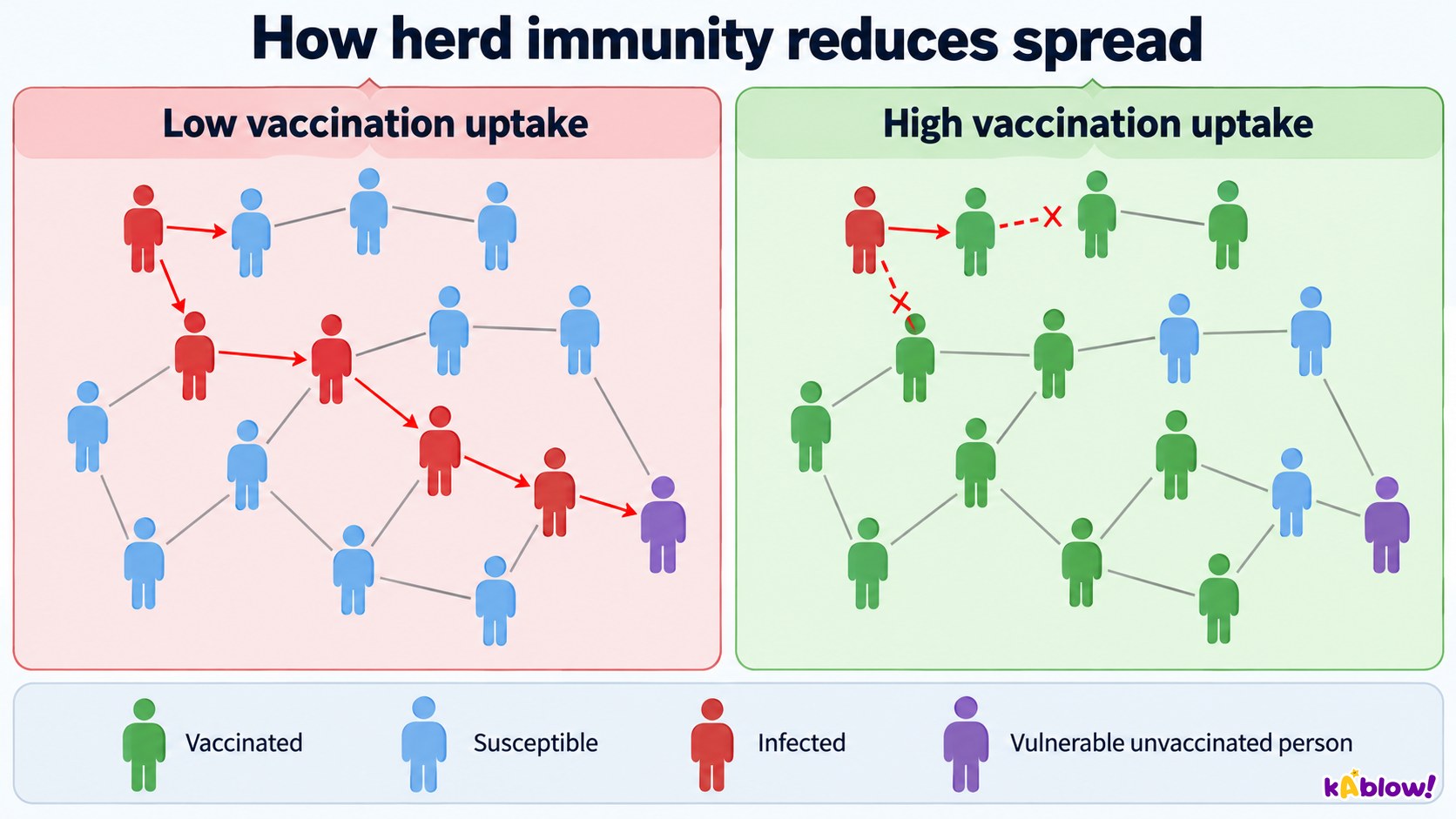
- A vaccination programme aims to get enough of a population immune to reach herd immunity. Then chains of infection break, and people who cannot be vaccinated (babies, or people with weak immune systems) are protected too.
- Programmes have worked: smallpox was declared eradicated in 1980 after a worldwide programme. If uptake falls below the threshold, outbreaks can return, as has happened with measles in places where uptake dropped.
- Reasons uptake can fall include access to clinics, cost, misinformation and fear of side effects. Serious side effects are very rare. Programmes use clear information, easy access and trust in local health workers.
- Other measures include quarantine (separating people who may have been exposed but are not known to be ill), isolation (separating people who are known to be ill), travel restrictions, masks, school closures and testing.
- Evaluating a measure. Ask: how well does it reduce spread (benefit)? What does it cost in money, education, health and freedom? Who is affected most, and is that fair? How good is the evidence, and was a control group used? There is rarely a perfect answer: a good evaluation weighs benefits against costs and says how certain the evidence is.
Herd immunity: low and high vaccination uptake
Antibiotic resistance and stewardship
- Antibiotics kill or stop the growth of bacteria. They do not work against viruses, so they are no use for colds or influenza.
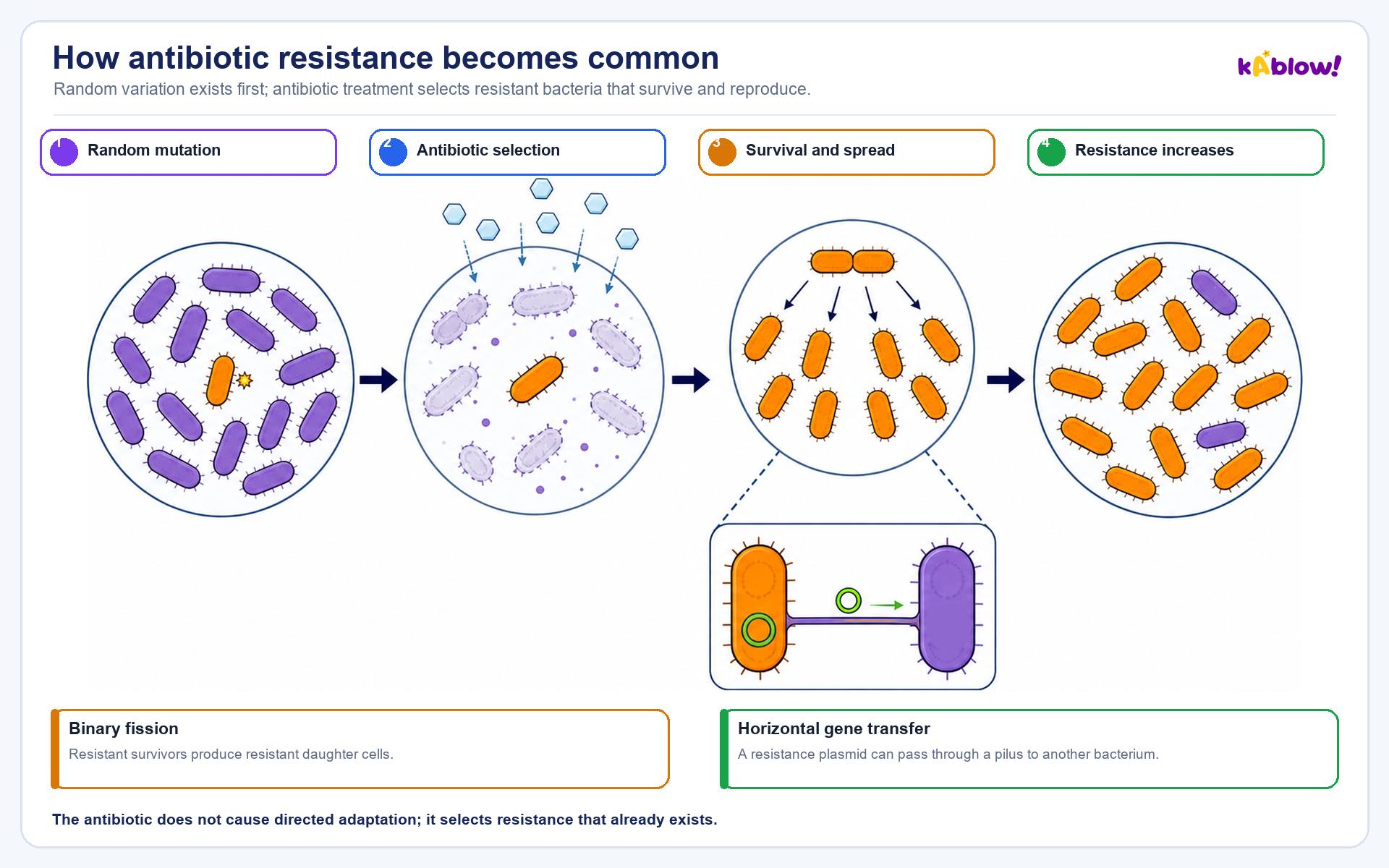
- Resistance arises by natural selection. In a large population of bacteria, a random mutation may make one bacterium resistant. When an antibiotic is used, the non-resistant bacteria die, and the resistant bacterium survives and reproduces. Resistance becomes more common. The antibiotic selects resistance that already exists; it does not cause the mutation.
- Bacteria can also share resistance genes on plasmids, so resistance can pass between different bacteria. MRSA is a bacterium resistant to several antibiotics, and drug-resistant tuberculosis needs longer, more complex treatment.
- Antibiotic stewardship means using antibiotics carefully to slow resistance: prescribe only when an infection is likely to be bacterial, choose the right antibiotic and dose, follow the prescriber's instructions, avoid routine use in healthy farm animals, and prevent infection in the first place with hygiene and vaccines.
- New antibiotics are hard and expensive to develop, so protecting the ones we have matters for everyone. Resistant bacteria cross borders, so this is a global problem that needs global cooperation.
How antibiotic resistance becomes common
Think like a scientist: does handwashing cut illness at school?
- Question: does a school handwashing programme reduce absence for illness? A school with a programme (soap at set times) is compared with a similar school without one. In one comparison (invented data), School A has 400 pupils and 60 illness absences. School B has 500 pupils and 100 illness absences.
- Calculate rates, not totals: A has 60 / 400 x 100 = 15 absences per 100 pupils, and B has 100 / 500 x 100 = 20 per 100. The rate in A is (20 - 15) / 20 x 100 = 25% lower.
- The independent variable is whether there is a programme. The dependent variable is illness absences per 100 pupils. Control variables include pupil age, the time of year, the length of the study and how absence is defined.
- Reliability and validity: two schools are not enough. A fairer design randomly chooses classes in the same school to start the programme, uses a control group and runs over several terms. A confounding variable (for example, one school is in a warmer area) could explain a difference.
- Inquiry task 1: plan a fair test of a handwashing programme, with a results table and a rule for what counts as an absence for illness. Inquiry task 2: a student says 'the programme caused the 25% fall'. Evaluate this conclusion and suggest three improvements.
Slide
Sign up free to view the lesson slides
Step through every slide for this topic — plus flashcards and revision notes — with a free account.
Câu hỏi luyện tập
Xem trước miễn phí — 8 trên 55 câu hỏi. Đăng ký để xem tất cả.
1.What is an epidemic?
Easy- AA disease that is always present at a steady level in an area
- BA sudden rise in cases of a disease in one area
- CA disease that has spread across many countries
- DA disease that cannot pass from one person to another
2.In which situation would a disease be described as endemic?
Easy- AIt has just spread to every continent within a few months
- BIt has disappeared from the world completely
- CIt appears once in a region and then never returns
- DIt is always present in a region at a fairly steady level
3.A communicable disease is caused by a pathogen that can pass from one host to another.
EasyTrue or false?
4.Match each term to its meaning.
Easy- Endemic
- Epidemic
- Pandemic
- Incidence
- An epidemic that spreads across many countries
- Always present in an area at a steady level
- The number of new cases in a population in a set time
- A sudden rise in cases above the number expected in an area
5.A country normally records about 20 cases of a disease each year. In one month it records 400 cases, nearly all in one region. Which term fits best?
Easy- AEpidemic
- BEndemic
- CPandemic
- DEradication
6.Complete the sentence.
EasyA disease that spreads across many countries at the same time is called a ____.
7.In 1854, John Snow mapped the homes of people who died in a cholera outbreak in part of London. Most were close to one water pump. What kind of evidence was this?
Medium- AA controlled trial with a treatment group and a control group
- BProof that a particular bacterium is the cause of cholera in humans
- CA pattern in the data that pointed to a likely source of the disease
- DAn example of herd immunity protecting people in a vaccinated community
8.Tuberculosis is spread mainly by which route?
Easy- ABites from mosquitoes that have fed on infected people
- BDrinking water that is contaminated with sewage
- CDroplets from the lungs of an infected person
- DContact with soil or plants in a garden or field
Unlock all 55 questions, flashcards & more
Tạo tài khoản miễn phí để xem mọi câu hỏi, slide, thẻ ghi nhớ và ghi chú ôn tập cho chủ đề này.