Electrolysis and moving ions
Học bằng cách chơi
Trả lời những câu hỏi này để kiếm năng lượng, rồi câu cá và khám phá. Không cần tài khoản.
Ghi chú bài học
Big idea: electrolysis and moving ions
- Key concept: Systems. Mobile positive ions move towards the negative cathode and gain electrons. Negative ions move towards the positive anode and lose electrons.
- Related concepts: Models and evidence. Use a scientific explanation to make predictions, then test it against observations.
- Global context: Scientific and technical innovation. Electrolysis separates elements from compounds using electrical energy.
Electrolysis Principles
- Electrolysis is the breakdown of a molten or aqueous ionic compound by an electric current.
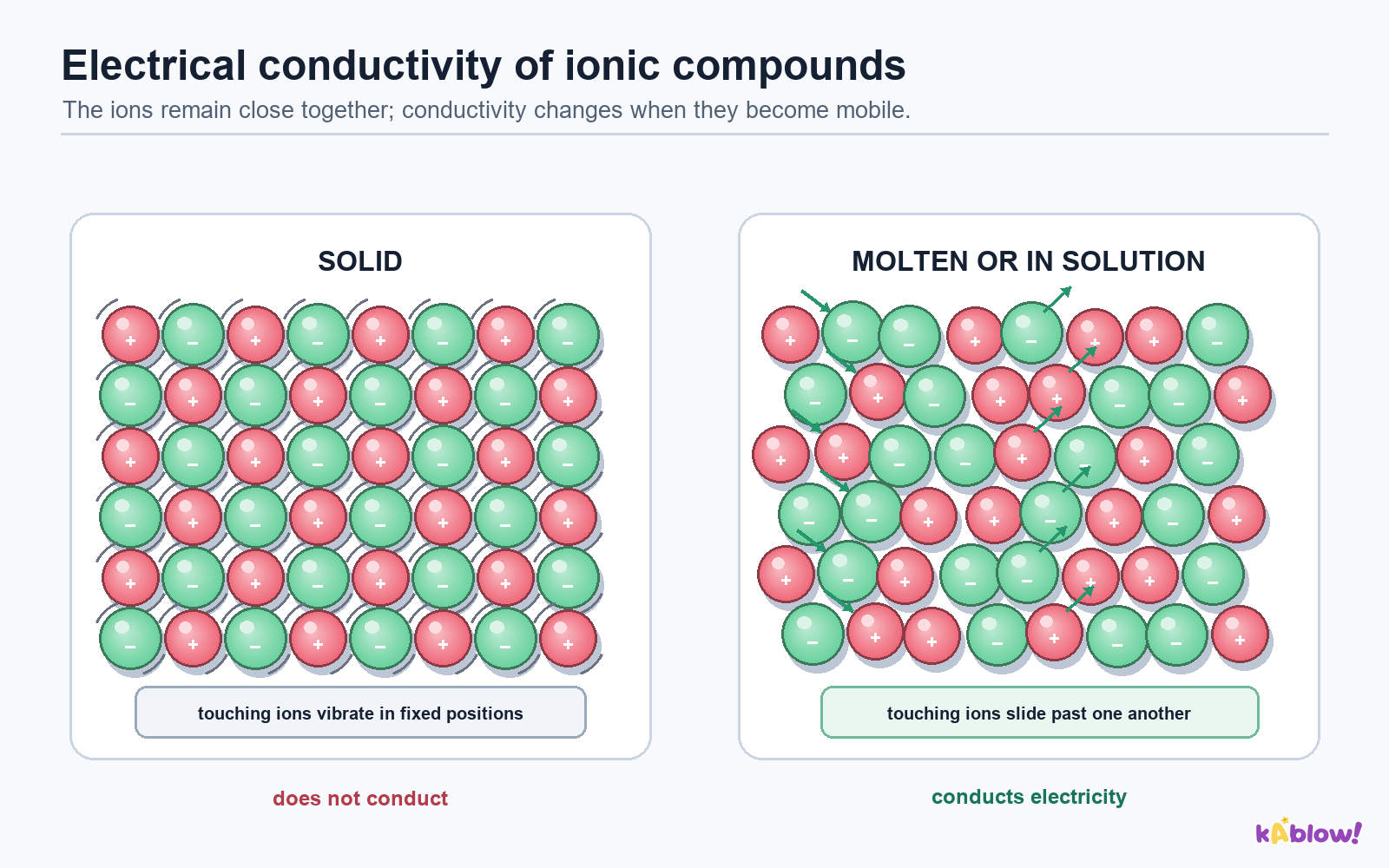
- Covalent compounds and solid ionic compounds cannot undergo electrolysis because they have no free mobile ions.
- Electrolyte: molten or dissolved ionic compound that conducts electricity.
- Anode (positive electrode) attracts anions (negative ions).
- Cathode (negative electrode) attracts cations (positive ions).
- Use PANIC: Positive is Anode, Negative Is Cathode.
- Electrons flow from the negative terminal of the power supply to the cathode; they do not pass through the electrolyte.
- Reduction (gain of electrons) occurs at the cathode; oxidation (loss of electrons) occurs at the anode.
Ionic conductivity: solid vs molten/dissolved
Electrolysis of Molten Compounds
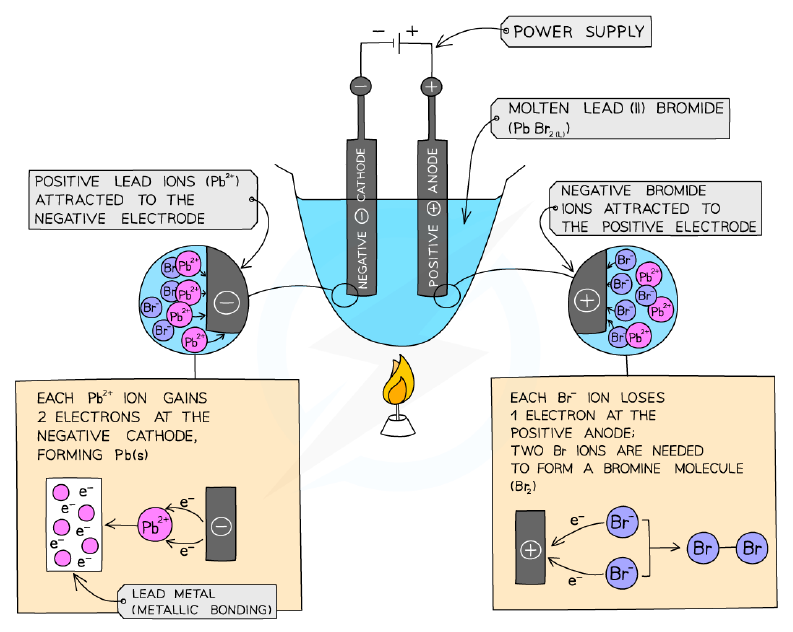
- Molten binary ionic compounds decompose into their elements: metal at cathode, non-metal at anode.
- Example: molten PbBr₂ → Pb (grey metal) at cathode, Br₂ (brown gas) at anode.
- Ions must be free to move – compound must be molten (or in solution).
- Electrodes must be inert (e.g., graphite or platinum) to avoid side reactions.
- Half-equation at cathode: Pb²⁺ + 2e⁻ → Pb.
- Half-equation at anode: 2Br⁻ → Br₂ + 2e⁻.
Electrolysis of molten lead(II) bromide
Electrolysis of Aqueous Sodium Chloride (Brine)
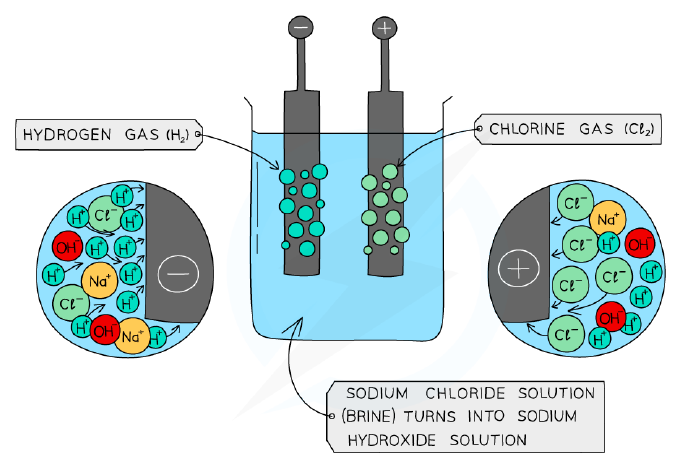
- Brine contains Na⁺, Cl⁻, H⁺, OH⁻ ions.
- At cathode: H⁺ is discharged (less reactive than Na⁺) → hydrogen gas.
- At anode: Cl⁻ is discharged → chlorine gas.
- Na⁺ and OH⁻ remain in solution → sodium hydroxide forms.
- Industrial uses: Cl₂ → bleach; H₂ → margarine; NaOH → soap and detergents.
Electrolysis of aqueous sodium chloride (brine)
Electrolysis of Dilute Sulfuric Acid
- Contains H⁺, SO₄²⁻, OH⁻ ions.
- At cathode: H⁺ gains electrons → hydrogen gas.
- At anode: OH⁻ loses electrons → oxygen gas (and water).
- Volume of H₂ produced is twice the volume of O₂.
- Gas tests: H₂ – lit splint gives 'squeaky pop'; O₂ – glowing splint relights.
Electrolysis of Aqueous Solutions
- Water dissociates: H₂O ⇌ H⁺ + OH⁻ – these ions compete with solute ions.
- At cathode: if metal is less reactive than hydrogen, metal is deposited; if more reactive, hydrogen gas is produced.
- At anode: if halide ions (Cl⁻, Br⁻, I⁻) are present, halogen forms; otherwise oxygen from OH⁻.
- Concentration matters: concentrated halide → halogen; dilute halide → oxygen.
- Example: CuSO₄(aq) with graphite electrodes → Cu at cathode, O₂ at anode; blue colour fades.
- With copper electrodes: anode dissolves (Cu → Cu²⁺ + 2e⁻), cathode gains mass (Cu²⁺ + 2e⁻ → Cu); solution concentration remains constant.
Ionic Half-Equations
- Oxidation Is Loss (of electrons), Reduction Is Gain (OIL RIG).
- REDuction at CAThode (RED CAT); ANode for OXidation (AN OX).
- Metal formation: Mⁿ⁺ + n e⁻ → M (reduction).
- Hydrogen formation: 2H⁺ + 2e⁻ → H₂.
- Halogen formation: 2X⁻ → X₂ + 2e⁻ (oxidation).
- Oxygen formation: 4OH⁻ → O₂ + 2H₂O + 4e⁻.
- Half-equations must balance atoms and charges.
Summary Table of Common Electrolyses
- Molten PbBr₂: anode – Br₂; cathode – Pb.
- Concentrated NaCl(aq): anode – Cl₂; cathode – H₂.
- Dilute H₂SO₄: anode – O₂; cathode – H₂.
- CuSO₄(aq) (inert electrodes): anode – O₂; cathode – Cu.
Think like a scientist
- Use a teacher-approved simulation to compare ion movement when the power supply is switched on and off.
- Comparison: whether the direct-current supply is on. Outcome: ion movement and products at each electrode.
- Control: keep the electrolyte and electrode materials unchanged. Explain why this makes the comparison fairer.
- Evidence: Use a consistent method, repeated observations where appropriate and a table with labelled quantities and units. Keep unexpected results and investigate their cause.
- Safety: Practical activities need teacher supervision and an appropriate risk assessment. Use the provided data or simulation where the investigation specifies it.
- Inquiry task: State a testable question, predict the outcome using the science, then explain how your observations would support or challenge the prediction.
Evaluate the science
- Electrolysis separates elements from compounds using electrical energy.
- Products depend on the electrolyte, water and electrode materials; molten and aqueous electrolytes can give different products.
- Evaluation task: Link your conclusion to evidence, identify a limitation and suggest a specific improvement. Distinguish a measured result from an explanation of its cause.
Slide
Sign up free to view the lesson slides
Step through every slide for this topic — plus flashcards and revision notes — with a free account.
Câu hỏi luyện tập
Xem trước miễn phí — 8 trên 52 câu hỏi. Đăng ký để xem tất cả.
1.What is the name of the process in which a molten ionic compound is broken down by an electric current?
Easy- AElectrolysis
- BElectroplating
- CElectrorefining
- DElectrolysis of aqueous solutions
2.Which electrode is the positive electrode in an electrolysis cell?
Easy- AAnode
- BCathode
- CElectrolyte
- DTerminal
3.What type of ion is attracted to the cathode?
Easy- ACation
- BAnion
- CElectron
- DNeutral atom
4.During electrolysis, what happens at the anode?
Easy- AOxidation (loss of electrons)
- BReduction (gain of electrons)
- CNo reaction
- DFormation of metal
5.In the electrolysis of molten lead(II) bromide, what is produced at the cathode?
Easy- ALead
- BBromine
- COxygen
- DHydrogen
6.During the electrolysis of concentrated aqueous sodium chloride (brine), which gas is produced at the anode?
Easy- AChlorine
- BOxygen
- CHydrogen
- DNitrogen
7.In the electrolysis of dilute sulfuric acid, what is the volume ratio of hydrogen to oxygen produced?
Medium- A2:1
- B1:2
- C1:1
- D3:1
8.Which of the following is a suitable material for inert electrodes?
Easy- AGraphite
- BCopper
- CIron
- DZinc
Unlock all 52 questions, flashcards & more
Tạo tài khoản miễn phí để xem mọi câu hỏi, slide, thẻ ghi nhớ và ghi chú ôn tập cho chủ đề này.