Periodic patterns and electron arrangements
Học bằng cách chơi
Trả lời những câu hỏi này để kiếm năng lượng, rồi câu cá và khám phá. Không cần tài khoản.
Ghi chú bài học
Big idea: periodic patterns and electron arrangements
- Key concept: Relationships. The proton number identifies the element. Electron arrangements explain periodic patterns; atoms in the same main group have similar outer-shell arrangements.
- Related concepts: Models and evidence. Use a scientific explanation to make predictions, then test it against observations.
- Global context: Scientific and technical innovation. Predicting chemical properties helps scientists choose materials.
Elements, Compounds & Mixtures
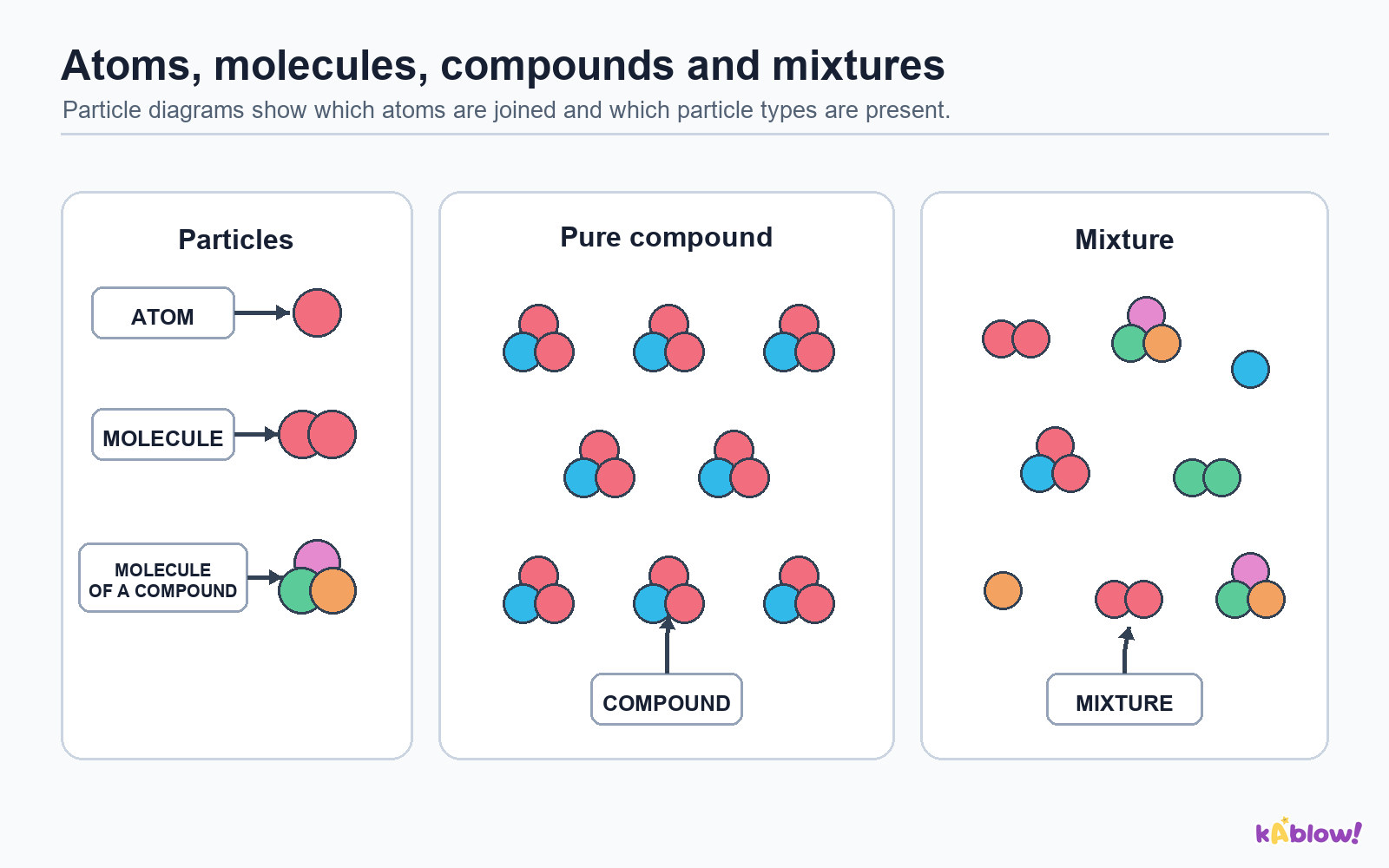
- Element: substance made of atoms with the same number of protons; cannot be split chemically.
- Compound: pure substance of two or more elements chemically combined; cannot be separated by physical means.
- Mixture: combination of substances not chemically combined; separable by physical methods (e.g., filtration).
- Examples: element = copper; compound = CO₂; mixture = sand and water.
Particle diagram showing elements, compounds and mixtures
Atomic Structure
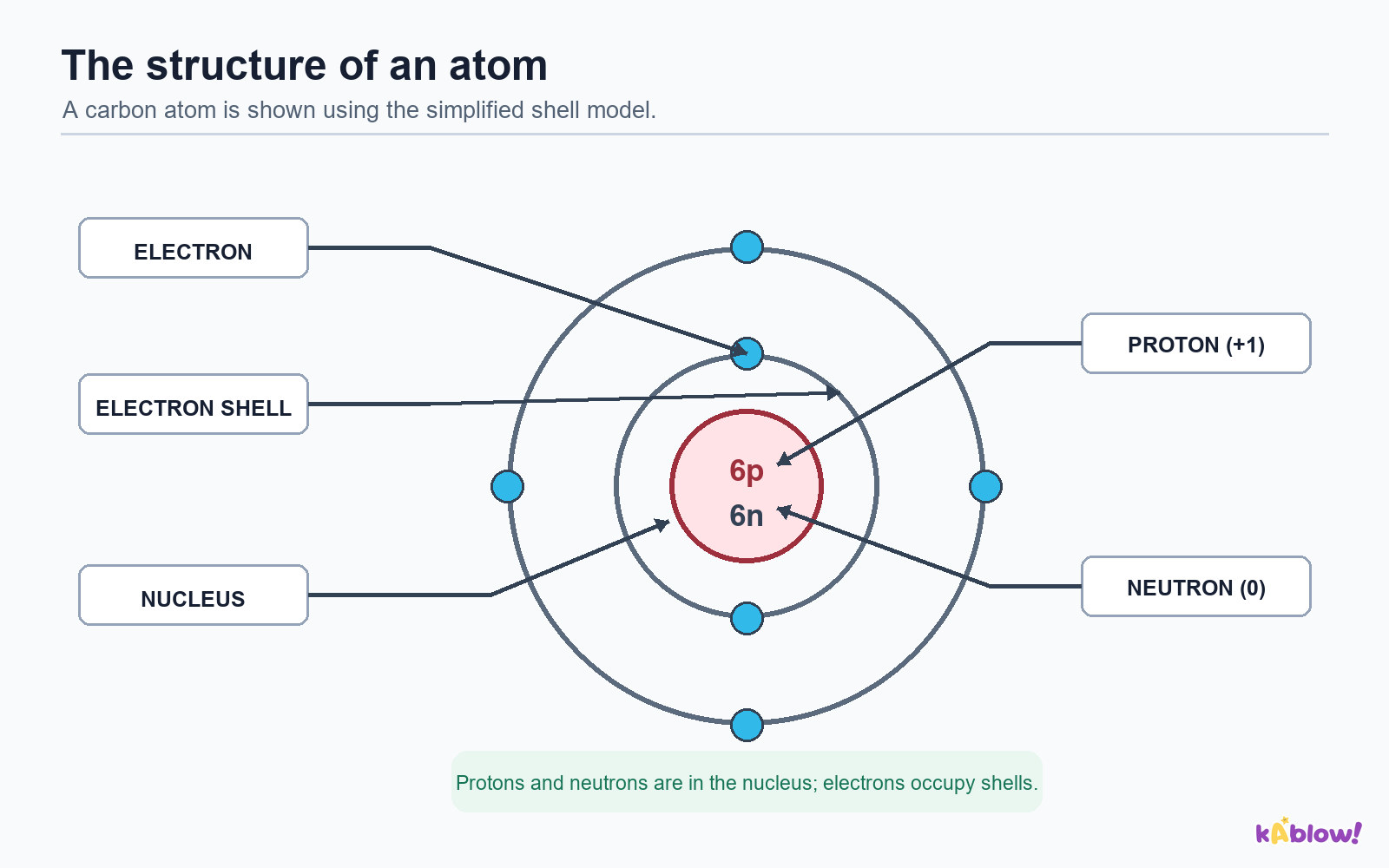
- Atoms consist of protons, neutrons (in nucleus) and electrons (in shells).
- Proton: relative mass 1, charge +1; Neutron: relative mass 1, charge 0; Electron: relative mass 1/1840, charge -1.
- Atomic number (Z) = number of protons; determines element and equals electrons in neutral atom.
- Mass number (A) = total protons + neutrons; also called nucleon number.
- Number of neutrons = mass number – atomic number.
The structure of the carbon atom
Electronic Configuration
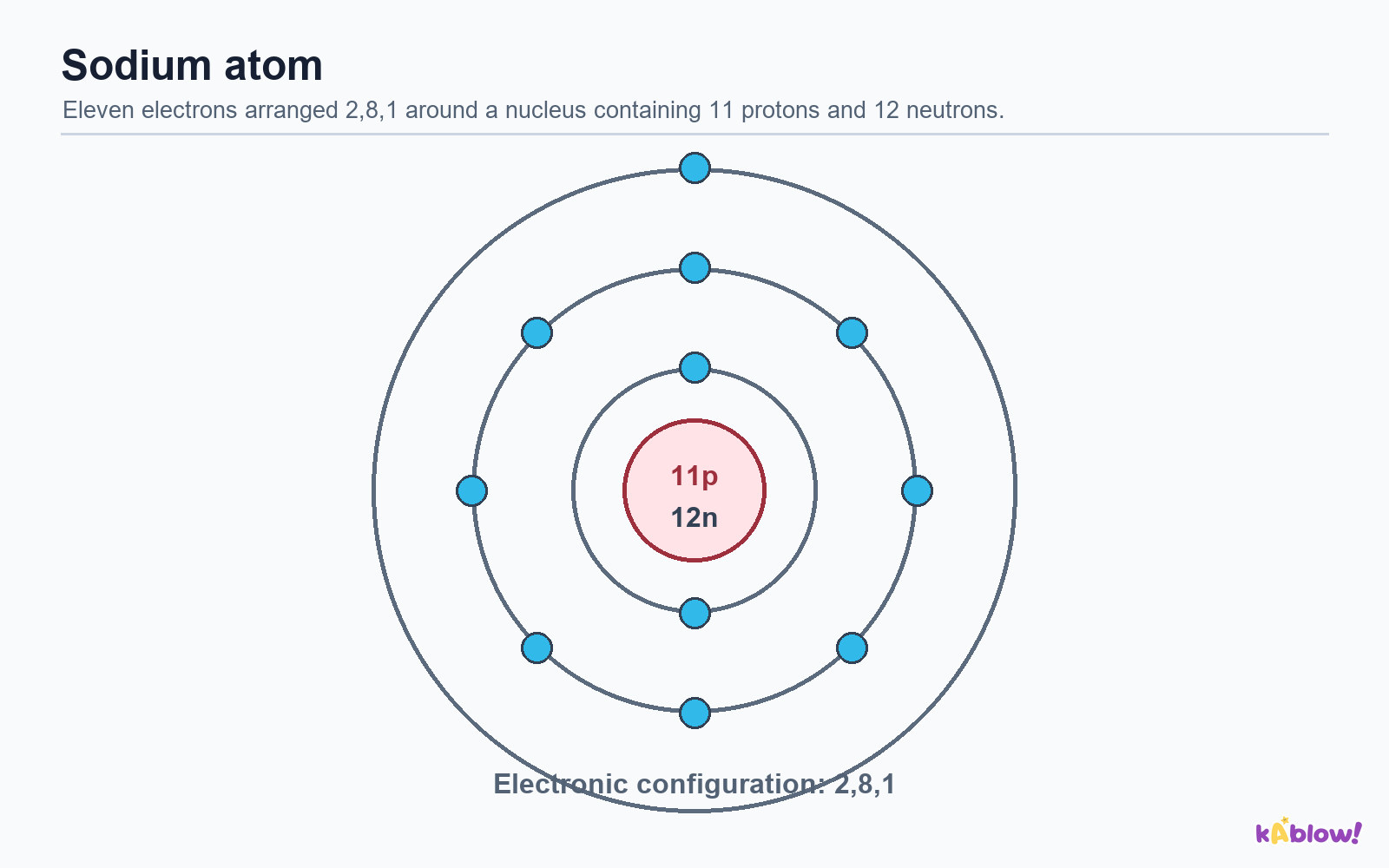
- Electrons occupy shells (energy levels); first shell holds 2, second 8, third 8 (simplified).
- Electronic configuration lists electrons per shell, e.g., carbon = 2,4.
- Outermost shell (valence shell) determines chemical properties; full outer shell = stable (noble gas).
- Number of occupied shells = Period number; number of outer electrons = Group number (for Groups I–VII).
- Ions: e.g., Na⁺ has configuration 2,8 (lost one electron).
Sodium atom: electron configuration 2,8,1
Isotopes
- Isotopes: same element, same number of protons, different number of neutrons.
- Isotopes have identical chemical properties (same outer electrons) but different physical properties (mass).
- Notation: e.g., carbon-14 or ¹⁴C.
Relative Atomic Mass
- Relative atomic mass (Aᵣ) = weighted average mass of all isotopes compared to 1/12 mass of carbon-12.
- Formula: Aᵣ = (Σ(% abundance × mass)) / 100.
- Example: rubidium: (72×85 + 28×87)/100 = 85.6.
Periodic Table & Groups
- Elements in same Group have same number of outer electrons and similar chemical properties.
- Noble gases (Group 0/VIII) have full outer shells and are unreactive.
- Group number for Groups I–VII equals number of outer electrons.
- Period number equals number of occupied electron shells.
Think like a scientist
- Use a teacher-provided dataset to compare the electron arrangements and properties of elements in a period.
- Comparison: the element being compared. Outcome: the electron arrangement and chemical properties.
- Control: compare atoms in their neutral state. Explain why this makes the comparison fairer.
- Evidence: Use a consistent method, repeated observations where appropriate and a table with labelled quantities and units. Keep unexpected results and investigate their cause.
- Safety: Practical activities need teacher supervision and an appropriate risk assessment. Use the provided data or simulation where the investigation specifies it.
- Inquiry task: State a testable question, predict the outcome using the science, then explain how your observations would support or challenge the prediction.
Evaluate the science
- Predicting chemical properties helps scientists choose materials.
- A simple shell model predicts many trends but does not describe the full behaviour of electrons.
- Evaluation task: Link your conclusion to evidence, identify a limitation and suggest a specific improvement. Distinguish a measured result from an explanation of its cause.
Slide
Sign up free to view the lesson slides
Step through every slide for this topic — plus flashcards and revision notes — with a free account.
Câu hỏi luyện tập
Xem trước miễn phí — 8 trên 45 câu hỏi. Đăng ký để xem tất cả.
1.Which option correctly describes the relative charges and masses of the subatomic particles?
Easy- AProton +1, neutron 0, electron -1; relative mass of proton 1, neutron 1, electron 0.00054
- BProton +1, neutron 0, electron -1; relative mass of proton 0.00054, neutron 1, electron 0
- CProton 0, neutron +1, electron -1; relative mass of proton 1, neutron 1, electron 0.00054
- DProton +1, neutron 0, electron 0; relative mass of proton 1, neutron 1, electron 0.00054
2.The atomic number of element Q is 9 and its mass number is 19. In which group of the Periodic Table should element Q be placed?
Easy- AGroup 0
- BGroup I
- CGroup VII
- DGroup II
3.Which two atoms are isotopes?
Easy- AQ and S
- BQ and T
- CR and T
- DR and S
4.Which of the following statements is correct?
Easy- AElements contain different atoms
- BCompounds consist of elements that are not chemically combined
- CMixtures consist of elements that are chemically combined
- DA mixture can contain elements and compounds
5.Which statement about carbon is correct?
Medium- AIt has 4 electron shells.
- BIt has 2 outer shell electrons.
- CIt has 12 nucleons.
- DIt has an electron configuration of 2,8,2.
6.Element X contains 12 of each sub-atomic particle. What is the correct Group number for element X?
Medium- AGroup 0
- BGroup I
- CGroup VII
- DGroup II
7.The X⁺ ion of element X has 16 electrons and a nucleon number of 37. What is the correct Group number for element X?
Hard- AVII
- BVIII
- CIII
- DI
8.Which row correctly describes the number of outer shell electrons and properties of isotopes?
Hard- ANumber of electrons: same; Chemical properties: same
- BNumber of electrons: same; Chemical properties: different
- CNumber of electrons: different; Chemical properties: same
- DNumber of electrons: different; Chemical properties: different
Unlock all 45 questions, flashcards & more
Tạo tài khoản miễn phí để xem mọi câu hỏi, slide, thẻ ghi nhớ và ghi chú ôn tập cho chủ đề này.