Organic formulae and functional groups
Học bằng cách chơi
Trả lời những câu hỏi này để kiếm năng lượng, rồi câu cá và khám phá. Không cần tài khoản.
Ghi chú bài học
Big idea: organic formulae and functional groups
- Key concept: Relationships. A functional group is the atom or group of atoms responsible for characteristic reactions. Homologous-series members share a functional group and show a pattern in their formulae.
- Related concepts: Models and evidence. Use a scientific explanation to make predictions, then test it against observations.
- Global context: Scientific and technical innovation. Functional groups guide the design and identification of useful organic compounds.
Organic Formulae
- Organic compounds contain carbon (except metal carbonates, CO₂, CO).
- Hydrocarbons contain only hydrogen and carbon atoms.
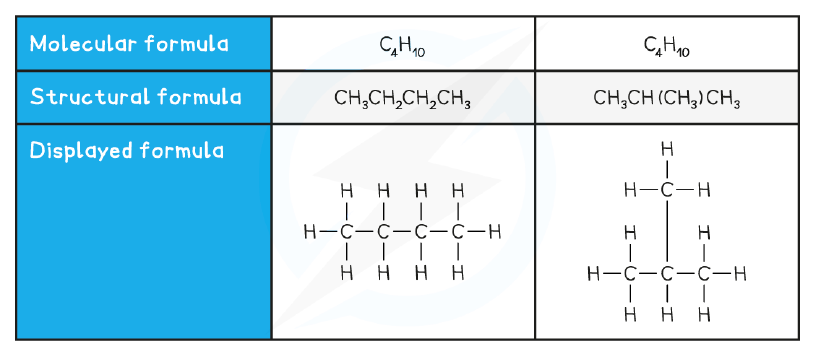
- Displayed formula shows the spatial arrangement of all atoms and bonds.
- Structural formula shows only important bonds (e.g., C=C); identical groups may be bracketed.
- Molecular formula gives the actual number of each atom in a compound.
- Structural isomers have the same molecular formula but different structural formulae (e.g., C₄H₁₀: butane and 2-methylpropane).
Structural isomers of C4H10
Homologous Series
- A homologous series is a family of organic compounds with the same functional group and similar chemical properties.
- The functional group is a specific arrangement of atoms responsible for characteristic reactions.
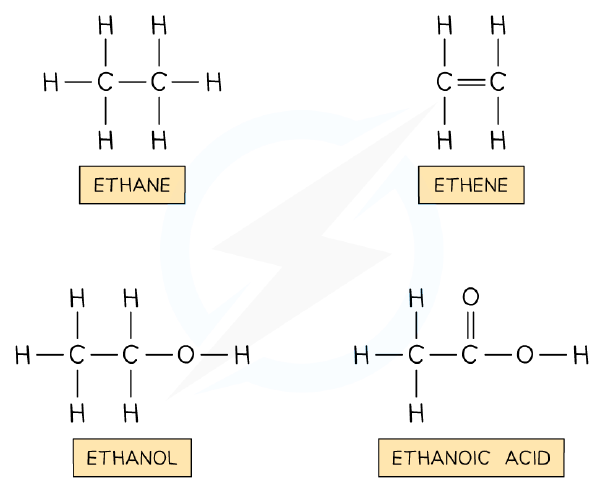
- Key functional groups: alkane (C–C), alkene (C=C), alcohol (–OH), carboxylic acid (–COOH), ester (–COO–).
- General formulae: alkane CₙH₂ₙ₊₂, alkene CₙH₂ₙ, alcohol CₙH₂ₙ₊₁OH, carboxylic acid CₙH₂ₙ₊₁COOH.
- Members differ by CH₂ and show a gradation in physical properties (e.g., boiling point increases with chain length).
- Example: ethanol (C₂H₅OH, b.p. 78°C) and propanol (C₃H₇OH, b.p. 97°C) are both alcohols with –OH group.
Displayed formulae of ethane, ethene, ethanol and ethanoic acid
Saturated & Unsaturated Compounds
- Saturated compounds have only single C–C bonds (e.g., alkanes).
- General formula for alkanes: CₙH₂ₙ₊₂; first three: methane (CH₄), ethane (C₂H₆), propane (C₃H₈).
- Unsaturated compounds contain at least one C=C double bond (e.g., alkenes).
- General formula for alkenes: CₙH₂ₙ; first three: ethene (C₂H₄), propene (C₃H₆), butene (C₄H₈).
- Mnemonic: Saturated = Single bonds; Unsaturated = doUble bonds.
Naming Organic Compounds
- Name consists of a stem (number of C atoms) and suffix (functional group).
- Stems: 1=meth, 2=eth, 3=prop, 4=but, 5=pent, 6=hex.
- Suffixes: -ane (alkane), -ene (alkene), -anol (alcohol), -anoic acid (carboxylic acid), -yl-anoate (ester).
- For positional isomers, number the carbon chain to locate the functional group (e.g., propan-1-ol, but-2-ene).
- For a simple monocarboxylic acid, number the chain from the carboxyl carbon, which is carbon 1.
- Ester names: the alcohol part (alkyl) comes first, then the carboxylic acid part (alkanoate) – e.g., methyl ethanoate from methanol + ethanoic acid.
Key Functional Groups Table
- Alkane: C–C, suffix -ane.
- Alkene: C=C, suffix -ene.
- Alcohol: –OH, suffix -anol.
- Carboxylic acid: –COOH, suffix -anoic acid.
- Ester: –COO–, suffix -yl-anoate.
Think like a scientist
- Classify a teacher-provided set of organic structures by functional group and compare their reaction patterns.
- Comparison: the functional group in each structure. Outcome: the assigned organic family and expected reaction type.
- Control: compare structures using the same naming rules. Explain why this makes the comparison fairer.
- Evidence: Use a consistent method, repeated observations where appropriate and a table with labelled quantities and units. Keep unexpected results and investigate their cause.
- Safety: Practical activities need teacher supervision and an appropriate risk assessment. Use the provided data or simulation where the investigation specifies it.
- Inquiry task: State a testable question, predict the outcome using the science, then explain how your observations would support or challenge the prediction.
Evaluate the science
- Functional groups guide the design and identification of useful organic compounds.
- A molecular formula can describe more than one structure, so it may not uniquely identify a compound.
- Evaluation task: Link your conclusion to evidence, identify a limitation and suggest a specific improvement. Distinguish a measured result from an explanation of its cause.
Slide
Sign up free to view the lesson slides
Step through every slide for this topic — plus flashcards and revision notes — with a free account.
Câu hỏi luyện tập
Xem trước miễn phí — 8 trên 52 câu hỏi. Đăng ký để xem tất cả.
1.Which of the following formulae shows an alkane?
Easy- AC2H4
- BC4H8
- CC4H10
- DC5H10
2.Which of the following is not a feature of a homologous series?
Easy- ACompounds have the same functional group
- BCompounds have the same physical properties
- CCompounds have the same general formula
- DCompounds have similar chemical properties
3.What is the general formula of the alkenes?
Easy- ACnH2n+2
- BCnH2n
- CCnH2n-2
- DCnH2n+1OH
4.What is the name of the compound with the formula CH3CH2CH2OH?
Easy- APropan-1-ol
- BPropan-2-ol
- CButan-1-ol
- DButan-2-ol
5.Which of the following structures shows a compound that belongs to a different homologous series to octane?
Medium- AA straight-chain hydrocarbon with all single bonds and 8 carbons
- BA hydrocarbon with 8 carbons and one double bond
- CA hydrocarbon with 8 carbons and all single bonds
- DA hydrocarbon with 8 carbons and only single bonds
6.Which of the following compounds is unsaturated?
Easy- AC2H6
- BC3H8
- CC2H4
- DCH4
7.What is the name of the compound with the structural formula CH3CH2CH2COOH?
Easy- AButanoic acid
- BPropanoic acid
- CButanol
- DButanone
8.Three statements about propane and propanol are listed below. 1. Propane and propanol belong to the same homologous series. 2. Propanol is a compound that contains three carbon atoms. 3. Propane is an unsaturated hydrocarbon. Which statements are correct?
Medium- A1 and 2 only
- B1 and 3 only
- C2 only
- D3 only
Unlock all 52 questions, flashcards & more
Tạo tài khoản miễn phí để xem mọi câu hỏi, slide, thẻ ghi nhớ và ghi chú ôn tập cho chủ đề này.