Air pollution, climate and evidence
Học bằng cách chơi
Trả lời những câu hỏi này để kiếm năng lượng, rồi câu cá và khám phá. Không cần tài khoản.
Ghi chú bài học
Big idea: air pollution, climate and evidence
- Key concept: Change. Combustion can produce greenhouse gases and air pollutants. Carbon dioxide contributes to warming through absorption and emission of infrared radiation; particulates affect air quality.
- Related concepts: Models and evidence. Use a scientific explanation to make predictions, then test it against observations.
- Global context: Scientific and technical innovation. Monitoring evidence informs decisions about transport and energy sources.
Composition of Air
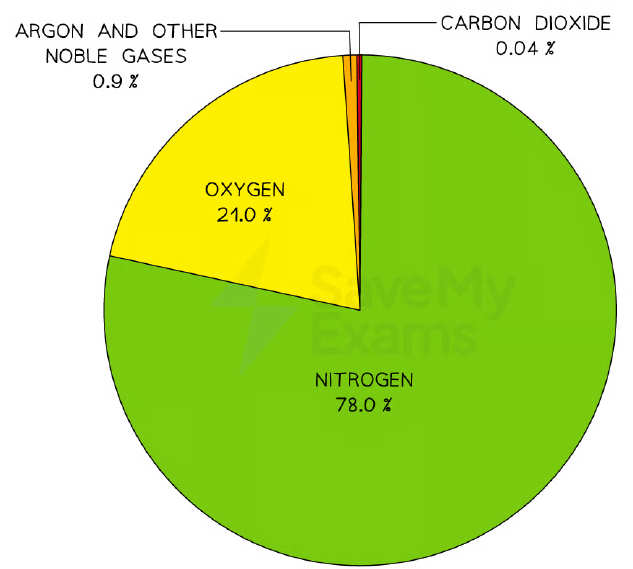
- Clean, dry air is approximately 78% nitrogen and 21% oxygen.
- The remaining 1% includes carbon dioxide and noble gases (e.g., argon).
- Atmospheric composition has changed over Earth's history; modern dry-air proportions are approximate and trace-gas concentrations vary.
Pie chart of the current atmosphere
Air Pollutants: Sources & Effects
- Carbon dioxide (CO₂): from complete combustion of fossil fuels; causes global warming.
- Carbon monoxide (CO): from incomplete combustion; toxic – binds to haemoglobin, preventing oxygen transport.
- Particulates (soot): from incomplete combustion; cause respiratory problems and cancer.
- Methane (CH₄): from animal digestion, decomposition, and landfill; a potent greenhouse gas.
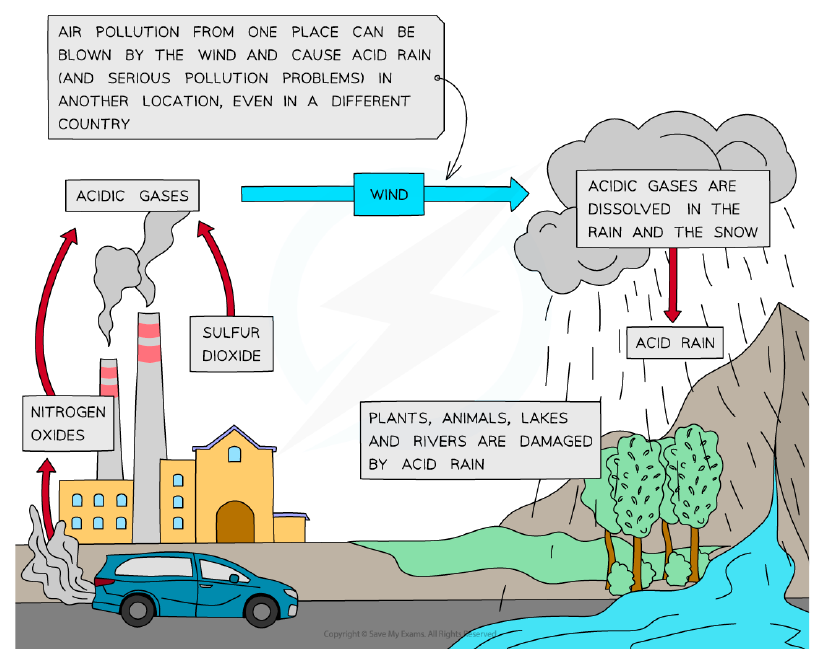
- Oxides of nitrogen (NOₓ): formed at high temperatures in car engines; cause acid rain and photochemical smog.
- Sulfur dioxide (SO₂): from burning sulfur-containing fossil fuels; causes acid rain.
How acid rain is produced
Complete vs Incomplete Combustion
- Complete combustion (excess O₂): produces CO₂ and H₂O only.
- Incomplete combustion (limited O₂): produces CO, H₂O, and sometimes carbon (soot).
- Example (complete): CH₄ + 2O₂ → CO₂ + 2H₂O.
- Example (incomplete): 2CH₄ + 3O₂ → 2CO + 4H₂O.
Greenhouse Effect & Global Warming
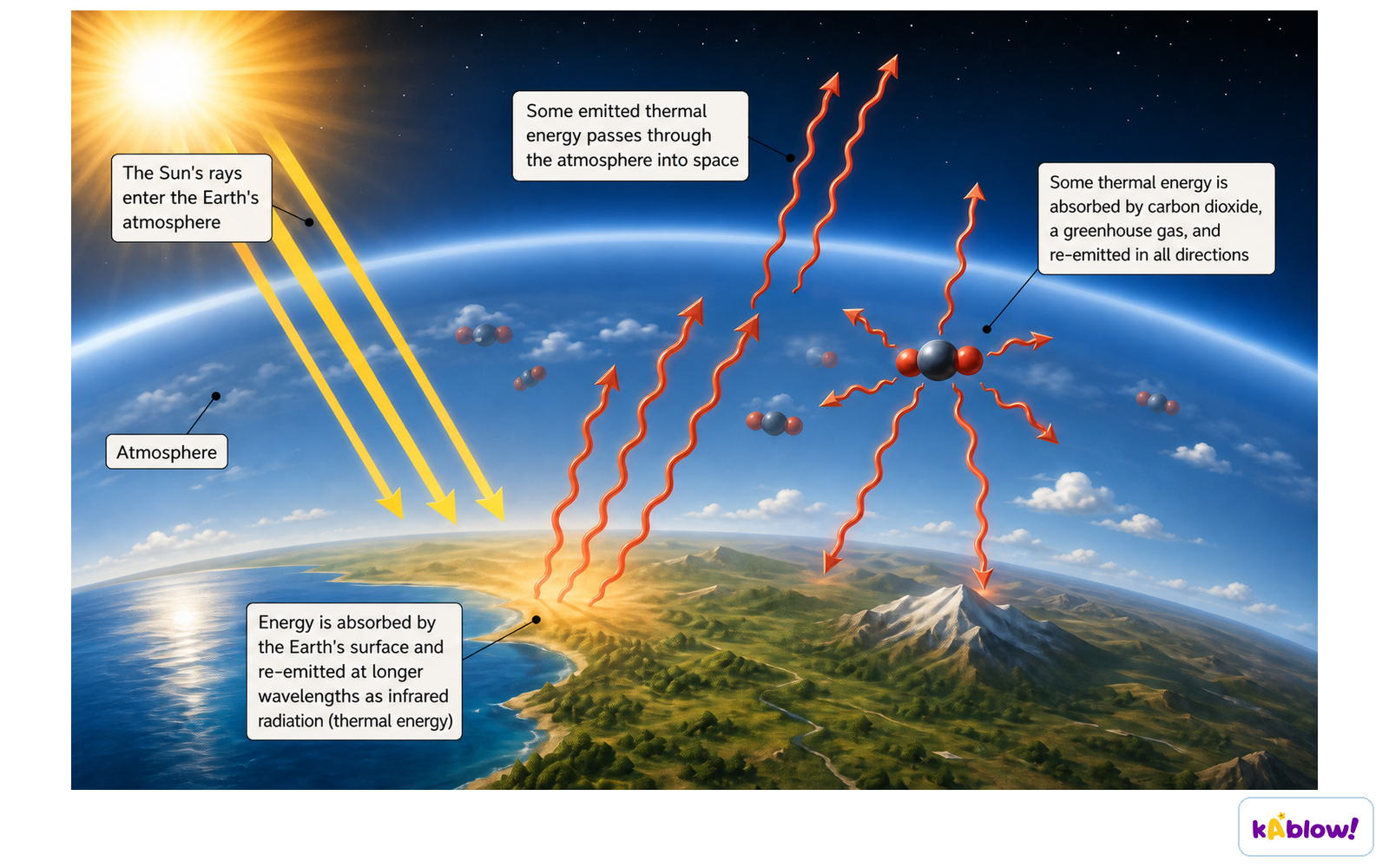
- The greenhouse effect is natural: greenhouse gases (CO₂, CH₄) trap thermal energy, keeping Earth warm.
- Enhanced greenhouse effect: increased greenhouse gas concentrations trap more heat, causing global warming.
- Consequences: climate change, rising sea levels (glacier melt), species extinction, habitat loss, disease spread.
Diagram showing how the greenhouse effect occurs
Reducing Climate Change
- Reduce CO₂ emissions: use renewable energy (solar, wind), fuel-efficient vehicles, public transport, recycling, and plant trees.
- Reduce methane emissions: reduce livestock farming (methane from digestion).
- Reduce deforestation and promote reforestation to absorb CO₂ via photosynthesis.
Reducing Acid Rain
- Acid rain is caused by SO₂ and NOₓ dissolving in rainwater.
- Use low-sulfur fuels to reduce SO₂ emissions.
- Flue gas desulfurisation: spray waste gases with lime slurry (CaO/CaCO₃) to remove 90–95% SO₂.
- Catalytic converters in vehicles remove NOₓ by reducing them to N₂.
Catalytic Converters
- Contain platinum and rhodium catalysts in a honeycomb to increase surface area.
- Oxidise CO to CO₂: 2CO + O₂ → 2CO₂.
- Reduce NOₓ to N₂: 2NO → N₂ + O₂; 2NO₂ → N₂ + 2O₂.
- Overall reaction: 2NO + 2CO → N₂ + 2CO₂.
- Unburned hydrocarbons are oxidised to CO₂ and H₂O.
Photosynthesis
- Endothermic reaction using light energy absorbed by chlorophyll.
- Reactants: carbon dioxide + water → Products: glucose + oxygen.
- Word equation: carbon dioxide + water → glucose + oxygen.
- Symbol equation: 6CO₂ + 6H₂O → C₆H₁₂O₆ + 6O₂.
- Conditions: light and chlorophyll.
Think like a scientist
- Use an existing monitoring dataset to compare particulate concentrations at two sites over the same dates.
- Comparison: the monitoring site. Outcome: particulate concentration in micrograms per cubic metre.
- Control: compare the same sampling periods and instrument method. Explain why this makes the comparison fairer.
- Evidence: Use a consistent method, repeated observations where appropriate and a table with labelled quantities and units. Keep unexpected results and investigate their cause.
- Safety: Practical activities need teacher supervision and an appropriate risk assessment. Use the provided data or simulation where the investigation specifies it.
- Inquiry task: State a testable question, predict the outcome using the science, then explain how your observations would support or challenge the prediction.
Evaluate the science
- Monitoring evidence informs decisions about transport and energy sources.
- A difference between sites does not alone identify its cause; traffic, weather and instrument placement may differ.
- Evaluation task: Link your conclusion to evidence, identify a limitation and suggest a specific improvement. Distinguish a measured result from an explanation of its cause.
Slide
Sign up free to view the lesson slides
Step through every slide for this topic — plus flashcards and revision notes — with a free account.
Câu hỏi luyện tập
Xem trước miễn phí — 8 trên 52 câu hỏi. Đăng ký để xem tất cả.
1.What is the approximate percentage of nitrogen in clean, dry air?
Easy- A78%
- B21%
- C50%
- D1%
2.Which gas is produced by the complete combustion of methane?
Easy- ACarbon dioxide
- BCarbon monoxide
- CSulfur dioxide
- DNitrogen dioxide
3.Which of the following is a greenhouse gas?
Easy- AMethane
- BOxygen
- CNitrogen
- DArgon
4.What is the main cause of acid rain?
Easy- AOxides of nitrogen and sulfur dioxide
- BCarbon dioxide and methane
- CCarbon monoxide and particulates
- DOzone and water vapor
5.In a catalytic converter, what is the function of the honeycomb structure?
Easy- ATo increase the surface area for catalytic reactions
- BTo filter out particulates
- CTo cool the exhaust gases
- DTo store unburnt fuel
6.Which of the following is a product of photosynthesis?
Easy- AGlucose
- BCarbon dioxide
- CWater
- DChlorophyll
7.Which process produces carbon monoxide?
Easy- AIncomplete combustion of fuels
- BComplete combustion of fuels
- CPhotosynthesis
- DRespiration
8.What is the main strategy to reduce sulfur dioxide emissions from power stations?
Easy- AFlue gas desulfurisation
- BUsing catalytic converters
- CPlanting more trees
- DReducing livestock farming
Unlock all 52 questions, flashcards & more
Tạo tài khoản miễn phí để xem mọi câu hỏi, slide, thẻ ghi nhớ và ghi chú ôn tập cho chủ đề này.