Industrial electrolysis and electroplating
Học bằng cách chơi
Trả lời những câu hỏi này để kiếm năng lượng, rồi câu cá và khám phá. Không cần tài khoản.
Ghi chú bài học
Big idea: industrial electrolysis and electroplating
- Key concept: Systems. Metal ions gain electrons at the cathode to form a coating. The electrode arrangement and electrolyte must suit the metal being deposited.
- Related concepts: Models and evidence. Use a scientific explanation to make predictions, then test it against observations.
- Global context: Scientific and technical innovation. Electroplating improves appearance or resistance to corrosion using a thin metal coating.
What is Electroplating?
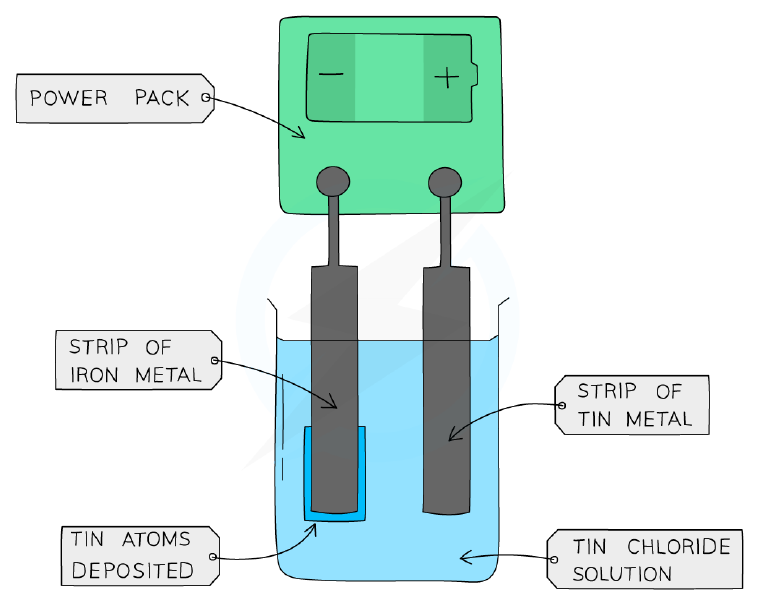
- Electroplating coats the surface of one metal with a layer of a different metal using electrolysis.
- The cathode (negative electrode) is the object to be plated.
- The anode (positive electrode) is made of the pure metal that will be plated onto the object.
- The electrolyte is an aqueous solution of a soluble salt of the anode metal (e.g., tin(II) chloride for tin plating).
- At the anode: metal atoms lose electrons (oxidation) and go into solution as ions.
- At the cathode: metal ions gain electrons (reduction) and deposit as metal atoms on the object.
- Example half-equations for tin plating: Anode: Sn(s) → Sn²⁺(aq) + 2e⁻; Cathode: Sn²⁺(aq) + 2e⁻ → Sn(s).
Uses of Electroplating
- To improve appearance – e.g., silver-plating cutlery and jewellery.
- To increase resistance to corrosion – e.g., chromium and nickel plating, galvanising (zinc coating on iron/steel).
- To reduce wear or provide a harder surface.
Electroplating Setup
- The object to be plated must be very clean and free of grease to ensure good adhesion.
- The anode must be the same metal as the plating layer (e.g., silver anode for silver plating).
- The electrolyte must contain ions of the plating metal (e.g., silver nitrate for silver plating).
- The power supply provides direct current; the object is connected to the negative terminal.
Electroplating a strip of iron with tin
Hydrogen Fuel Cells – Basics
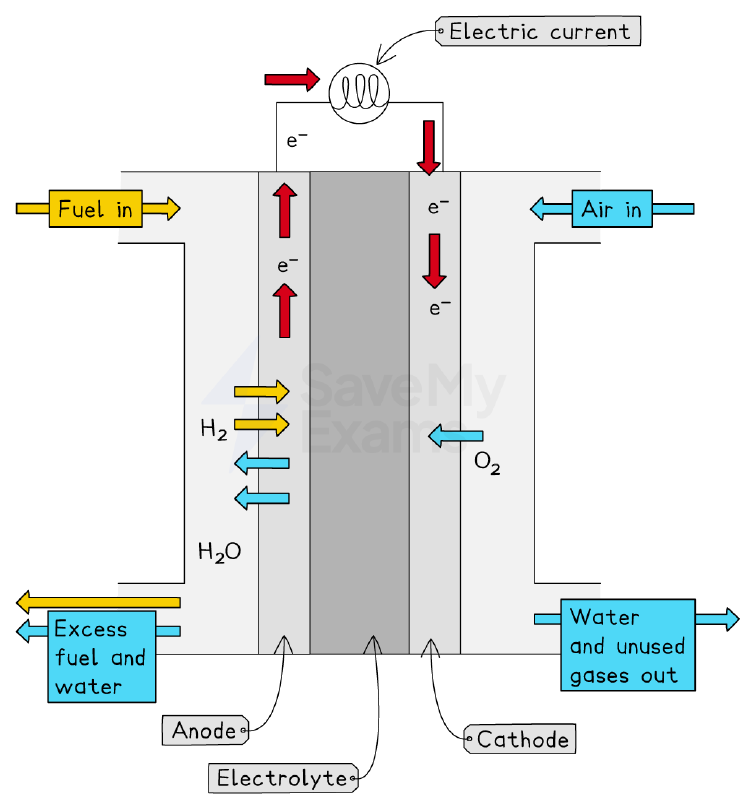
- A fuel cell is an electrochemical cell that converts chemical energy from a fuel into electricity.
- In a hydrogen-oxygen fuel cell, hydrogen is the fuel and oxygen is the oxidant.
- The only product is water; no pollutants are produced.
- Overall reaction: 2H₂ + O₂ → 2H₂O (hydrogen + oxygen → water).
- At the anode: H₂ → 2H⁺ + 2e⁻ (oxidation of hydrogen).
- At the cathode: O₂ + 4H⁺ + 4e⁻ → 2H₂O (reduction of oxygen).
- The electrolyte (e.g., potassium hydroxide solution) allows ion flow between electrodes.
Hydrogen-oxygen fuel cell
Advantages of Hydrogen Fuel Cells
- No pollutants – only water is produced, unlike petrol engines which emit CO₂, NOₓ, and CO.
- High efficiency – more energy per kilogram than petrol or diesel.
- Renewable – hydrogen can be produced by electrolysis of water using renewable electricity.
Disadvantages of Hydrogen Fuel Cells
- Hydrogen production – most hydrogen currently comes from fossil fuels (releases CO₂); electrolysis requires large amounts of electricity.
- Storage and safety – hydrogen is highly flammable and requires high-pressure tanks, making storage difficult and expensive.
- Cost and infrastructure – fuel cell materials are expensive; very few hydrogen filling stations exist.
Think like a scientist
- Use teacher-provided electroplating data to compare deposited metal masses at different plating times with the same current.
- Comparison: the electroplating time. Outcome: the mass of metal deposited.
- Control: keep the current and electrolyte composition constant. Explain why this makes the comparison fairer.
- Evidence: Use a consistent method, repeated observations where appropriate and a table with labelled quantities and units. Keep unexpected results and investigate their cause.
- Safety: Practical activities need teacher supervision and an appropriate risk assessment. Use the provided data or simulation where the investigation specifies it.
- Inquiry task: State a testable question, predict the outcome using the science, then explain how your observations would support or challenge the prediction.
Evaluate the science
- Electroplating improves appearance or resistance to corrosion using a thin metal coating.
- A coating's benefit must be weighed against electrical energy use and the treatment of chemical waste.
- Evaluation task: Link your conclusion to evidence, identify a limitation and suggest a specific improvement. Distinguish a measured result from an explanation of its cause.
Slide
Sign up free to view the lesson slides
Step through every slide for this topic — plus flashcards and revision notes — with a free account.
Câu hỏi luyện tập
Xem trước miễn phí — 8 trên 52 câu hỏi. Đăng ký để xem tất cả.
1.What is electroplating?
Easy- ACoating the surface of one metal with a layer of a different metal
- BExtracting metals from their ores using electricity
- CBreaking down a compound using heat
- DA method of sacrificial protection
2.In electroplating, the object to be plated is connected to which electrode?
Easy- AThe negative electrode (cathode)
- BThe positive electrode (anode)
- CThe electrolyte
- DThe power supply
3.What is the product of the reaction in a hydrogen fuel cell?
Easy- AWater
- BHydrogen peroxide
- COxygen
- DCarbon dioxide
4.Which half-equation represents the reaction at the cathode when electroplating an iron spoon with silver?
Medium- AAg⁺ + e⁻ → Ag
- BAg → Ag⁺ + e⁻
- CFe²⁺ + 2e⁻ → Fe
- DFe → Fe²⁺ + 2e⁻
5.Which substance is used as the electrolyte when electroplating an iron spoon with copper?
Easy- AAqueous copper nitrate
- BAqueous iron nitrate
- CCopper rod
- DIron rod
6.In a hydrogen fuel cell, what happens to hydrogen at the anode?
Medium- AHydrogen is oxidised to form H⁺ ions and electrons
- BHydrogen is reduced to form H⁻ ions
- CHydrogen combines with oxygen to form water
- DHydrogen is produced from water
7.Which of the following is a disadvantage of using hydrogen fuel cells in cars?
Easy- AHydrogen is difficult to store safely
- BThe only product is water
- CFuel cells are very quiet
- DHydrogen is a renewable fuel
8.Why does the concentration of metal ions in the electrolyte remain constant during electroplating?
Medium- AMetal ions are removed at the cathode and replenished at the anode at the same rate
- BThe electrolyte is continuously stirred
- CMetal ions are neither produced nor consumed
- DThe power supply is alternating current
Unlock all 52 questions, flashcards & more
Tạo tài khoản miễn phí để xem mọi câu hỏi, slide, thẻ ghi nhớ và ghi chú ôn tập cho chủ đề này.