Quantitative chemistry and the mole
Học bằng cách chơi
Trả lời những câu hỏi này để kiếm năng lượng, rồi câu cá và khám phá. Không cần tài khoản.
Ghi chú bài học
Big idea: quantitative chemistry and the mole
- Key concept: Relationships. Amount of substance equals mass divided by molar mass. Equation coefficients give mole ratios, which connect reactant and product amounts.
- Related concepts: Models and evidence. Use a scientific explanation to make predictions, then test it against observations.
- Global context: Scientific and technical innovation. Stoichiometry helps predict required reactant masses and theoretical yields.
The Mole & Avogadro Constant
- The mole (mol) is the SI unit for amount of substance.
- One mole contains 6.02 × 10²³ particles (atoms, molecules, or ions) – the Avogadro constant.
- One mole of sodium (Na) contains 6.02 × 10²³ Na atoms; one mole of H₂ contains 6.02 × 10²³ H₂ molecules.
- Molar mass of an element = relative atomic mass in grams; for a compound = relative formula mass in grams.
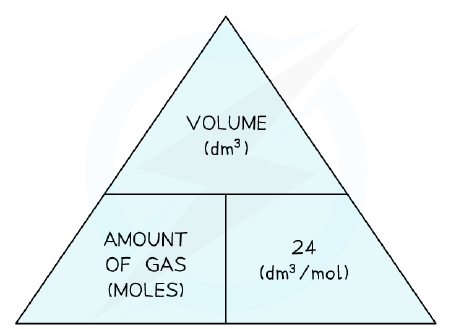
- At RTP (20 °C, 1 atm), one mole of any gas occupies 24 dm³ (or 24 000 cm³) – the molar gas volume.
- Gas volume (dm³) = moles × 24; moles = volume (dm³) ÷ 24.
Molar gas volume formula triangle
Linking Moles, Mass & Mr
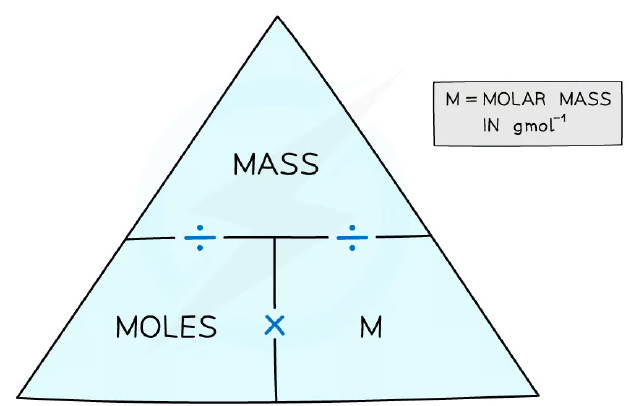
- Moles = mass (g) ÷ Mᵣ (or Aᵣ for elements).
- Mass = moles × Mᵣ.
- Example: 0.250 mol Zn (Aᵣ=65) has mass = 0.250 × 65 = 16.25 g.
- Example: 2.64 g sucrose (Mᵣ=342) gives moles = 2.64 ÷ 342 = 7.72 × 10⁻³ mol.
- Use the formula triangle: cover the quantity you want to find.
Moles, mass and molar mass formula triangle
Reacting Masses & Limiting Reactants
- Use balanced equation to find molar ratio between reactants and products.
- Convert given mass to moles, then use ratio to find moles of required substance, then convert back to mass.
- Limiting reactant is the one used up first; it determines the amount of product.
- To identify limiting reactant: calculate moles of each reactant, compare with the molar ratio from the equation.
- Example: 2Mg + O₂ → 2MgO; 6.0 g Mg (0.25 mol) gives 0.25 mol MgO (mass = 10 g).
Calculating Concentration
- Concentration in g/dm³ = mass of solute (g) ÷ volume (dm³).
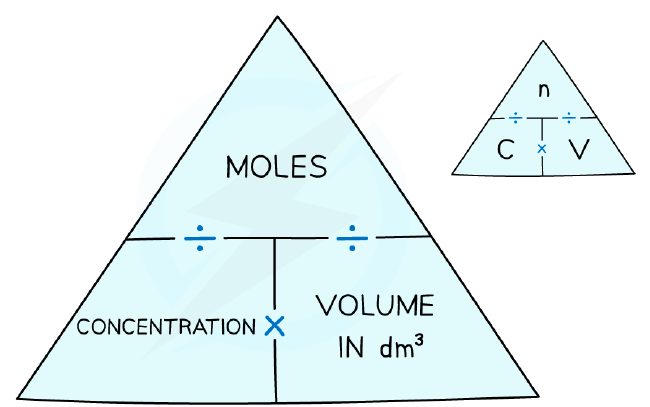
- Concentration in mol/dm³ = moles of solute ÷ volume (dm³).
- To convert g/dm³ to mol/dm³, divide by molar mass; to convert mol/dm³ to g/dm³, multiply by molar mass.
- Always convert cm³ to dm³ by dividing by 1000.
- Example: 10 g NaOH in 2 dm³ gives 5 g/dm³.
Concentration, moles and volume formula triangle
Titration Calculations
- Use the balanced equation to find the mole ratio between acid and base.
- Calculate moles of known solution: moles = concentration × volume (dm³).
- Use ratio to find moles of unknown, then concentration = moles ÷ volume (dm³).
- Example: 25.0 cm³ HCl titrated with 12.1 cm³ 0.100 mol/dm³ NaOH (1:1 ratio) gives [HCl] = 0.0484 mol/dm³.
Empirical & Molecular Formula
- Empirical formula is the simplest whole‑number ratio of atoms in a compound.
- To find empirical formula: divide each element's mass (or % mass) by its Aᵣ, then divide by the smallest result to get a ratio; multiply to get whole numbers if needed.
- Molecular formula = (empirical formula)ₙ, where n = Mᵣ(compound) ÷ Mᵣ(empirical formula).
- Example: empirical formula CH₂O (Mᵣ=30); if Mᵣ=60, n=2, so molecular formula = C₂H₄O₂.
- Water of crystallisation: use similar method to find x in hydrated salt formula (e.g., CuSO₄·xH₂O).
Percentage Yield & Purity
- Percentage yield = (actual yield ÷ theoretical yield) × 100%.
- Actual yield is the mass obtained; theoretical yield is calculated from the balanced equation.
- Percentage purity = (mass of pure substance ÷ total mass of sample) × 100%.
- Percentage composition by mass = (total mass of element in compound ÷ Mᵣ of compound) × 100%.
- Example: Fe₂O₃ (Mᵣ=160) contains 112 g Fe → %Fe = (112÷160)×100 = 70%.
Think like a scientist
- Use measured mass data to compare amounts of substance for samples of different compounds.
- Comparison: the compound being considered. Outcome: the amount of substance in moles.
- Control: use the same specified sample mass. Explain why this makes the comparison fairer.
- Evidence: Use a consistent method, repeated observations where appropriate and a table with labelled quantities and units. Keep unexpected results and investigate their cause.
- Safety: Practical activities need teacher supervision and an appropriate risk assessment. Use the provided data or simulation where the investigation specifies it.
- Inquiry task: State a testable question, predict the outcome using the science, then explain how your observations would support or challenge the prediction.
Evaluate the science
- Stoichiometry helps predict required reactant masses and theoretical yields.
- Theoretical yield assumes the specified reaction and limiting reactant; incomplete reaction and losses reduce practical yield.
- Evaluation task: Link your conclusion to evidence, identify a limitation and suggest a specific improvement. Distinguish a measured result from an explanation of its cause.
Slide
Sign up free to view the lesson slides
Step through every slide for this topic — plus flashcards and revision notes — with a free account.
Câu hỏi luyện tập
Xem trước miễn phí — 8 trên 52 câu hỏi. Đăng ký để xem tất cả.
1.Which row correctly describes the mole and the value of Avogadro's constant?
Easy- Aone mole of a substance is equal to the substance's relative atomic or molecular mass in grams; one mole of a substance contains 6.02 × 10²³ atoms, molecules or formula units
- Bone mole of a substance is equal to the substance's atomic number in grams; one mole of a substance contains 6.02 × 10²³ atoms, molecules or formula units
- Cone mole of a substance is equal to the substance's relative atomic or molecular mass in grams; one mole of a substance contains 12.04 × 10²³ atoms, molecules or formula units
- Done mole of a substance is equal to the substance's atomic number in grams; one mole of a substance contains 12.04 × 10²³ atoms, molecules or formula units
2.What is the mass of one mole of carbon dioxide (CO₂)? (Ar: C = 12, O = 16)
Easy- A28 g
- B44 g
- C32 g
- D12 g
3.How many molecules are there in one mole of hydrogen gas (H₂)?
Easy- A6.02 × 1023 molecules
- B1.204 × 1024 molecules
- C3.01 × 1023 molecules
- D12.04 × 1023 molecules
4.The complete combustion of methane produces carbon dioxide and steam. CH₄(g) + 2O₂(g) → 2H₂O(g) + CO₂(g). Which statements about the reaction are correct? 1. The empirical formula of methane is CH₄ 2. The number of atoms in 1 mole of methane is 4 × Avogadro's constant 3. 1 mole of methane produces 72 dm³ of gaseous products at r.t.p. 4. 1 mole of methane occupies a volume of 12 dm³ at r.t.p.
Medium- A1, 2 and 3
- B1 and 2
- C1 and 3
- D2 and 4
5.Magnesium carbonate and hydrochloric acid react: MgCO₃(s) + 2HCl(aq) → MgCl₂(aq) + H₂O(l) + CO₂(g). What is the volume of CO₂ produced when 21 g of magnesium carbonate (Mr = 84) reacts completely with excess hydrochloric acid? (One mole of gas occupies 24.0 dm³ at r.t.p.)
Medium- A4 dm³
- B8 dm³
- C6 dm³
- D2 dm³
6.Calcium carbonate undergoes thermal decomposition: CaCO₃ → CaO + CO₂. What mass of calcium oxide (Mr = 56) is formed when 60 g of calcium carbonate (Mr = 100) is completely decomposed?
Medium- A28 g
- B18.5 g
- C60 g
- D33.6 g
7.Substance X was analysed and found to contain 40.00% carbon, 6.67% hydrogen and 53.33% oxygen by mass. What is the empirical formula of X?
Medium- AC₄H₈O₄
- BC₆H₁₂O₈
- CC₂H₄O₂
- DCH₂O
8.What is the concentration in mol dm⁻³ of a solution of sodium hydroxide that contains 16 g of NaOH in 200 cm³ of distilled water? (Mr NaOH = 40)
Medium- A2 mol dm⁻³
- B2.5 mol cm⁻³
- C0.2 mol dm⁻³
- D1 mol cm⁻³
Unlock all 52 questions, flashcards & more
Tạo tài khoản miễn phí để xem mọi câu hỏi, slide, thẻ ghi nhớ và ghi chú ôn tập cho chủ đề này.