Acceleration and motion graphs
Học bằng cách chơi
Trả lời những câu hỏi này để kiếm năng lượng, rồi câu cá và khám phá. Không cần tài khoản.
Ghi chú bài học
Big idea: acceleration and motion graphs
- Key concept: Relationships. Acceleration is change in velocity divided by time. The gradient of a velocity-time graph gives acceleration and the area beneath it gives displacement.
- Related concepts: Models and evidence. Use a scientific explanation to make predictions, then test it against observations.
- Global context: Scientific and technical innovation. Motion models help analyse transport and stopping distances.
Speed & Velocity
- Speed = distance travelled per unit time; a scalar quantity (magnitude only).
- Equation: v = \frac{s}{t}, where v in m/s, s in m, t in s.
- Average speed = total distance / total time; useful when speed varies.
- Velocity = speed in a given direction; a vector quantity (magnitude and direction).
- Velocity uses displacement (vector) instead of distance.
- Same speed but different directions → different velocities.
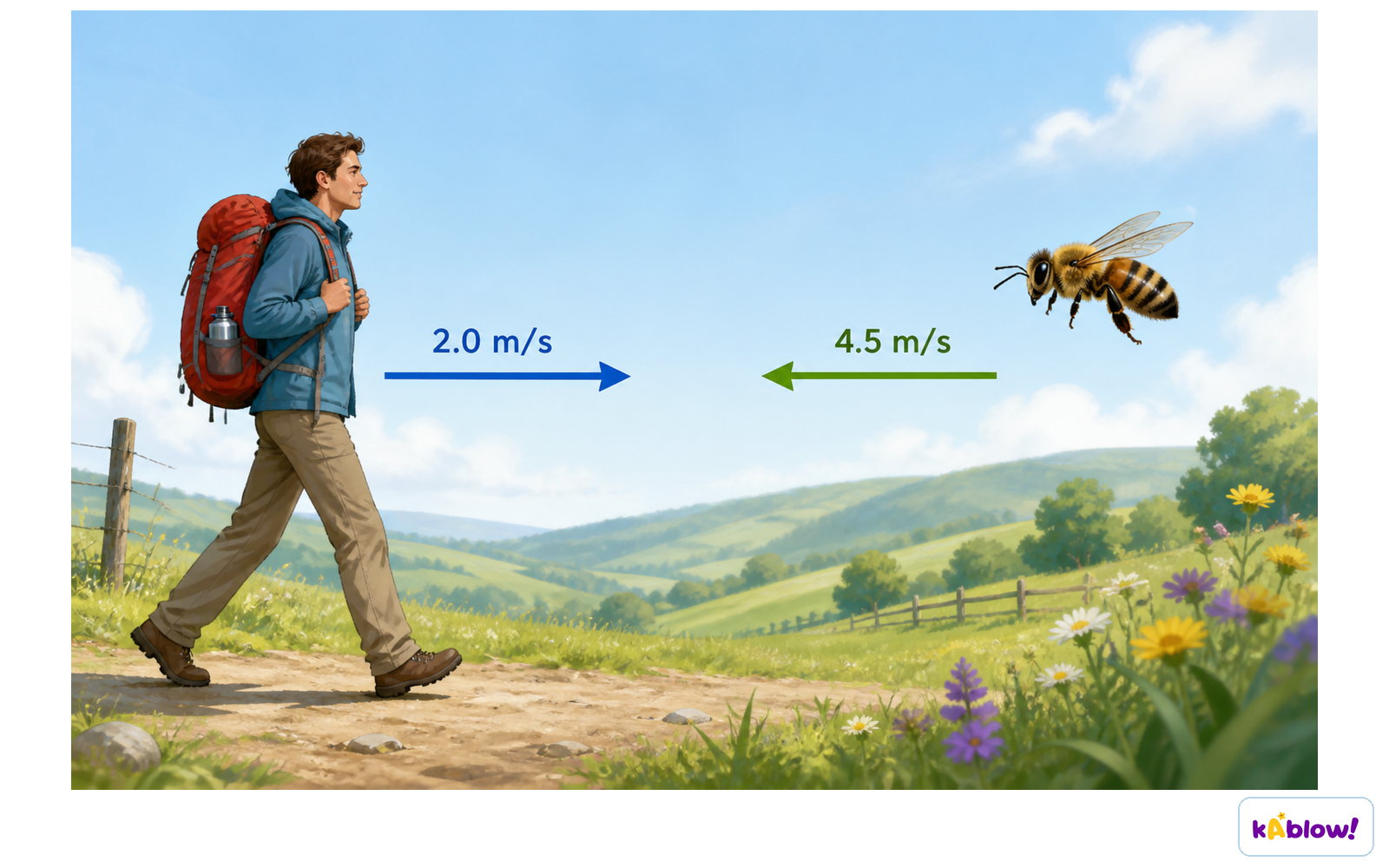
A person walking at 2.0 m/s and a bee flying at 4.5 m/s, illustrating speed.
Acceleration
- Acceleration = rate of change of velocity; a = \frac{\Delta v}{\Delta t}, units m/s².
- Change in velocity: \Delta v = v - u (final minus initial).
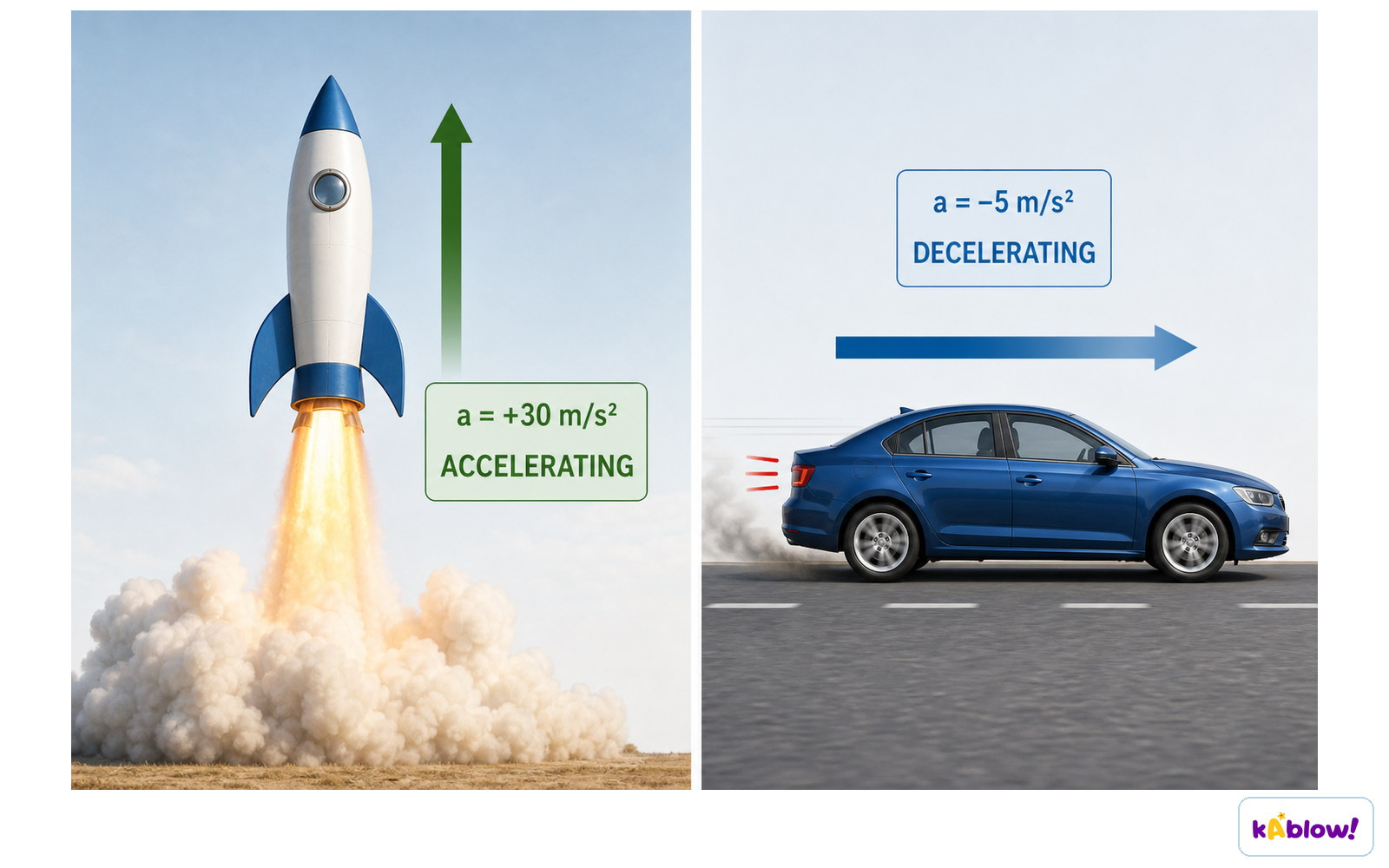
- Positive acceleration = speeding up; negative acceleration (deceleration) = slowing down.
- Any change in velocity (speed up, slow down, change direction) is acceleration.
- Formula triangle: cover the quantity to find; a = \frac{\Delta v}{\Delta t}, \Delta v = a \times \Delta t, \Delta t = \frac{\Delta v}{a}.
Examples of positive and negative acceleration
Distance-Time Graphs
- Distance-time graph: straight line = constant speed; horizontal line = stationary.
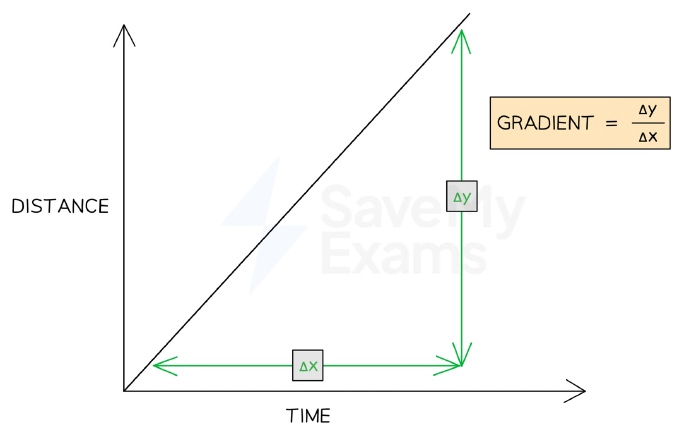
- Gradient = speed; steeper slope = faster speed.
- Curved line = changing speed (acceleration/deceleration); increasing gradient = speeding up, decreasing = slowing down.
- To calculate speed: draw a large gradient triangle, find \frac{\Delta y}{\Delta x}.
- Always check units (e.g., km → m, min → s).
The gradient of a distance-time graph, found from the change in distance (Δy) over the change in time (Δx), gives the speed.
Speed-Time Graphs
- Speed-time graph: straight line = constant acceleration; horizontal line = constant speed (zero acceleration).
- Gradient = acceleration; positive gradient = acceleration, negative = deceleration.
- Area under graph = distance travelled.
- Split area into triangles and rectangles: triangle area = \frac{1}{2}bh, rectangle area = bh.
- Total distance = sum of all areas under the line.
Calculating Acceleration from Speed-Time Graphs
- For constant acceleration: gradient = \frac{\Delta v}{\Delta t} using a straight line.
- For changing acceleration: draw a tangent at the point; gradient of tangent = instantaneous acceleration.
- A tangent is a straight line that just touches the curve at that point.
- Use a large gradient triangle on the tangent to calculate \frac{\Delta y}{\Delta x}.
Freefall
- In absence of air resistance, all objects fall with same acceleration: g = 9.8 \, \text{m/s}2 (acceleration of freefall).
- Weight W = mg, where g is gravitational field strength (N/kg).
- With air resistance: forces are weight (down) and air resistance (up).
- Air resistance increases with speed; when it equals weight, resultant force = 0 → terminal velocity.
- Skydiver: initially accelerates, then air resistance increases, eventually reaches terminal velocity; deploying parachute increases air resistance → deceleration to a lower terminal velocity.
- In a vacuum (no air resistance), objects never reach terminal velocity; they accelerate at g continuously.
Think like a scientist
- Measure a toy trolley's speed at different times as it moves down a low ramp.
- Comparison: the elapsed time after release. Outcome: the trolley's speed in metres per second.
- Control: use the same ramp angle and release point. Explain why this makes the comparison fairer.
- Evidence: Use a consistent method, repeated observations where appropriate and a table with labelled quantities and units. Keep unexpected results and investigate their cause.
- Safety: Practical activities need teacher supervision and an appropriate risk assessment. Use the provided data or simulation where the investigation specifies it.
- Inquiry task: State a testable question, predict the outcome using the science, then explain how your observations would support or challenge the prediction.
Evaluate the science
- Motion models help analyse transport and stopping distances.
- A straight graph fitted to a few points may hide changing acceleration; collect enough readings to test the model.
- Evaluation task: Link your conclusion to evidence, identify a limitation and suggest a specific improvement. Distinguish a measured result from an explanation of its cause.
Slide
Sign up free to view the lesson slides
Step through every slide for this topic — plus flashcards and revision notes — with a free account.
Câu hỏi luyện tập
Xem trước miễn phí — 8 trên 52 câu hỏi. Đăng ký để xem tất cả.
1.Which of the following is a scalar quantity?
Easy- Avelocity
- Bdisplacement
- Cacceleration
- Dspeed
2.What is the acceleration of free fall near Earth's surface?
Easy- A9.8 m/s
- B9.8 m/s²
- C9.8 m/s² downward
- D9.8 N/kg
3.On a distance-time graph, a horizontal line indicates that the object is:
Easy- Aaccelerating
- Bmoving at constant speed
- Cstationary
- Ddecelerating
4.Which of the following is the correct definition of velocity?
Easy- ADistance travelled per unit time
- BSpeed in a given direction
- CChange in displacement per unit time
- DRate of change of speed
5.The area under a speed-time graph represents:
Easy- Aacceleration
- Bvelocity
- Cdistance travelled
- Ddeceleration
6.An object accelerates from 4 m/s to 10 m/s in 3 s. What is its acceleration?
Medium- A2 m/s²
- B3 m/s²
- C4 m/s²
- D6 m/s²
7.On a speed-time graph, a straight line with negative gradient represents:
Easy- Aconstant acceleration
- Bconstant deceleration
- Cconstant speed
- Dincreasing acceleration
8.A skydiver falls from a plane. After reaching terminal velocity, the parachute opens. Which statement is correct?
Medium- AThe skydiver immediately stops falling.
- BThe skydiver accelerates upward.
- CThe skydiver decelerates to a lower terminal velocity.
- DThe skydiver continues at the same terminal velocity.
Unlock all 52 questions, flashcards & more
Tạo tài khoản miễn phí để xem mọi câu hỏi, slide, thẻ ghi nhớ và ghi chú ôn tập cho chủ đề này.