Momentum and collision evidence
Học bằng cách chơi
Trả lời những câu hỏi này để kiếm năng lượng, rồi câu cá và khám phá. Không cần tài khoản.
Ghi chú bài học
Big idea: momentum and collision evidence
- Key concept: Systems. Momentum equals mass times velocity and includes direction. Total momentum is conserved in a system with no resultant external force.
- Related concepts: Models and evidence. Use a scientific explanation to make predictions, then test it against observations.
- Global context: Scientific and technical innovation. Longer stopping times reduce average collision force for a given momentum change.
Momentum
- Momentum = mass × velocity; p = mv
- Units: kg m/s (mass in kg, velocity in m/s)
- An object at rest (v = 0) has zero momentum
- Momentum is a vector quantity – direction matters; can be positive or negative
- Large momentum makes it difficult to change an object's direction
Conservation of Momentum
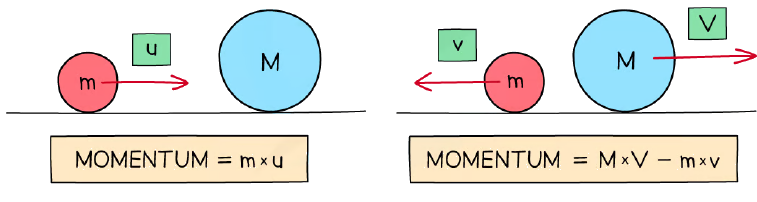
- In a closed system (no external forces), total momentum before an event equals total momentum after
- Total momentum before = Total momentum after
- Total momentum is conserved in a system with no resultant external force.
- For objects moving in opposite directions, momenta cancel (vector sum)
Conservation of momentum in a collision between two objects
Impulse
- Impulse = force × time for which it acts; impulse = FΔt
- Units: N s (newton seconds)
- Impulse equals change in momentum: FΔt = Δp = mv – mu
- Impulse is a vector – direction same as change in momentum
Force and Momentum
- Newton's second law in terms of momentum: F = Δp / Δt
- Force = rate of change of momentum (change in momentum per unit time)
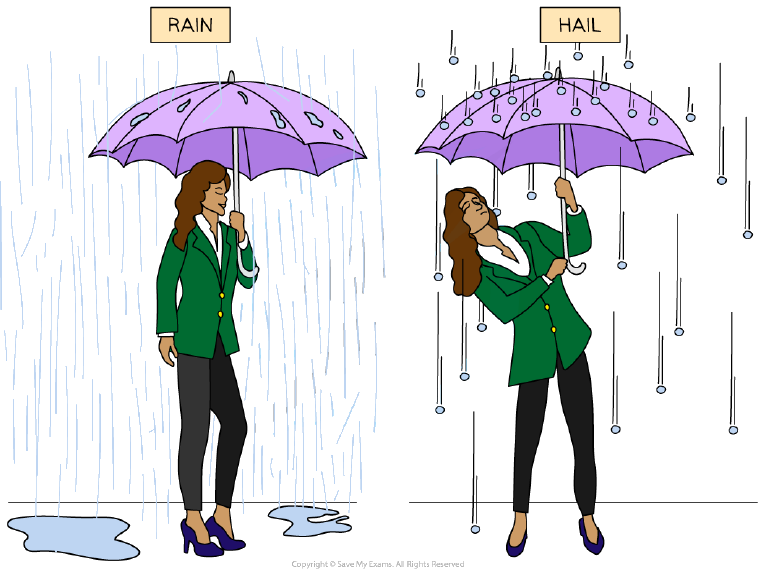
- A larger force or shorter contact time gives a larger change in momentum
A person holding an umbrella in rain versus hail, illustrating the difference in force and momentum change.
Worked Examples
- Example 1: Tennis ball (0.06 kg) at 75 m/s has p = 4.5 kg m/s; brick (3 kg) at 1.5 m/s has same momentum
- Example 2: Car (990 kg, 10 m/s) hits stationary van (4200 kg); after collision car moves at 2 m/s, van velocity = 1.9 m/s (conservation)
- Example 3: Tennis ball (58 g) from 30 m/s left to 20 m/s right; impulse = –2.9 N s (to the right)
- Example 4: Same Δp = 0.5 kg m/s; shorter contact time (0.1 s) gives larger force (5 N) than longer time (2 s gives 0.25 N)
Think like a scientist
- Use a teacher-approved simulation to compare two-cart collisions with different initial speeds.
- Comparison: the first cart's initial velocity. Outcome: the total momentum before and after collision.
- Control: keep both cart masses constant. Explain why this makes the comparison fairer.
- Evidence: Use a consistent method, repeated observations where appropriate and a table with labelled quantities and units. Keep unexpected results and investigate their cause.
- Safety: Practical activities need teacher supervision and an appropriate risk assessment. Use the provided data or simulation where the investigation specifies it.
- Inquiry task: State a testable question, predict the outcome using the science, then explain how your observations would support or challenge the prediction.
Evaluate the science
- Longer stopping times reduce average collision force for a given momentum change.
- Momentum conservation does not imply conservation of kinetic energy; some collisions transfer kinetic energy to other stores.
- Evaluation task: Link your conclusion to evidence, identify a limitation and suggest a specific improvement. Distinguish a measured result from an explanation of its cause.
Slide
Sign up free to view the lesson slides
Step through every slide for this topic — plus flashcards and revision notes — with a free account.
Câu hỏi luyện tập
Xem trước miễn phí — 8 trên 52 câu hỏi. Đăng ký để xem tất cả.
1.What is the equation for momentum?
Easy- Amomentum = mass × velocity
- Bmomentum = mass × acceleration
- Cmomentum = force × time
- Dmomentum = mass × speed
2.What are the units of momentum?
Easy- Akg m/s
- Bkg m/s²
- CN s
- DN/m
3.What is the momentum of an object at rest?
Easy- A0 kg m/s
- B1 kg m/s
- CIts mass in kg m/s
- DCannot be determined
4.A 5.0 kg ball is moving at 10 m/s. What is its momentum?
Easy- A50 kg m/s
- B0.5 kg m/s
- C15 kg m/s
- D5 kg m/s
5.A 0.025 kg squash ball hits a wall at 44 m/s and rebounds at 42 m/s. What is the change in momentum? (Take initial direction as positive.)
Medium- A-2.15 kg m/s
- B2.15 kg m/s
- C0.05 kg m/s
- D-0.05 kg m/s
6.What is the impulse on an object equal to?
Easy- AThe change in momentum of the object
- BThe force multiplied by the distance moved
- CThe mass multiplied by the acceleration
- DThe velocity multiplied by the time
7.A 0.046 kg golf ball is hit, leaving the club at 65 m/s. The contact time is 5.0 × 10⁻⁴ s. What is the average force on the ball?
Medium- A5980 N
- B2990 N
- C598 N
- D0.598 N
8.Which word best completes the sentence: 'Momentum is a property of a moving object making it difficult for it to change its ______.'
Easy- Adirection
- Bmass
- Cspeed
- Dweight
Unlock all 52 questions, flashcards & more
Tạo tài khoản miễn phí để xem mọi câu hỏi, slide, thẻ ghi nhớ và ghi chú ôn tập cho chủ đề này.