Refraction, lenses and optical evidence
Học bằng cách chơi
Trả lời những câu hỏi này để kiếm năng lượng, rồi câu cá và khám phá. Không cần tài khoản.
Ghi chú bài học
Big idea: refraction, lenses and optical evidence
- Key concept: Systems. Light changes speed when it crosses into another medium. At oblique incidence this changes direction; lenses use refraction to form images.
- Related concepts: Models and evidence. Use a scientific explanation to make predictions, then test it against observations.
- Global context: Scientific and technical innovation. Lenses are used in cameras and instruments to form useful images.
Reflection of Light
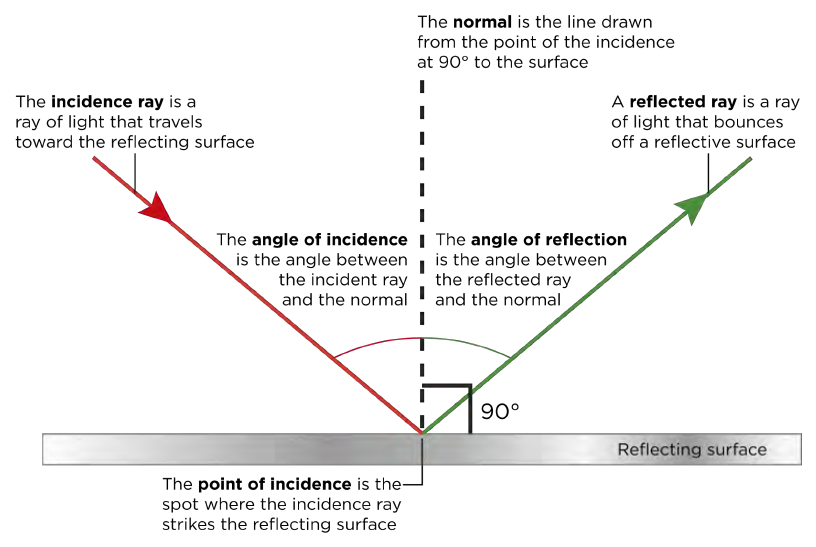
- A normal is drawn at right angles to the boundary between two media.
- Angles are measured between the ray and the normal: angle of incidence (i) and angle of reflection (r).
- Law of reflection: angle of incidence = angle of reflection (i = r).
- In a plane mirror, the image is virtual, same size, same distance behind the mirror as the object is in front, and laterally inverted.
- Ray diagrams show incident and reflected rays with arrows indicating direction.
Reflection of light
Investigating Reflection
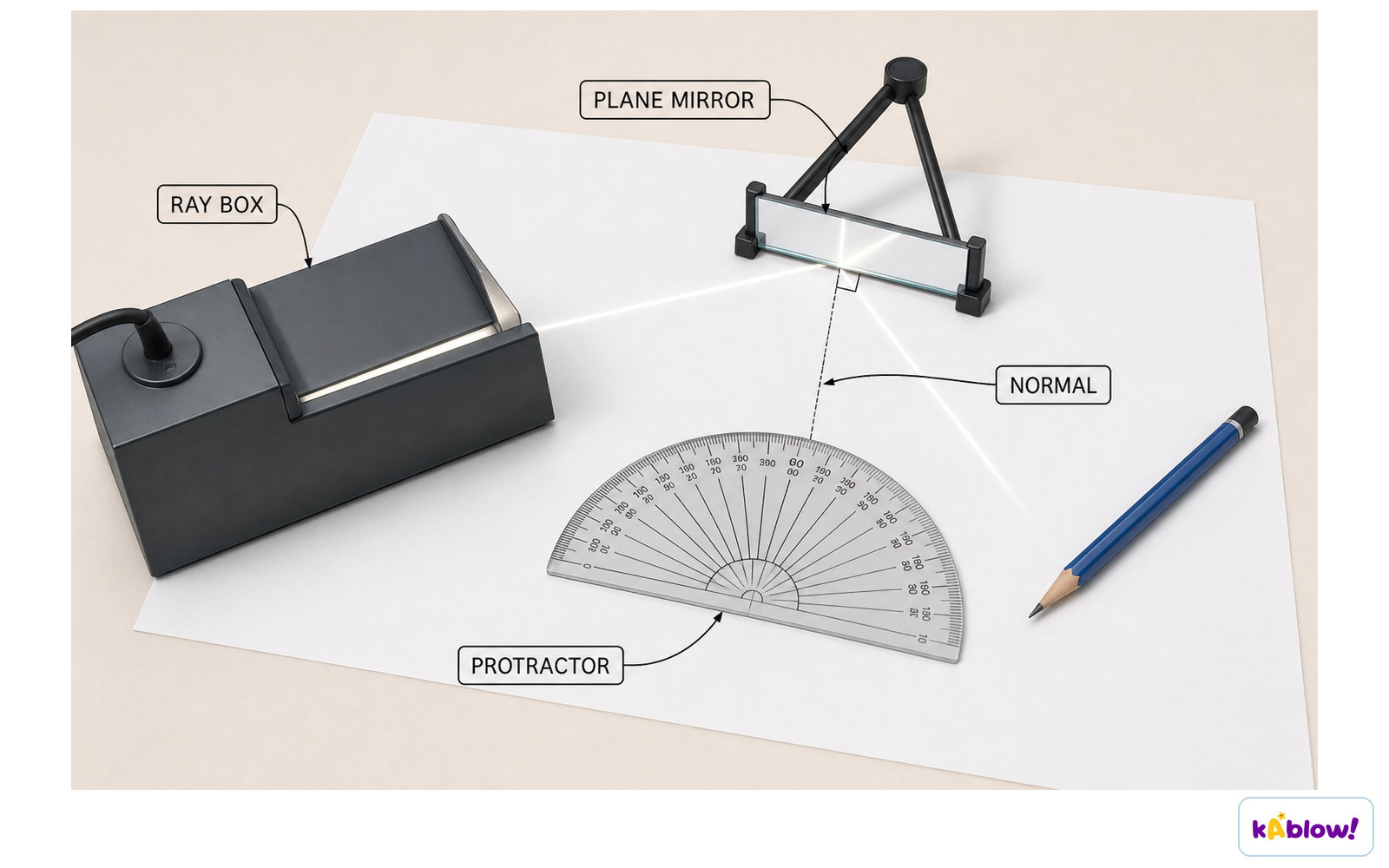
- Aim: To investigate reflection by a plane mirror.
- Independent variable: angle of incidence; dependent variable: angle of reflection.
- Use a ray box, protractor, paper, pencil, ruler, and plane mirror.
- Mark incident and reflected ray positions, then measure angles with a protractor.
- Repeat for different angles of incidence to verify i = r.
Apparatus for investigating the reflection of light
Refraction of Light
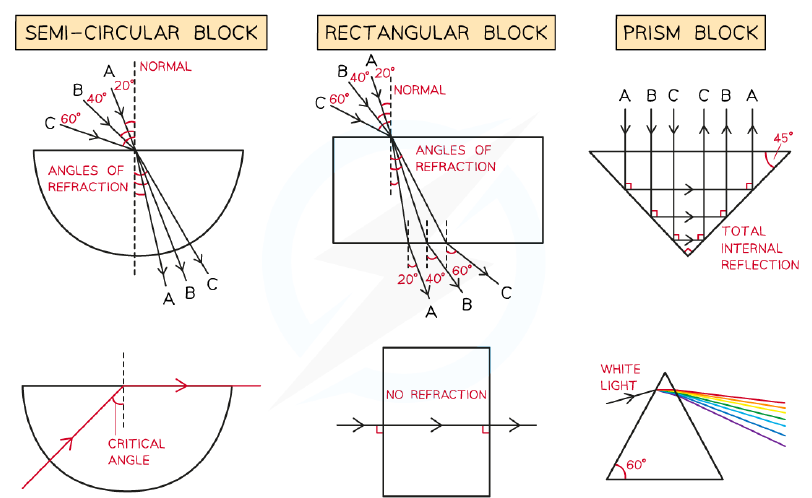
- Refraction occurs when light passes between two transparent media of different optical density.
- From less dense to more dense (e.g., air to glass): light bends towards the normal.
- From more dense to less dense (e.g., glass to air): light bends away from the normal.
- If light travels along the normal, it does not bend.
- Frequency remains constant; speed and wavelength change.
Refraction of light through different shapes of perspex blocks (semi-circular, rectangular, prism)
Refractive Index
- Refractive index n = speed of light in vacuum / speed of light in material.
- Also n = sin i / sin r (Snell's law).
- Refractive index has no unit. For the ordinary transparent materials studied here, such as glass and water, it is greater than 1 relative to a vacuum.
- Higher n means more optically dense (e.g., diamond n ≈ 2.4, glass n ≈ 1.5).
Total Internal Reflection
- Total internal reflection (TIR) occurs when light travels from a denser to a less dense medium and the angle of incidence exceeds the critical angle (c).
- Critical angle: angle of incidence for which angle of refraction = 90°.
- Relationship: sin c = 1/n.
- Higher n gives smaller critical angle.
- Uses: optical fibres (communications, endoscopes), prisms in periscopes, binoculars.
Ray Diagrams for Lenses
- Converging (convex) lens: brings parallel rays to a focus at the principal focus (f).
- Diverging (concave) lens: makes parallel rays diverge; virtual focus on same side as incoming light.
- Focal length: distance from lens centre to principal focus.
- Three key rays: through optical centre (undeviated), parallel to axis (through focus), through focus (emerges parallel).
Real & Virtual Images
- Real image: formed where rays converge and can be projected on a screen. A single converging lens forms an inverted real image of a real object outside its focal length.
- Virtual image: rays appear to diverge from its position; it cannot be projected directly on a screen. The single-lens examples studied here produce upright virtual images of real objects.
- Converging lens can produce real or virtual images depending on object position.
- Diverging lens always produces a virtual, upright, diminished image.
Correcting Sight & Dispersion
- Long-sightedness: image forms behind retina; corrected with converging (convex) lens.
- Short-sightedness: image forms in front of retina; corrected with diverging (concave) lens.
- Dispersion: white light splits into colours when refracted by a prism; violet bends most, red least.
- Visible spectrum: red, orange, yellow, green, blue, indigo, violet (longest to shortest wavelength).
- Monochromatic light: single frequency/colour (e.g., laser).
Think like a scientist
- Use a school ray box to compare angles of incidence and refraction as light enters a glass block; never direct it towards eyes.
- Comparison: the angle of incidence. Outcome: the angle of refraction measured from the normal.
- Control: use the same glass block and light source. Explain why this makes the comparison fairer.
- Evidence: Use a consistent method, repeated observations where appropriate and a table with labelled quantities and units. Keep unexpected results and investigate their cause.
- Safety: Practical activities need teacher supervision and an appropriate risk assessment. Use the provided data or simulation where the investigation specifies it.
- Inquiry task: State a testable question, predict the outcome using the science, then explain how your observations would support or challenge the prediction.
Evaluate the science
- Lenses are used in cameras and instruments to form useful images.
- The ray model predicts paths but does not describe every wave effect or correct for all lens distortions.
- Evaluation task: Link your conclusion to evidence, identify a limitation and suggest a specific improvement. Distinguish a measured result from an explanation of its cause.
Slide
Sign up free to view the lesson slides
Step through every slide for this topic — plus flashcards and revision notes — with a free account.
Câu hỏi luyện tập
Xem trước miễn phí — 8 trên 50 câu hỏi. Đăng ký để xem tất cả.
1.What is the law of reflection?
Easy- AAngle of incidence equals angle of reflection
- BAngle of incidence equals angle of refraction
- CAngle of reflection is twice the angle of incidence
- DAngle of incidence is greater than angle of reflection
2.Which type of image cannot be projected onto a screen?
Easy- AReal image
- BVirtual image
- CInverted image
- DMagnified image
3.When light passes from air into glass, it bends towards the normal. What happens to the speed of light?
Easy- AIt increases
- BIt decreases
- CIt stays the same
- DIt becomes zero
4.A ray of light enters a glass block of refractive index 1.5 at an angle of incidence of 30°. What is the angle of refraction? (sin 30° = 0.5)
Medium- A19.5°
- B30°
- C45°
- D9.7°
5.What is the critical angle for a material with refractive index 1.5?
Medium- A41.8°
- B25°
- C90°
- D30°
6.Which of the following is a condition for total internal reflection to occur?
Easy- ALight travels from a less dense to a more dense medium
- BThe angle of incidence is less than the critical angle
- CLight travels from a more dense to a less dense medium and the angle of incidence is greater than the critical angle
- DThe angle of incidence equals the angle of refraction
7.A student measures the angle of incidence as 40° and the angle of refraction as 25°. What is the refractive index of the medium? (sin 40° = 0.643, sin 25° = 0.423)
Medium- A1.52
- B0.66
- C1.0
- D2.0
8.Which colour of light is refracted the most when white light passes through a prism?
Easy- ARed
- BGreen
- CBlue
- DViolet
Unlock all 50 questions, flashcards & more
Tạo tài khoản miễn phí để xem mọi câu hỏi, slide, thẻ ghi nhớ và ghi chú ôn tập cho chủ đề này.