Thermal transfer and insulation
Học bằng cách chơi
Trả lời những câu hỏi này để kiếm năng lượng, rồi câu cá và khám phá. Không cần tài khoản.
Ghi chú bài học
Big idea: thermal transfer and insulation
- Key concept: Change. Thermal energy transfers by conduction, convection and radiation. Insulation reduces particular transfer pathways rather than stopping all transfer.
- Related concepts: Models and evidence. Use a scientific explanation to make predictions, then test it against observations.
- Global context: Scientific and technical innovation. Insulation can reduce energy demand in buildings.
Demonstrating Conduction
- Good thermal conductors (e.g., aluminium, copper) transfer heat easily; insulators (e.g., wool, cardboard) transfer heat poorly.
- Tiles feel colder than a rug at the same temperature because tiles conduct heat away from the foot faster.
- In the wood–metal rod experiment, paper over metal stays unburnt because metal conducts heat away; paper over wood chars because wood insulates.
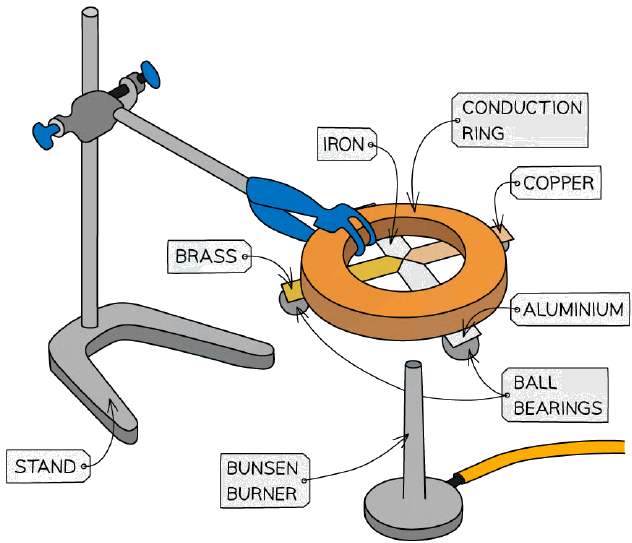
- Relative conductivity of metals can be compared by timing when wax melts and ball bearings drop from metal strips heated at a common centre.
Apparatus for demonstrating conduction with a conduction ring and Bunsen burner
Thermal Conduction
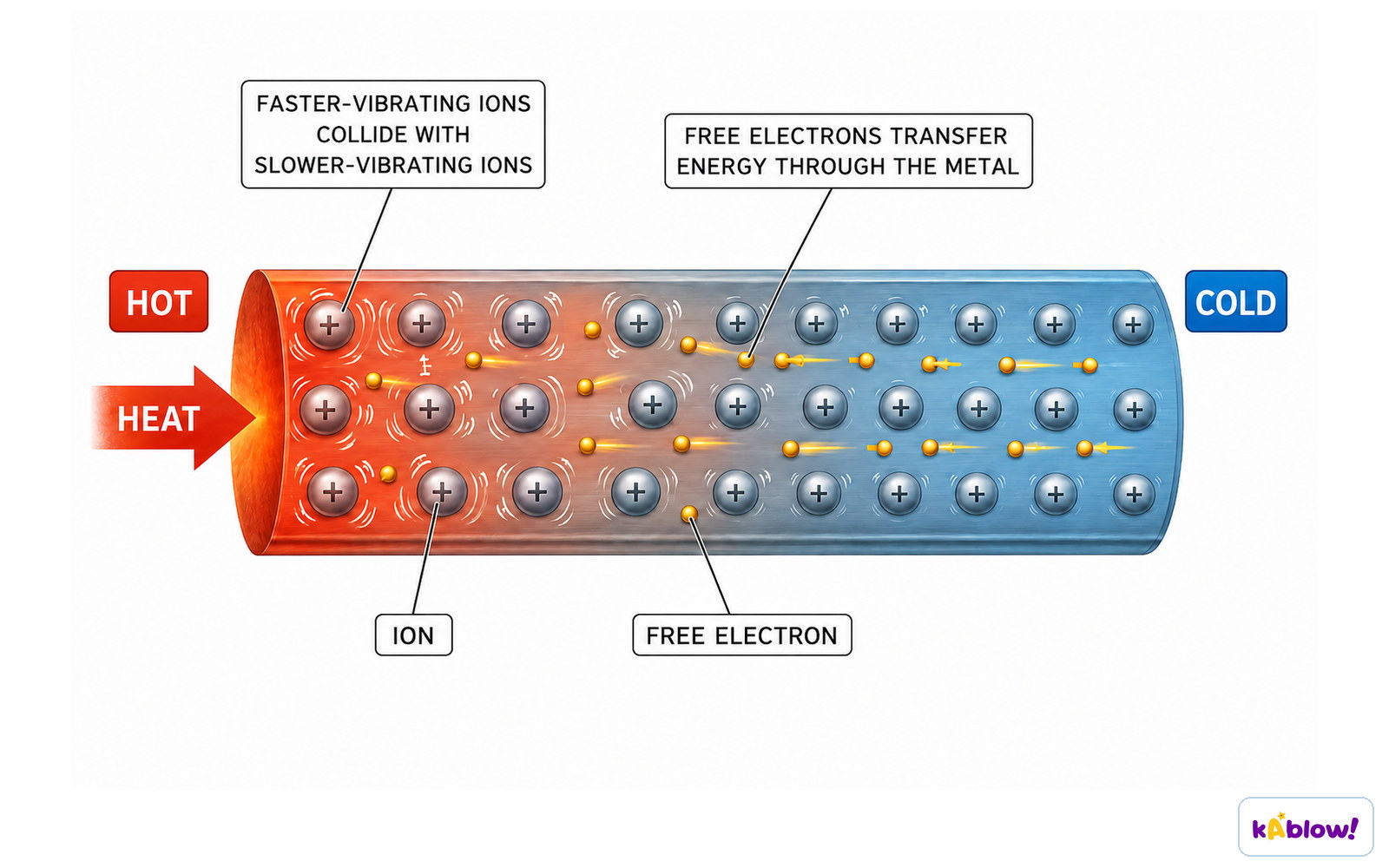
- Conduction in solids occurs via atomic vibrations and, in metals, via free electron collisions.
- Metals are the best conductors because they have many free electrons that transfer energy rapidly.
- Liquids and gases are poor conductors because particles are too far apart or slide past each other, hindering vibration transfer.
- Thermal conductivity varies widely among materials; conductors are typically metals with delocalised electrons.
Conduction in a metal via atomic vibrations and free electron collisions
Convection
- Convection is the main heat transfer method in fluids (liquids and gases); it cannot occur in solids.
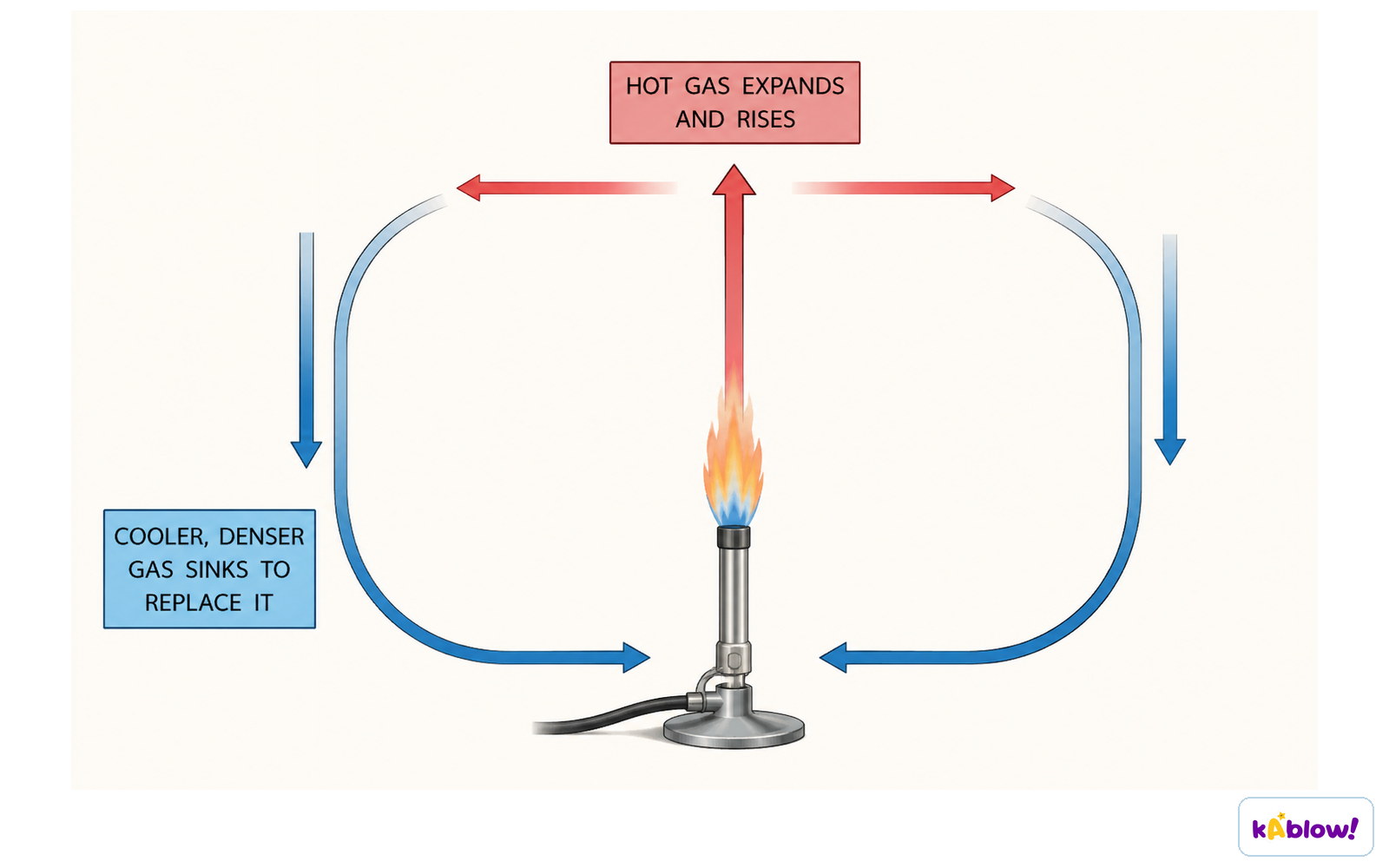
- Heating a fluid causes it to expand, become less dense, and rise; cooler fluid sinks, creating a convection current.
- Cooling a fluid makes it contract, become denser, and sink, also driving a convection current.
- A convection current can be demonstrated using potassium permanganate crystals in water: the purple dye reveals the rising and falling motion.
Convection current from a fire
Radiation
- Objects above absolute zero emit thermal radiation. At everyday temperatures much is infrared; hotter objects emit more energy per unit area under otherwise comparable conditions.
- Thermal radiation can travel through a vacuum (e.g., from the Sun to Earth).
- Black/dull surfaces are good absorbers and good emitters of radiation; white/shiny surfaces are poor absorbers and poor emitters.
- At thermal equilibrium, an object absorbs and emits radiation at the same rate, so its temperature remains constant.
The Greenhouse Effect
- Without an atmosphere, Earth's average surface temperature would be about −18 °C.
- Greenhouse gases (e.g., CO₂, water vapour, methane) absorb and re-emit longer-wavelength infrared radiation from Earth, trapping heat.
- This process keeps Earth warm enough for life; increasing greenhouse gases raises the rate of radiation absorbed, leading to global warming.
Investigating IR Radiation
- Experiment: use identical flasks painted black, grey, white, and silver, filled with hot water at the same initial temperature.
- Measure temperature at regular intervals (e.g., every 30 s for 10 min).
- The black flask cools fastest (best emitter); the silver flask cools slowest (poorest emitter).
- Plot temperature vs. time; the curves show that surface colour affects the rate of infrared emission.
Consequences of Thermal Energy Transfer
- Conduction applications: metal pans heat food quickly; plastic handles insulate; double-glazed windows use trapped air as an insulator.
- Convection applications: room radiators heat air which rises and circulates; steam rises from hot drinks.
- Complex transfers: a hot drink loses heat by conduction through the cup, convection from the surface, and radiation from the cup's sides.
- A car radiator transfers energy from coolant through metal by conduction, then mainly to moving air by convection; radiation can also contribute.
Think like a scientist
- Compare the cooling of warm water in containers wrapped in different safe insulating materials.
- Comparison: the insulating material. Outcome: water temperature after a fixed time.
- Control: keep water volume and starting temperature constant. Explain why this makes the comparison fairer.
- Evidence: Use a consistent method, repeated observations where appropriate and a table with labelled quantities and units. Keep unexpected results and investigate their cause.
- Safety: Practical activities need teacher supervision and an appropriate risk assessment. Use the provided data or simulation where the investigation specifies it.
- Inquiry task: State a testable question, predict the outcome using the science, then explain how your observations would support or challenge the prediction.
Evaluate the science
- Insulation can reduce energy demand in buildings.
- Thickness, cost, moisture and fire performance also matter when comparing real insulation products.
- Evaluation task: Link your conclusion to evidence, identify a limitation and suggest a specific improvement. Distinguish a measured result from an explanation of its cause.
Slide
Sign up free to view the lesson slides
Step through every slide for this topic — plus flashcards and revision notes — with a free account.
Câu hỏi luyện tập
Xem trước miễn phí — 8 trên 48 câu hỏi. Đăng ký để xem tất cả.
1.Which of the following is the main method of thermal energy transfer in solids?
Easy- AConduction
- BConvection
- CRadiation
- DEvaporation
2.Thermal radiation is part of which electromagnetic spectrum?
Easy- AVisible light
- BInfrared
- CUltraviolet
- DMicrowave
3.In the experiment comparing conduction in wood and metal, a rod made of half wood and half metal is wrapped in paper and heated at the join. What is observed?
Easy- AThe paper chars only where it touches the metal
- BThe paper chars only where it touches the wood
- CThe paper chars evenly across both materials
- DThe paper does not char at all
4.Which of the following is a greenhouse gas that contributes to the greenhouse effect?
Easy- AOxygen
- BNitrogen
- CCarbon dioxide
- DHydrogen
5.In the investigation of infrared radiation using flasks painted different colours, which flask is expected to cool the fastest?
Easy- ABlack flask
- BWhite flask
- CSilver flask
- DDull grey flask
6.Convection currents in fluids are caused by changes in:
Easy- ATemperature and density
- BPressure and volume
- CColour and texture
- DMass and weight
7.Which of the following is a good thermal insulator?
Easy- ACopper
- BAluminium
- CWool
- DIron
8.A student places one foot on a tile floor and the other on a rug in the same room. The tile feels colder because:
Medium- AThe tile is at a lower temperature than the rug
- BThe tile conducts heat away from the foot faster than the rug
- CThe rug radiates heat towards the foot
- DThe tile has a higher specific heat capacity
Unlock all 48 questions, flashcards & more
Tạo tài khoản miễn phí để xem mọi câu hỏi, slide, thẻ ghi nhớ và ghi chú ôn tập cho chủ đề này.